Your shopping cart is empty!

NAC and the respiratory tract: what is known about mucus and sputum
Published: 05/11/2026
Times Read: 120
Comments : 0
N-acetylcysteine (NAC) is interesting in the respiratory tract for a specific reason: it has chemical properties that can change the structure of thick mucus. This is why acetylcysteine is well known in medicine as a mucolytic substance. However, there is a fundamental difference between the mechanism of action of the molecule, the results of clinical trials, and the claims of a common dietary supplement.
In this article, we will look at what phlegm is made of, why it becomes viscous, what studies of NAC in people with respiratory diseases show, and why these findings cannot be transferred to any person with a cough. This is informational material about the substance, not instructions for self-administration.
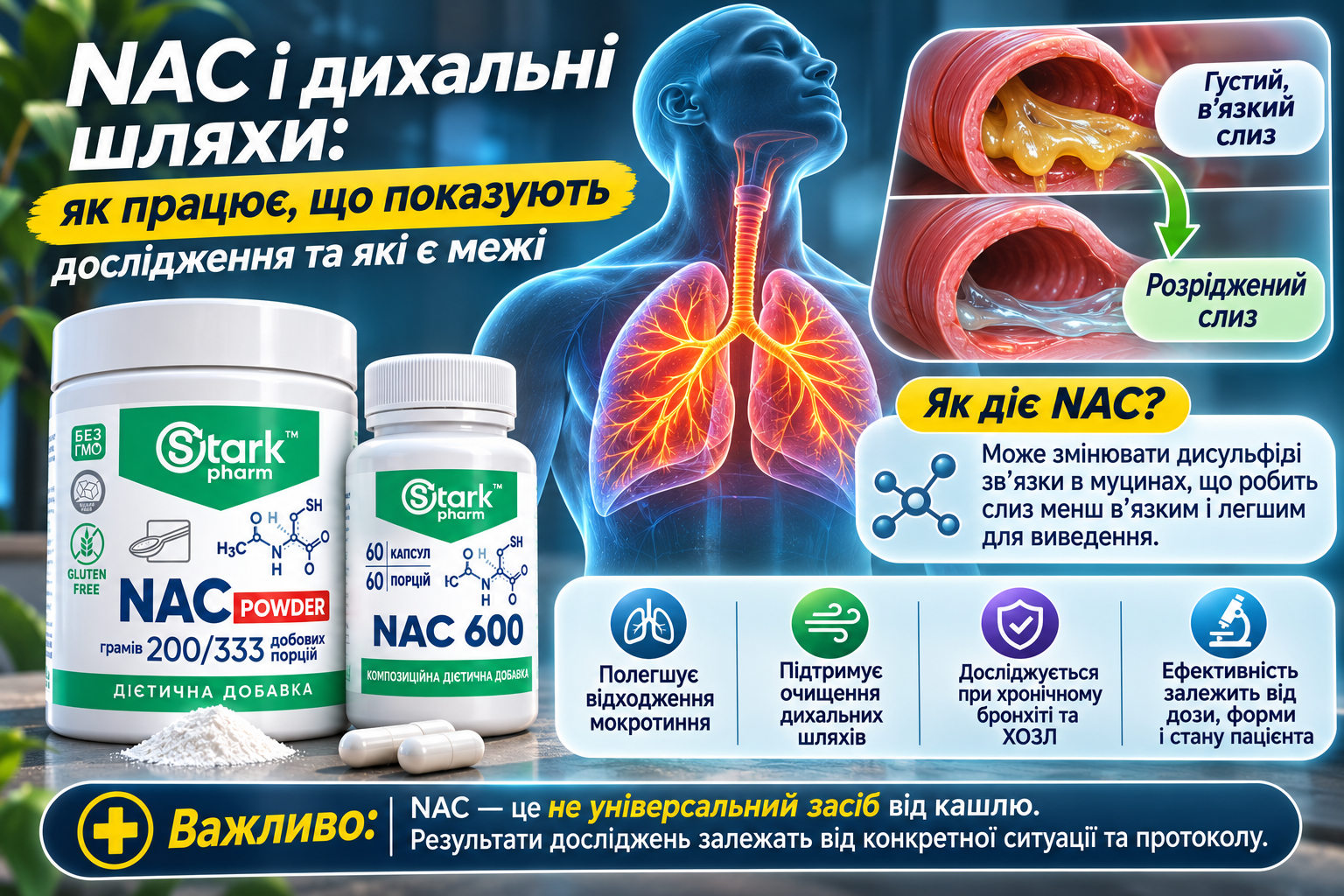
Why do respiratory tracts need mucus?
The mucous membrane of the respiratory tract constantly produces a protective secretion. It traps dust particles and other irritants, and the movement of the epithelial cilia helps move them towards the pharynx. This mechanism is called mucociliary clearance. Under normal conditions, a person hardly notices how it works.
When there is too much secretion, the composition of proteins changes or its excretion worsens, phlegm can be thick and difficult to cough up. The reasons are different: inflammatory processes, features of chronic diseases, exposure to polluted air, disruption of the ciliated epithelium. The same complaint about "mucus in the throat" does not mean the same mechanism of its occurrence.
It is important to distinguish between the following concepts: sputum density is a physical characteristic of the secretion, cough is a protective reflex, and disease is the cause of the symptoms. Even if you influence one characteristic of the secretion, this does not mean eliminating the cause of the cough.
How NAC is related to sputum viscosity
| Concept | What does it mean? | What does not mean |
|---|---|---|
| Mucus | Physiological secretion that traps particles | Normal protection function |
| Sputum | Secretion that is coughed up from the respiratory tract | A symptom, not an independent disease |
| Mucolytic mechanism | Alteration of mucin disulfide bonds | Does not prove the cause of the cough is eliminated |
| Clinical trials | Specific medical groups and endpoints | Not an advertisement for a dietary supplement |
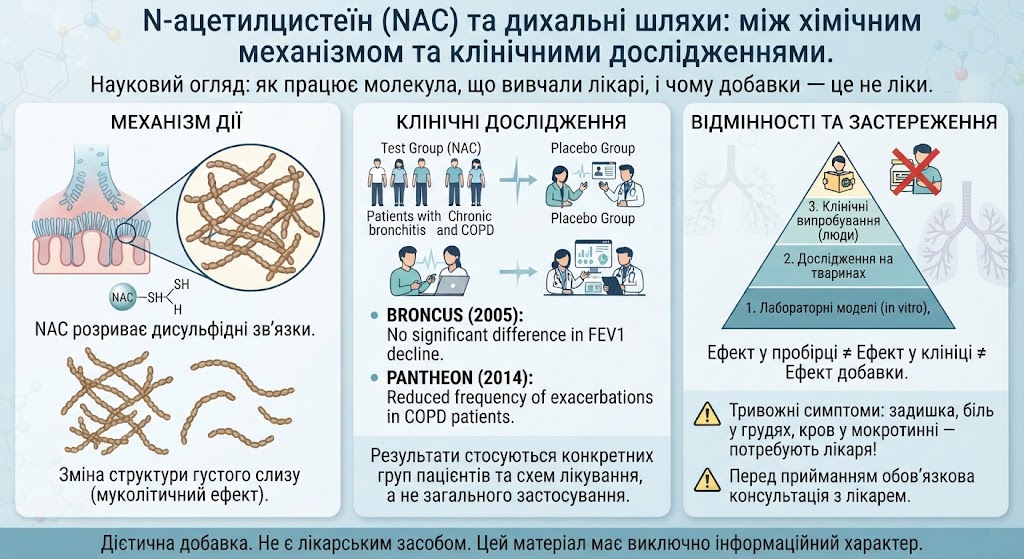
The NAC molecule has a free thiol group. It is able to participate in the reduction reactions of disulfide bonds - chemical "bridges" that maintain the spatial structure of some mucus proteins, in particular mucins. When the network of such bonds is changed, the properties of the secretion can also change.
In a scientific review by Aldini et al. (2018), this mechanism is described as one of the reasons for the mucolytic activity of acetylcysteine. Researchers also consider another role of NAC - providing the body with a precursor of cysteine, which is necessary for the synthesis of glutathione. These are two different biochemical aspects that should not be confused.
The route of administration should be considered. The chemical reaction upon direct contact with mucus and the effects after oral administration are not the same. Results may vary for different dosage forms, sites of action, and clinical situations; the mere existence of a mechanism is not proof of the effect of a particular capsule.
What was actually studied in clinical trials
Much of the research on acetylcysteine has been in patients with chronic bronchitis or chronic obstructive pulmonary disease (COPD). These studies have evaluated NAC as a medical intervention in a specific patient population, with specific regimens, physician supervision, and pre-specified endpoints. The results of these studies should not be interpreted as universal advice on supplementation.
In the BRONCUS trial (Decramer et al., 2005), participants with COPD received 600 mg of acetylcysteine per day or placebo for three years. The primary comparison showed no significant difference in the rate of decline in FEV1. This is an important example of why even long-term follow-up does not confirm all expected effects.
PANTHEON (Zheng et al., 2014) investigated a different regimen—600 mg twice daily for a year—in adults with moderate to severe COPD. The authors reported a lower rate of exacerbations in the study population. The differences in results between studies do not make one conclusion “correct for all”: the participant groups, protocols, concomitant medications, and assessment criteria varied.
A Cochrane review of mucolytics included 38 trials involving over 10,000 adults with chronic bronchitis or COPD. Overall, mucolytics were found to reduce exacerbation rates, but the studies did not include NAC alone , and results from different time periods varied. It is not correct to extrapolate the effects of an entire class of drugs to a single substance without further clarification.

What is the difference between laboratory and clinical results?
But the authors emphasize a limitation: for some of the described mechanisms, confirmation in human bronchial tissues is lacking. The result in cell culture, changes in laboratory markers, and a real change in well-being are different levels of evidence. It is important for the reader not to perceive them as interchangeable.
When the words "helps with coughs" are misleading
Coughs can be dry, wet, acute, or persistent; they can accompany infections, allergies, asthma, and other conditions. The mechanism of NAC addresses specific properties of mucus, not all causes of cough. Therefore, the blanket promise of “NAC eliminates cough” is scientifically incorrect.
It is particularly dangerous to extrapolate the findings of studies of medical drugs in patients with COPD to the advertising of dietary supplements. In such studies, the health status of the participants, the inclusion criteria, the form of the substance, the duration of observation and concomitant medications are known. For the average person without this initial data, the conclusion does not have the same strength.
That is why it is appropriate to explain the topic of the respiratory tract through mucins, chemical mechanism, and the limits of evidence, rather than turning the article into a list of diseases for which it is worth trying the supplement yourself.
Caution: What signs should not be ignored?
Shortness of breath, difficulty breathing, chest pain, blood in the sputum, high fever, or a persistent cough require medical evaluation. If the condition is accompanied by severe shortness of breath, seek emergency medical attention. Do not mask these symptoms by experimenting with dietary supplements.
NAC can also cause nausea, abdominal discomfort, and other adverse reactions. In case of asthma, chronic respiratory diseases, pregnancy, lactation, and concomitant use of medications, any decisions regarding the intake of the substance should be coordinated with a doctor. The features of inhalation and oral forms cannot be considered the same.
The main thing: data on the medicinal use of acetylcysteine does not mean that a regular dietary supplement has a similar purpose, indication, or expected result.
Why not every respiratory symptom is associated with phlegm
Feeling a sore throat, a tickle in the throat, or a constant need to cough does not always mean that there is a thick secretion in the bronchi. The source of the symptoms may be the upper respiratory tract, irritation of the mucous membrane, nasal breathing characteristics, or completely different factors. That is why the description of “hard to cough” cannot be used to determine what process is taking place in the body.
Where mucolytics are studied, researchers usually have a well-defined population. Participants may be given spirometry, exacerbation rates assessed, and information on other medications collected. Such data are not available in everyday life, so it is impossible to draw conclusions about the usefulness of NAC by analogy with clinical work. Equally important, different experiments assess different endpoints: sputum may become less viscous, but this does not prove an improvement in all respiratory parameters.
A separate issue is the confusion between a brief description of a chemical property and a broad claim about lung health. The phrase “breaks disulfide bonds in mucins” explains the mechanism of the molecule. However, a claim about improving breathing in all people would require much larger trials with corresponding results. This is a different level of scientific evidence.
In practical reading of studies, it is worth looking for answers to simple questions: was it mucus in a test tube, a cell model or real patients; how were changes assessed; was there a comparison with a placebo; how long did the work take? This approach helps to avoid attributing to NAC what a particular publication did not prove.
Frequently asked questions
What is NAC in the context of the respiratory tract?
This is N-acetylcysteine, a substance that has been studied, in particular, for its ability to change the structure of mucus proteins.
Why is phlegm sometimes thick?
Its viscosity is influenced by the composition of the secretion, the amount of mucins, the water content, and the state of mucociliary clearance.
Does the mucolytic mechanism mean that NAC eliminates cough?
No. Cough has different causes, and the chemical mechanism does not produce the same clinical effect in all situations.
Has NAC been studied in humans?
This is particularly true in groups of patients with chronic bronchitis and COPD, but these results do not automatically apply to healthy people.
Do capsules and inhalation forms work the same?
No. The route of administration changes the tissue contact and the conditions of action of the substance.
Can a supplement be evaluated based on COPD research results?
No. Clinical studies have studied specific medical regimens and specific patient groups.
When does a cough require a doctor's consultation?
If it is prolonged, accompanied by shortness of breath, chest pain, blood in the sputum, or other alarming symptoms.
Does NAC replace a medical examination?
No. The cause of respiratory symptoms should be evaluated by a medical professional.
Sources
- Aldini G. et al. (2018). N-Acetylcysteine as an antioxidant and disulphide breaking agent: the reasons why. Free Radical Research, 52(7), 751–762. PubMed
- Rogliani P. et al. (2024). Impact of N-Acetylcysteine on Mucus Hypersecretion in the Airways: A Systematic Review. International Journal of Chronic Obstructive Pulmonary Disease, 19, 2347–2360. PubMed
- Poole P., Sathananthan K., Fortescue R. (2019). Mucolytic agents versus placebo for chronic bronchitis or chronic obstructive pulmonary disease. Cochrane Database of Systematic Reviews, CD001287. DOI
- Decramer M. et al. (2005). Effects of N-acetylcysteine on outcomes in chronic obstructive pulmonary disease (Bronchitis Randomized on NAC Cost-Utility Study, BRONCUS): a randomized placebo-controlled trial. The Lancet, 365(9470), 1552–1560. PubMed
- Zheng JP et al. (2014). Twice daily N-acetylcysteine 600 mg for exacerbations of chronic obstructive pulmonary disease (PANTHEON): a randomized, double-blind placebo-controlled trial. The Lancet Respiratory Medicine, 2(3), 187–194. PubMed
Dietary supplement. Not a medicine. Consult a doctor before use.
Products related to this post
Related Posts
Comments
Information
Customer Service
Extras
My Account


Sports nutrition manufacturer in Ukraine StarkPharm © 2026


