Your shopping cart is empty!

NAC or Glutathione: Which is Better for Antioxidant Protection?
Published: 04/11/2026
Times Read: 130
Comments : 0
NAC (N-acetylcysteine) and glutathione are related, but they are not the same thing. NAC is a source of cysteine, one of the components the body needs to produce its own glutathione. Glutathione, in turn, is a ready-made molecule that participates in cellular antioxidant defense reactions. Therefore, the question of “which is better” does not have a universal answer without specifying the goal and the indicator we want to evaluate.
The debate is often simplified to two extremes: that glutathione in capsules is not absorbed at all, or that NAC is always more effective than any form of glutathione. Clinical studies do not support either of these absolute conclusions. They vary in duration, form of substance, groups of participants, and in which tissue or fluid the results were measured.
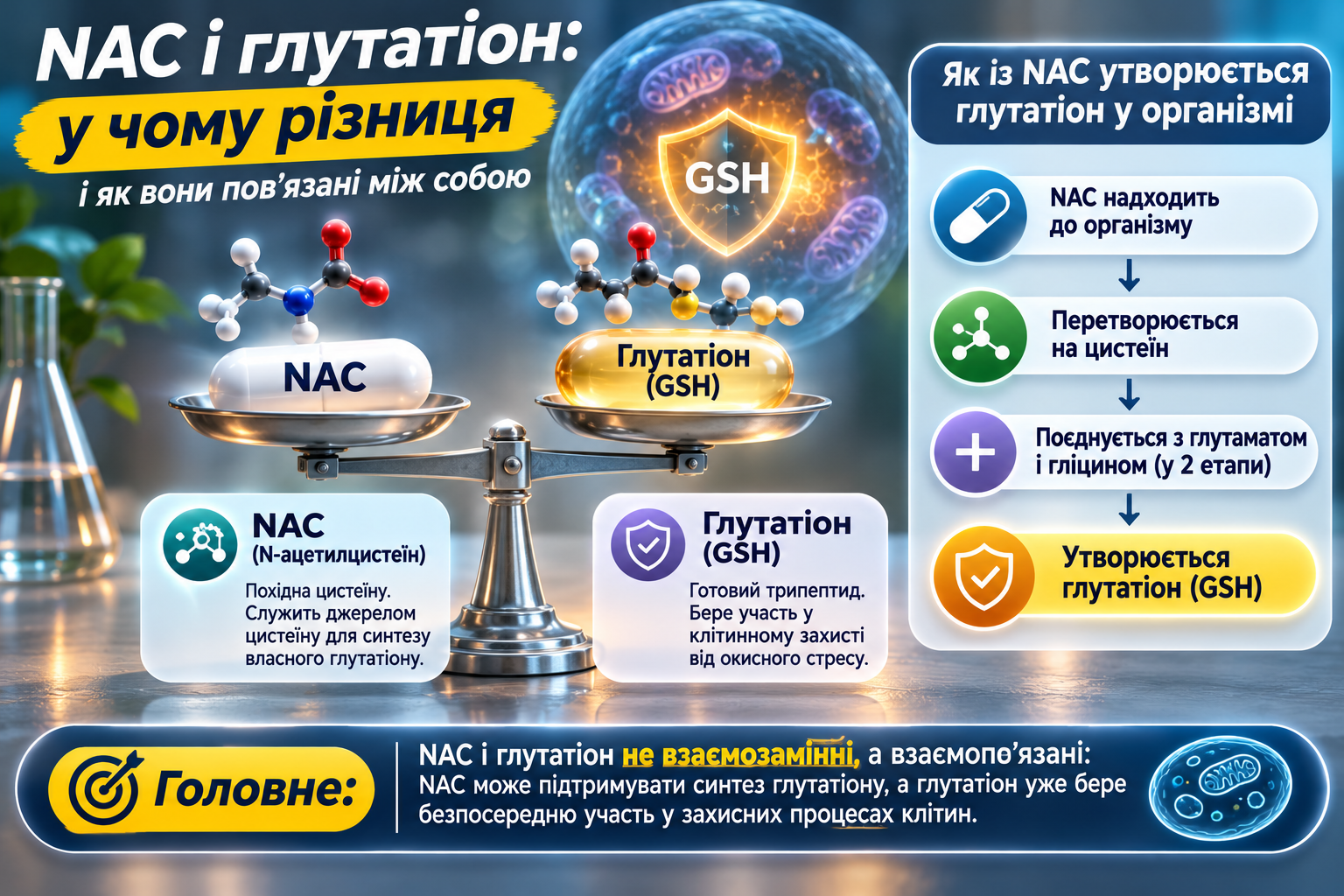
What do NAC and glutathione have in common?
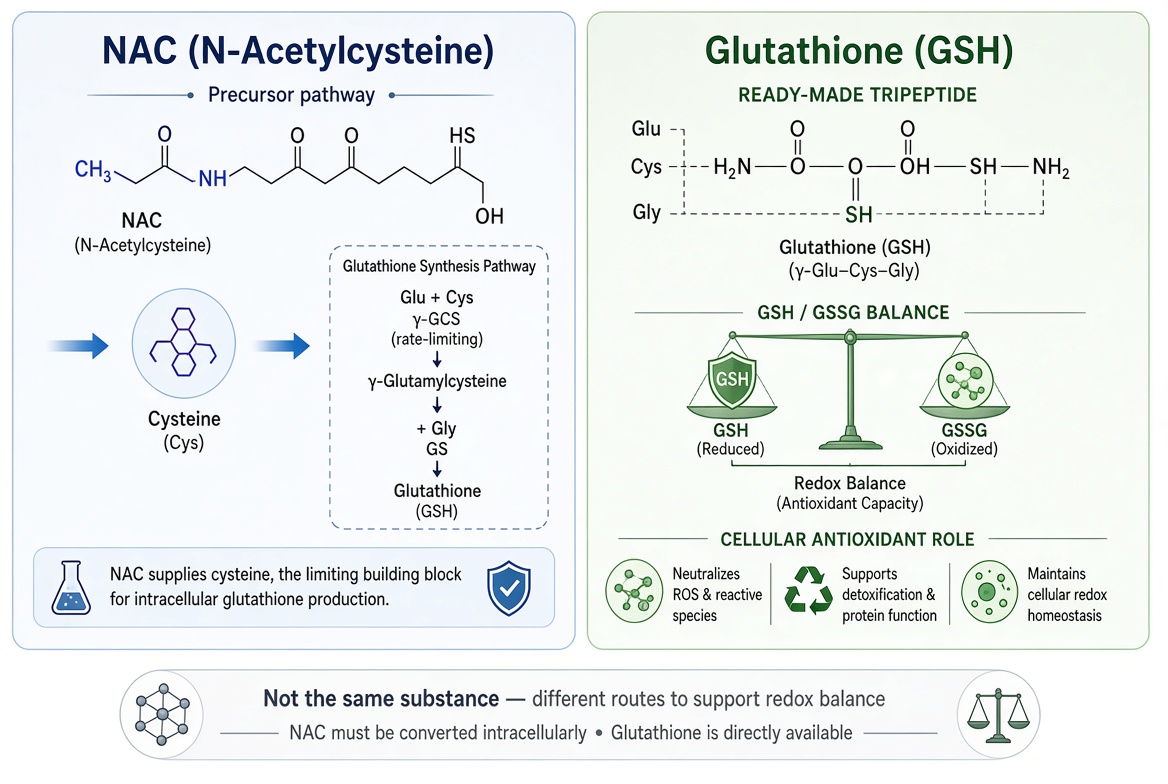
Glutathione (GSH) is a small tripeptide formed from glutamate, cysteine, and glycine. In cells, it is involved in maintaining redox balance: it switches between reduced (GSH) and oxidized (GSSG) forms, interacts with enzymes, and helps neutralize certain reactive compounds. This is a normal part of cellular biochemistry, not a separate property of any supplement.
Glutathione synthesis requires two enzymatic steps. First, an intermediate compound is formed from glutamate and cysteine, and then glycine is added. The availability of cysteine is often an important limiting factor. This is where NAC makes biochemical sense: after conversion, it can supply cysteine for its own GSH synthesis.
At the same time, the presence of a precursor does not automatically or equally increase glutathione levels in every person. Synthesis is regulated by enzymes, tissue needs, nutrition, and the current redox state. The body does not work like a tank into which you can simply “top up” a certain amount of antioxidant.
Main difference: precursor vs. finished molecule
NAC is not glutathione in a different package. It undergoes metabolic transformations and participates in the supply of cysteine. In addition to glutathione-related pathways, it is also being studied for its own thiol reactions, effects on signaling processes, and the balance of sulfur-containing compounds. Not all of the observed effects of NAC can be properly explained by an increase in GSH alone.
Ready-made glutathione can be partially broken down after entering the digestive tract, and its absorption and further distribution depend on the form and conditions. However, the statement “oral glutathione does not work by definition” contradicts some human studies. It is important to talk not about complete or zero absorption, but about the measured results of specific forms.
| Question | NAC | Glutathione |
|---|---|---|
| What's coming | Cysteine derivative | Ready-made GSH tripeptide |
| Main road | Supply of cysteine for the synthesis of its own GSH | Intake of GSH and its transformation products |
| What was studied? | GSH levels, oxidative stress markers, selected clinical indicators | GSH in blood and cells, GSH/GSSG ratio, other biomarkers |
| Main limitation | The result depends on the condition and metabolism of the participants. | The form, dose, duration and location of measurement change the result |
| Can it be called "the best"? | No, universal advantage has not been proven | No, universal advantage has not been proven |
Is glutathione absorbed if taken orally?
In early studies, doubts about the effectiveness of conventional oral forms were justified: some short trials did not record significant changes in blood. For example, Allen and Bradley (2011) studied 40 healthy adults who received glutathione 500 mg twice daily or placebo for four weeks. They found no significant differences in markers of oxidative stress and glutathione status between the groups.
However, Richie et al. (2015) conducted a longer, six-month randomized trial in 54 healthy adults. They reported increases in glutathione levels in a number of biological samples when given 250 or 1000 mg/day, with the magnitude of the changes being time- and dose-dependent. Some of the values returned to baseline after discontinuation of the study.
These results do not cancel each other out. Four weeks and six months are different periods; levels in specific cells, levels in plasma, and clinical benefit are also not identical measures. Therefore, the claim of “complete ineffectiveness” of oral glutathione is too strong, but neither can any product be proven to be beneficial in any scenario.
Have NAC and ready-made glutathione been directly compared?
Yes, but there are far fewer direct comparisons than there are studies on antioxidants in general. Schmitt et al. (2015) studied 20 participants with metabolic syndrome in a randomized crossover trial. They compared oral NAC, conventional oral GSH, and sublingual glutathione, each lasting 21 days.
Furthermore, an increase in biomarker concentration is not proof that a person feels better, is less ill, or has higher physical performance. Such conclusions require studies with appropriate clinical endpoints, not just blood tests.
What NAC meta-analyses show
In a systematic review by Mahmoudinezhad et al. (2023), 26 controlled clinical trials of NAC were analyzed. On average, increases in total antioxidant capacity and glutathione levels were reported, but not all antioxidant enzyme systems were changed statistically significantly.
In this context, it is important not to confuse three different conclusions. The first is that NAC can alter laboratory parameters. The second is that its effects on parameters vary between studies. The third, much stronger, is that any person will experience a specific benefit. The third conclusion does not follow from the first two.
Some of the differences are related to the initial state of the body. A person with an already sufficient supply of glutathione precursors may react differently than a study participant with metabolic disorders or high physical exertion. That is why there is no reason to transfer averages from a scientific sample to all consumers.
Why “higher glutathione” doesn’t always mean better results
Biomarkers are useful tools, but they have limitations. Total GSH, reduced GSH, GSSG, and the ratios between them describe different parts of the redox metabolism. Changing one parameter does not prove that all cells in the body are functioning better.
It is also important where the sample is taken from: plasma, erythrocytes, lymphocytes or mucosal cells may show different changes. They cannot be mechanically added into a single “antioxidant protection score”. When comparing studies, it is worth comparing the measurement method, duration and characteristics of the people.
Another limitation is the difference between the physiological role of the substance and the results of supplementation. Glutathione is indeed involved in important cellular processes. But this does not mean that additional amounts from the outside will improve health in a healthy person.
How to read supplement comparisons without advertising simplifications
A proper comparison starts with defining the goal: are we studying cysteine provision, increased blood GSH, changes in the GSH/GSSG ratio, or long-term health? These are different questions that require different studies. If the advertisement only shows a lab number, it is worth checking what it actually means.
Equally important is the form of the substance. "Glutathione" can refer to conventional oral, sublingual, and other formats; they should not be considered interchangeable. Similarly, data on NAC in patients with certain conditions does not automatically provide evidence of efficacy in healthy individuals.
The attentive reader should ask not “which substance sounds stronger” but “which people participated, what was measured, and was there a control group?” This is a simpler and more reliable way to evaluate scientific arguments.
Should I combine NAC with glutathione?
A known biochemical relationship does not mean that taking two substances together necessarily produces a cumulative effect. Such a statement would require a separate study of the combination, comparing each substance with placebo. The available studies evaluating NAC or GSH separately do not automatically answer the question of their combined use.
It is also important to remember about tolerability: for NAC, gastrointestinal adverse reactions have been described, in particular; interactions with drugs are possible. For other supplements, the safety profile depends on the composition and form. It is not worth unnecessarily increasing the amount of substances in the diet just because of the word "antioxidant".
If you have chronic diseases, regularly take medications, are pregnant or breastfeeding, the issue of use should be discussed with a doctor. The research regimens listed above are a description of experiments, not instructions for self-administration.
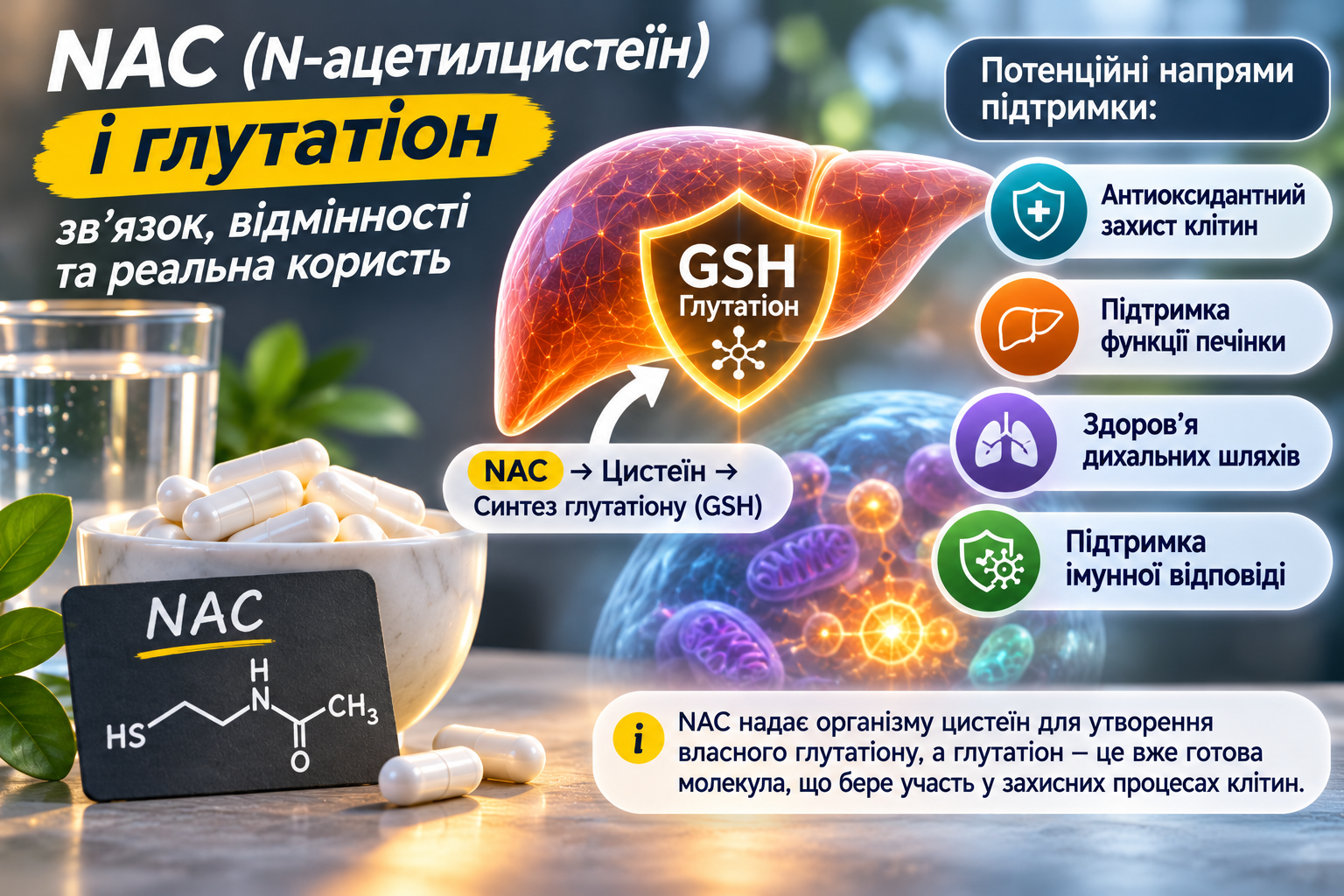
Summary: What can be said with confidence?
NAC and glutathione have different mechanisms of uptake and metabolism. NAC provides a precursor for its own synthesis, while GSH supplementation is being investigated as a source of the finished molecule. Both approaches have clinical evidence of effects on certain biochemical parameters.
There is currently no evidence to suggest that NAC is universally superior to glutathione or vice versa. The correct answer depends on the specific form, the population, and the study endpoint. The most important thing is not to confuse biochemical activity with proven health outcomes.
Frequently asked questions
Are NAC and glutathione the same substance?
No. NAC is a cysteine derivative that can provide a component for the synthesis of glutathione. Glutathione is a separate tripeptide.
Is it true that glutathione in capsules is not absorbed at all?
No, such a categorical conclusion does not fit all the data. Studies of varying lengths and formats have yielded varying results.
Does NAC always increase glutathione levels better?
No. In a small head-to-head comparison, the sublingual form of glutathione had an advantage on individual biomarkers, but these results cannot be generalized to all forms.
Why does the body need cysteine?
Cysteine is one of the three components of glutathione, and its availability can affect the rate at which this molecule is formed.
Does higher glutathione levels mean better immunity?
Not necessarily. A biochemical marker is not direct evidence of a specific clinical benefit.
Should I take NAC with glutathione?
The need for this combination of tests has not been established. The question of appropriateness depends on the individual condition and the recommendations of the specialist.
Why do different studies contradict each other?
They may have different durations, samples, forms of substances, and laboratory techniques. These differences alter the interpretation.
Can I repeat doses from studies myself?
No. Doses from publications characterize specific experiments, not individual regimens.
Sources
- Lu SC (2013). Glutathione synthesis. Biochimica et Biophysica Acta, 1830(5), 3143–3153. PubMed.
- Schmitt B. et al. (2015). Effects of N-acetylcysteine, oral glutathione (GSH) and a novel sublingual form of GSH on oxidative stress markers: A comparative crossover study. Redox Biology, 6, 198–205. PubMed.
- Richie JP Jr. et al. (2015). Randomized controlled trial of oral glutathione supplementation on body stores of glutathione. European Journal of Nutrition, 54(2), 251–263. PubMed.
- Allen J., Bradley RD (2011). Effects of oral glutathione supplementation on systemic oxidative stress biomarkers in human volunteers. Journal of Alternative and Complementary Medicine, 17(9), 827–833. PubMed.
- Mahmoudinezhad M. et al. (2023). N-acetylcysteine, a powerful agent in the reinforcement of antioxidant profile: A systematic review and dose-response meta-analysis of controlled clinical trials. Clinical Nutrition ESPEN. PubMed.
- Pedre B. et al. (2021). The mechanism of action of N-acetylcysteine (NAC): The emerging role of H2S and sulfane sulfur species. Pharmacology & Therapeutics, 228, 107916. PubMed.
Dietary supplement. Not a medicine. Consult a doctor before use.
Products related to this post
Related Posts
Comments
Information
Customer Service
Extras
My Account


Sports nutrition manufacturer in Ukraine StarkPharm © 2026


