Your shopping cart is empty!

Melatonin: Is it addictive and how long can it be taken?
Published: 03/11/2026
Times Read: 211
Comments : 0
Can melatonin be taken every night, is it addictive, and what happens if you stop using it? It is important to separate these issues. Addiction, tolerance, and the return of sleep problems are different phenomena. Studies do not provide grounds to equate melatonin with classic sleeping pills with a known risk of addiction, but they also do not allow us to consider long-term use as absolutely safe for everyone.
Melatonin is a hormone associated with circadian rhythms. Supplemental melatonin can alter the biological clock signal, and its effect depends on the causes of the regime disruption, the form of the drug, the time of use and individual characteristics. That is why the duration of administration cannot be evaluated separately from the goal.
Habituation, addiction, and relapse are not the same thing
In everyday language, the word "habituation" refers to several situations at once. In fact, there is a fundamental difference between them:
- Tolerance - over time, a different level of exposure to a substance is required to achieve the same effect. Its presence should be checked by a change in response, and not assumed simply because the drug has been used for a long time.
- Physical dependence - after stopping the use of the substance, a characteristic withdrawal syndrome appears. Not every deterioration in sleep after stopping the drug is such a syndrome.
- Return of the original symptoms - the person has trouble falling asleep again because the cause of the sleep difficulties has not disappeared: irregular schedule, anxiety, pain, lighting in the evening, or another factor.
- Psychological habit — the feeling that it is impossible to fall asleep without a certain evening ritual. It is not the same as pharmacological addiction, although it also deserves attention.
This distinction is especially important when evaluating stories like “I quit and I can’t sleep again.” Without information about the initial problem and its course, it is impossible to determine exactly what happened.
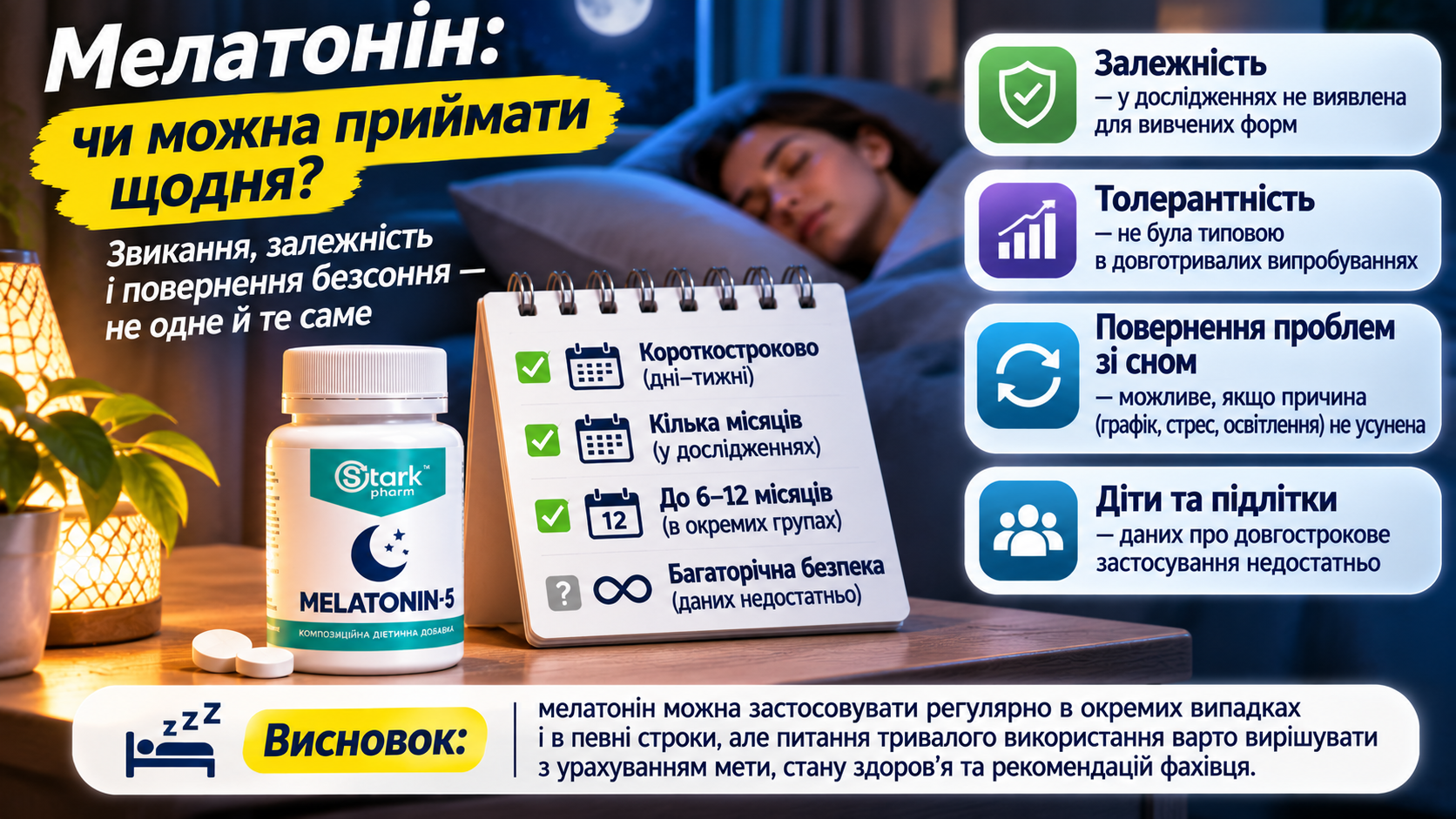
Does tolerance to melatonin develop: research data
In a randomized, long-term follow-up trial, Wade et al. (2011) evaluated extended-release melatonin in adults with sleep problems. The trial used 2 mg; some participants were followed for up to six months. The authors found no evidence of a decrease in effect over time or of specific symptoms after discontinuation. However, these data are for a specific formulation and a selected group of participants, not for all products and all possible situations.
In an open-label extension study, Lemoine et al. (2011) followed 244 adults who received 2 mg of extended-release melatonin for 6–12 months, followed by a 2-week washout period. The authors did not observe any evidence of tolerance, withdrawal symptoms, or suppression of endogenous melatonin production. However, an open-label study without a parallel, blinded control group throughout the extension phase has limitations for assessing rare and remote risks.
The practical conclusion: in some well-described conditions, signs of classical dependence were not detected. This is a more cautious and accurate statement than "melatonin is not addictive at all."
How long has melatonin been studied and what does this suggest?
A study that covers a period of a few months is not the same as having data on the effects of many years of regular use. The longer the horizon, the more important the number of participants, the control group, the way adverse events are recorded, and the composition of the sample become.
| Observation horizon | What can be assessed? | What the conclusion does not cover |
|---|---|---|
| Days and weeks | Changes in falling asleep, drowsiness, headache, feeling well the next day | Effects of long-term use |
| Several months | Durability of the effect, part of the side effects, reaction after the end of the reception | Rare risks and long-term consequences |
| 6–12 months in selected groups | Individual safety indicators of a specific form and possible signs of tolerance | Safety for all age groups and any doses |
| Many years | Requires large-scale studies with systematic supervision | The available data are insufficient for a general conclusion. |
A review by Besag and Vasey (2022) of long-term melatonin studies reported a small number of clinically significant adverse events in the available literature, but highlighted the lack of high-quality long-term double-blind studies. Another systematic review by Besag et al. (2019) also indicated that the lack of long-term data limits safety assessments.
Therefore, the phrase “the study found no problems” means exactly what was measured in the specific study. It does not indicate that undesirable effects are not possible.
What happens after stopping treatment?
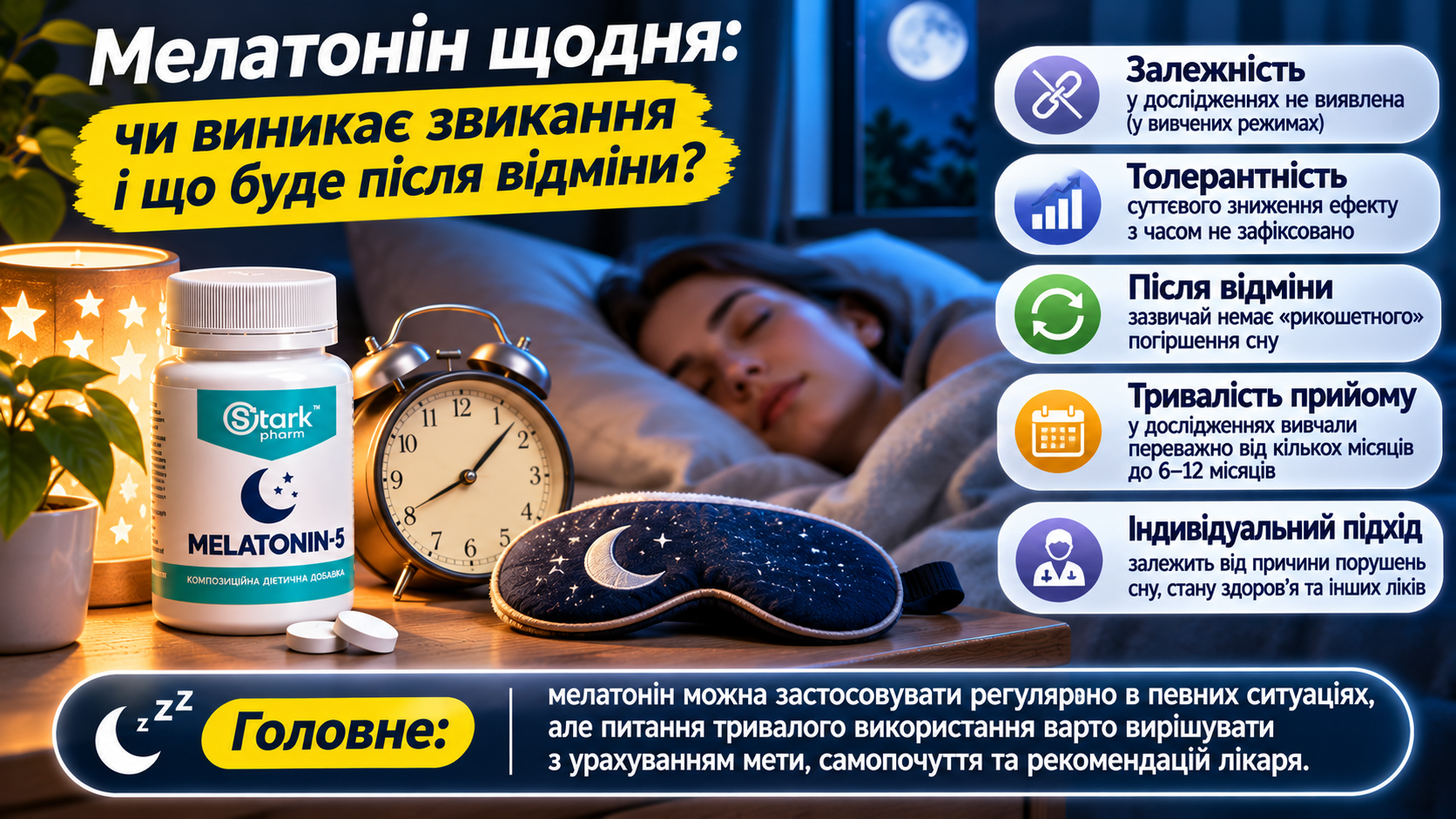
In the studies by Wade and Lemoine (2011), mentioned above, the state after discontinuation of long-acting melatonin was specifically observed. The authors did not find the “ricochet” sharp deterioration in sleep characteristic of some sleeping pills. At the same time, the absence of such an effect in the trial does not exclude individual difficulties after discontinuation and is not a substitute for an assessment of the cause of the symptoms.
A separate issue is the actual production of the hormone. In an open study by Lemoine et al. (2011), no suppression of endogenous melatonin production was found after long-term administration according to the estimated indicator. This result should not be transferred to any regimen and indefinitely long-term.
Why the duration of treatment depends on the cause of the problem
Flight disruption, night shift work, late chronotype, and long-term sleep difficulties have different mechanisms. A temporary shift in the body clock is not the same as a situation where a person wakes up at night or cannot fall asleep for months due to anxiety or discomfort.
When the main problem is the timing of the internal biological rhythm, not only the substance itself is important, but also light in the morning and evening, a stable rise time and work schedule. If sleep difficulties have become regular, continuing to use any aid without clarifying the reasons may delay the necessary assessment.
The updated European guidelines by Riemann et al. (2023) distinguish between forms of melatonin. For adults aged 55 years and older, extended-release melatonin for up to three months is considered in certain clinical situations, while rapid-release without a circadian component is not recommended as a routine approach to chronic sleep difficulties. This is a characteristic of specific clinical guidelines, not a universal dietary supplement regimen.
What is known about the safety of long-term use
The most commonly reported adverse events are drowsiness, headache, dizziness, and other mostly mild events. The conclusion about tolerability depends on age, health status, other medications, and quality of data. In a systematic review by Besag et al. (2019), adverse events were mostly mild or moderate, but the authors cautioned against drawing strong conclusions about long-term safety due to trial limitations.
There is also the issue of drug interactions. It is especially important to coordinate use with a doctor if you are on ongoing medication, pregnant, breastfeeding, have chronic illnesses, epilepsy, or experience increased daytime sleepiness. After taking melatonin, you should not drive or operate dangerous machinery if you are drowsy or have slowed reactions.
Another reason not to rely solely on a “feel good” feeling is that long-term effects don’t always show up right away. Proper safety assessments require studies that plan ahead to collect adverse events and follow participants for a long enough period of time.
A separate issue is children and adolescents.
Results from adults cannot be extrapolated to children. A systematic review by Händel et al. (2023) analyzed 22 randomized trials involving 1350 children and adolescents on adverse events, as well as four observational studies on puberty. The researchers found a higher incidence of non-serious adverse events; there was limited certainty regarding long-term outcomes, particularly on development during puberty.
Three observational studies found no significant effect on puberty after 2–4 years, while one reported a possible delay with even longer use. Due to methodological limitations, this does not prove causality, but it does not remove the need for caution. Long-term self-administration of melatonin by children without expert evaluation is not a good strategy.
When to Reconsider Your Need for Melatonin
Just because melatonin has become part of your evening routine doesn't mean it needs to be continued indefinitely. It's more useful to periodically assess not only your ability to fall asleep, but also your overall well-being, daytime alertness, schedule stability, and whether the cause of your sleep difficulties has been addressed.
- If falling asleep has not changed or daytime drowsiness has appeared, the appropriateness of use should be reassessed.
- If the problem is due to an unstable schedule, attention should be paid to the time of waking up, lighting, and rest conditions.
- If there are frequent awakenings, loud snoring, breathing stops during sleep, significant daytime fatigue, or persistent deterioration in well-being, it is important to seek medical evaluation.
- If you are using other medications or your health condition has changed, it is worth checking for possible interactions and contraindications.
For chronic sleep difficulties, it is important to consider non-pharmacological approaches. The 2023 European guidelines identify cognitive behavioral therapy as the first-line treatment for insomnia in adults. Melatonin should not replace the investigation of the cause of persistent sleep disturbances.
The main thing about the duration of reception and habituation
The available studies do not support the idea that extended-release melatonin of the studied regimens necessarily causes tolerance or withdrawal. However, the amount of data on long-term use is limited, and the results of a particular dosage form cannot be automatically generalized to all supplements. The question of “how long” should start with another: what it is being used for and whether the need for it continues.
Frequently asked questions
Is melatonin addictive?
Studies of extended-release melatonin over 6–12 months have not shown any evidence of dependence or withdrawal symptoms. However, there is insufficient data to draw a uniform conclusion across all forms and durations.
Do I need to increase the dose over time?
Increasing the dose requirement was not a typical outcome of the long-term trials described. It is not advisable to change the amount on your own due to the lack of the expected effect.
What happens if you stop taking melatonin?
The groups studied did not exhibit the characteristic withdrawal syndrome. If sleep difficulties return, it may mean that the original cause remains.
Does the body stop producing its own melatonin?
In one long-term study, no suppression of endogenous production was observed after discontinuation of the extended-release formulation. These data are insufficient to generalize to any regimen.
Can melatonin be taken every day for a year?
Studies lasting up to a year exist, but they have involved specific participants and forms of melatonin. This is not a general recommendation for self-administration for a year.
Are a short course and a multi-month course the same?
No. Short-term studies better reflect immediate effects, while long-term observations are needed to assess long-term safety.
Can children use melatonin for a long time?
Long-term data are insufficient for children and adolescents, particularly regarding development. Use should be discussed with a doctor.
When is it better to consult a specialist instead of continuing the treatment?
If sleep difficulties persist, daytime well-being worsens, or there is snoring with breathing stops, a professional assessment of the causes is required.
Sources
- Wade AG and others. (2011). Prolonged release melatonin in the treatment of primary insomnia: evaluation of the age cut-off for short- and long-term response. Current Medical Research and Opinion. PubMed
- Lemoine P. and others. (2011). Prolonged-release melatonin for insomnia – an open-label long-term study of efficacy, safety, and withdrawal. Therapeutics and Clinical Risk Management. PubMed
- Besag FMC, Vasey MJ (2022). Adverse events in long-term studies of exogenous melatonin. Expert Opinion on Drug Safety. PubMed
- Besag FMC and others. (2019). Adverse Events Associated with Melatonin for the Treatment of Primary or Secondary Sleep Disorders: A Systematic Review. CNS Drugs. PubMed
- Riemann D. and others. (2023). The European Insomnia Guideline: An update on the diagnosis and treatment of insomnia 2023. Journal of Sleep Research. PubMed
- Händel MN and others. (2023). The short-term and long-term adverse effects of melatonin treatment in children and adolescents: a systematic review and GRADE assessment. eClinicalMedicine. PubMed
Dietary supplement. Not a medicine. Consult a doctor before use.
Products related to this post
Related Posts
Comments
Information
Customer Service
Extras
My Account


Sports nutrition manufacturer in Ukraine StarkPharm © 2026


