Your shopping cart is empty!

Blue light from screens and melatonin: does your phone prevent you from falling asleep?
Published: 03/11/2026
Times Read: 149
Comments : 0
Smartphones are often blamed for “switching off melatonin” before bedtime. There is a scientific basis for this, but the explanation is more complex: the body's nighttime signal is affected not only by the blue wavelengths emitted by screens, but also by light brightness, exposure duration, time of day, and surrounding lighting. Two phones with different settings, or the same hour of screen use under different conditions, do not create identical exposure for the circadian system.
Melatonin is a hormone whose levels normally rise in the evening under appropriate lighting conditions. It helps the body signal biological nighttime, but it is not a switch that instantly turns off consciousness. It is therefore important to distinguish three questions: whether light suppressed melatonin secretion, whether it shifted biological timing, and whether the person actually fell asleep later. In experiments, these outcomes are sometimes related, but they are not the same.
How the eyes tell the biological clock that it is still daytime
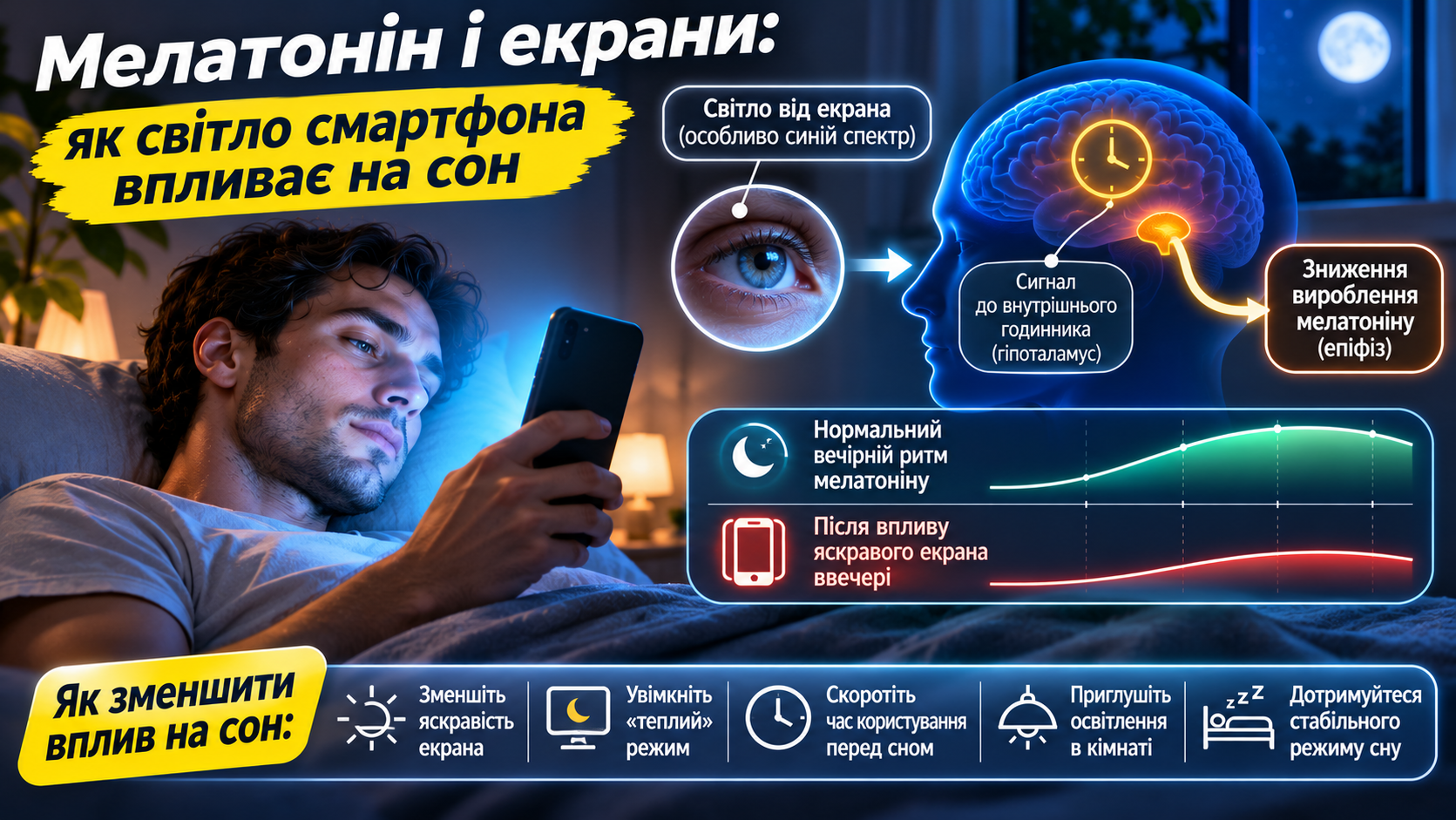
When light reaches the retina, the brain receives information for more than image formation. Some light-sensitive retinal neurons help regulate circadian rhythms. They contain the photopigment melanopsin and send signals to the biological clock system associated with the suprachiasmatic nucleus of the hypothalamus. Rods and cones also participate in this process.
Bright light in the evening can send the body a signal that conflicts with the natural dark phase of the day. This can suppress the rise in melatonin and change its timing. An important detail is that a person may feel tired even though hormone measurements indicate that their biological night begins later than it would under dim lighting.
Prayag, Najjar, and Gronfier (2019) showed that predicting melatonin suppression requires more than measuring perceived brightness: illuminance weighted for melanopsin sensitivity is important. That is why lamps with similar visible brightness may differ in their circadian effects. This does not mean other colors or ordinary room lighting are biologically neutral.
Why blue light matters but is not the only cause
Short wavelengths in the visible spectrum, commonly described as blue light, effectively activate mechanisms associated with melanopsin. This is why displays and cool-white LED lamps attracted the attention of sleep researchers. However, saying that “blue light is harmful and yellow light is safe” greatly oversimplifies human physiology.
The amount of light reaching the eyes matters at least as much as its color. Making a display warmer while keeping it very bright and viewing it for a long time does not automatically eliminate its circadian effects. Conversely, reducing overall brightness, exposure time, and room lighting can decrease evening light exposure without searching for the “perfect” color.
Light-related effects must also be distinguished from behavioral effects. Watching emotionally engaging videos, messaging, or dealing with work emails may delay bedtime even in a dark room. In that case, the person goes to bed later not only because of a physiological response to light, but because they remain engaged in an activity.
Screen, lamp, and usage time: what matters most
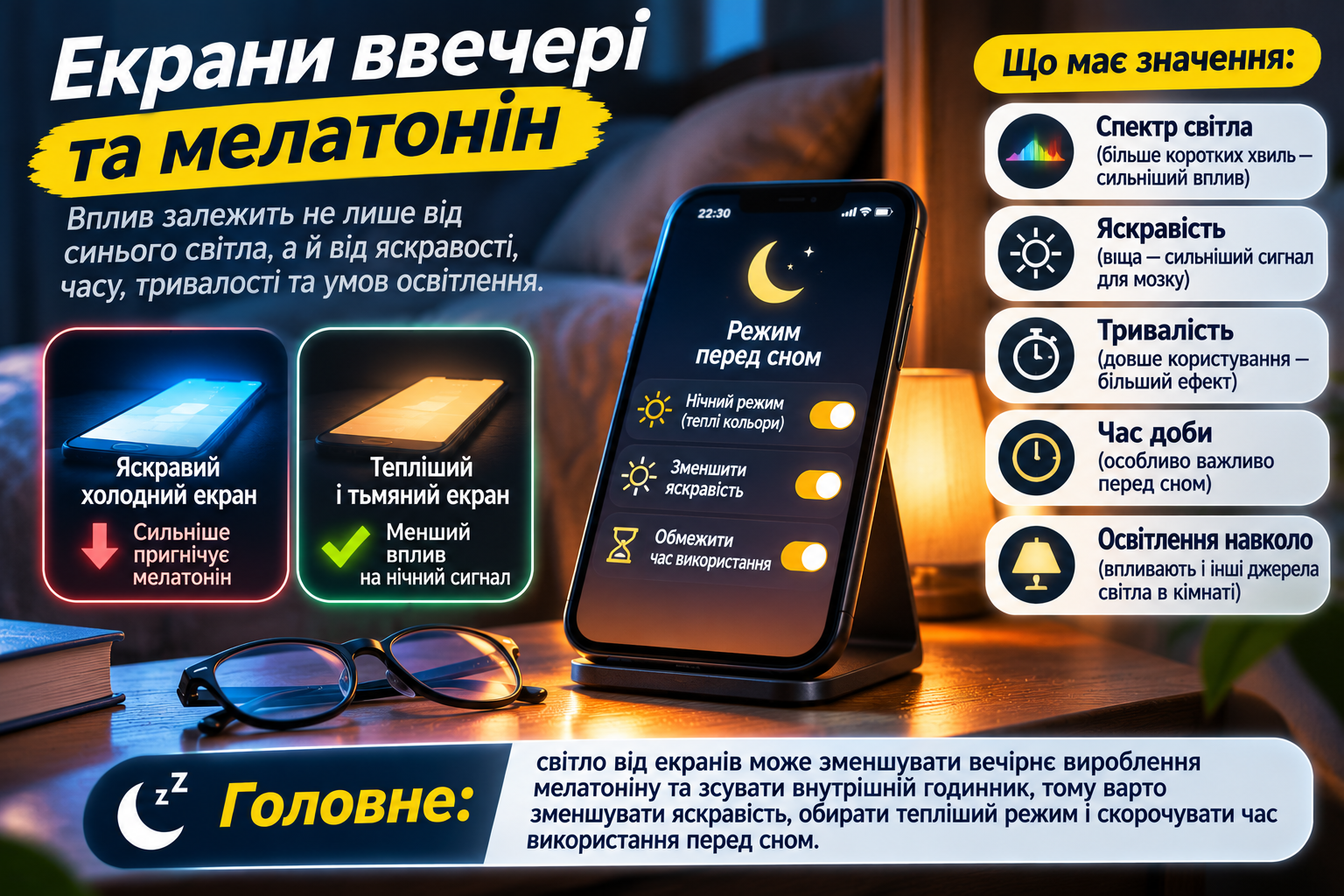
Nighttime light exposure cannot be assessed well with a single parameter. A realistic assessment must consider at least four factors: the spectral composition of light, its intensity at the eyes, the duration of exposure, and its timing relative to the body's internal biological rhythm.
| Factor | What happens | Practical takeaway |
|---|---|---|
| Spectrum | Light with a larger proportion of short wavelengths may activate the melanopsin system more strongly when other conditions are comparable. | A warmer screen is one adjustment, not complete protection. |
| Brightness | More light reaching the eyes generally means a stronger stimulus for the circadian system. | Reduce display brightness and overall lighting. |
| Duration | Two hours of screen use are not equivalent to a brief glance under the same lighting conditions. | Shorten evening device use. |
| Time of day | The same stimulus can have different effects depending on the circadian phase. | Be particularly mindful of light before your usual bedtime. |
| Room lighting | Lamps and other sources may contribute as much as or more than the display itself. | Do not focus exclusively on the smartphone while ignoring the room. |
These factors interact. For example, a very dim screen in a brightly lit kitchen is unlikely to be the only significant source of evening light. A bright tablet held close to the face in darkness creates different exposure conditions. At the same time, there is no simple household brightness threshold that produces the same effect for everyone.
What research on tablets and e-readers actually found
One particularly informative experiment was conducted by Chang, Aeschbach, Duffy, and Czeisler (2015), who compared reading on a light-emitting device in the evening with reading a printed book. Under the study conditions, participants using the electronic device took longer to fall asleep on average, had lower evening melatonin secretion, later circadian timing, and reduced alertness the following morning. This experimentally demonstrates that screens can alter sleep physiology.
However, it would be incorrect to apply these results to every phone notification. Participants read continuously for several hours under a prescribed laboratory protocol. Actual effects depend on the display model, settings, viewing distance, and ambient lighting. The study demonstrates that an effect is possible, not that every screen produces the same response.
In a study by Cajochen and colleagues (2011), evening use of an LED-backlit computer screen changed several circadian and cognitive measures compared with other display-lighting conditions. This illustrates the role of light characteristics even when the computer task appears similar.
Another important experiment was conducted by Wood and colleagues (2013). They examined tablet light exposure under varying conditions and durations. Two hours of viewing a tablet without additional blue light produced statistically significant melatonin suppression, while one hour under the same conditions did not yield a statistically significant difference from zero. This is not “permission” for an hour of screen use: the study had only 13 participants and its conclusion applies to specific laboratory parameters.
Why ordinary room light can also affect melatonin
Focusing solely on displays overlooks important evidence about indoor lighting. Gooley and colleagues (2011) compared evening exposure to room light of less than 200 lux with very dim light of less than 3 lux. Among 116 young adults, they found that room light delayed the onset of the evening melatonin rise and shortened the duration of its nighttime signal by approximately 90 minutes.
This does not mean every ordinary light source delays actual sleep onset by exactly an hour and a half. The study primarily measured the timing of the hormone signal, not a universal rule about sleep duration. Nevertheless, it helps explain why dimming overhead lighting can be useful even for someone who puts their phone away well before bedtime.
Phillips and colleagues (2019) also demonstrated considerable variation between individuals in responses to evening light. In an experiment involving 55 participants, sensitivity to melatonin suppression differed greatly. Thus, the claim “my friend uses a phone and sleeps fine, so light has no effect” does not disprove the biological mechanism: people have different sensitivities, rhythms, and everyday conditions.
Do night mode and blue-light-blocking glasses help?
Features such as Night Shift, Eye Comfort, and similar modes change the display's color temperature, generally reducing the proportion of short-wavelength light. This can change the spectral stimulus, but it does not make the device dark or shorten the time spent using it. Night mode is a supplementary setting, not a substitute for dim lighting and a consistent sleep schedule.
Duraccio and colleagues (2021) investigated whether iPhone Night Shift offsets the potential negative effects of evening smartphone use on sleep outcomes in young adults. The study found no convincing overall benefit of night mode for the sleep measures assessed. Importantly, this does not prove that spectral filtering has no effect on melatonin: sleep studies and direct hormone measurements address different questions.
Glasses that filter short-wavelength light should not be treated as a universal solution either. In a controlled study of adolescent boys, van der Lely and colleagues (2015) found that such glasses reduced melatonin suppression and some alerting effects of evening light. Yet the assessed sleep measures did not show corresponding improvements. Changes in a single hormonal measure do not necessarily translate into noticeably better nighttime sleep.
What to do in the evening when screen use is unavoidable
Giving up technology completely is not always realistic: some people need to finish work, reply to an important message, or read e-books. For most people, it makes more sense to reduce total light exposure and allow sufficient time for sleep than to search for a single “right” setting.
- Dim the room lights. Bright overhead lights also affect circadian signals; do not focus only on the phone.
- Lower screen brightness. The comfortable minimum depends on the task and your vision; avoid unnecessary eye strain.
- Use warmer colors if needed. Treat this as an additional step, not a complete offset for high brightness.
- Limit prolonged scrolling before bed. This helps manage both light exposure and the gradual postponement of bedtime.
- Reduce stimulating content. Work disputes, distressing news, or intense games can interfere with bedtime regardless of the screen's color.
- Get adequate daytime light. A clear contrast between a bright day and a calmer evening helps the body distinguish different parts of the day.
For people working night shifts or regularly changing schedules, these suggestions need a different context: their biological night may not coincide with conventional nighttime hours. Decisions should be based on their own sleep schedule and safety requirements, not only the clock.
Can a melatonin supplement offset evening light exposure?
These are two different questions. Light-exposure studies show how environmental lighting affects the body's own melatonin signal. Studies of melatonin as a substance evaluate different interventions, doses, and timing. Findings from the first category therefore do not establish that a supplement neutralizes the consequences of prolonged bright-screen use.
It is equally important to distinguish suppression of hormone secretion, shifts in circadian phase, and poorer sleep: these are separate outcomes. Some studies detect changes in hormonal measures without equally pronounced differences in subjective wellbeing or sleep duration. Screen use alone is not a sound reason to conclude that a supplement is needed.
When the problem goes beyond a phone-use habit
If falling asleep is occasionally difficult after working late, start by reviewing your schedule, lighting conditions, and time allowed for rest. However, persistent difficulty falling asleep, daytime exhaustion, frequent awakenings, or marked sleepiness may have many causes beyond screens. Medical advice can be helpful in such cases, especially when symptoms affect driving, work, or everyday safety.
Key takeaway: light from displays can indeed affect natural melatonin levels and the timing of their evening rise. But the actual outcome depends on a combination of spectrum, brightness, duration, and individual sensitivity. The most practical approach is not to search for a “magic” filter, but to create a calmer evening lighting environment and avoid losing sleep time to the phone.
Frequently asked questions
Does blue light from a phone really reduce melatonin?
At certain brightness levels, durations, and times of use, screen light can suppress evening melatonin secretion. The response depends on exposure conditions and individual sensitivity.
Is blue light the only thing that makes it harder to fall asleep?
No. Overall brightness, other room lighting, device use duration, and the activity itself also matter.
Is switching on the smartphone's night mode enough?
No. Warmer colors change the spectrum but do not eliminate light or resolve delayed bedtimes.
Which matters more: screen brightness or color?
Both matter. A warm tone at high brightness does not mean there is no circadian effect.
Is reading a printed book safer before bedtime?
In a controlled experiment, reading a printed book rather than using a light-emitting device was associated with different melatonin and sleep-onset patterns. However, the lamp used for reading also matters.
Do blue-light-filtering glasses help?
Some studies report changes in hormonal responses, but this is not equivalent to proven improvements in all sleep measures.
Is there an exact number of minutes of phone use after which melatonin falls?
There is no universal threshold. Effects depend on light intensity, spectrum, duration, and individual sensitivity.
Should I take melatonin if I work on a computer in the evening?
Working at a screen alone is not a reason to take a supplement. First consider lighting conditions, sleep schedule, and the causes of difficulty falling asleep.
References
- Chang A.-M., Aeschbach D., Duffy J.F., Czeisler C.A. (2015). Evening use of light-emitting eReaders negatively affects sleep, circadian timing, and next-morning alertness. Proceedings of the National Academy of Sciences, 112(4), 1232–1237. PubMed.
- Gooley J.J., Chamberlain K., Smith K.A. et al. (2011). Exposure to room light before bedtime suppresses melatonin onset and shortens melatonin duration in humans. Journal of Clinical Endocrinology & Metabolism, 96(3), E463–E472. PubMed.
- Cajochen C., Frey S., Anders D. et al. (2011). Evening exposure to a light-emitting diodes (LED)-backlit computer screen affects circadian physiology and cognitive performance. Journal of Applied Physiology, 110(5), 1432–1438. PubMed.
- Wood B., Rea M.S., Plitnick B., Figueiro M.G. (2013). Light level and duration of exposure determine the impact of self-luminous tablets on melatonin suppression. Applied Ergonomics, 44(2), 237–240. PubMed.
- Phillips A.J.K., Vidafar P., Burns A.C. et al. (2019). High sensitivity and interindividual variability in the response of the human circadian system to evening light. Proceedings of the National Academy of Sciences, 116(24), 12019–12024. PubMed.
- Prayag A.S., Najjar R.P., Gronfier C. (2019). Melatonin suppression is exquisitely sensitive to light and primarily driven by melanopsin in humans. Journal of Pineal Research, 66(4), e12562. PubMed.
- Duraccio K.M., Zaugg K.K., Blackburn R.C., Jensen C.D. (2021). Does iPhone night shift mitigate negative effects of smartphone use on sleep outcomes in emerging adults? Sleep Health, 7(4), 478–484. PubMed.
- van der Lely S., Frey S., Garbazza C. et al. (2015). Blue blocker glasses as a countermeasure for alerting effects of evening light-emitting diode screen exposure in male teenagers. Journal of Adolescent Health, 56(1), 113–119. PubMed.
Dietary supplement. Not a medicinal product. Consult a physician before use.
Products related to this post
Related Posts
Comments
Information
Customer Service
Extras
My Account


Sports nutrition manufacturer in Ukraine StarkPharm © 2026


