Your shopping cart is empty!

Melatonin and night shifts: how to get enough sleep on a shift schedule
Published: 03/11/2026
Times Read: 154
Comments : 0
The night shift is over, and you can’t fall asleep at home. Or vice versa: you feel sleepy before going to work, although you still have a few hours of activity ahead. For shift workers, this is not always a matter of discipline or habit. Often, the work schedule conflicts with the internal biological clock. Melatonin participates in this conflict, but on its own is not able to replace daytime sleep, light control and sufficient rest time.
To understand its possible role, it is necessary to distinguish three situations: permanent night shifts, alternating day and night shifts, and transition back to normal. They have different purposes, and the results of the studies should not be transferred from one scenario to another.

Why the body doesn't want to sleep after a night shift
Sleep depends on two major processes. The first is the accumulation of the need for rest during wakefulness. The second is the circadian signal from the internal clock, which determines when the body is usually set for activity and when it is for sleep. Fatigue can be severe after a night shift, but morning light and the circadian system simultaneously maintain vigor. As a result, daytime sleep is often shorter and more intermittent.
Melatonin is produced primarily during the dark hours of the day and serves as one of the signals of biological night. Under normal schedules, its concentration increases in the evening and decreases closer to the morning. Working under bright lights at night can suppress this signal, and sleep after a shift occurs when the environment already tells the body that it is day.
An important nuance: a person can work at night for years, but not completely rebuild their circadian rhythm. This is especially difficult with a variable schedule, when after several night shifts you have to get up early in the morning again. In such a situation, promising the body "full adaptation in a few days" is incorrect.
Permanent night shifts and a changing schedule: what's the difference?
With constant night shifts, sleep times can be made more predictable. If a person sleeps during the day at approximately the same hours even on weekends, the body clock can sometimes be partially shifted. However, this is influenced by sunlight after work, responsibilities at home, social contacts, and waking time on non-working days.
With a rotating schedule—for example, a few day shifts, then nights, then weekends—a complete clock shift is often neither realistic nor desirable. The body is constantly receiving different signals. So the practical emphasis here is usually not on trying to “reset” the biological clock with a pill, but on planning the available hours of sleep and reducing dangerous drowsiness.
| Situation | The main problem | What to consider |
|---|---|---|
| Constant night work | Sleep occurs during daylight hours. | Estimated rest time, bedroom darkness, morning light control |
| Frequent day-night transitions | There is no time for stable adaptation | Prioritize safe sleep between shifts, gradually plan rest |
| First night shift after the weekend | Sleepiness while working | Possibility of prior rest and assessment of fatigue risk |
| Return to daily schedule | Shifting bedtime | Gradual restoration of stable sleep hours, working with light |
What melatonin studies have shown in night shift workers
A systematic review by Liira et al. (2014) published in the Cochrane Database of Systematic Reviews analyzed randomized trials of sleep aids after shift work. The pooled results showed that melatonin was associated with approximately 24 additional minutes of daytime sleep after a night shift compared with placebo. However, the review did not show a convincing reduction in time to fall asleep, and the quality of the evidence was rated as low.
These 24 minutes are not a prediction for every worker, nor is they a promise to “make up” for missed hours. Studies have varied in shift schedules, observation duration, timing, and participant characteristics. Furthermore, even slightly longer naps during the day do not necessarily translate into better attention, fewer errors, or the absence of sleepiness the following night.
A laboratory study published in 2001 is illustrative: after simulated night work, melatonin prolonged daytime sleep under certain conditions, but did not provide a noticeable improvement in attention and task performance during the night shift. That is, sleep and performance indicators can change independently of each other.
There are also neutral results. A randomized trial of 15 emergency room physicians (1998) found no significant differences between melatonin and placebo after night shifts in recovery scores, sleep duration, fatigue, or cognitive tests. The small sample size limits generalizability, but it is a reminder that the effects are not uniform across occupational groups.
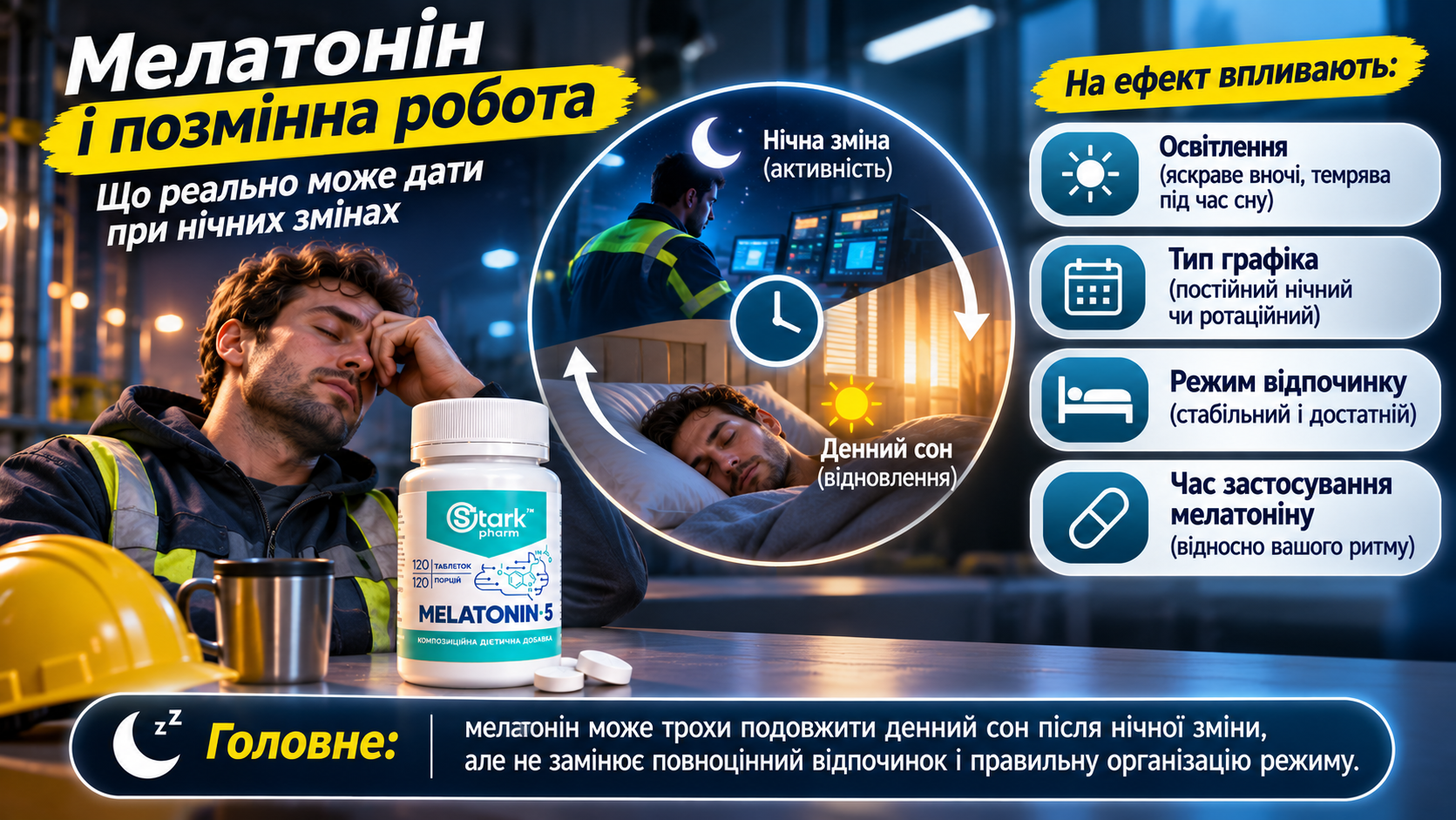
The American Academy of Sleep Medicine clinical guidelines published in 2026 consider melatonin as a possible option for adults with shift work-related sleep disorder. For daytime sleep after a night shift, the recommendation is conditional and based on very low-certainty evidence. For sleep during the transition from a night shift to a night's rest at home, the certainty of the evidence is somewhat higher, but the recommendation is also conditional.
The word “conditional” is important here: it means that the decision depends on the specific schedule, the accompanying circumstances, the potential benefits and risks. This is not a recommendation that all night shift workers take melatonin. The same recommendations specifically address light, sleep patterns, brief rest periods before shifts, and cognitive-behavioral approaches for persistent sleep disturbances.
When time is more important than the amount of melatonin
In the case of melatonin, it is not only the amount of the substance that is important, but also the relative timing of its use in relation to one's own circadian rhythm. Melatonin can participate in the body's time signals and at the same time cause drowsiness. If used at a time when you need to stay alert, the result may be undesirable.
Because of this, there is no universal rule that “every night shift is treated the same.” A person who finishes work at 7 a.m. and goes to bed soon after has a different routine than an employee who has to drive after the shift, take care of a child, or return to a morning schedule the next day.
Various doses and forms of melatonin have been used in clinical trials. This is a description of the methods, not a ready-made regimen to repeat yourself. It is best to discuss the timing and appropriateness of its use with a doctor, especially in cases of irregular changes, concomitant diseases, or taking other medications.
Light after the shift, bedroom and sleep: what can be done without additives
The most practical goal after working nights is to create conditions in which sleep has a chance to last long enough. It is not necessary to completely change the biological clock: sometimes it is more important to reduce the number of factors that wake a person in the middle of the day.
- Blackout: Blackout curtains or an eye mask help reduce daylight in the bedroom.
- Silence. Arrangements with loved ones, turning off notifications, and, if necessary, noise protection reduce the risk of awakenings.
- Cool and comfortable. A ventilated room with a comfortable temperature makes it easier to rest at an unusual time for sleep.
- Be careful with caffeine. Coffee closer to your planned bedtime can delay falling asleep, even if you are very tired.
- Scheduled time: A realistic window of rest is more important than trying to fall asleep “whenever you can” between chores.
Lighting at work and after work requires special attention. Bright light during the night shift can temporarily keep you awake, but it also affects your circadian rhythm. However, reducing the amount of light on the way home should not jeopardize your driving safety: if you are sleepy, the main thing is not to get behind the wheel, and not to try to “endure” the road with dark glasses.
How to handle naps and weekends
A short nap before a night shift can sometimes help reduce accumulated fatigue. However, after waking up, sleep inertia is possible: for a while, a person feels inhibited and reacts more slowly. Therefore, not only the duration of rest is important, but also the amount of time before traveling or performing dangerous work.
On weekends, it’s tempting to go back to your regular nightly sleep schedule. However, with frequent shifts, this means another change in schedule. In some cases, it’s possible to maintain at least a common portion of sleep time between workdays and weekends. This approach can make your schedule more predictable, although there’s no one-size-fits-all approach for all professions.
For high-responsibility shifts—drivers, medics, and equipment operators—rest planning should consider not only comfort but also safety. No supplement can compensate for critical sleep deficits or replace proper breaks.
How to understand that the problem goes beyond ordinary fatigue
After a single night shift, sleep can be worse for many people. Another situation is when difficulties recur, daytime sleep is constantly reduced, and at night at work, irresistible drowsiness occurs. Episodes of involuntary falling asleep, errors due to fatigue, or dangerous drowsiness while driving are especially important.
These symptoms should be evaluated by a doctor: they may be related to a shift schedule, but they also occur in other sleep disorders, including obstructive sleep apnea. It is helpful to keep a record of your work hours, bedtimes, awakenings, caffeine intake, and periods of extreme sleepiness for several weeks. This can help you see patterns that may be difficult to recall during a consultation.

Melatonin is a biological clock signal, not a replacement for normal rest. Studies have shown that it may be associated with slightly longer sleep after a shift in some workers, but it does not always improve sleep speed, alertness, or well-being. With ever-changing schedules, adequate sleep time, light control, and safety at work and on the road remain key.
The most important question is not “should everyone who works nights take melatonin?” but “what sleep problem needs to be addressed and is there a safer way to get some rest?” The answer depends on your work schedule, health, and occupational risks.
Frequently asked questions
Why is it hard to fall asleep after a night shift, even if you are very tired?
Accumulated fatigue and the signal of the biological clock can contradict each other. Morning light and a familiar circadian rhythm maintain alertness when a person is trying to sleep.
Does melatonin help you sleep during the day after working nights?
Systematic reviews suggest that, on average, a small increase in daytime sleep is possible, but the certainty of the results is limited and the effect is not the same for everyone.
Can melatonin be used before the night shift itself?
This is not a one-size-fits-all approach: melatonin can cause drowsiness and impair attention precisely when you need to work. The timing of use is decided individually.
Will it be easier to work at night if daytime sleep is extended?
Not necessarily. Studies distinguish between sleep duration, well-being, mindfulness, and productivity. Improving one metric doesn't necessarily mean improving all the others.
How is permanent night shifts different from a two-by-two schedule?
With a stable nighttime schedule, it is easier to establish a rest time. With frequent rotations, the biological clock receives conflicting signals, and full adaptation often does not occur.
Is it enough to darken the room for daytime sleep?
Darkening helps, but silence, sufficient window space, temperature, and caffeine are also important. Even under good conditions, daytime sleep can be shorter than nighttime sleep.
Can I drive after taking melatonin?
Due to possible drowsiness and decreased reaction time, one should not drive while the effect is felt. If a person almost falls asleep after the change, the trip should be organized in a safer way.
When should you see a doctor about shift work?
When sleep problems persist, involuntary falling asleep, dangerous drowsiness while driving, or marked impairment in performance appear. It is important to rule out other causes of sleep disorders.
Sources
- American Academy of Sleep Medicine (2026). Management of shift work disorder: an American Academy of Sleep Medicine clinical practice guideline. Journal of Clinical Sleep Medicine. DOI.
- Liira J., Verbeek JH, Costa G. and others. (2014). Pharmacological interventions for sleepiness and sleep disturbances caused by shift work. Cochrane Database of Systematic Reviews, CD009776. PubMed.
- Effects of melatonin administration on daytime sleep after simulated night shift work (2001). PubMed.
- Randomized clinical trial of melatonin after night-shift work: efficacy and neuropsychological effects (1998). PubMed.
- Sadeghniiat-Haghighi K., Aminian O., Pouryaghoub G., Yazdi Z. (2008). Efficacy and hypnotic effects of melatonin in shift-work nurses: double-blind, placebo-controlled crossover trial. Journal of Circadian Rhythms, 6:10. PubMed.
- Eastman CI, Stewart KT, Mahoney MP, Liu L, Fogg LF (1994). Dark goggles and bright light improve circadian rhythm adaptation to night-shift work. Sleep, 17(6):535–543. PubMed.
Dietary supplement. Not a medicine. Consult a doctor before use.
Products related to this post
Related Posts
Comments
Information
Customer Service
Extras
My Account


Sports nutrition manufacturer in Ukraine StarkPharm © 2026


