Your shopping cart is empty!

Melatonin for flights: how to reduce jet lag and get used to the new time faster
Published: 02/11/2026
Times Read: 131
Comments : 0
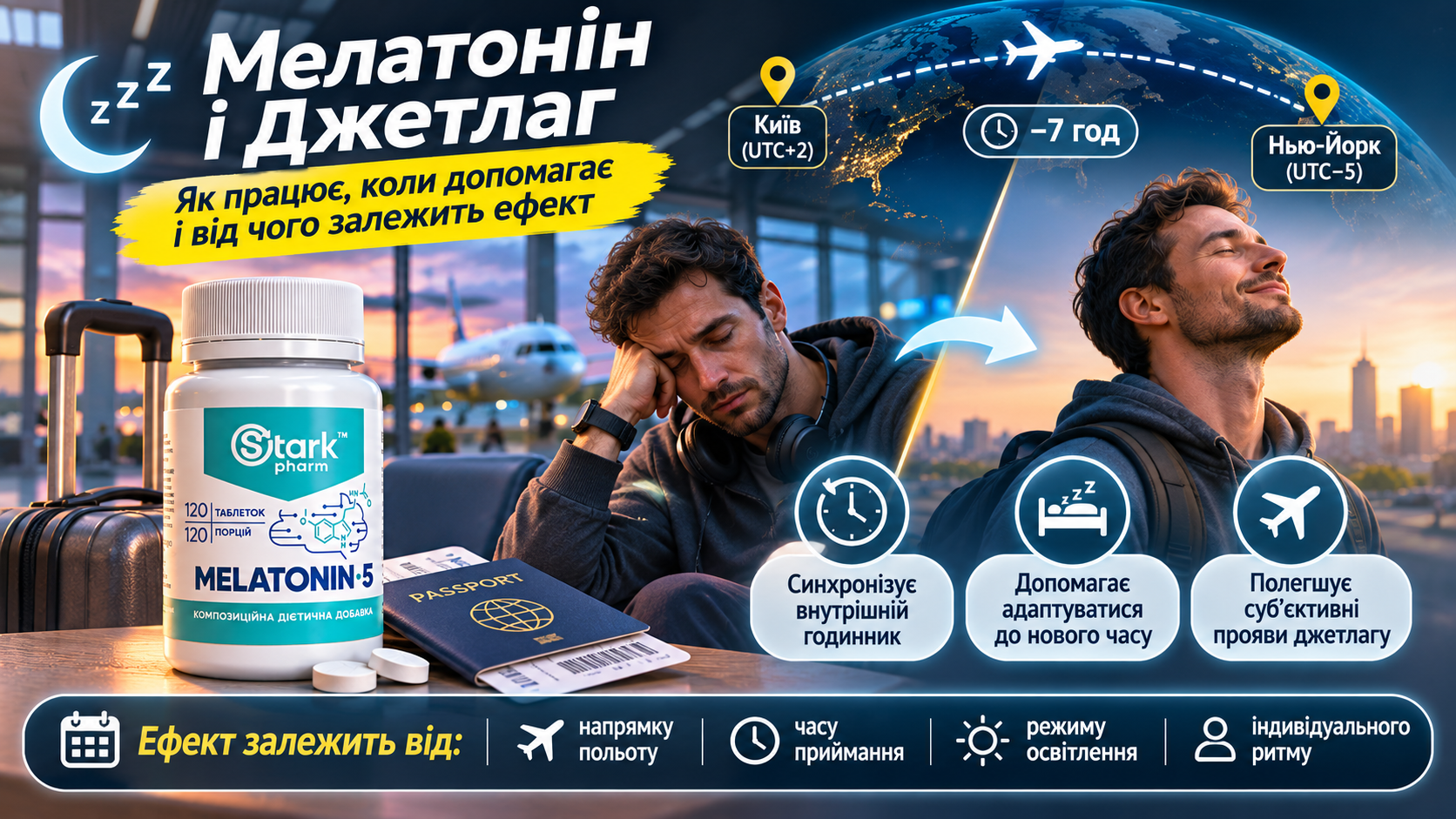
After flying across several time zones, you may find yourself in a situation where it is already evening in a new city, but your body is still living on home time. It is difficult to fall asleep at night, you tend to feel sleepy during the day, and normal concentration requires effort. This is jet lag - a temporary mismatch of the internal biological clock with the local day-night cycle. Melatonin is being studied as one of the ways to alleviate the subjective symptoms of jet lag, but the result depends not only on its amount, but also, above all, on the time of use.
To figure out how to approach melatonin while traveling, it’s important to consider the direction of your flight, the number of time zones you’ll cross, your usual sleep schedule, and the lighting conditions upon arrival. A one-size-fits-all “take a pill on the plane” approach doesn’t take these differences into account.
Why does jet lag occur after a flight?
The internal rhythm of a person regulates the alternation of drowsiness and alertness, fluctuations in body temperature and many physiological processes. Its central coordinator is located in the suprachiasmatic nucleus of the hypothalamus. Light falling on the retina helps this clock to compare time with the external environment. In the dark, the pineal gland increases the production of its own melatonin - one of the signals of biological night.
A plane can travel six time zones in a matter of hours, but your circadian clock doesn’t adjust its schedule that quickly. If it’s 4:00 PM at home and 10:00 PM at your destination, your body may not be ready for a night’s sleep. And vice versa: in the morning local time, your body may still perceive the world around you as night.
Jet lag is not limited to falling asleep. It can also cause daytime sleepiness, irritability, difficulty concentrating, decreased performance, changes in appetite, and digestive discomfort. The severity varies from person to person and usually increases with the number of time zones crossed quickly. Normal fatigue from an overnight flight can also be a symptom, but this is not the same as circadian misalignment.
Why the direction of flight matters
Flying east usually requires shifting your internal rhythm to an earlier time: falling asleep and waking up earlier than your body is used to. For many people, this adjustment is more difficult than lengthening the day. If you fly west, you often have to shift your sleep to a later time. In both cases, the local time, the individual circadian phase, and the moment of receiving the light signal become decisive.
| Situation | What's happening with the rhythm? | What do they pay attention to? |
|---|---|---|
| Flight to the east | Local day and night come earlier than the body expects | Gradual shift to earlier sleep, correctly selected light regime and melatonin time |
| Flight to the west | Local day and night come later according to the internal clock | Prolonging the period of cheerfulness and appropriate lighting time |
| Short trip for 1–2 days | Full reconstruction may not be completed before return | Sometimes it is more convenient to partially maintain a home schedule, if circumstances allow. |
| Long stay | It's time to synchronize the rhythm with the new terrain | Consistent sleep schedule, daylight, adaptation planning |
These are guidelines, not an individual scheme: for example, morning light according to local time is not always useful for quickly shifting the rhythm if it falls on an unfavorable phase of the internal clock. That is why professional recommendations take into account not only the direction, but also the specific route.
How melatonin is related to adaptation to the new time
Melatonin doesn’t just induce sleepiness. It also acts as a chronobiotic signal —it can influence when the internal circadian system perceives the onset of biological night. Its effect depends on when it is used relative to one’s own rhythm. Under some conditions, the signal helps shift the rhythm earlier, under others, later.
This explains why the same action after two different flights will not necessarily give the same result. If you focus solely on the clock on your phone and do not take into account the time that the body still lives by, melatonin may not help synchronization or even complicate it. It is especially undesirable to experiment with it during daytime hours, when you need to remain alert, drive transport or work with machinery.
Clinical guidelines consider melatonin in conjunction with light and sleep planning. It does not replace sleep, does not reverse the effects of sleep deprivation before a trip, and does not allow you to instantly “shift” your internal clock.
When melatonin was studied for jet lag
In these studies, melatonin was typically administered near the desired bedtime at the destination, rather than randomly throughout the flight. Participants received varying amounts of the substance, so the numerical values in the review describe the conditions of scientific experiments, not a ready-made regimen for self-administration. The current CDC review also emphasizes that the right timing is important for the direction of circadian rhythm shift.
Some studies have documented changes in subjective fatigue, well-being, and sleep scores, but in practice, people may experience varying degrees of relief. Melatonin does not address all causes of fatigue after travel — including lack of sleep, airplane noise, stress, and a disrupted diet.

How to plan usage time during a flight
The first step is not to choose the quantity, but to determine the time zone of the destination. Next, the number of hours of difference, the desired rest time after arrival, and whether the process of shifting the regime before departure has already begun are taken into account.
- A few days before the trip. If your schedule allows, gradually adjust your sleep schedule to the new location. This may mean going to bed earlier for an eastbound flight, and later for a westbound flight. Drastic changes are not necessary and may be uncomfortable.
- During the flight. Focus on the upcoming local time for sleep, try not to accumulate a sleep deficit, maintain your usual drinking regimen. You should not take melatonin just because the plane has already taken off: the duration of the flight does not say anything about the required circadian phase.
- Upon arrival. Plan daylight, activity, and rest according to the new schedule. If the use of melatonin has been agreed with a specialist, the time of its use is tied to the individual adaptation plan, and not to a random moment of drowsiness.
In studies and recommendations, the guideline “close to local bedtime” is often found. But for a real route, this is not enough: with a large time difference, “evening at the destination” sometimes corresponds to the traveler’s inner morning. Such a coincidence can change the expected effect. For complex routes, calculation tools that take into account flight time, light, and individual sleep are described in the professional literature.
At what point after arrival may melatonin be inappropriate?
A common mistake is to perceive melatonin as a tool that can be used at any time to eliminate fatigue. Daytime drowsiness after a flight does not mean that the body needs an additional signal of biological night. At an unfortunate time, drowsiness is possible when it interferes, and an undesirable shift in the internal rhythm.
You should not use the substance before driving, navigating an unfamiliar city at night, or other activities that require quick reactions. If you arrive during the day and have an important meeting the next morning, it is more useful to plan your sleep, walks, and lighting in advance than to compensate for fatigue by accidentally taking supplements.
Why light may be more important than supplementation
The main external synchronizer of the circadian system is light. Properly selected periods of bright light can help the internal clock shift in the right direction. At the same time, bright light at the wrong time can have the opposite effect. Therefore, the advice “walk more in the sun immediately after arrival” does not apply equally to all routes.
When preparing for a trip, it is worth considering not only the flight ticket, but also the arrival time, the possibility of daytime rest, darkening the room, curtains or an eye mask, as well as meeting times in the first days. Together, these details often affect the comfort of adaptation more than finding one “universal” pill.
Caffeine can also provide a short-term boost, but consuming it too late in the new local time can make it difficult to get a good night's sleep. Alcohol before bed is not a reliable way to recover: it can disrupt the structure of your rest. On a long flight, the usual actions are important - water, movement within the carrier's recommendations, comfortable clothing and planning a time for sleep.
Do all travelers adapt equally?
No. Even on the same route, the speed of synchronization can vary. Chronotype, usual sleep time, previous sleep deprivation, age, length of stay, lighting, and individual reactions to schedule changes are all factors. A person who is used to going to bed late may tolerate an eastbound flight differently than a traveler with a morning chronotype.
If the trip is only a day or two, a complete reset of the internal rhythm is not always advisable. Professional reviews consider partial retention of the home schedule for very short stops. When the stay is a week or longer, a gradual adjustment to the local day and night signals makes more sense.
For people with shift work, chronic sleep difficulties, or other circadian rhythm disturbances, the situation is more complicated. The combination of night shifts and flights may require an individualized plan. Recommendations for tourists after a single flight should not be applied to permanent night work.
Short-term use of melatonin has been studied in adult travelers, but this does not mean it is equally suitable for everyone. Drowsiness, headache, dizziness, and other adverse reactions may occur. There is less data on long-term regular use than on short-term use.
Special caution is needed for people taking anticoagulants or other ongoing medications, having epilepsy, chronic illnesses, or planning to combine melatonin with sedatives. Pregnant women, breastfeeding women, and children should not rely on the protocols of adult tourist studies. In such situations, the issue of supplementation should be discussed with a doctor.
It is also important to distinguish between finished products, dosage forms in different countries, and study settings. Findings about a particular regimen in a scientific publication do not prove that a particular supplement has the same effect. Dosages and product instructions should be checked against the actual product label, without copying experimental protocols.

Practical conclusion before the next flight
Melatonin is of interest for flights primarily because it is associated with circadian clock resetting, rather than simply temporary drowsiness. Scientific reviews show potential benefits for subjective jet lag, especially after long-haul flights. However, the specific effect depends on the route, time of use, light conditions, and individual characteristics.
Before planning to use melatonin, it’s worth answering three questions: how many time zones you’ll be crossing, where and when you’ll need to sleep upon arrival, and what kind of light you’ll be exposed to in the first few days. These factors form the basis of a careful adaptation strategy; the dosage and appropriateness of any supplement should be discussed individually.
Frequently asked questions
What is jetlag in simple words?
This is the time difference between the body's internal biological time and local day and night after quickly crossing time zones.
Does melatonin help after a flight?
Studies suggest that for some adult travelers, the use of melatonin at the right time can alleviate subjective symptoms of jet lag. The results are not the same for everyone.
When is it most difficult to adapt — after flying east or west?
For many people, the eastern direction is more difficult, as they have to shift their usual sleep time to an earlier time. But individual differences are significant.
Do I need to take melatonin right on the plane?
No, the mere fact of being on a plane does not determine the right time. What is important is local time, internal rhythm, route, and a strategy agreed upon with a specialist.
Is it enough to take melatonin only upon arrival?
Studies have used different protocols. For some routes, sleep staging is also being considered. There is no one-size-fits-all plan.
Can melatonin be replaced by walks in the sun?
Light is a key signal for the internal clock, but its timing matters. A well-thought-out light and sleep schedule can be the basis for adaptation without additional tools.
Does severe daytime sleepiness mean that melatonin should be used during the day?
No. Daytime sleepiness can be related to sleep deprivation, and taking melatonin at the wrong time can interfere with circadian rhythm adjustment and reduce alertness.
Why is it sometimes not advisable to completely change your regime for a short trip?
If you return after a day or two, your body clock may not have time to adjust. In some situations, it may be more practical to maintain a partial home schedule.
Sources
- Herxheimer A., Petrie KJ (2002). Melatonin for the prevention and treatment of jet lag. Cochrane Database of Systematic Reviews, CD001520. PubMed.
- Arendt J. (2009). Managing jet lag: Some of the problems and possible new solutions. Sleep Medicine Reviews, 13(4), 249–256. PubMed.
- Morgenthaler TI, et al. (2007). Practice parameters for the clinical evaluation and treatment of circadian rhythm sleep disorders. An American Academy of Sleep Medicine report. Sleep, 30(11), 1445–1459. PubMed.
- Brown GM, Pandi-Perumal SR, Trakht I., Cardinali DP (2009). Melatonin and its relevance to jet lag. Travel Medicine and Infectious Disease, 7(2), 69–81. PubMed.
- Riedy SM, Williams SG (2025). Jet Lag Disorder. CDC Yellow Book 2026: Health Information for International Travel. CDC.
- National Center for Complementary and Integrative Health. Melatonin: What You Need To Know. National Institutes of Health. NCCIH.
Dietary supplement. Not a medicine. Consult a doctor before use.
Products related to this post
Related Posts
Comments
Information
Customer Service
Extras
My Account


Sports nutrition manufacturer in Ukraine StarkPharm © 2026


