Your shopping cart is empty!

Melatonin: what is proven by science and what remains an advertising promise
Published: 01/11/2026
Times Read: 144
Comments : 0
“Melatonin helps you fall asleep,” “eliminates jet lag,” and “restores biological rhythms” may sound similar, but they promise different outcomes. Some statements have precisely defined conditions for use on food products, while others are too broad or attribute properties to a substance that the relevant scientific assessments do not confirm. For consumers, this is a matter of clear information; for manufacturers, it is a matter of accuracy and responsibility for every word.
Using melatonin as an example, we will examine which claims are included in the EU list, what the figures of 0.5 and 1 mg mean, why they cannot be turned into universal dosing instructions, and what needs to be checked separately for the Ukrainian market. This is not a guide to taking supplements, but an explanation of how to distinguish supported facts from advertising exaggeration.
What can actually be claimed about melatonin — and what cannot be added
Scientific studies can measure dozens of outcomes: how long it takes a person to fall asleep, how long they sleep, how they feel after a flight, or whether the phase of their internal clock changes. A positive change in one measure does not imply positive changes in all the others. For example, falling asleep faster is not the same as sleeping longer overall or no longer waking during the night.
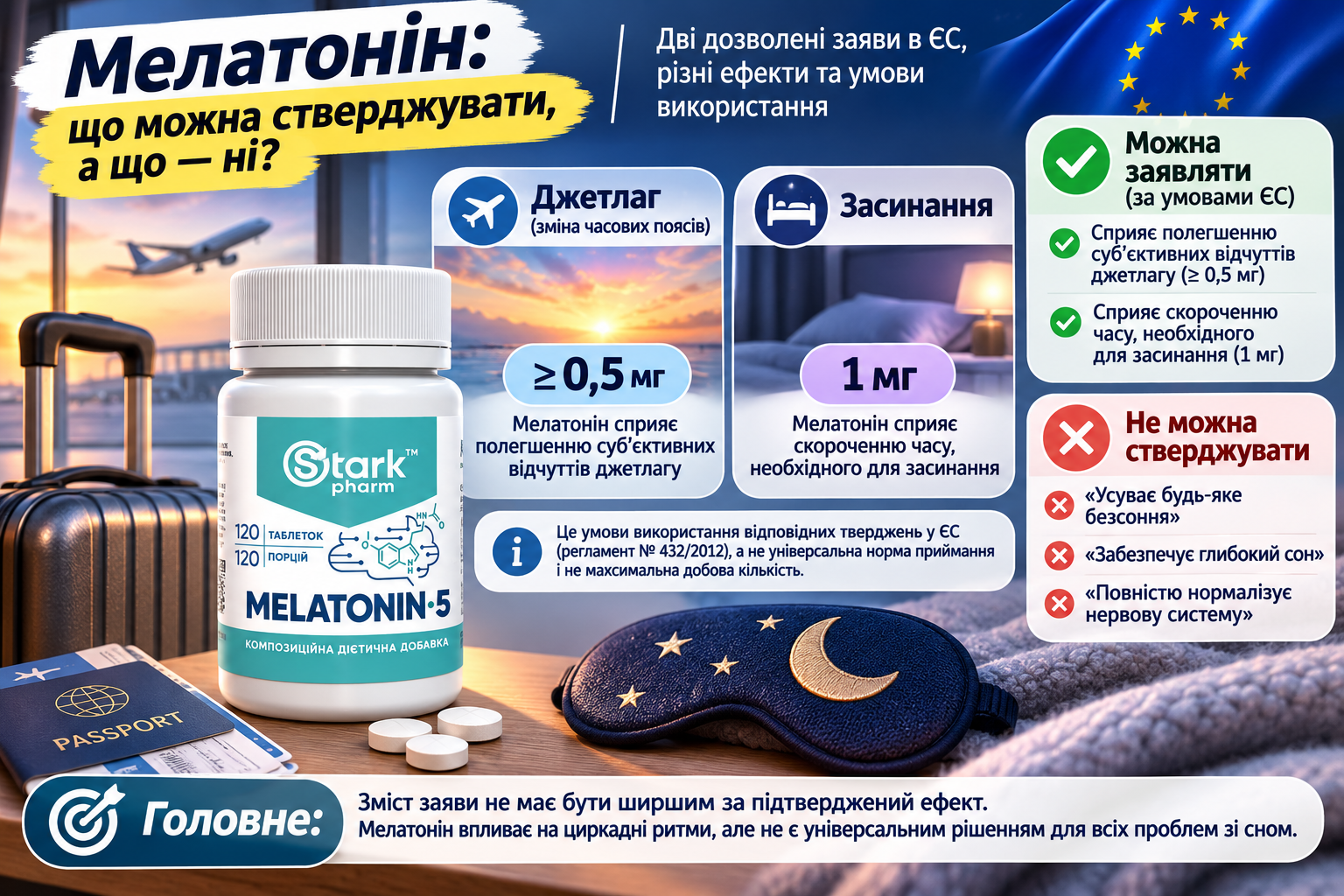
There are also authorised health claims. Their wording and conditions of use are established. The EU list includes two narrowly defined claims for melatonin: one concerning subjective feelings of jet lag and the other concerning the time needed to fall asleep. Phrases such as “eliminates all insomnia,” “ensures deep sleep,” or “completely normalises the nervous system” are not equivalent paraphrases.
The rule is simple: a claim must not be broader than the substantiated effect. Even precise wording does not guarantee the same response in every person — studies and official scientific assessments describe patterns, not individual outcomes.
Two EU claims: different effects and different conditions
The European list established by Regulation No 432/2012 distinguishes two situations. The quantities below are conditions for using the respective claims on foods in the EU, not a universal recommendation for taking melatonin and not a maximum permitted daily amount.
| Subject of the claim | Authorised meaning in the EU | Amount requirement | Accompanying information |
|---|---|---|---|
| Jet lag | Melatonin contributes to the alleviation of subjective feelings of jet lag | At least 0.5 mg in the specified portion | The effect is associated with at least 0.5 mg close to bedtime on the first day of travel and on the following few days after arrival |
| Falling asleep | Melatonin contributes to the reduction of time taken to fall asleep | 1 mg in the specified portion | The effect is associated with 1 mg close to bedtime |
The threshold of “at least 0.5 mg” for jet lag and the condition of “1 mg” for falling asleep are worded differently. They cannot simply be turned into the conclusion that “the more melatonin, the stronger the effect.” Nor should these figures be treated as general advice for every consumer: they appear specifically in the context of authorised EU claims.
The conditions also require consumers to be informed about the situation in which the beneficial effect is obtained. Merely writing “melatonin” on a label or listing the quantity per tablet is therefore not sufficient — what is being promised and what information accompanies that claim both matter.
Why jet lag and ordinary sleep onset call for different claims
Jet lag is associated with rapid travel across time zones: the internal daily rhythm does not immediately adjust to local time. Periods of sleepiness and alertness may shift, nighttime sleep may be disrupted, and daytime discomfort may occur. Studies have assessed the subjective severity of these effects, among other outcomes, rather than merely how quickly a person falls asleep.
The systematic review by Herxheimer and Petrie (2002) included ten controlled trials, nine of which were suitable for the overall assessment. Many trials found reductions in jet-lag symptoms after crossing multiple time zones. The authors emphasised the importance of timing. However, these results do not mean that melatonin eliminates all consequences of flying or works equally well regardless of the itinerary.
Sleep onset latency is a different outcome: the interval between attempting to sleep and actually falling asleep. On its own, it does not show how many hours a person will sleep, how often they will wake up, or how they will feel in the morning. EFSA published a separate scientific assessment of this outcome in 2011. This is precisely why the two European claims should not be combined into the broad promise “normalises sleep.”
What research shows — and what it does not establish
Scientific studies help explain why these effects are considered at all. For example, the meta-analysis by Ferracioli-Oda and colleagues (2013) combined 19 trials with 1,683 participants and found a small but statistically significant average reduction in sleep onset latency compared with placebo. This is an outcome for the studied groups, not proof of equal benefits for everyone or grounds for claiming that any supplement can eliminate persistent sleep disorders.
It is important to distinguish statistical significance from the practical magnitude of an effect. A statistically supported difference between groups is not necessarily large or noticeable to all participants. Moreover, different studies enrolled people with different complaints, used different assessment methods, and varied in duration.
Scientific sources may also discuss other outcomes, such as shifts in circadian phase, subjective sleep quality, and sleep duration. But each measure requires its own assessment. Marketing copy cannot automatically add “deep sleep,” “recovery of the body,” or “effects on all biological rhythms” simply because some trials documented a reduction in the time needed to fall asleep.
Why timing matters, not just the amount of melatonin
Melatonin is one component of the circadian system that aligns the body's processes with the cycle of light and darkness. According to the CDC Yellow Book, the effect of exogenous melatonin on the phase of the internal clock depends on the biological time at which it is taken. Thus, the same clock time may represent different conditions for someone at home and a traveller who has just crossed several time zones.
Poor timing may cause an unwanted shift in the rhythm. Scientific protocols specifying a particular amount and time therefore cannot be reduced to the simple advice “take more in the evening.” European claims also link their stated effects to particular conditions, but they do not replace an individual medical decision.
The essential distinction for this article is that the threshold for making a specific authorised claim is not the upper limit for daily intake. These are different questions and may be regulated differently depending on the country and product category.
Do European claims automatically apply in Ukraine?
No. In Ukraine, the use of claims on food products is governed by national requirements, including regulatory document No 1145 of 15 May 2020, as currently amended. The European list is useful for understanding where these claims originate, but Ukrainian rules and the specific product must be checked when preparing labels or advertising for Ukraine.
Assessment covers not just claims of benefit, but also product composition, its category, recommended daily portion, and mandatory warnings. Accordingly, the existence of an EU claim does not in itself establish that the claim may be used for any form or quantity of melatonin offered on the Ukrainian market.
The figures of 0.5 and 1 mg from the European list should not be confused with Ukrainian limits on daily intake. Nor can they establish compliance of a particular product label. Such compliance must be assessed separately against the current version of the label.
How consumers can distinguish accurate descriptions from exaggeration
First, check which specific outcome the text promises. “Reduces the time needed to fall asleep” describes a particular measure; “gives you perfect sleep” does not explain what it means. “Contributes to the alleviation of subjective feelings of jet lag” is likewise not equivalent to “completely removes the effects of crossing time zones.”
Next, establish the conditions on which the claim rests: whether the required amount per portion is stated, whether a study result has been replaced by a marketing generalisation, and whether the country of sale has been taken into account. A description must be accurate whether it appears on a label, a product page, or in an advertisement.
Finally, clinical studies should not be used as stand-alone instructions for taking a supplement. Publications describe experimental protocols, while actual use depends on the product, age, health status, concomitant medicines, and medical advice.
When particular caution is needed
Melatonin may affect sleepiness and alertness. Medical advice should be sought before use, especially for people with chronic conditions, those taking medicines, or those engaged in activities requiring high concentration. Use by children and adolescents under 18 is prohibited according to the stated warnings for this substance. Melatonin is not recommended for pregnant or breastfeeding women.
People with inflammatory or autoimmune diseases, epilepsy, or asthma also require a separate medical consultation. Positive findings for certain measures in scientific literature do not remove these restrictions. A food supplement does not replace medical advice, and the directions for use provided on the label take precedence.
Frequently asked questions
Which melatonin claims are provided for in the EU?
Two: one about alleviating subjective feelings of jet lag and one about reducing the time needed to fall asleep. Each has its own conditions.
What is the difference between the 0.5 mg and 1 mg conditions?
In the EU, at least 0.5 mg relates to the jet-lag claim, while 1 mg relates to the sleep onset claim. These are not universal dosing recommendations.
Can a label say that melatonin eliminates insomnia?
No. Such a broad statement does not follow from the two authorised food health claims described here.
Does falling asleep faster prove that sleep improves overall?
No. Sleep onset time, sleep duration, awakenings, and how a person feels in the morning are different outcomes.
Does a larger dose mean better results?
No. The conditions for using claims do not establish a “more is better” rule, and the timing of melatonin also matters.
Can EU claim wording be used on a Ukrainian website?
Only after checking the current Ukrainian requirements and the specific product. European rules do not replace national ones.
Can doses used in studies determine the portion of a supplement?
No. Research doses describe particular protocols, not universal instructions for consumers.
Why does the timing of melatonin matter?
It is linked to the body's internal biological clock. Its effect on circadian phase may depend on when the substance is taken.
Sources
- European Commission (2012, as amended). Commission Regulation (EU) No 432/2012 establishing a list of permitted health claims made on foods. Official list of claims, annex, Melatonin entries. EUR-Lex.
- Ministry of Health of Ukraine (2020, version in force in 2026). Order No. 1145 “On Approval of the Requirements for Nutrition Claims and Health Claims Made on Foods”. Verkhovna Rada of Ukraine.
- EFSA NDA Panel (2010). Scientific Opinion on the substantiation of health claims related to melatonin and alleviation of subjective feelings of jet lag, reduction of sleep onset latency, and improvement of sleep quality. EFSA Journal, 8(2), 1467. DOI.
- EFSA NDA Panel (2011). Scientific Opinion on the substantiation of a health claim related to melatonin and reduction of sleep onset latency. EFSA Journal, 9(6), 2241. DOI.
- Herxheimer A, Petrie KJ (2002). Melatonin for the prevention and treatment of jet lag. Cochrane Database of Systematic Reviews, CD001520. PubMed.
- Ferracioli-Oda E, Qawasmi A, Bloch MH (2013). Meta-analysis: melatonin for the treatment of primary sleep disorders. PLoS ONE, 8(5), e63773. PubMed.
- Centers for Disease Control and Prevention (2026). Jet Lag Disorder. CDC Yellow Book: Health Information for International Travel. CDC.
Food supplement. Not a medicinal product. Consult your doctor before use.
Products related to this post
Related Posts
Comments
Information
Customer Service
Extras
My Account


Sports nutrition manufacturer in Ukraine StarkPharm © 2026


