Your shopping cart is empty!

Melatonin and the biological clock: how the body distinguishes between day and night
Published: 01/11/2026
Times Read: 170
Comments : 0
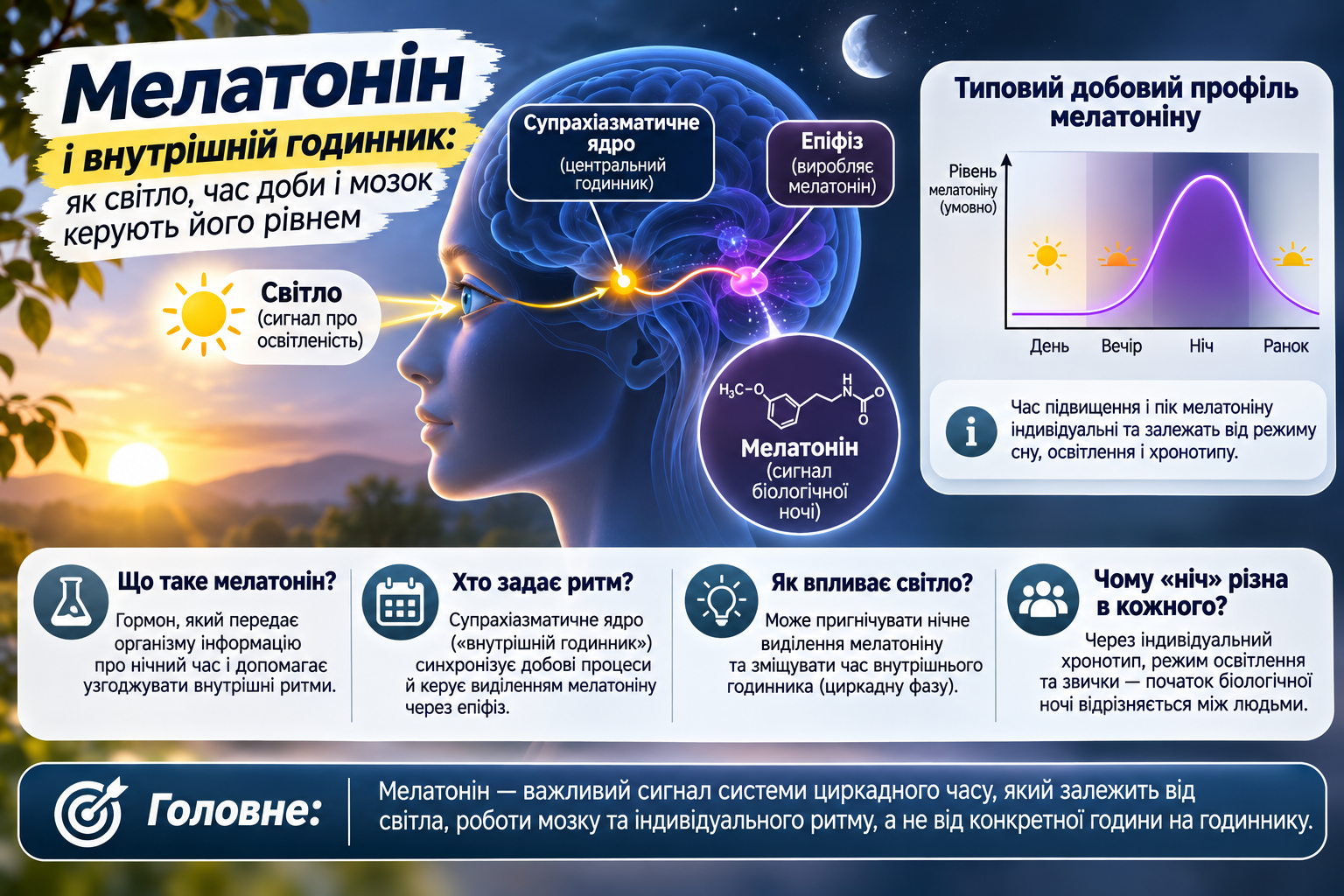
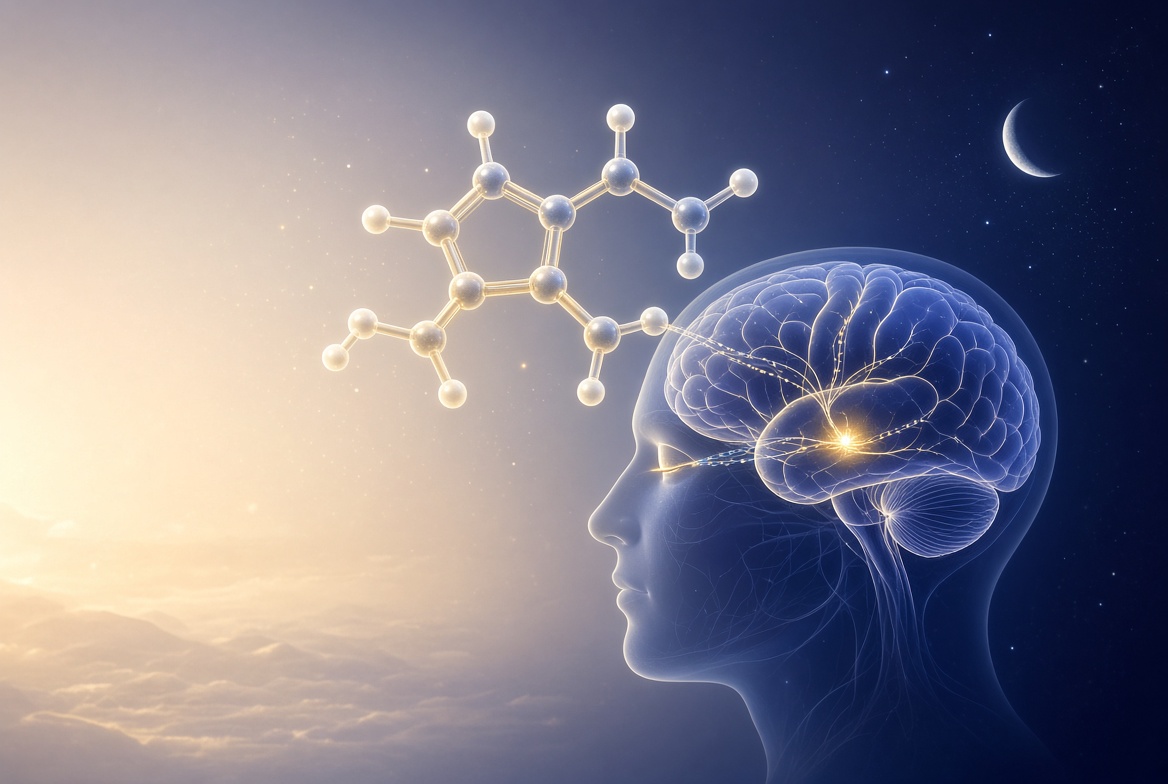
Melatonin is a hormone whose circadian oscillations can be observed when the body is in the biological night phase. It is most often associated with sleep, but melatonin has a broader function than simply making us feel sleepy: it transmits information to tissues about the time of day and is involved in synchronizing internal rhythms with changes in light and darkness. The main source of circulating melatonin in humans is the pineal gland, or pineal gland.
When light levels decrease in the evening, melatonin levels usually start to rise; during the day they remain low. However, the hormone is not an independent “switch” of wakefulness. To understand its role, it is necessary to understand who sets the circadian rhythm, how the eyes transmit information about light to the brain, and why the time of biological night does not always coincide with the readings of the clock.
What is melatonin and where is it produced?
Melatonin is chemically an indoleamine, which is synthesized from the amino acid tryptophan through intermediate steps, including the formation of serotonin. The main source of the characteristic nocturnal increase in melatonin in the blood is the pineal cells. The process of hormone formation itself is not determined solely by the fact that it is dark outside: it is controlled by the nervous system, which takes into account information about lighting and the body's internal time.
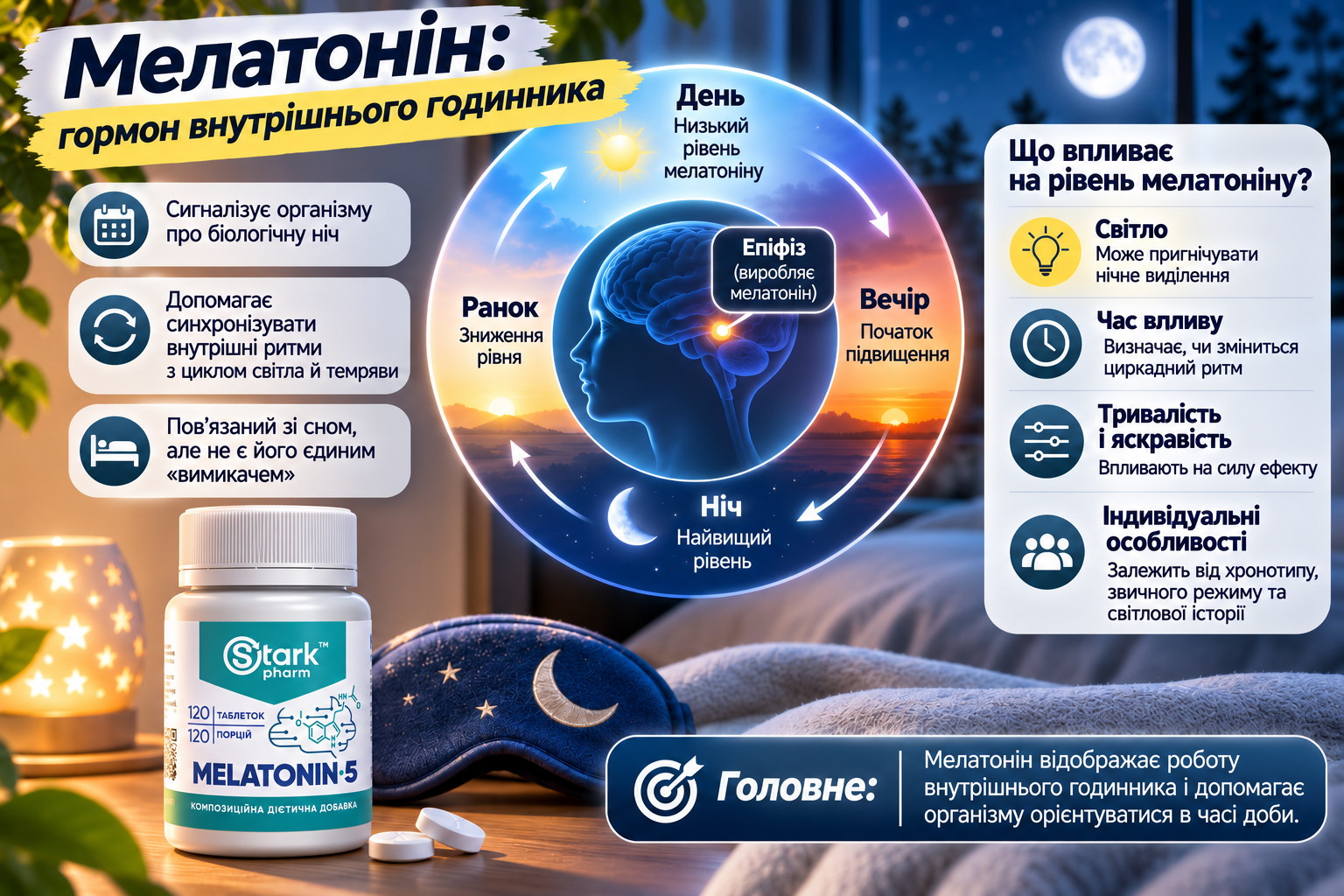
Under normal conditions, the hormone concentration has a distinct diurnal profile: low daytime values, increases in the evening, higher levels at night, and decreases closer to morning. The specific time of onset and peak depends on the individual, their usual regimen, and light conditions. Therefore, the popular phrase “melatonin is produced at exactly ten o’clock in the evening” is not a physiological rule. Reviews by Geoffriau et al. (1998) and Brown (1994) describe melatonin as the hormonal output signal of the circadian clock system.
Who controls the biological clock?
The suprachiasmatic nucleus, a small group of nerve cells often called the central biological clock, is located in the hypothalamus. Its activity sets the roughly daily pattern of changes in many physiological processes. These rhythms are called circadian: they can persist in the absence of usual external cues, but they require regular synchronization to align with the 24-hour day.
The most powerful external cue is light. Some of the photosensitive cells in the retina tell the suprachiasmatic nucleus not about what we see, but about the general level of light. Through a complex neural circuit, the central clock regulates the activity of the pineal gland. Thus, a connection arises between the external light environment and the nocturnal secretion of melatonin.
It is important not to confuse the cause with the indicator: the melatonin rhythm reflects the work of the central clock, but is not the only mechanism that triggers all circadian processes. Internal clocks are also present in many peripheral tissues; the central system helps to maintain their coherence.
How light and darkness change melatonin levels
Light affects melatonin in two related ways. First, exposure to light during biological night can directly suppress the ongoing secretion of the hormone. Second, depending on the timing of exposure, light can shift the phase of the internal clock—that is, change the time when the usual night processes begin the next day. These are not the same thing: a short-term decrease in hormone concentration does not necessarily mean an identical shift in the entire circadian rhythm.
A systematic review by Tähkämö, Partonen and Pesonen (2019) shows that the outcome depends not only on brightness: the spectral composition, duration and time of exposure, as well as previous light history are important. Evening or nighttime lighting can affect both current melatonin secretion and circadian phase. At the same time, reactions vary between people - there is no universal threshold of “safe light” for every situation.
| System element | What does | What should not be concluded from this? |
|---|---|---|
| Light | Provides an external time signal and may suppress nocturnal melatonin secretion | Does not define sleep solely on the principle of “there is light, there is no sleep” |
| Suprachiasmatic nucleus | Coordinates the central circadian rhythm | Does not work like a regular mechanical watch with fixed hours for everyone |
| Epiphysis | Creates a characteristic nocturnal hormonal signal | Is not an independent control center for all phases of sleep |
| Melatonin | Notifies the body of biological night and interacts with the circadian system | Does not in itself guarantee falling asleep or uninterrupted sleep |
Why biological night does not begin at the same time for everyone
In chronobiological studies, the DLMO, the onset of melatonin rise under dim light, is used to estimate circadian phase. According to clinical literature, this point often precedes the usual bedtime by about a few hours, but is not the same point for all people. When melatonin is measured under bright light, the result may reflect not only the internal time, but also the immediate response to light.
This is why two adults who go to bed at 11:00 p.m. may have different circadian states of preparation for the night. And vice versa: the same sleep parameters do not prove the identity of their hormonal rhythm. In the work of Dijk et al. (1997), the relationship between melatonin and the structure and timing of sleep was examined through measurements of circadian and electrophysiological parameters.
Melatonin and sleep: there is a connection, but these are different mechanisms
Sleep is regulated by at least two interacting processes. The first is homeostatic sleep pressure: the need for sleep usually increases as the body is kept awake for a long time. The second is circadian control, which determines when the body tends to be more alert and when it is more likely to transition to a night's rest. Melatonin is closely related to the second process, although it can also affect the tendency to fall asleep.
This explains why elevated melatonin levels are not a guarantee of sleep, and low levels of the hormone do not preclude falling asleep after a long period of wakefulness. According to a review by Cajochen, Kräuchi, and Wirz-Justice (2003), melatonin acts as an internal time signal and can shift the circadian phase. However, the nature of this shift depends on the biological moment at which the exposure occurs.
There is also an important distinction between the body's own melatonin and that of an exogenous substance. The administration of melatonin in experiments may create a time signal that is different from the natural circadian profile. Therefore, findings about the regulation of the day–night cycle cannot be automatically translated into general recommendations for supplementation, dosage, or timing. These issues require separate consideration.
What can you learn from a melatonin analysis?
In research settings, melatonin is measured in blood or saliva, and sometimes its metabolites in urine are used. If the goal is to establish circadian phase, it is important to collect samples under controlled light conditions and over a period of time. A single random measurement without specifying the time of day and lighting can be difficult to interpret.
A systematic review of light exposure and chronobiology studies has highlighted that lighting before and during sampling can influence the result. For example, a temporary suppression of secretion by light can be mistaken for the absence of a nocturnal increase. This is why DLMO is usually assessed by a series of measurements in dim light, rather than by a single analysis at an arbitrary time.
For most people without a specific research or clinical need, a melatonin test is not a way to self-select a supplement. The result requires context: sleep pattern, light schedule, age, possible medications, and the chosen laboratory method.
What maintains the consistency of the day-night cycle?
The most obvious physiological factor is regular light exposure. Brighter daytime lighting and reduced light exposure late in the evening help the body distinguish between day and night. However, the strength and direction of the phasic response depend on the specific time of exposure: not all light at all hours has the same effect.
Other stabilizing cues include relatively consistent wake times, regular activity and meal times. They do not replace the central light mechanism, but they do make the daily schedule more consistent. For people with variable schedules or frequent flyers, coordinating these cues can be much more difficult than for those who work during the day.
It is important to distinguish between natural synchronization and the use of supplements. Melatonin in supplements is not a substitute for daylight, sleep patterns, or an assessment of the causes of persistent sleep difficulties. And if sleep disturbances recur, it is important not to automatically attribute them to “melatonin deficiency”: similar complaints can have different causes.
Precautions for melatonin supplements
Melatonin has biological activity, so it should not be perceived as a neutral component of food. Before consumption, it is recommended to consult a doctor. Dietary supplements with melatonin are prohibited for children under 18 years of age; they are not recommended for pregnant and lactating women, people with inflammatory or autoimmune diseases, epilepsy or asthma, as well as those who perform activities that require increased attention. If a person is taking medication or has chronic conditions, the issue of combination should be discussed with a doctor.
This article does not provide a dosing schedule or dosage recommendations: its purpose is to explain the role of endogenous melatonin in the biological clock. Dosage information and specific usage scenarios are covered in separate, independently reviewed topics.
Frequently asked questions
Is melatonin a hormone or a vitamin?
Melatonin is a hormone involved in signaling biological night. It is not a vitamin.
Is melatonin only produced when a person is sleeping?
No. Its circadian rhythm is linked primarily to its internal clock and light conditions, rather than directly to the act of falling asleep.
Why does melatonin increase in the evening?
The circadian clock system regulates pineal gland activity through neural signals. During the appropriate phase of the internal rhythm, dimmed lighting allows the nocturnal increase in the hormone to occur.
Does everyone's biological clock work the same way?
No. Chronotype and circadian phase are different, so the same time on the clock does not necessarily mean the same internal biological time.
Can evening light affect melatonin?
Yes. Depending on the characteristics and timing of lighting, it can temporarily suppress hormone secretion and affect circadian phase.
What does DLMO mean?
This is the beginning of the rise in melatonin in dim light. In research, it is used as a marker of internal circadian time.
If melatonin is elevated, will a person necessarily fall asleep?
No. Sleep also depends on the accumulated need for rest, external conditions, and many other factors.
Do I need to take a melatonin test before choosing a supplement?
A single test alone does not provide a complete picture of your circadian rhythm. The need for testing and interpretation of the results is determined by a specialist.
Sources
- Brown GM (1994). Light, melatonin and the sleep-wake cycle. Journal of Psychiatry & Neuroscience, 19(5), 345–353. PubMed.
- Geoffriau M., Brun J., Chazot G., Claustrat B. (1998). The physiology and pharmacology of melatonin in humans. Hormone Research, 49(3–4), 136–141. PubMed.
- Shanahan TL, Zeitzer JM, Czeisler CA (1997). Resetting the melatonin rhythm with light in humans. Journal of Biological Rhythms, 12(6), 556–567. PubMed.
- Cajochen C., Kräuchi K., Wirz-Justice A. (2003). Role of melatonin in the regulation of human circadian rhythms and sleep. Journal of Neuroendocrinology. PubMed.
- Dijk DJ, Cajochen C. (1997). Melatonin and the circadian regulation of sleep initiation, consolidation, structure, and the sleep EEG. Journal of Biological Rhythms, 12(6), 627–635. PubMed.
- Tähkämö L., Partonen T., Pesonen A.-K. (2019). Systematic review of light exposure impact on human circadian rhythm. Chronobiology International, 36(2), 151–170. PubMed.
- Prayag AS, Münch M, Aeschbach D, Chellappa SL, Gronfier C (2019). Light Modulation of Human Clocks, Wake, and Sleep. Clocks & Sleep. PubMed.
Dietary supplement. Not a medicine. Consult a doctor before use.
Products related to this post
Comments
Information
Customer Service
Extras
My Account


Sports nutrition manufacturer in Ukraine StarkPharm © 2026


