Your shopping cart is empty!

Melatonin and sleep: why falling asleep faster doesn't mean sleeping longer
Published: 02/11/2026
Times Read: 147
Comments : 0
Melatonin is often called the "sleep hormone," but this phrase is easily misunderstood. It does not act as a button that, when pressed, will cause a person to fall asleep and sleep without waking up until morning. Its main physiological role is to signal the body that it is biologically night and participate in the synchronization of circadian rhythms. Supplemental melatonin sometimes affects the time it takes to fall asleep, but this is not the same as a significant increase in sleep duration.
To properly evaluate the research, it is important to distinguish between three independent questions: how quickly a person falls asleep, how much sleep they get, and how they feel after waking up. These indicators can vary widely. It is this difference that explains why some people notice the effects of melatonin while others do not experience any significant changes.
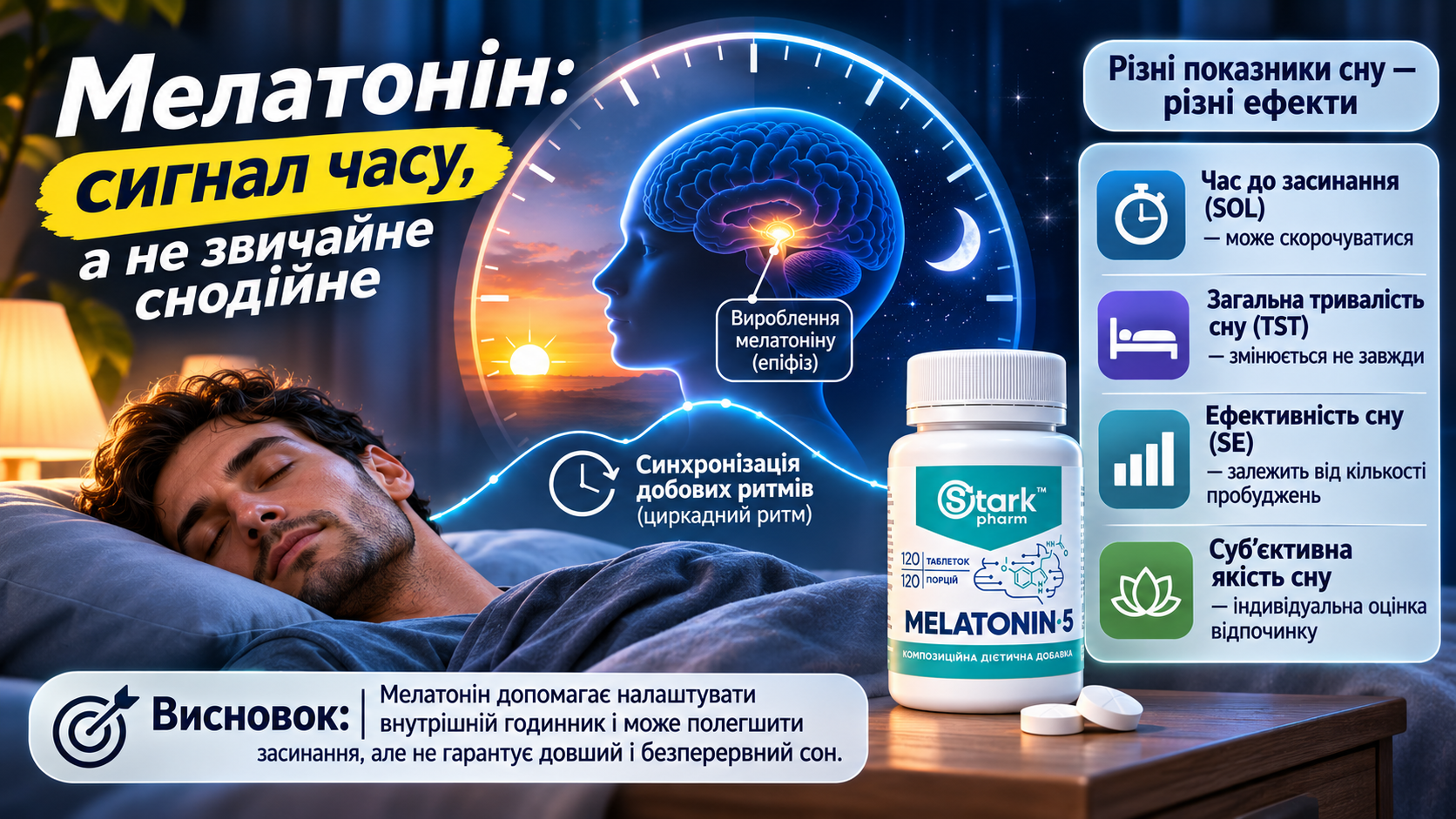
Melatonin is a time signal, not a regular sleeping pill
During the dark period of the day, the pineal gland produces melatonin in response to signals from the internal clock system. These signals depend on lighting, activity patterns, and the individual's circadian phase. The evening increase in melatonin does not in itself create sleep: it coincides with other physiological changes that prepare the body for a night's rest.
Researchers call the ability of a substance to change the position of the circadian rhythm a chronobiotic effect. A review by Arendt and Skene (2005) describes how melatonin, at a certain time of exposure, can shift the phase of the internal clock, as well as cause mild drowsiness. These are different effects. Other classes of hypnotics may act primarily through inhibitory mechanisms in the central nervous system. Melatonin should not be automatically equated with them either in terms of mechanism or strength of effect.
At the same time, the statement “melatonin has no effect on falling asleep at all” would be incorrect. It has been studied specifically for this indicator, and some studies have yielded statistically significant results. The question is the scale and predictability of this effect.
Falling asleep time, sleep duration and sleep quality: three different indicators
Scientific articles often use the abbreviations SOL, TST, and SE. Without understanding them, a conclusion like “sleep improved” says little about actual change.
| Indicator | What does it measure? | Why is this important? |
|---|---|---|
| Time to sleep (SOL) | Minutes from trying to fall asleep to actually starting to sleep | May decrease even if the person wakes up the same number of times |
| Total sleep time (TST) | Total sleep time per night | Does not equal time spent in bed |
| Sleep Efficiency (SE) | The proportion of time in bed that a person actually slept | Depends on both falling asleep and waking up at night |
| Subjective sleep quality | A person's own assessment of rest | May not match objective measurements |
For example, a person may fall asleep a few minutes earlier but wake up at the same time. In this case, the total sleep time will only increase slightly. And if prolonged nocturnal awakenings persist, the feeling of rest may not change at all. This is why reports of an effect on SOL cannot be interpreted as evidence of continuous sleep throughout the night.
What the study found: There is an effect, but its size matters
A meta-analysis by Ferracioli-Oda, Qawasmi, and Bloch (2013) pooled 19 randomized trials involving 1,683 people with primary sleep disorders. Compared with placebo, melatonin reduced the time to fall asleep by an average of about 7 minutes, and increased total sleep time by about 8 minutes. The authors also noted a small improvement in subjective ratings of sleep quality.
This is a real difference in the aggregated results, but it does not promise the same effect for every person. The average hides differences between participants, types of disorders, assessment methods, and study duration. For some changes, a few minutes may not be enough to notice a difference in daily well-being.
Another systematic review by Buscemi et al. (2005) found an average reduction in time to fall asleep of 11.7 minutes. However, in this analysis, the change in total sleep time was not statistically significant. These results are not contradictory: the reviews included different sets of studies and used different methods. It is important not to just pick the number that sounds the most impressive.
A meta-analysis by Cruz-Sanabria et al. (2024) included 26 randomized trials that assessed the association between melatonin dosage and timing of use. The authors concluded that both variables may influence sleep outcomes. However, this analysis does not imply that any individual will experience longer sleep with increased melatonin dosage.

Why findings about chronic insomnia vary
A 2022 systematic review specifically focused on chronic insomnia evaluated 24 randomized trials. In a group of adults without comorbid conditions, the authors found no statistically significant improvement in time to fall asleep, total sleep duration, or sleep efficiency compared to placebo. The results in children and adolescents were different, but they cannot be transferred to an adult audience. This highlights the importance of clarifying in which group the effect was obtained.
The presence of positive results in larger meta-analyses and cautious conclusions in a specialized review is not a scientific error. It is a consequence of different inclusion criteria and different characteristics of participants. The statement “melatonin improves sleep” without such context simplifies the picture to the level of advertising.
Going to bed earlier doesn't mean sleeping longer.
The difference is especially noticeable when the problem is related to the late setting of the internal clock. A person may feel sleepy much later than required by their work or study schedule. Shifting the time of falling asleep closer to the desired hour has a different purpose here than mechanically increasing the number of hours of sleep.
In a meta-analysis by van Geijlswijk et al. (2010) on sleep phase delay, melatonin on average delayed the onset of its own secretion by approximately 1.18 hours and the actual time of falling asleep by approximately 0.67 hours. The time to fall asleep was also reduced. However, the authors did not find a statistically significant increase in total sleep time.
This is a good example of a situation where a substance can affect sleep patterns but does not automatically add new hours of sleep. If a person starts to fall asleep earlier but wakes up earlier, the total duration may remain almost the same. The original request is important for assessing the benefit: to shift the hours of sleep or to increase its duration.
What about night awakenings?
Nighttime awakenings are a separate outcome that should not be confused with “falling asleep quickly.” Awakenings can be influenced by light, noise, temperature, stress, sleep schedule, alcohol, certain medications, and various health conditions. The biological night signal does not necessarily eliminate these factors.
Trials sometimes measure the time awake after first falling asleep, or WASO. In a meta-analysis by Buscemi et al. (2005), there was no convincing evidence of a significant reduction in this measure. Therefore, the data on shorter time to fall asleep do not allow us to conclude that melatonin consistently helps prevent waking during the night.
A separate topic is the rapid-release and extended-release forms. They differ in their delivery profile and have been studied in separate studies for different sleep parameters. But the same number of milligrams in different forms does not guarantee the same result, and the presence of extended release is not proof of uninterrupted sleep for everyone.
Why people's opinions can vary so much
Subjective experience is an important part of self-monitoring, but it is not a substitute for controlled research. After a sleepless night, a person may fall asleep faster the next night due to an accumulated need for sleep, rather than a single specific supplement. Changing the lighting, avoiding late-night coffee, or having a more regular schedule may also coincide with starting melatonin.
Additionally, chronotype is important: the natural tendency to fall asleep earlier or later. When a person tries to sleep against their circadian phase, the timing of biological signals comes to the fore. If the difficulties are related to night awakenings or insufficient time allocated to sleep, the impact on the circadian signal may be less noticeable.
In studies, these differences are partially accounted for through inclusion criteria and control for other factors. In personal reviews, such control is usually not available. Therefore, the statement “helped me sleep through the night” does not prove a universal effect, and “didn’t feel anything” does not refute the results of all clinical studies.
How to read melatonin promises critically
The first thing to do is to determine what outcome is being described: faster falling asleep, earlier bedtime, fewer nighttime awakenings, or longer total sleep time. These are different endpoints. If the description cites research on falling asleep time but promises “deep sleep without awakenings,” there is a gap between the evidence and the conclusion.
- Look for a specific metric. “Time to fall asleep decreased” is more informative than the general “sleep improved.”
- Pay attention to the scale. A statistically significant average difference of a few minutes does not equal an equally noticeable effect for everyone.
- Read who was studied. Data on circadian rhythm shifts, chronic insomnia, and healthy volunteers are not interchangeable.
- Don't confuse falling asleep and waking up at night. A positive change in one indicator does not prove a change in the other.
- Consider limitations. Even a high-quality meta-analysis cannot completely eliminate differences between individual trials.
This approach helps to evaluate not only melatonin, but also any popular supplement claims. Accurate information should state a specific result and not promise more than is shown in the studies.

If you have trouble falling asleep or waking up at night is a recurring problem, it is important to assess your sleep habits and possible factors that contribute to them. A regular wake-up time, adequate rest, and darkness at night and light during the day are all factors that can help your circadian system function properly. But even these steps cannot explain every situation.
Constant awakenings, severe daytime sleepiness, loud snoring with breathing pauses, significant deterioration in well-being or long-term sleep problems are reasons to consult a doctor. Pregnant women, breastfeeding women, children, people with chronic diseases and those taking medications require an individual assessment of the appropriateness of supplements. After taking drugs that cause drowsiness, you should avoid driving and dangerous work if the body's reaction is unknown.
Melatonin does not compensate for systematic sleep deprivation and does not replace identifying the causes of persistent sleep disorders. Its scientifically proven effects should be considered in the context of a specific situation and the indicator being studied, without expecting a universal result.
Conclusion: What exactly can change?
Melatonin may affect the timing of sleep onset and circadian rhythm, but this does not translate into significant sleep prolongation or absence of nocturnal awakenings. In some meta-analyses, mean changes in time to fall asleep and total sleep duration were small, and results for adults with chronic insomnia remain mixed.
The most accurate question is not “does melatonin work at all?” but “for what indicator, in which people, and how noticeable is the result?” This is how scientific data becomes useful information, not an advertising promise.
Frequently asked questions
Is melatonin a sleeping pill?
Melatonin is a hormone involved in the regulation of circadian rhythms. It can contribute to drowsiness and change the time it takes to fall asleep, but its mechanism of action is not identical to that of classic sleeping pills.
Does melatonin help you fall asleep faster?
Some meta-analyses have reported small average reductions in time to fall asleep. The effect size varies depending on the participants and study conditions.
Does melatonin increase sleep duration?
Some reviews have shown a small average increase, but others have not found a convincing difference. This effect is not seen in all studies.
Does melatonin help you not wake up at night?
The evidence for nighttime awakenings is more limited than for time to fall asleep. Reducing the time to fall asleep does not automatically mean that awakenings will disappear.
If I go to sleep earlier, will I sleep longer?
Not necessarily. With the same rise time, the duration may increase slightly, but if the entire schedule is shifted, the total sleep may not change.
Why does one person notice the result and another does not?
Chronotype, cause of sleep difficulties, lighting, schedule, and individual response may vary. Reviews are not a substitute for placebo comparison.
Do different forms of melatonin work the same?
Rapid and extended release form different delivery profiles. This does not mean that one form provides the same effect for everyone.
When should you see a doctor about sleep problems?
When difficulties persist, worsen daytime well-being, or are accompanied by severe drowsiness, snoring with pauses in breathing, or other symptoms.
Sources
- Arendt J., Skene DJ (2005). Melatonin as a chronobiotic. Sleep Medicine Reviews. PubMed.
- Ferracioli-Oda E., Qawasmi A., Bloch MH (2013). Meta-analysis: melatonin for the treatment of primary sleep disorders. PLoS ONE, 8(5), e63773. PubMed.
- Buscemi N. et al. (2005). The efficacy and safety of exogenous melatonin for primary sleep disorders: a meta-analysis. Journal of General Internal Medicine. PubMed.
- Cruz-Sanabria F., Bruno S., Crippa A. et al. (2024). Optimizing the Time and Dose of Melatonin as a Sleep-Promoting Drug: A Systematic Review of Randomized Controlled Trials and Dose-Response Meta-Analysis. Journal of Pineal Research, 76(5), e12985. PubMed.
- van Geijlswijk IM et al. (2010). The use of exogenous melatonin in delayed sleep phase disorder: a meta-analysis. Sleep. PubMed.
- Efficacy of melatonin for chronic insomnia: Systematic reviews and meta-analyses (2022). Sleep Medicine Reviews. PubMed.
Dietary supplement. Not a medicine. Consult a doctor before use.
Products related to this post
Related Posts
Comments
Information
Customer Service
Extras
My Account


Sports nutrition manufacturer in Ukraine StarkPharm © 2026


