Your shopping cart is empty!

Melatonin: Why a Higher Dose Isn't Always Better
Published: 02/11/2026
Times Read: 155
Comments : 0
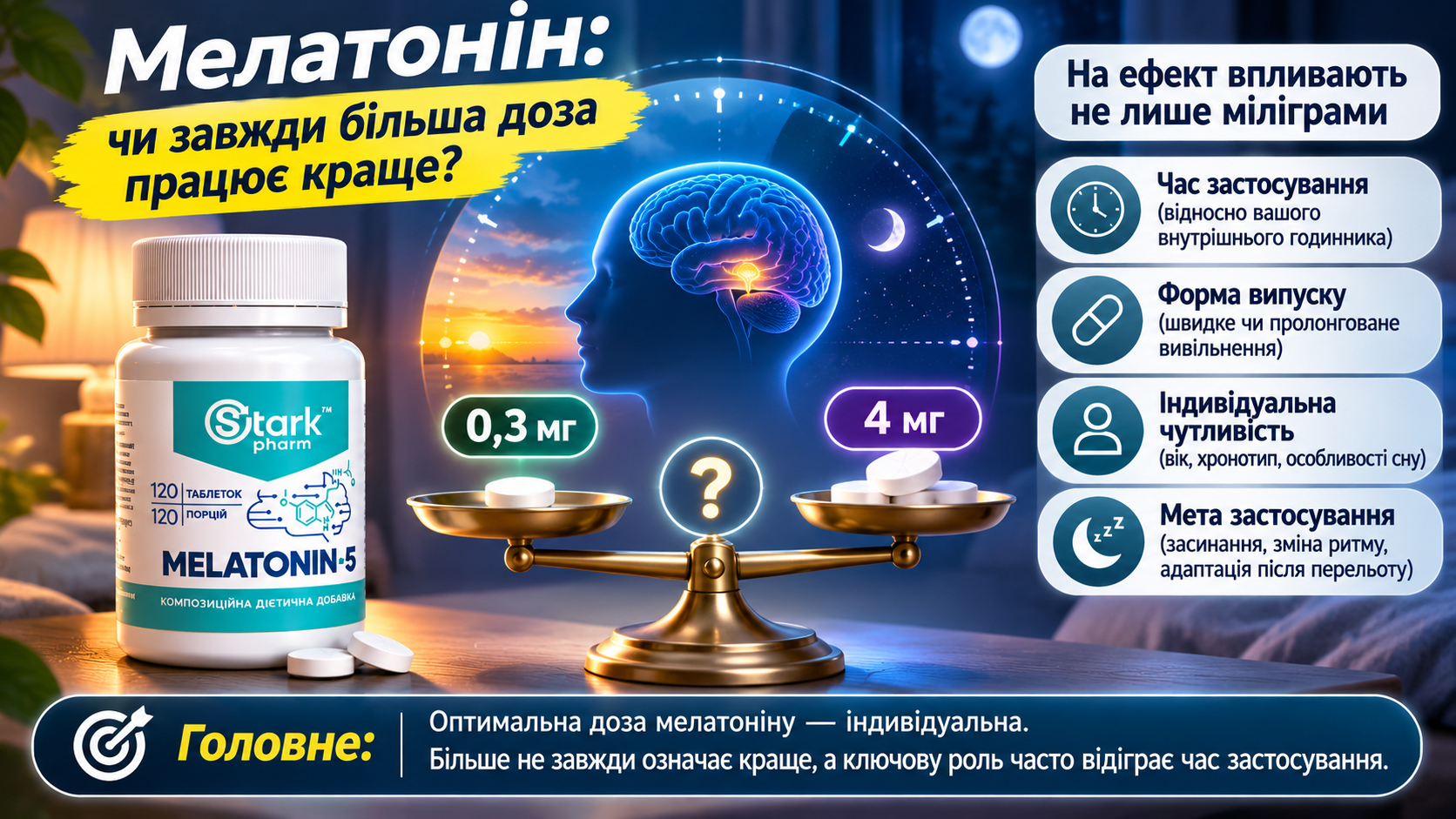
Should I increase my melatonin dosage if I can't fall asleep right away? Not necessarily. Melatonin is involved in setting circadian rhythms, so the result depends not only on the amount in milligrams, but also on the time of use, individual sensitivity and form of release. Studies have studied both fractions of a milligram and larger doses. However, this does not mean that the highest number on the label will be the best choice for every person.
To understand the difference, it is worth separating three questions: how much melatonin enters the bloodstream, how the biological clock is changed, and whether specific sleep indicators are improved. These effects are related, but not identical. It is especially important not to confuse the result of a single study with a ready-made instruction for use.
Why does the body need melatonin and why dose doesn't decide everything?
The body produces its own melatonin mainly during the dark period of the day. Its secretion helps the circadian rhythm system recognize biological night. In this sense, melatonin works primarily as a time signal. It does not replace full sleep, does not eliminate the effects of evening light, and does not compensate for an irregular schedule.
When melatonin is taken externally, its concentration in the blood depends on the dose and absorption characteristics. However, a higher concentration does not guarantee a proportionally stronger effect. For example, changes in the time of falling asleep, sleep duration, and circadian phase shift are different indicators, and their response to melatonin is different.
The point of use in relation to the internal clock is also important. The same amount of melatonin used at different times can affect the phase of the circadian rhythm differently. Therefore, the simple rule "if it doesn't work, add more" ignores one of the main mechanisms of this substance.
What studies of low and high doses have shown
Zhdanova et al. (2001) studied 0.1, 0.3, and 3 mg of melatonin in people over 50 years of age, particularly those with reduced sleep efficiency. Each regimen was studied for one week in a crossover design. The 0.3 mg dose helped restore melatonin concentrations to the physiological nighttime range and improved sleep efficiency in the study group. This is important evidence that a biological effect is possible with small amounts of the substance.
However, these data do not prove that 0.3 mg is sufficient for all people or for any regimen violations. The study involved specific participants and a short period of time. In addition, the result regarding the concentration of the hormone in the blood should not automatically be equated with the same clinical benefit.
A different picture is provided by a meta-analysis by Cruz-Sanabria et al. (2024), which pooled 26 randomized trials. The authors assessed the dependence of sleep parameters on dose and time of administration. In the pooled models, the largest average effect in terms of reducing time to fall asleep was observed at approximately 4 mg, and the overall trend for sleep duration was not linear. This does not support the thesis that lower doses always work better than higher doses, but it also does not mean that increasing the dose without restrictions will provide additional benefit.
Meta-analysis combines studies with different participants, drug forms, and time of administration. The resulting average curve cannot be extrapolated to each individual person. It helps to understand the pattern, but does not select an individual dose.
Dose comparison: what can we really say?
| Range in studies | What was studied? | What the results mean |
|---|---|---|
| 0.1–0.3 mg | Physiological concentrations and sleep efficiency in a selected group of older adults (Zhdanova et al., 2001) | A noticeable effect is possible even with a small amount, but the conclusion is not universal. |
| 0.5 mg | Phase shift of circadian rhythms in laboratory conditions (Burgess et al., 2010) | Timing is important for the circadian effect, not just quantity |
| 1–5 mg | Average dose-response of sleep parameters in randomized trials (Cruz-Sanabria et al., 2024) | Effect may vary with dose; increase does not provide unlimited gain |
| 10 mg or more | Safety of high doses in heterogeneous clinical trials (Menczel Schrire et al., 2022) | Some adverse events were more frequently reported in this dose group; this is not evidence of better sleep. |
The numbers in the table are the history of specific studies, not a pattern of supplement use. For example, comparing 0.5 and 3 mg for circadian phase shift does not answer the same question as comparing doses for reducing time to fall asleep.

Why not only the dose size, but also the time of administration is more important
This shows why you can't analyze milligrams separately from the clock. If the signal comes at the wrong time, increasing the amount won't necessarily fix the situation. Moreover, people with different chronotypes may have different times when their melatonin peaks, even if they go to bed at about the same time.
This mechanism is especially important when changing time zones, but by itself does not create universal advice on the time of reception. In practice, the reason for the change in sleep, the usual regimen, lighting and individual characteristics must be taken into account.
Rapid and sustained release are not the same effect
Melatonin labels come in both rapid-release and extended-release forms. The former is designed to deliver the active ingredient more quickly, while the latter is designed to release it more slowly. These options create different blood concentration profiles, even though the stated amount in milligrams may be the same.
Therefore, two supplements with the same dosage cannot necessarily be compared based on the number on the package alone. The result also depends on the specific form, the quality of the product, the study conditions, and which sleep outcome was assessed. At the same time, pharmacokinetic data do not guarantee the clinical advantage of any one form for all people.
Do not split or crush modified-release tablets yourself: this may change the way the substance is released. If you need to specify the form or method of administration, refer to the manufacturer's information and the recommendation of a specialist.
Is 1.9 mg universally sufficient?
No, science has not established 1.9 mg as the universal optimal dose of melatonin. Studies have used different amounts depending on the purpose, composition of participants, and endpoints. Fractional doses do not in themselves make it better or worse. Similarly, the results obtained do not conclude that everyone needs a higher dose.
The thesis “a small dose can be biologically active” is supported by research. The thesis “any small dose is always enough” is not. This is a fundamental difference that is important to see when reading advertising descriptions and popular reviews.
The specific quantitative thresholds that may apply to dietary supplements should not be confused with the point of maximal efficacy in research. The scientific answer depends on the question asked and does not boil down to a single number.
What can happen if the dose is increased uncontrollably?
Increasing melatonin levels is not a neutral experiment. Possible side effects include drowsiness the next day, headache, dizziness, and nausea. These symptoms do not necessarily mean that a reaction will occur, but they should be considered, especially when driving or performing tasks that require alertness.
A systematic review by Menczel Schrire et al. (2022) examined the use of high doses—10 mg or more—in adults. In the small subset of studies suitable for quantitative comparison, the incidence of some adverse events, including drowsiness, headache, and dizziness, was higher. However, the authors noted that there was incomplete reporting of adverse reactions and a lack of long-term safety data. Such a review does not allow us to conclude that all doses below a certain threshold are completely safe.
You should also consider possible drug interactions. Drugs that cause drowsiness, blood thinners, and certain other medications can alter the risks. The fact that melatonin is a natural hormone does not mean that there are no contraindications.
How to estimate dosage without chasing milligrams
First, it is important to determine what issue a person is trying to resolve. Difficulty falling asleep, a shift in sleep schedule, and fatigue after a flight are not the same situation. Accordingly, studies of these conditions may evaluate different results. Transferring a conclusion from one situation to another often creates inflated expectations.
Next, you need to look not only at the number of milligrams, but also at the form of melatonin, the time of administration, the duration of observation, and the characteristics of the study participants. If the article mentions a positive result, it is worth asking: is this an average change in time to fall asleep, an improvement in subjective well-being, or a measured shift in circadian rhythm?
Do not assume that a higher dose is needed just because the desired effect is not felt the first time. Sleep can be affected by evening light, caffeine, schedule, stress, and co-morbid conditions. If problems persist, an assessment of the cause is needed, not just an experiment with the amount of supplement.
Who needs special care?
Melatonin is not suitable for self-dosing experiments in children and adolescents. It is not recommended for pregnant or breastfeeding women without individual medical evaluation due to insufficient safety data.
Prior consultation with a doctor is especially important for people with epilepsy, asthma, inflammatory or autoimmune diseases, and those who are constantly taking medications. After using melatonin, you should not drive or perform work that requires increased attention if you feel sleepy or have slowed reactions. If you regularly have difficulty sleeping, it is better to find out the reasons for this with a specialist.
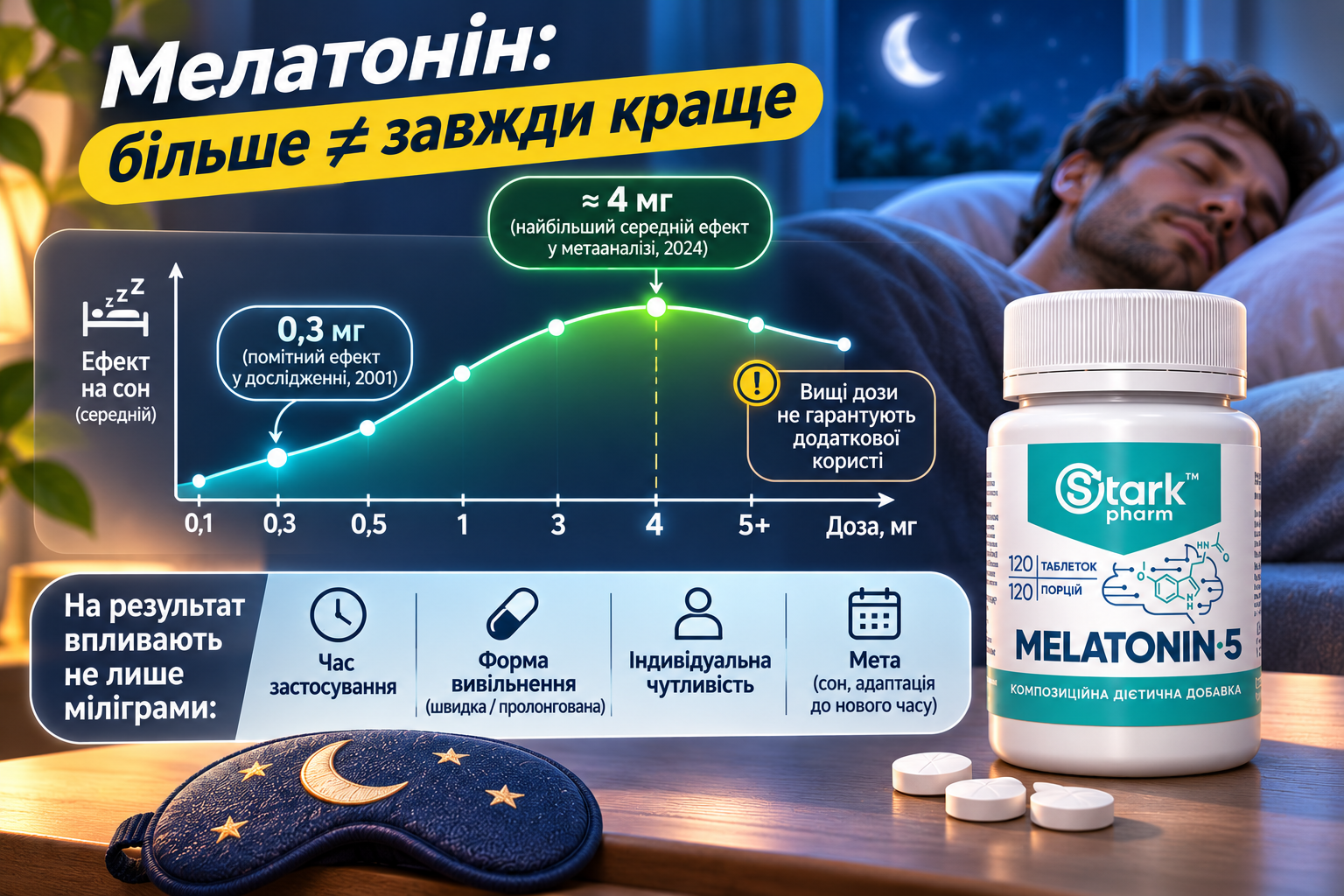
The research data support two conclusions at once: small amounts of melatonin can be biologically active, but the smallest dose does not always produce the most pronounced average effect on all sleep parameters. The strength of the effect depends on the purpose, time of use, form of the substance and the characteristics of the person. Increasing the amount on your own is not a reliable way to get better results and may increase the likelihood of unwanted sensations.
Frequently asked questions
Does a higher dose of melatonin mean faster sleep?
Not necessarily. Average results from studies depend on the dose, but also on the time of administration, the form of the substance, and the characteristics of the participants.
Can melatonin work at a dose of less than 1 mg?
Yes, in specific studies, biological effects were observed at 0.3–0.5 mg. This does not mean that all people will benefit equally.
Why do studies compare 0.3, 3, and 4 mg?
The authors test the dose-response effect or evaluate various indicators. These figures do not automatically constitute a recommendation for self-administration.
Is it proven that 1.9 mg is optimal for everyone?
No. There is no universal scientifically determined optimal dose of 1.9 mg for all people.
What is more important: melatonin dose or timing of use?
Both factors are important. The timing of the signal may be particularly important in influencing circadian rhythms.
What is the difference between rapid-release and extended-release melatonin?
They differ in the rate of delivery of the substance. The same amount in milligrams does not guarantee the same action profile.
Can higher doses cause daytime drowsiness?
Yes, drowsiness is a known adverse reaction. Its occurrence depends on individual factors and circumstances of use.
Should I increase the dose myself if there is no result?
No. You should first find out the reasons for your sleep difficulties and discuss the situation with a medical professional.
Sources
- Zhdanova IV, Wurtman RJ, Regan MM, Taylor JA, Shi JP, Leclair OU (2001). Melatonin treatment for age-related insomnia. The Journal of Clinical Endocrinology & Metabolism, 86(10), 4727–4730. PubMed.
- Cruz-Sanabria F., Bruno S., Crippa A., et al. (2024). Optimizing the Time and Dose of Melatonin as a Sleep-Promoting Drug: A Systematic Review of Randomized Controlled Trials and Dose-Response Meta-Analysis. Journal of Pineal Research, 76(5), e12985. PubMed.
- Burgess HJ, Revell VL, Molina TA, Eastman CI (2010). Human phase response curves to three days of daily melatonin: 0.5 mg versus 3.0 mg. The Journal of Clinical Endocrinology & Metabolism, 95(7), 3325–3331. PubMed.
- Menczel Schrire Z., Phillips CL, Chapman JL, et al. (2022). Safety of higher doses of melatonin in adults: A systematic review and meta-analysis. Journal of Pineal Research, 72(2), e12782. PubMed.
Dietary supplement. Not a medicine. Consult a doctor before use.
Products related to this post
Related Posts
Comments
Information
Customer Service
Extras
My Account


Sports nutrition manufacturer in Ukraine StarkPharm © 2026


