Your shopping cart is empty!

L-theanine in everyday use: time of administration, compatibility and tolerability
Published: 31/10/2026
Times Read: 2
Comments : 0
There is no universally accepted “best time” for L-theanine: in clinical studies, it has been used both once before attention tests and regularly over several weeks. The regimen in these experiments was determined by the research goal, not by the proven advantage of morning or evening. At the same time, practical questions remain important: how quickly the substance appears in the blood, whether food is needed, whether theanine can be combined with caffeine, how to assess tolerance, and what precautions should not be ignored.
L-theanine is a non-protein amino acid naturally found in tea. It should not be confused with sleeping pills or stimulants. The results of the studies relate to specific groups of people, doses, test conditions, and indicators. Below, we will focus on the practical interpretation of this data, without turning scientific protocols into a ready-made intake regimen.
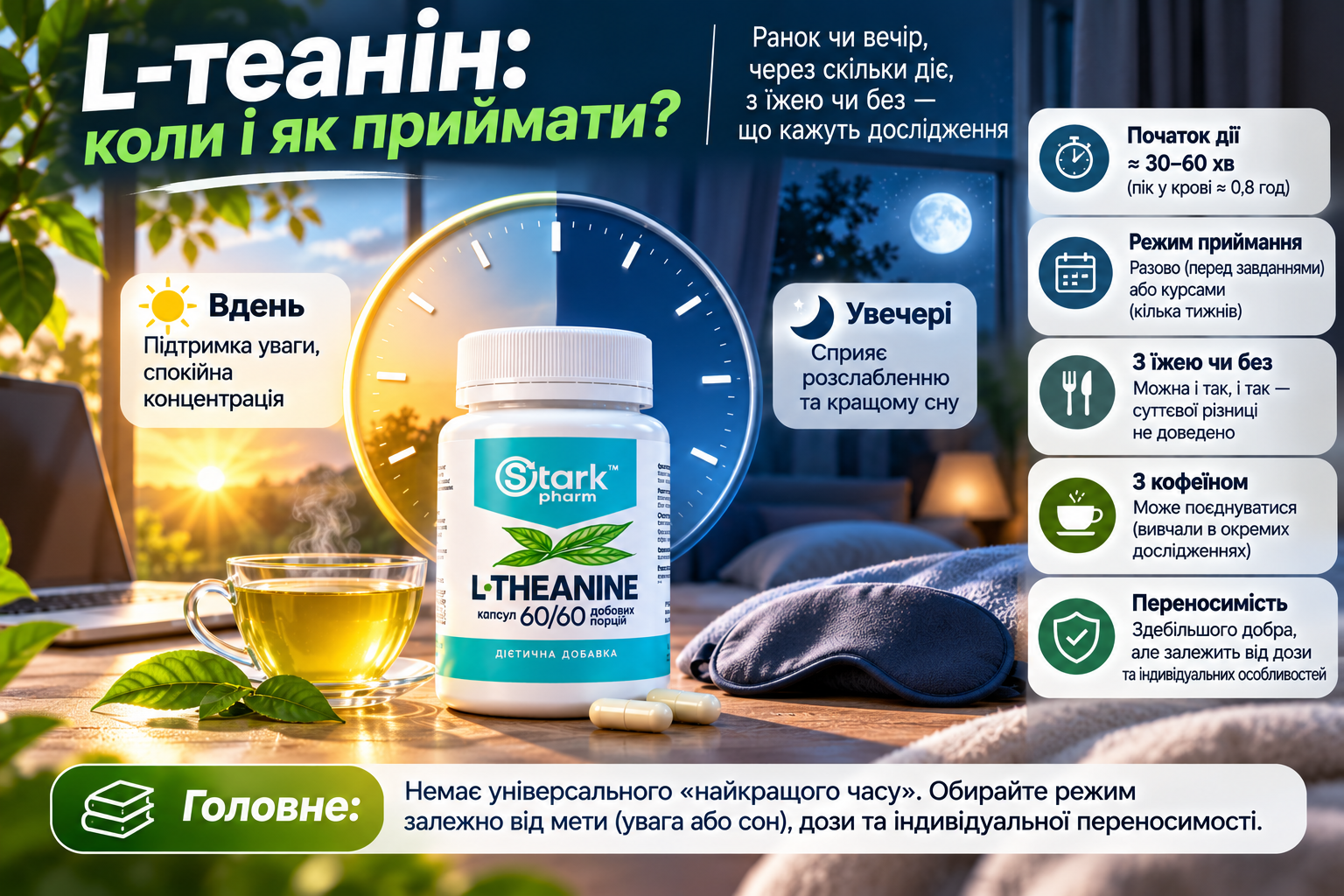
Morning or evening: why there is no universal answer
The timing of theanine intake is often chosen based on the intended purpose: daytime focus or nighttime rest. But to answer “which is better” requires a special trial in which the same doses are compared in the morning and evening, evaluating the same results. The vast majority of existing studies do not have this structure. They compare the substance with a placebo according to a schedule determined by the researchers.
For example, in a meta-analysis by Gerolymos et al. (2026), which included 31 randomized trials and 1168 participants, the acute effects on task performance and psychological measures were analyzed. In a subset of experiments with a single dose of 200 mg 30–60 minutes before cognitive tests, changes in choice reaction time were recorded. This is the result of a specific experimental window, and not evidence that 30–60 minutes before any task is an optimal rule for everyone.
Another model was used by Hidese et al. (2019): 30 adults participated in a double-blind crossover trial where 200 mg of L-theanine per day was used for four weeks. The researchers assessed stress scales, sleep characteristics, and selected cognitive tests. Such data describe the effects of repeated intake of the substance, but do not answer the question of whether evening intake is better than morning intake.
So, the time of day should be separated from the duration of the experiment and from the time over which the scientists performed the measurements. Mixing these three concepts creates false advice.
How long does it take for L-theanine to appear in the blood?
The most specific data on the rate of uptake come not from mood studies but from pharmacokinetics. Scheid et al. (2012) compared the absorption of 100 mg of L-theanine from a capsule and tea in 12 volunteers. Peak plasma concentrations were observed after approximately 0.8 hours in both formulations. Additional studies with 50 and 200 mg in three participants showed a dose-dependent increase in total plasma exposure.
These numbers are useful for understanding learning, but they don't mean that the greatest sense of calm, the best focus, or improved sleep necessarily occur at the time of peak blood levels. Concentration of a molecule is one measure, functional changes are another. They are also influenced by the measurement method, the characteristics of the participants, and the specific task.
Scheid et al. also found metabolites, including ethylamine and glutamic acid. This means that after absorption, the substance is involved in metabolic processes. However, this study does not allow us to determine the individual “time of action” of the supplement or the duration of the subjective effect in each individual.
With food or on an empty stomach: what can be said for sure?
Tea, capsule, food, and drink are all different ways to deliver L-theanine. Scheid et al.'s pharmacokinetic comparison showed similar theanine dynamics after capsule and green tea under the conditions studied. However, it was not a complete comparison of intake on an empty stomach and after a standard breakfast of varying fat or calorie content.
Therefore, it is incorrect to conclude that food necessarily blocks the absorption of L-theanine, just as it is incorrect to promise a higher result from taking it on an empty stomach. In people with sensitive digestion, tolerance on an empty stomach and after eating may vary individually, but this practical observation should not be taken as the result of a large controlled trial.
The method of use of a particular dietary supplement should be determined by its current label. If a person is taking medications or has a medical condition, coordinating supplements with a doctor is more important than trying to find the “fastest” combination with food on their own.

What studies report on tolerability
Moulin et al (2024) conducted a double-blind, placebo-controlled study in 30 adults with moderate stress. They studied 400 mg/day for 28 days, also assessing safety and tolerability. Evans et al (2021) studied a single dose of 200 mg in the context of a short-term stress task. Both protocols provide information on their samples and time frames, but not on long-term use.
In a meta-analysis by Gerolymos et al. (2026), no serious adverse events were reported among 31 randomized trials. However, this does not exclude rare reactions that may be missed in small studies. A separate systematic review by Cotter et al. (2026) included 13 trials with a total of 550 participants and noted generally good tolerability within the protocols studied.
Drowsiness, headache, or digestive discomfort may be reasons to reconsider using the supplement, especially if symptoms develop after starting it. Do not automatically attribute any symptom to theanine: a causal relationship requires consideration of concomitant factors and a medical evaluation. If a significant deterioration in well-being occurs, you should stop self-experimentation and consult a specialist.
Combination with caffeine: a researched combination, not a universal recipe
The combination of L-theanine and caffeine has been studied in the context of attention and alertness. Giesbrecht et al. (2010) tested 97 mg of L-theanine with 40 mg of caffeine in 44 young adults, assessing cognitive tests and subjective alertness. Positive results were observed compared to placebo in specific tasks. However, this does not prove that any coffee with any amount of theanine produces the same result.
Yoto et al. (2012) studied L-theanine and caffeine separately, not a ready-made combination, against the background of physical and psychological stress. Among 14 participants, differences in individual blood pressure responses were recorded in the subgroup with a pronounced stress response. This does not mean that theanine neutralizes caffeine, eliminates its effects on sleep, or allows you to safely increase the amount of coffee.
The caffeine content in tea, coffee and energy drinks varies significantly, and individual reactions depend on habits, sensitivity and time of day. Therefore, deriving the household formula “theanine compensates for caffeine” from individual laboratory tests would be an exaggeration. The detailed results of the combination are discussed in a separate cluster article, and here the important principle is: data on the joint effect are limited by specific ratios and experimental conditions.
Glycine, GABA and other components: why compatibility does not mean proven synergy
In complex dietary supplements, L-theanine is sometimes combined with glycine, GABA, magnesium, or herbal extracts. However, the presence of two ingredients in one capsule does not in itself confirm that they enhance the effect of each other. To make such a conclusion, a comparison of at least four conditions is required: placebo, component A alone, component B alone, and their combination.
If a study tested L-theanine alone, these results are primarily for the isolated substance. They should not be extrapolated to a glycine formula without separate testing. The same applies to combinations with GABA or other compounds, even if each has its own scientific literature.
A separate issue is drug interactions. For many combinations of data from qualitative studies, there is not enough to declare them safe or unsafe in all cases. Special caution is required in situations where a person is already using drugs that affect drowsiness, attention, or blood pressure. Pregnancy, breastfeeding, childhood, and chronic diseases also cannot be equated with samples from healthy adult volunteers.
How do experimental protocols differ?
The following are not recommendations for intake, but examples of the questions researchers asked. It is the varying endpoints that explain why it is impossible to get a single answer from the body of work on “when is the best time to take L-theanine?”
| Research | How was it used in work? | What was measured? | Conclusion limit |
|---|---|---|---|
| Scheid et al., 2012 | 100 mg once, capsule or tea | Blood levels and metabolites | Does not determine the time of the greatest noticeable effect |
| Evans et al., 2021 | 200 mg once under stressful task conditions | EEG, cortisol, subjective and physiological indicators | Not a daily routine check |
| Hidese et al., 2019 | 200 mg/day for 4 weeks | Stress scales, sleep, cognitive tests | Does not compare morning with evening |
| Moulin et al., 2024 | 400 mg/day for 28 days | Stress, sleep, tolerance | Does not establish long-term safety |
Meta-analyses help to assess the overall picture, but they cannot correct for the lack of direct comparisons of dosing times in the original studies. So the pharmacokinetic “how long does it take to get absorbed,” the clinical “what has changed in four weeks,” and the practical “when is it most convenient for me” remain separate questions.
For an adult user, it is more important to not find an imaginary ideal time, but to check the composition of the specific supplement, the instructions on the label, possible accompanying ingredients, and your own circumstances. If a formula contains multiple active ingredients, judging it by the label “L-theanine” alone is not enough.
- Follow the instructions for use and warnings on the current packaging; do not transfer experimental doses to the household regimen.
- Consider other sources of caffeine if tea, coffee, or combination products are used.
- Be cautious about changes in your usual well-being, drowsiness, or reaction speed before driving.
- Consult your doctor when using medications simultaneously, during pregnancy, lactation, and in the presence of chronic diseases.
The scientific basis allows for discussion of short-term and multi-week protocols, but does not provide grounds for promising the same response for all people. The practical decision should be based on instructions, composition, and individual limitations, rather than a random comparison of doses in different publications.
Frequently asked questions
When is it better to take L-theanine - in the morning or in the evening?
Qualitative direct comparisons of the same dose in the morning and evening are insufficient to establish a universal preference for one time. The method of administration of a particular supplement is determined by the label.
How long does it take for L-theanine to be absorbed?
In a small pharmacokinetic study, peak blood concentrations were observed approximately 0.8 hours after 100 mg. This is not the same as the time of maximum effect on sensation or attention.
Should I take theanine on an empty stomach?
There is no conclusive evidence that taking on an empty stomach is necessarily preferable. Please follow the instructions and individual tolerance.
Does L-theanine cause drowsiness?
It has not been characterized as a pronounced sedative in many studies, but individual reactions may vary. If drowsiness occurs, this should be considered before driving.
Can I combine L-theanine with coffee?
This combination has been studied in separate clinical trials, but their results do not prove that any amounts of caffeine are safe or that they have the same effect for everyone.
Is it proven that L-theanine and glycine enhance each other?
Direct comparative trials of a specific combination are needed to conclude about synergy. The results of studies on isolated theanine cannot be automatically extrapolated to the mixture.
What side effects are possible?
In controlled studies, L-theanine was generally well tolerated, but small sample sizes do not rule out individual reactions. If you experience severe or unusual symptoms, you should seek medical attention.
Can L-theanine be used with medication?
Compatibility depends on the specific drug and health condition. If you use medications simultaneously, you should consult a doctor.
Sources
- Scheid L., Ellinger S., Alteheld B. and others. (2012). Kinetics of L-theanine uptake and metabolism in healthy participants are comparable after ingestion of L-theanine via capsules and green tea. The Journal of Nutrition, 142(12), 2091–2096. PubMed.
- Gerolymos C., Saddier E., Boyer L., Fond G. (2026). Cognitive and affective effects of L-Theanine: a systematic review and meta-analysis of 31 randomized trials. Molecular Psychiatry. PubMed.
- Hidese S., Ogawa S., Ota M. and others. (2019). Effects of L-Theanine Administration on Stress-Related Symptoms and Cognitive Functions in Healthy Adults: A Randomized Controlled Trial. Nutrients, 11(10), 2362. PubMed.
- Evans M., McDonald AC, Xiong L., Crowley DC, Guthrie N. (2021). A Randomized, Triple-Blind, Placebo-Controlled, Crossover Study to Investigate the Efficacy of a Single Dose of AlphaWave L-Theanine on Stress in a Healthy Adult Population. Neurology and Therapy, 10, 1061–1078. PubMed.
- Moulin M, Crowley DC, Xiong L, Guthrie N, Lewis ED (2024). Safety and Efficacy of AlphaWave L-Theanine Supplementation for 28 Days in Healthy Adults with Moderate Stress: A Randomized, Double-Blind, Placebo-Controlled Trial. Neurology and Therapy, 13(4), 1135–1153. PubMed.
- Cotter J, Caddick CE, Harper JL, Ebajemito JK (2026). Examining the effect of L-theanine on sleep: a systematic review of dietary supplementation trials. Nutritional Neuroscience, 29(2), 224–238. PubMed.
- Giesbrecht T, Rycroft JA, Rowson MJ, De Bruin EA (2010). The combination of L-theanine and caffeine improves cognitive performance and increases subjective alertness. Nutritional Neuroscience, 13(6), 283–290. PubMed.
- Yoto A., Motoki M., Murao S., Yokogoshi H. (2012). Effects of L-theanine or caffeine intake on changes in blood pressure under physical and psychological stresses. Journal of Physiological Anthropology, 31, 28. PubMed.
Dietary supplement. Not a medicine. Consult a doctor before use.
Products related to this post
Related Posts
Comments
Information
Customer Service
Extras
My Account


Sports nutrition manufacturer in Ukraine StarkPharm © 2026


