Your shopping cart is empty!

Magnesium stearate and microcrystalline cellulose: are these additives harmful?
Published: 26/11/2026
Times Read: 5
Comments : 0
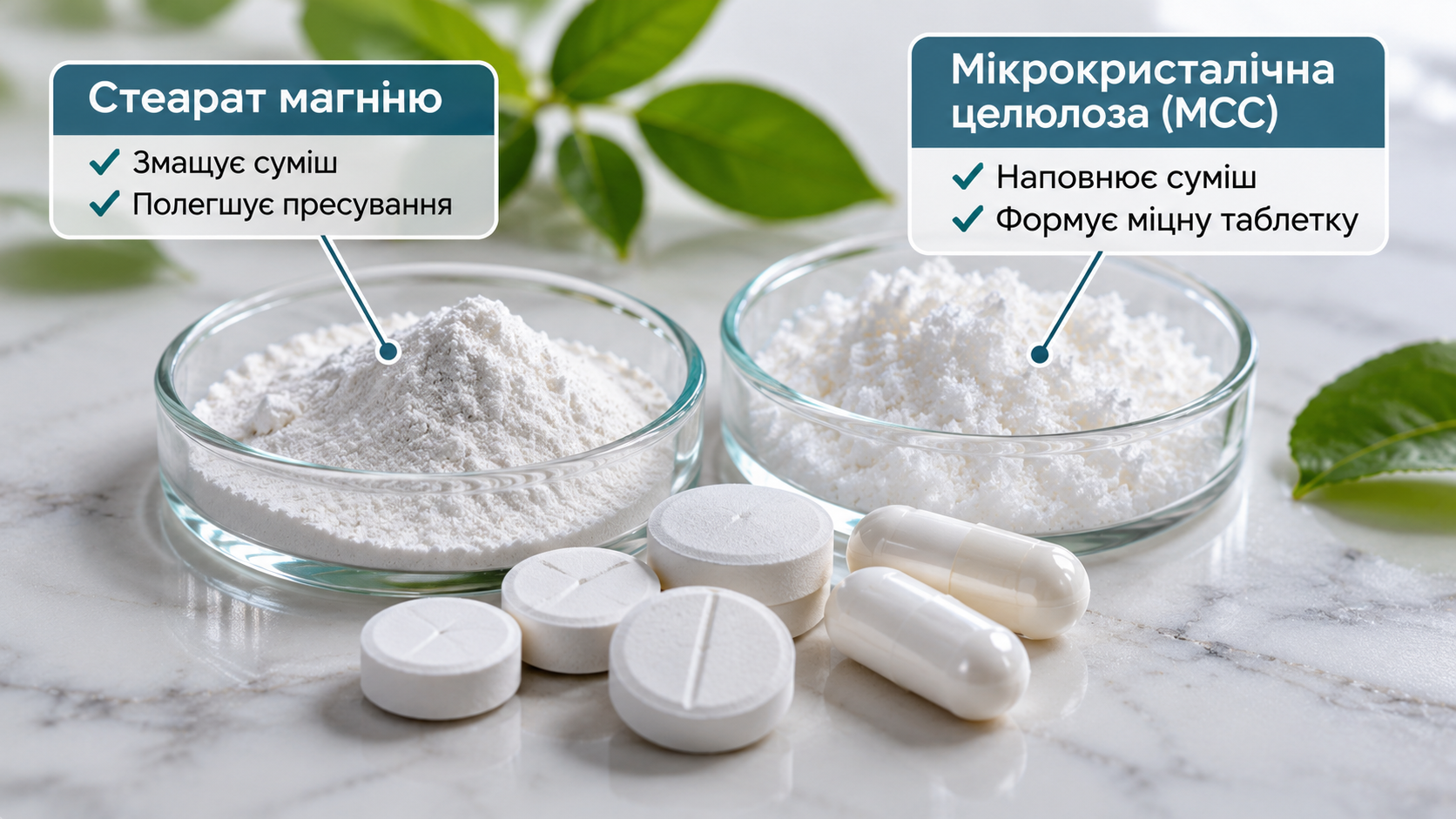
Magnesium stearate and microcrystalline cellulose often appear near the end of the ingredient lists for tablets and capsules. They are not primary nutrients but processing aids: the first helps prevent powder from sticking to manufacturing equipment, while the second adds the necessary bulk to a mixture and helps form a durable tablet. Their presence on a label alone proves neither harm to health nor poor supplement quality.
There are two separate questions here. First, what is known about the safety of these substances under normal conditions of use? Second, can they alter the properties of a finished tablet? EFSA scientific assessments and pharmaceutical technology studies address both, but they should not be confused: a change in tablet disintegration time does not in itself mean that a filler is unsafe.

Magnesium stearate and cellulose: a brief comparison
| Feature | Magnesium stearate | Microcrystalline cellulose |
|---|---|---|
| English name | Magnesium Stearate | Microcrystalline Cellulose, MCC |
| What it is | A magnesium salt of stearic acid; technical-grade material may contain salts of other fatty acids | Purified, partially depolymerized cellulose of plant origin |
| Primary role | Lubricating the blend and facilitating ejection of tablets from the die | Bulking, binding and providing mechanical tablet strength |
| Food additive classification | E470b — a broader category of magnesium salts of fatty acids | E460(i) — microcrystalline cellulose |
| Whether it supplies a main nutrient | Not used as a meaningful source of magnesium | Not used as a source of vitamins or minerals |
| What it affects in the formulation | Friction, compression and, under certain conditions, disintegration and dissolution | Volume, compactability, strength and tablet disintegration |
E470b refers to a group of fatty acid salts, not to any particular capsule formulation. Likewise, E460(i) and the general term “cellulose” are not completely interchangeable: the exact name of the excipient matters.
Why do tablets need fillers at all?
When a serving contains very little active ingredient, it is difficult to divide a blend evenly into hundreds of thousands of identical tablets. Excipients provide the required bulk, flowability, compressibility and mechanical stability. This matters for content uniformity: tablets should not crumble on the production line, and ingredients must be distributed correctly.
Different ingredients play different manufacturing roles: fillers increase blend mass; binders help form tablets; lubricants reduce friction during compression; and disintegrants promote tablet breakup upon contact with liquid. One ingredient may perform several functions. It is therefore misleading to judge supplement quality solely by the number of unfamiliar names on the label.
What is magnesium stearate? Composition and manufacturing role
Magnesium stearate is a magnesium salt of stearic acid, a common saturated fatty acid. In dry-tablet manufacturing, it serves as a lubricant: powder particles move more readily against equipment surfaces, and the compressed tablet can be ejected from the die more easily.
Its surface properties explain both its technological advantage and a potential disadvantage. The material is relatively hydrophobic: if used excessively, mixed improperly or combined with certain formulations, it may coat other particles with a thin layer. Liquid may then penetrate the tablet more slowly, altering disintegration performance. This is a formulation issue, not a reason to assume that every tablet containing magnesium stearate performs poorly.
Is magnesium stearate harmful?
The European Food Safety Authority (EFSA) reassessed magnesium salts of fatty acids (E470b) in 2018, together with the corresponding sodium, potassium and calcium salts. The scientific assessment considered a specific class of substances, stated uses and exposure data. It does not support the sweeping claim that the mere presence of E470b in food means that the product is toxic.
However, an assessment of a food additive class is not a certificate for every individual bottle. Raw material quality, purity, excipient quantity, manufacturing controls and the overall formulation remain important for finished products. Without these details, a particular batch cannot be evaluated from one line of an ingredient label.
Magnesium stearate is sometimes accused of suppressing the immune system or causing “toxins” to accumulate. Existing manufacturing studies of tablet disintegration do not demonstrate such effects in the human body. These are different questions that require different kinds of research.
Can magnesium stearate slow tablet dissolution?
Yes, under certain manufacturing conditions, this is possible. A study indexed as PMID 27444551 (2016) investigated delayed tablet dissolution in acidic media due to magnesium stearate. Another study (PMID 33010396, 2020) showed that how magnesium stearate is blended with microcrystalline cellulose can substantially alter the properties of a tableting mixture.
Three measures need to be distinguished. Disintegration is the breakup of a tablet into smaller pieces. Dissolution is the transfer of a substance into solution. Bioavailability refers to the extent and rate at which a substance enters systemic circulation. Faster tablet breakup does not always mean greater absorption, and slower dissolution in a laboratory does not by itself establish a clinically meaningful effect.
| Factor affecting the result | Why it matters | What cannot be concluded |
|---|---|---|
| Amount of stearate | Changes how extensively powder particles are coated | That any amount is harmful |
| Mixing time and intensity | Affect lubricant distribution | That one ingredient-list entry describes the process |
| Properties of other ingredients | Powders differ in compressibility and wettability | That all formulations behave identically |
| Tablet type | Release mechanisms vary | That laboratory results apply without verification |
Tableting studies examine finished dosage-form quality under defined conditions. Their findings help formulators, but they do not establish a universal ranking of dietary supplements based on the presence or absence of a single ingredient.
Microcrystalline cellulose: what it is and where it comes from
Cellulose is a structural polysaccharide found in plant cell walls. To produce microcrystalline cellulose, raw materials are purified and processed to isolate a fraction with the required manufacturing properties. The resulting powder is well suited to direct compression, allowing tablets to be formed with the desired volume and mechanical strength.
The term “microcrystalline” describes the material's structure; it does not mean that the substance contains glass or dangerous crystalline particles. Nor should it be equated with every other cellulose-based excipient: modified derivatives may have different properties and functions.
Humans do not have digestive enzymes that break down cellulose in the same way as starch. However, this does not mean that microcrystalline cellulose always behaves like ordinary dietary fiber from vegetables or grains: serving sizes, physical properties and patterns of consumption differ.
Is microcrystalline cellulose safe?
In its 2018 opinion on E460(i) and several other cellulose ingredients, EFSA found no safety concerns at the examined levels and uses. The agency also did not consider it necessary to set a numerical acceptable daily intake (ADI) for this group. This is a scientific assessment of specified uses, not a claim covering all imaginable amounts or manufacturing impurities.
That conclusion does not mean that all excipients are identical or that raw material quality is irrelevant. Clear labeling, proper manufacturing and individual tolerance of the finished product matter to consumers. If unusual symptoms repeatedly occur after taking a particular supplement, it makes sense to review the complete formulation and consult a healthcare professional rather than automatically blaming cellulose.
E460(i) and E470b: what E numbers actually mean
An E number identifies a food additive within a particular classification system. By itself, it does not establish whether a substance is “chemical,” “natural,” beneficial or harmful. The absence of an E number on a label does not mean that processing aids are absent either: manufacturers may list ingredient names in words in accordance with labeling rules.
For magnesium stearate, E470b covers the broader group of magnesium salts of fatty acids. Microcrystalline cellulose is designated E460(i). These categories help identify ingredients but do not reveal their exact amounts in a given capsule.
Is a supplement without fillers better?
“Filler-free” can be a useful description of a particular formulation, but it is not evidence of improved absorption or overall superiority. Powder products have different manufacturing requirements from small tablets containing low amounts of active ingredients. In some formulations, omitting fillers is convenient; in others, excipients support dose consistency and product stability.
It is more sensible to compare active ingredients, amounts per serving, manufacturing reputation, labeling clarity and evidence about the specific formulation. Choosing between capsules, tablets and powders also depends on convenience, not merely the length of the excipient list.
| Label claim | What it actually tells you | What it does not prove |
|---|---|---|
| “No magnesium stearate” | The substance is not listed as an ingredient | That the supplement is absorbed better |
| “Cellulose-free” | No cellulose filler is declared | That another formulation is safer |
| “Minimal ingredients” | The ingredient list is shorter | That the active ingredient concentration is optimal |
| “Plant-based capsule” | Information about the capsule shell | That the contents contain no excipients |
How to assess the ingredients of a specific supplement
First, identify the active substance and its amount per serving, rather than relying only on the product name. Then check the serving size: the composition of two capsules is not the same as that of one. Next, review the other ingredients, distinguishing processing aids from substances with nutritional or functional roles.
If magnesium stearate or microcrystalline cellulose is listed without an amount, do not invent a milligram figure. Formulations vary in their excipient content. When comparing products, independent data on purity and compliance with the declared composition, if available, may matter more than the mere presence of these names.
Known allergens, individual ingredient reactions, medication use and health conditions deserve particular attention. Do not replace prescribed medications simply because their excipients include magnesium stearate or cellulose: treatment changes should be discussed with a healthcare professional.

Four common myths about magnesium stearate and cellulose
Myth 1: any ingredient with an E number is dangerous. An E number is an identifier; scientific safety assessments depend on the specific substance and conditions of use.
Myth 2: magnesium stearate blocks the absorption of all vitamins. Laboratory studies show possible effects on certain tablet properties, but do not prove a universal block of nutrient absorption in humans.
Myth 3: microcrystalline cellulose is a foreign plastic. It is a purified cellulose-based material, not plastic; its properties depend on how it is produced and processed.
Myth 4: a shorter ingredient list always means a better supplement. Ingredient count alone does not establish dose consistency, manufacturing quality, stability or effectiveness of the active substance.
Key takeaway for buyers: evaluate the formula, not a single word
Scientific safety assessments are available for magnesium stearate and microcrystalline cellulose under the examined conditions of use. Some manufacturing studies show that magnesium stearate can alter the compression and dissolution of specific tablets. This supports the need for manufacturers to control formulations, but does not demonstrate that every supplement containing it is harmful.
The most useful approach is to read active ingredients, serving sizes, excipients and available quality information carefully. Neither fear every filler nor assume that its presence automatically guarantees the safety of the complete formulation.
Frequently asked questions
What is magnesium stearate in a supplement?
It is an excipient used to reduce friction when producing tablets and capsules. It is not intended to provide dietary magnesium.
Is magnesium stearate harmful in tablets?
Available scientific assessments do not justify considering it unsafe merely because it is present. Conditions of use, raw material quality and the entire formulation matter.
Does magnesium stearate reduce vitamin absorption?
Some laboratory studies found changes in tablet disintegration or dissolution. This does not establish the same effect on absorption for all supplements in humans.
Why is microcrystalline cellulose used?
It helps give tablets bulk, strength and the required properties during compression.
Is microcrystalline cellulose plastic?
No. It is made from purified plant cellulose, not synthetic plastic.
What does E470b mean on a label?
It identifies a group of magnesium salts of fatty acids in food additive classification. The designation alone does not establish finished-product safety.
What is E460(i)?
It is the food additive classification for microcrystalline cellulose.
Are supplements without fillers better?
Not always. Active ingredients, amounts per serving, quality and suitability for your needs matter more.
Can the amount of magnesium stearate be determined from the ingredient list?
Not always: the list does not necessarily provide its mass. Without manufacturer data, the precise amount should not be inferred.
When should I discuss a supplement's ingredients with a doctor?
Individual assessment is important if you experience unusual reactions, have chronic conditions, are pregnant or take medications concurrently.
Sources
- EFSA ANS Panel et al. (2018). Re-evaluation of sodium, potassium and calcium salts of fatty acids (E 470a) and magnesium salts of fatty acids (E 470b) as food additives. EFSA Journal. PubMed.
- EFSA ANS Panel et al. (2018). Re-evaluation of celluloses E 460(i), E 460(ii), E 461, E 462, E 463, E 464, E 465, E 466, E 468 and E 469 as food additives. EFSA Journal. PubMed.
- Profound tabletability deterioration of microcrystalline cellulose by magnesium stearate (2020). International Journal of Pharmaceutics. PubMed.
- Delay effect of magnesium stearate on tablet dissolution in acidic medium (2016). International Journal of Pharmaceutics. PubMed.
- Challenges in Detecting Magnesium Stearate Distribution in Tablets (2013). AAPS PharmSciTech. PMC.
- The impact of solid-state form, water content and surface area of magnesium stearate on lubrication efficiency, tabletability, and dissolution (2020). International Journal of Pharmaceutics. PubMed.
- Effect of particle size on the dispersion behavior of magnesium stearate blended with microcrystalline cellulose (2024). International Journal of Pharmaceutics. PubMed.
Dietary supplement. Not a medicinal product. Consult your doctor before use.
Products related to this post
Related Posts
Comments
Information
Customer Service
Extras
My Account


Sports nutrition manufacturer in Ukraine StarkPharm © 2026


