Your shopping cart is empty!

NAC and Vitamin C: Why Combine and What Studies Show
Published: 06/11/2026
Times Read: 79
Comments : 0
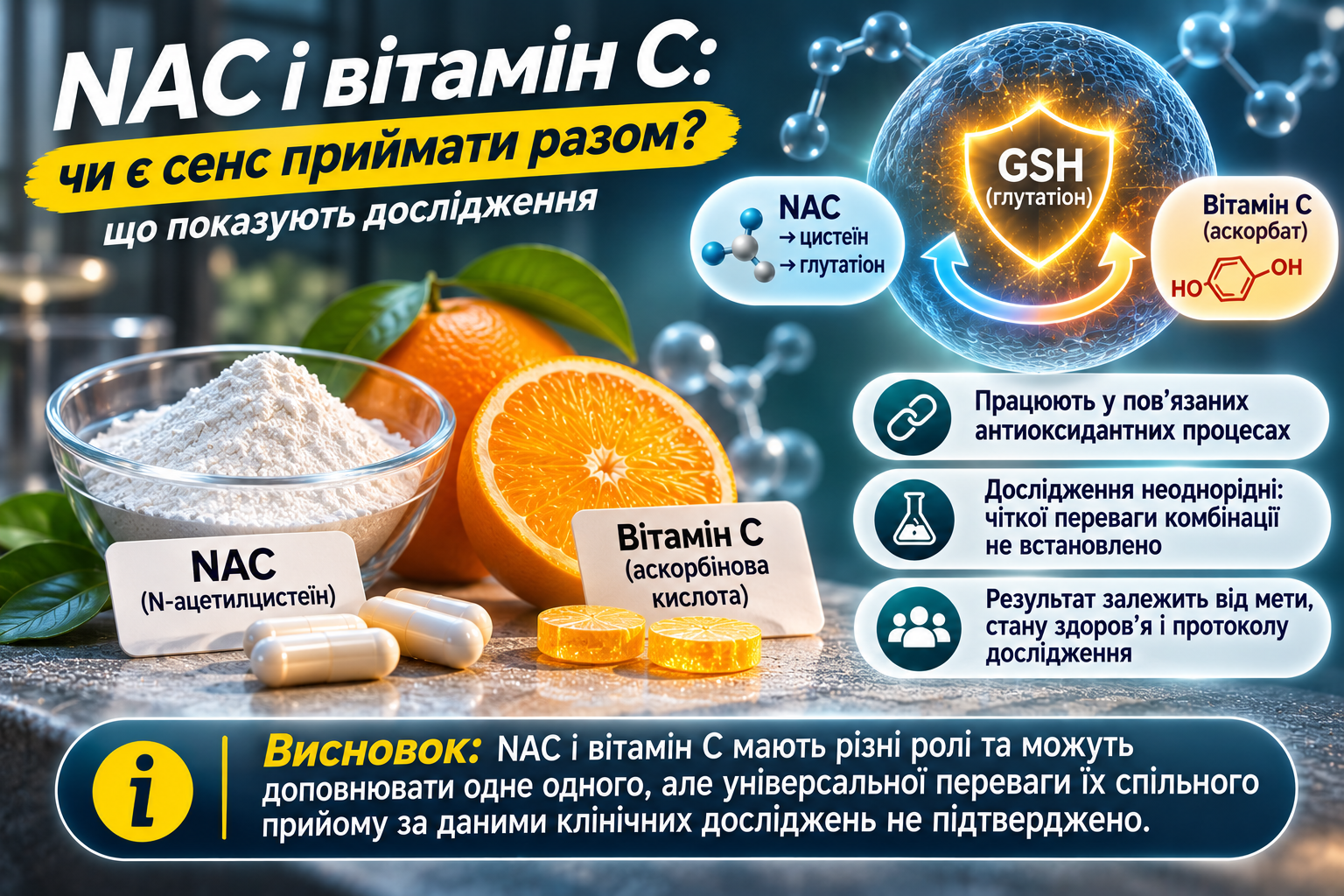
N-acetylcysteine (NAC) and vitamin C are often combined because of their connection to antioxidant defense. However, they are not two versions of the same substance: NAC supplies the body with cysteine — a component needed for glutathione synthesis — while vitamin C acts as a water-soluble antioxidant and participates in its own reduction reactions. This makes the idea of taking them together seem logical. The real question is whether human studies support this idea.
The evidence is mixed. Some studies have found no benefit from combined use for selected outcomes, others have reported changes in individual biomarkers, and one experiment even found worsening markers of oxidative stress after exercise. Therefore, a biochemical connection between the substances cannot be turned into a promise of better results from their combination.
Why NAC and vitamin C are combined in the first place
The term “antioxidant defense” does not refer to a single universal substance, but to a network of molecules and enzymes that maintain a cell’s redox balance. Reactive oxygen species are also generated during normal bodily functions: energy metabolism, physical activity, and immune reactions. What matters is not eliminating these compounds entirely but enabling the system to regulate their amounts and signaling at the right time.
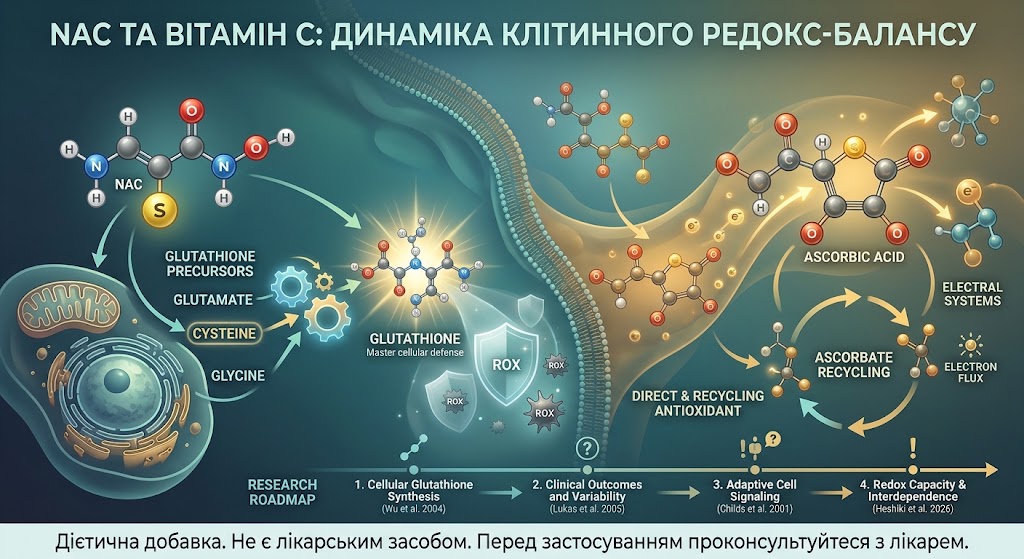
Within this network, glutathione and ascorbate (a form of vitamin C) perform different, partly interconnected functions. Glutathione can participate in enzyme-mediated reactions involving peroxides and other molecules. Ascorbate can donate electrons and become oxidized. Its subsequent reduction depends on the conditions and the relevant cellular systems. The proximity of these processes gave rise to the popular idea of taking NAC together with vitamin C — but “working in the same network” does not mean “necessarily working better together.”
NAC and glutathione: the link through cysteine
NAC is an acetylated form of the amino acid cysteine. Once in the body, it can serve as a source of cysteine. To synthesize glutathione, cells need three amino acid components: glutamate, cysteine, and glycine. Under certain conditions, cysteine availability is one of the factors that limit the rate of this process. Wu and colleagues (2004) describe this role in their review of glutathione metabolism.
At the same time, increasing the availability of a precursor does not guarantee the same increase in glutathione across all tissues. The outcome depends on the cells’ initial state, enzyme activity, the supply of other nutrients, and the body’s ability to maintain the balance between reduced and oxidized glutathione. Therefore, the statement “NAC increases glutathione” needs qualification: it describes a biochemical pathway, not a guaranteed increase in the marker in every person taking the supplement.
More recent reviews also discuss NAC in relation to other cellular mechanisms, but the existence of these mechanisms does not make the supplement a universal solution for every purpose. Assessing a practical outcome requires a study of a specific population, a particular form of administration, and a defined endpoint.
What vitamin C does in this system
Vitamin C, or ascorbic acid, is a water-soluble nutrient. Beyond its role in antioxidant reactions, it is needed for certain enzymatic processes, including collagen synthesis. The human body does not synthesize sufficient vitamin C on its own, so it must be obtained from food. This fundamentally distinguishes it from NAC: ascorbate is a vitamin with an established dietary requirement, whereas NAC is a cysteine derivative studied in other contexts.
When ascorbate participates in reduction reactions, some of its molecules become oxidized. Returning them to a reduced state is not a single simple process but a series of reactions involving cellular enzymes and reducing molecules. Glutathione may participate in some of these reactions. A review by Heshiki and colleagues (2026) explains that ascorbate’s interaction with sulfur-containing systems is complex and that the contribution of individual mechanisms in living organisms is still being investigated.
This is an important distinction: even shared chemical reactions do not prove that taking two supplements simultaneously improves well-being, endurance, or a particular laboratory marker. Such conclusions require comparative trials.
NAC and vitamin C: the main differences at a glance
| Parameter | NAC | Vitamin C |
|---|---|---|
| What it is | A derivative of the amino acid cysteine | A water-soluble vitamin |
| Connection to glutathione | Can provide cysteine for its synthesis | Participates in related redox processes |
| Key characteristic | Its role as a precursor and sulfur-containing compound | Direct participation in enzymatic and reduction reactions |
| Has an advantage from combining them been proven? | Clinical trials have not established a universal advantage | |
| What matters when evaluating it | Conditions, formulation, and participants’ baseline status | Vitamin status, conditions, and endpoints |
This comparison illustrates why the substances should not be described as interchangeable. NAC is not a “stronger version of vitamin C,” and vitamin C does not replace glutathione. Their pathways may intersect, but each has its own biological role.
What studies of their combined use have shown
The trial by Lukas and colleagues (2005). A randomized, double-blind study enrolled 100 people with chronic bronchitis. Over three months, researchers compared NAC at 600 mg twice daily, vitamin C at 500 mg twice daily, a combination of both at the same experimental amounts, and placebo. They measured the production of reactive oxygen species by blood cells, intracellular glutathione, and other markers. No significant improvement in the selected laboratory and clinical outcomes was established in the groups receiving these substances. This is a direct example of how a convincing biochemical hypothesis may fail to be confirmed in a particular trial.
The study by Pirabbasi and colleagues (2016). In a six-month trial involving 79 men with chronic obstructive pulmonary disease, researchers compared NAC, vitamin C, their combination, and a control. According to the authors, the intervention groups showed changes in certain measures, including plasma glutathione. However, this does not mean that combining the two substances was better than using either alone, nor can the result be generalized to healthy people without further evidence.
The experiment by Childs and colleagues (2001). The researchers studied the body’s response to muscle damage deliberately induced by eccentric exercise. Under the experimental protocol, participants received NAC and vitamin C at body-weight-adjusted doses or placebo for seven days after exercise. In the combination group, some markers of oxidative stress and tissue damage were temporarily higher. This does not mean the combination is always harmful, but it clearly challenges the idea that more antioxidants always produce better results under all conditions.
Importantly, these three studies investigated different populations and situations. They cannot simply be averaged into the formula “NAC + C works” or “NAC + C does not work.” The shared conclusion is more modest: there is no confirmed universal advantage to combining them, and the outcome depends on the context.
Why study results may differ
The first reason is the body’s baseline condition. If a particular system does not have a substantial shortage of substrates, supplying more of a substance will not necessarily change a laboratory marker. The second reason is the choice of endpoint: plasma glutathione levels, enzyme activity, subjective well-being, and duration of physical activity are different questions that cannot all be answered by a single result.
The third reason is the duration and protocol of the trial. A short-term response after exercise is not equivalent to processes measured several months later. The fourth is the distinction between biomarkers and genuinely noticeable effects: even when a blood marker changes, that does not yet prove a meaningful benefit for health or everyday life.
Finally, reactive oxygen species also serve as signaling molecules. During exercise and adaptation, cells use these signals to regulate their own processes. Therefore, an approach aimed at “eliminating all reactive oxygen species” would be misguided at the physiological level itself.
Should you expect a “double” antioxidant effect?
Combining two substances with different mechanisms does not mean their effects simply add up. To demonstrate genuine synergy, it is necessary to show that using them together produces a greater result than would be expected from each one separately under the same conditions. That is why studies with separate NAC, vitamin C, combination, and control groups are especially informative.
The word “synergy” appears frequently in advertising, but in the context of NAC and vitamin C it should remain a hypothesis until a corresponding advantage has been demonstrated for a specific outcome. A reference to the chemical relationship between ascorbate and glutathione alone is not enough to support such a claim.
Is the combination related to sports and recovery?
Physical activity increases the demands placed on cellular energy metabolism and can temporarily change redox markers. This is a normal part of the response to exercise. For this reason, athletes may find it logical to take NAC and vitamin C as additional supplements. However, the experiment by Childs and colleagues shows that the response after intense exercise can be unexpected: in that particular model, the combination did not produce the desired antioxidant effect.
These findings do not permit a general conclusion about every sport or every method of use. They simply underscore the need to distinguish stress markers from athletic performance and not to assume that antioxidant supplements are automatically beneficial for recovery.
What matters for a practical decision
First, three separate questions should be distinguished. Does a person obtain enough vitamin C from their usual diet? Is there a specific reason to consider NAC? Are there high-quality studies demonstrating the precise benefit expected from using them together? The first question concerns diet. The second and third require an assessment of the goal and available evidence, not an advertising promise.
Vitamin C is found in fruits, berries, peppers, cabbage, and other foods. Meeting the body’s vitamin C needs starts with nutrition, not with searching for the largest number of milligrams on a label. NAC has a different role, and findings from NAC studies depend on the situation in which it was investigated.
Doses from clinical trials should not be independently transferred to everyday use. In studies, they are tied to specific protocols and monitoring conditions. Likewise, there is no basis for assuming that two supplements are always better than one, or that the combination can compensate for an unbalanced diet, inadequate sleep, or insufficient recovery.
Precautions: when combining supplements requires extra attention
Both NAC and high amounts of vitamin C can cause digestive side effects. Potential interactions with certain medications and individual sensitivity are also important considerations for NAC. People who regularly take medications, have chronic illnesses, are pregnant, or are breastfeeding should discuss additional supplementation with a doctor.
Special care is also needed when people expect changes in laboratory markers or are already receiving medical treatment. NAC research conducted in clinical populations should not be interpreted as instructions for self-medication. Healthy individuals should distinguish between an adequate intake of nutrients and interventions tested under specialized conditions.
Conclusion: a logical combination, but no proven universal advantage
NAC and vitamin C are linked to cellular antioxidant defense through different mechanisms. NAC can provide cysteine for glutathione synthesis, while vitamin C participates in its own redox processes. This explains the combination’s popularity, but it does not prove that using them together always increases glutathione, improves well-being, or helps after exercise.
The most accurate conclusion from the available studies is to evaluate specific outcomes rather than the mere fact that the substances are combined. Some studies show no noticeable benefit, others show changes in certain biomarkers, and experiments have reported unfavorable changes in selected markers. That is why “taken together” and “scientifically proven to work better together” are not equivalent statements.
Frequently asked questions
Why are NAC and vitamin C combined?
They are combined because they participate in different but interconnected antioxidant defense systems. The mechanism itself does not prove any advantage from simultaneous use.
Are NAC and vitamin C the same thing?
No. NAC is a cysteine derivative, while vitamin C is an essential water-soluble nutrient for humans.
Does the combination increase glutathione levels?
Results depend on the study conditions. Some trials found changes in certain markers, while others did not detect a convincing increase.
Has NAC combined with vitamin C been proven more effective?
No universal advantage has been established. This would require direct comparisons of the combination with each substance used separately.
Does antioxidant activity mean better endurance?
No. Laboratory markers are not the same as athletic outcomes, and the body’s response to exercise is more complex.
Can vitamin C be obtained from ordinary foods?
Yes. Sources include vegetables, berries, and fruits; a balanced diet remains the foundation for meeting the body’s vitamin C needs.
Can doses from clinical studies be used as a guide?
No. Doses in trials describe specific protocols and are not universal recommendations for self-administration.
When should you consult a doctor?
If you have chronic conditions, take medications regularly, are pregnant or breastfeeding, or experience adverse reactions to supplements.
Sources
- Wu G., Fang Y.-Z., Yang S., Lupton J. R., Turner N. D. (2004). Glutathione metabolism and its implications for health. Journal of Nutrition, 134(3), 489–492. PubMed.
- Lukas R., Schärling B., Schultze-Werninghaus G., Gillissen A. (2005). Antioxidantien-Therapie mit N-Acetylcystein und Vitamin C bei Patienten mit chronischer Bronchitis. Deutsche Medizinische Wochenschrift, 130(11), 563–567. PubMed.
- Pirabbasi E., Shahar S., Abdul Manaf Z., Rajab N. F., Abdul Manap R. (2016). Efficacy of Ascorbic Acid (Vitamin C) and/N-Acetylcysteine (NAC) Supplementation on Nutritional and Antioxidant Status of Male Chronic Obstructive Pulmonary Disease (COPD) Patients. Journal of Nutritional Science and Vitaminology, 62(1), 54–61. PubMed.
- Childs A., Jacobs C., Kaminski T., Halliwell B., Leeuwenburgh C. (2001). Supplementation with vitamin C and N-acetyl-cysteine increases oxidative stress in humans after an acute muscle injury induced by eccentric exercise. Free Radical Biology and Medicine, 31(6), 745–753. PubMed.
- Heshiki R., Mizumoto K. B., Naomasa R. F., Matsumura T., Yamasaki H. (2026). Ascorbate Recycling as a Molecular Redox Capacitor: A Sulfur-Centered Perspective on Dehydroascorbate Reduction in Biological Systems. Cells, 15(15), 1391. PubMed.
Dietary supplement. Not a medicinal product. Consult your doctor before use.
Products related to this post
Related Posts
Comments
Information
Customer Service
Extras
My Account


Sports nutrition manufacturer in Ukraine StarkPharm © 2026


