Your shopping cart is empty!

Why do NAC capsules smell like sulfur: what's normal and what should alert you
Published: 06/11/2026
Times Read: 117
Comments : 0
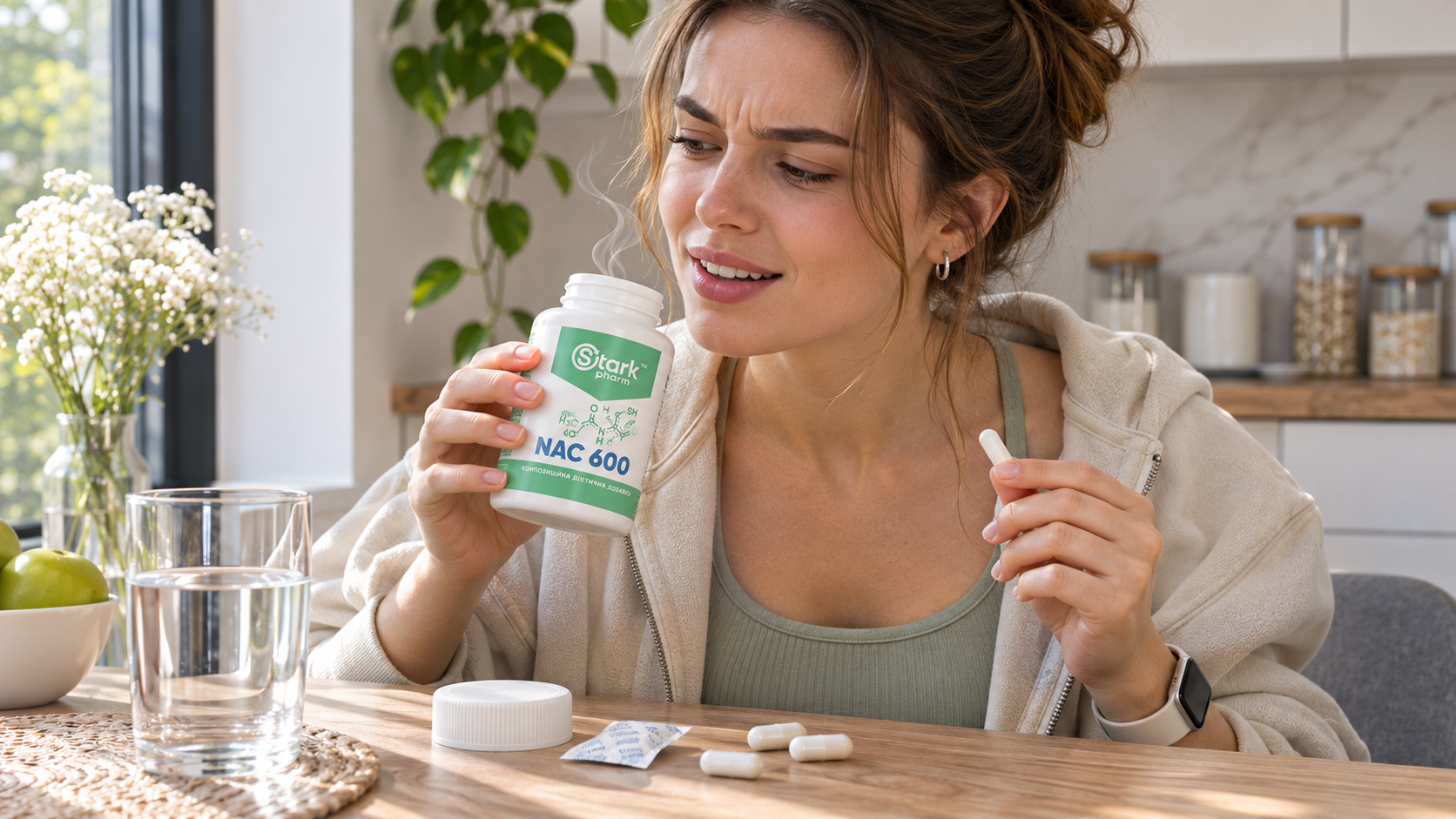
N-acetylcysteine (NAC) has a characteristic sulfurous odor. Sometimes it is noticeable immediately after opening the bottle of capsules, sometimes only when you bring the capsule closer. For someone who buys NAC for the first time, this may come as a surprise: the smell resembles sulfur, boiled eggs, or something sharp and unusual. But the aroma alone cannot be used to conclude that the capsules are spoiled, of poor quality, or, conversely, particularly effective.
The reason for the characteristic smell is related to the chemical structure of acetylcysteine. At the same time, storage conditions can also affect its condition. We understand why NAC smells, how the normal smell of the substance differs from the reasons for checking the packaging, and what stability studies can actually show.
Why does NAC have a sulfurous smell?
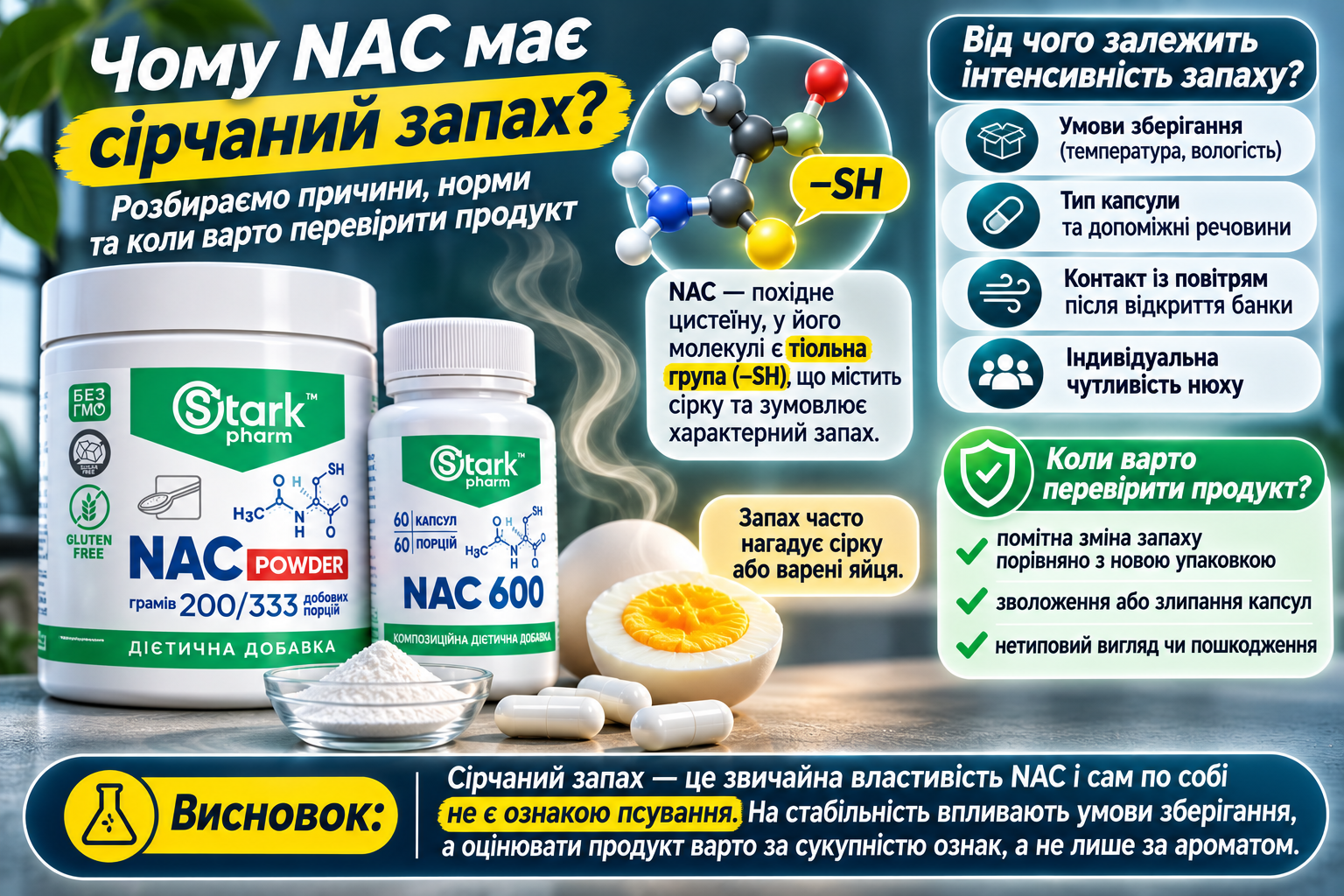
NAC is a derivative of the amino acid cysteine. Its molecule contains a thiol group (–SH), i.e. a site containing a sulfur atom and participating in chemical reactions. It is with this feature that the characteristic organoleptic properties of the substance are associated. The sulfur smell is also known for pharmaceutical forms of acetylcysteine: in the instructions for some powder preparations it is directly described as a normal property of the active substance.
It is important not to oversimplify the explanation for the phrase “it smells because it contains sulfur.” Not every compound that contains sulfur has a strong odor. The perceived aroma depends on the chemical nature of the molecule, its interaction with air, trace volatile components, and the conditions in which the substance was stored. NAC capsules can smell differently, even though their main ingredient has the same name.
Studies of the biochemistry of NAC also show the involvement of sulfur-containing compounds in cellular processes, but these results cannot be used to determine the freshness of capsules by smell. The mechanism of action of the substance in the body and the smell of the powder in the jar are different issues.
Why the smell may be more noticeable after opening the can
While the can is closed, the odors inherent in its contents can accumulate in the small air space under the lid. After opening, a person feels them immediately and concentratedly. If the capsules were stored tightly closed, this in itself does not mean a change in the composition.
The intensity can also depend on the number of capsules, the size of the package, the type of shell, the composition of excipients and the sensitivity of the sense of smell. Two people can describe the same can differently. One will notice a faint sour-sulfur aroma, another will feel it much stronger.
What happens after opening is also important: a can that is left uncovered, kept in a humid room, or frequently moved from cold to warm is in different conditions than a tightly closed package. However, the mere fact of contact with air does not allow us to assess how much the content of the active ingredient has changed.
Does a rotten egg smell mean that NAC is spoiled?
No, not necessarily. Acetylcysteine has a characteristic sulfurous odor, and its presence alone is not a reason to declare the product unsuitable. At the same time, the opposite statement - "the stronger the smell, the better the NAC" - also has no scientific basis.
Odor is a subjective characteristic. It does not indicate the exact amount of NAC in a capsule, the content of impurities, compliance with specifications, or stability during the shelf life. For this, manufacturers use instrumental control methods, including chromatographic analysis. Home odor evaluation is not a substitute for such tests.
A separate issue is a noticeable change in the smell compared to the new packaging, especially if it is accompanied by moisture, sticking, damage, or an atypical appearance of the capsules. In such a situation, it is better not to experiment with the product, but to contact the seller or manufacturer to check the batch and storage conditions.
What research says about the stability of NAC in capsules
To et al. (2008) studied specially prepared capsules containing acetylcysteine and lactose at different temperatures and humidity levels. The authors measured the amount of NAC and its transformation product in a laboratory manner. At the combination of high temperature and high humidity, they noted noticeable physical changes in the capsules, a sulfurous odor, and a decrease in NAC content. Under the other conditions tested, the capsules maintained significantly better stability.
This experiment is important not because it allows you to “nose test NAC,” but because it shows that storage conditions can indeed affect the condition of a particular capsule form. However, the results were obtained for a specific capsule composition and laboratory conditions. They cannot be automatically transferred to all NAC supplements or guess the percentage of substance loss based on the intensity of the smell.
Another study, Friciu et al. (2021), evaluated the stability of aqueous solutions of acetylcysteine prepared for medical use. Under the conditions of the study, the solutions remained chemically stable and no significant changes in odor were observed. This again emphasizes that the behavior of NAC depends on the dosage form, environment, and storage method. The data for solutions are not a direct guide to dry capsules.
It is not just a single smell that should be evaluated, but a set of observations. This approach is not a laboratory test, but it helps to understand when to contact the manufacturer for clarification.
| What did you notice? | What could this mean? | What to do |
|---|---|---|
| Mild sulfurous odor immediately upon opening | May be a natural feature of NAC | Check the expiration date and packaging integrity |
| The smell is noticeable near the capsule, but the appearance is normal | Does not in itself confirm damage | Follow the storage conditions specified on the label. |
| Capsules have stuck together, become damp or deformed | Possible exposure to moisture or heat | Do not use until the batch status is confirmed. |
| Is the protective packaging broken or has the expiration date expired? | There is a reason, independent of the smell, to doubt the condition of the product | Do not use the product, contact the seller. |
| The smell has changed dramatically along with the color or texture | The cause cannot be determined at home | Provide information to the manufacturer, including a photo and batch number if necessary. |
The reverse rule is also important: if the smell is almost absent, this does not prove that the capsules are fake or do not contain NAC. The shell, packaging and auxiliary ingredients can affect the perception of the aroma. The absence of smell is not a confirmation of quality - just as its presence is not a confirmation of effectiveness.
How to properly store NAC capsules
The most reliable guide is the conditions specified by the manufacturer on the specific package. For dry capsules, protection from excessive humidity, heat, and prolonged exposure to open air is usually important. However, you should not independently set a different temperature regime, for example, move the jar to the refrigerator, unless this is provided for in the instructions: condensation may appear during temperature changes.
- Close the jar tightly immediately after removing the capsule.
- Do not store it near a stove, radiator, or on a sunny windowsill.
- Do not leave capsules in the bathroom, where humidity changes frequently.
- Do not pour the contents into unknown containers without a label and expiration date.
- Do not remove the inserted dehumidifier if the manufacturer has provided it in the packaging.
- If in doubt, check the batch number, expiration date, and condition of the original packaging.
It is often tempting to “air out” the capsules by leaving the jar open to help the scent fade. This is a bad idea: a weaker scent after airing does not mean the product is better, but it does increase exposure to air and moisture. Similarly, do not heat, dry, or wash the capsules in an attempt to change the scent.
Can you tell if NAC is genuine by smell?
No. A sulfurous aroma is sometimes perceived as a “home test for naturalness” or a “sign of high concentration.” Both conclusions are false. Odor intensity is not a standardized value, and the manufacturer may use different casings and packaging technologies.
To verify authenticity, raw material documents, specifications, manufacturing procedures, and analytical studies are required. If necessary, the laboratory can compare the sample with a reference substance and measure the amount of the main component. The human sense of smell does not determine the mass fraction of NAC, purity, or compliance with the declared composition.
Therefore, it is worth avoiding two extremes: considering every sulfurous smell as a sign of defect or, conversely, calling a pungent aroma evidence of high quality. A realistic assessment is based on the known properties of the substance, storage conditions, the integrity of the packaging and, if there is any doubt, checking the batch.

What to do if the smell seems too strong
If the capsules have an unusual aroma, first check the label and the condition of the container. Opening a new can does not require any “taste test” or inhaling the powder. Do not open the capsules just to assess the smell: this will not give a reliable conclusion.
If there is a suspicion of moisture or storage conditions being compromised, contact the seller or manufacturer. It is helpful to provide the name, batch number, expiration date, when the package was opened, and what exactly has changed. If the product has already caused an adverse reaction, you should stop using it and seek medical advice.
Bottom line: The sulfurous odor of NAC capsules may be a normal characteristic of acetylcysteine. But odor is not a test of quality. Proper packaging, storage, and confirmation of composition by appropriate methods remain crucial.
Frequently asked questions
Why do NAC capsules smell like sulfur?
N-acetylcysteine contains a thiol group associated with the substance's characteristic sulfurous organoleptic properties.
Is it normal if it smells like rotten eggs?
For acetylcysteine, this odor is described in the documentation for some forms of the drug. In itself, it does not indicate that the capsules are spoiled.
Does a stronger smell mean higher quality NAC?
No. The intensity of the odor does not determine the amount of active ingredient, purity, or effectiveness.
Can the smell get worse due to improper storage?
Yes, storage conditions can affect the condition of a particular form of NAC. However, it is not possible to determine the cause or extent of the change based on smell alone.
Why does one bottle of NAC smell stronger than another?
The shell, excipients, type of container, volume of air in the can, and individual perception of smell may vary.
If the capsules don't smell, are they fake?
No. The absence of a pronounced odor does not prove either a fake or authenticity. Verification requires data on the composition and quality control.
Should I leave the jar open to let the smell dissipate?
No. This increases the capsules' contact with air and moisture and is not a way to improve their quality.
When is it better not to use capsules?
When the expiration date has passed, the integrity of the packaging is broken, or there are noticeable changes in the condition of the capsules. If in doubt, contact the seller or manufacturer.
Sources
- To T., Ellis AG, Ching MS, et al. (2008). Stability of a Formulated N-acetylcysteine Capsule for Prevention of Contrast-Induced Nephropathy. Journal of Pharmacy Practice and Research, 38(3), 219–222. DOI.
- Tenório MCDS, Graciliano NG, Moura FA, et al. (2021). N-Acetylcysteine (NAC): Impacts on Human Health. Antioxidants, 10(6), 967. PubMed.
- Ezeriņa D., Takano Y., Hanaoka K., et al. (2018). N-Acetyl Cysteine Functions as a Fast-Acting Antioxidant by Triggering Intracellular H2S and Sulfane Sulfur Production. Cell Chemical Biology, 25(4), 447–459.e4. PubMed.
- Friciu MM, Monfort A., Dubé P.-A., Leclair G. (2021). Stability of N-Acetylcysteine 60 mg/mL in Extemporaneously Compounded Injectable Solutions. Canadian Journal of Hospital Pharmacy, 74(4), 344–349. PubMed.
Dietary supplement. Not a medicine. Consult a doctor before use.
Products related to this post
Related Posts
Comments
Information
Customer Service
Extras
My Account


Sports nutrition manufacturer in Ukraine StarkPharm © 2026


