Your shopping cart is empty!

Vitamin K2: MK-7 or MK-4 — Difference in Absorption, Dosage, and Duration of Action
Published: 10/11/2026
Times Read: 27
Comments : 0
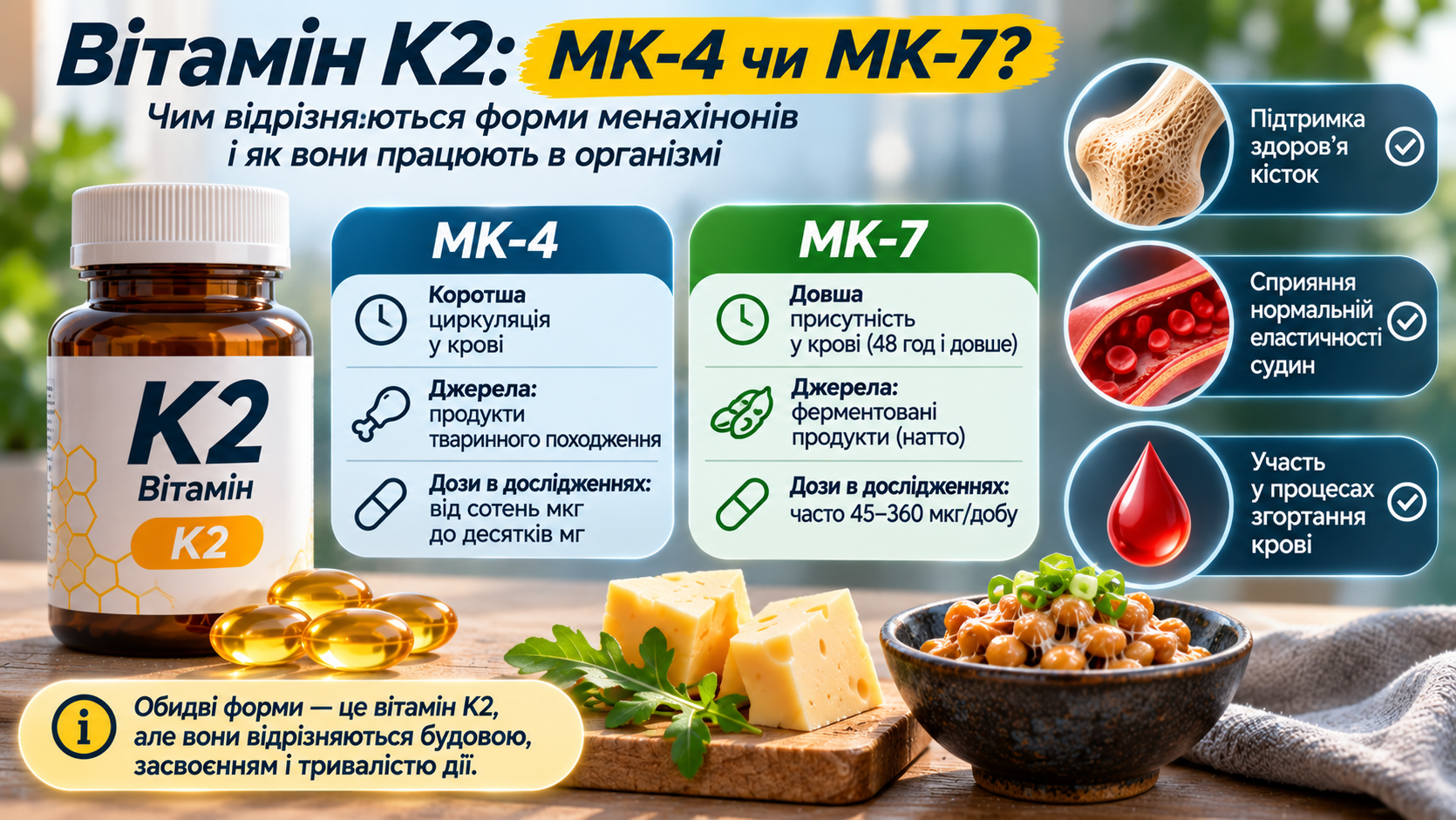
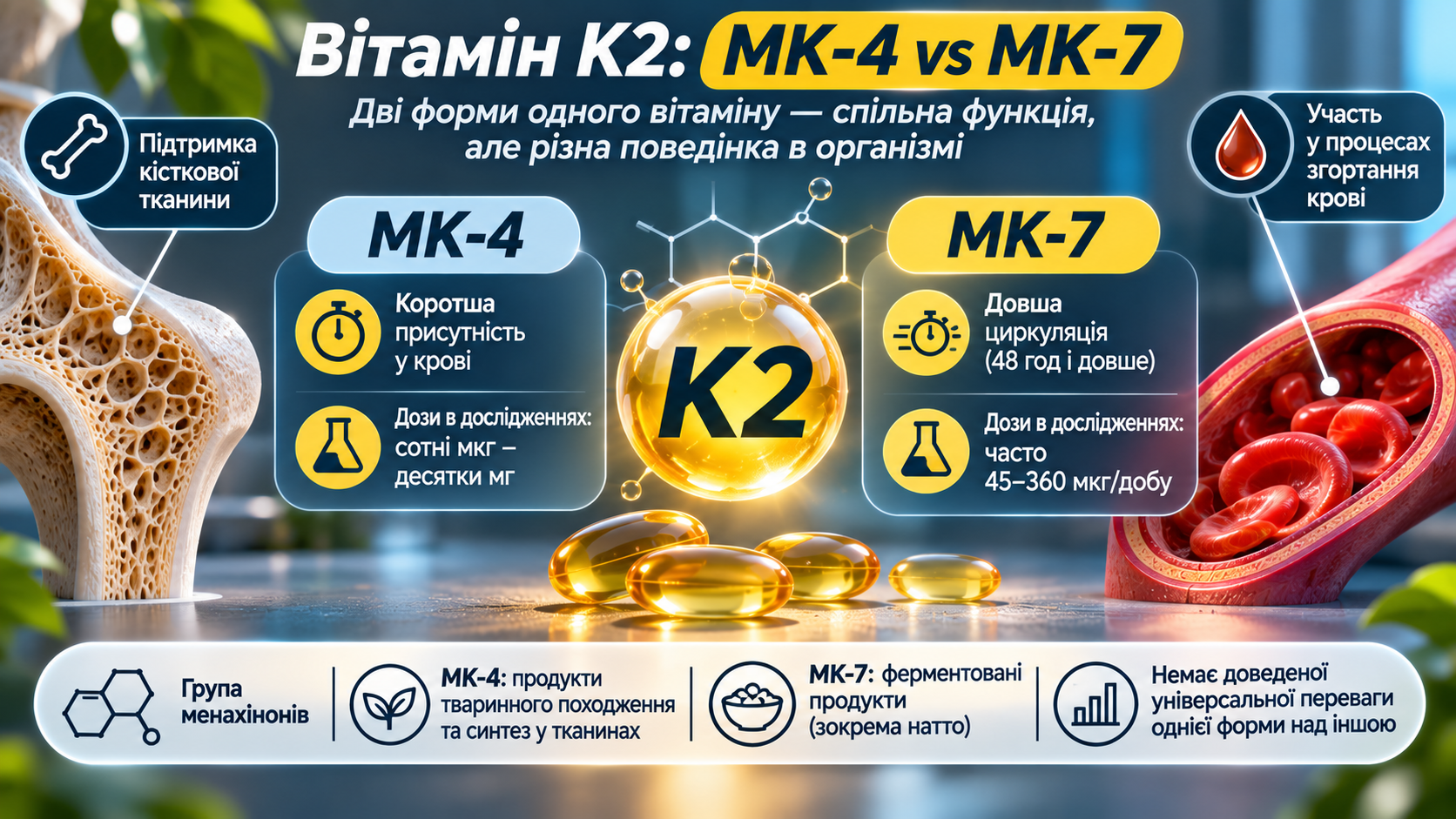
Vitamin K2 is not a single compound but a group of menaquinones. The two best-known forms are MK-4 (menaquinone-4) and MK-7 (menaquinone-7). They share a vitamin function but behave differently after absorption: they differ in how long they remain in the blood, their sources, and the dose ranges studied by researchers. That is why the numbers on MK-4 and MK-7 packages should not be compared without context.
The most consistent difference confirmed in human studies is the longer circulation of MK-7 in blood plasma after oral intake. However, remaining in the blood longer does not establish superiority for every organ or all long-term health outcomes.
MK-7 and MK-4: key differences at a glance
| Criterion | MK-4 | MK-7 |
|---|---|---|
| Name | Menaquinone-4, menatetrenone | Menaquinone-7 |
| Structure | Four isoprenoid units in the side chain | Seven isoprenoid units in the side chain |
| Sources | Some animal-derived foods; also formed in tissues from precursors | Fermented foods, particularly natto |
| Blood after a single dose | At low dietary doses, levels may rapidly drop below the detection limit | Detectable after 48 hours or longer in some studies |
| Doses in clinical studies | From hundreds of micrograms to tens of milligrams, depending on the aim and study design | Often 45–360 mcg/day in biomarker studies |
| Is universal superiority established? | No | No |
This comparison summarizes the pharmacokinetic study by Sato et al. (2012), the review by Shearer et al. (2012), and clinical research data. The dose ranges describe research protocols, not recommendations for self-administration.
Why MK-4 and MK-7 are called different forms of the same vitamin
All menaquinones have a common naphthoquinone ring. The number after “MK” indicates the length of the side chain: MK-4 has four isoprenoid units, while MK-7 has seven. This chemical difference affects their behavior in lipoproteins, transport between tissues, and clearance from the blood.
Vitamin K is required for the enzyme gamma-glutamyl carboxylase. It enables the carboxylation of certain proteins, a process without which these proteins cannot perform their normal functions. Vitamin K-dependent proteins include blood clotting factors, bone osteocalcin, and matrix Gla protein (MGP), which is studied in relation to tissue mineralization.
An important distinction: a change in a laboratory marker of carboxylation confirms biological activity but does not, by itself, prove fewer fractures, cardiovascular events, or other clinical benefits. These represent different levels of evidence.
Absorption and duration of action: what blood tests actually show
Vitamin K is fat-soluble. Its absorption involves dietary lipids, bile, and intestinal transport mechanisms. Different forms may subsequently be distributed differently among lipoproteins and tissues. Thus, “bioavailability” cannot be reduced to the number of hours a substance is detectable in serum.
In the study by Sato et al. (2012), healthy women received a single 420 mcg dose of either MK-4 or MK-7 with a standardized breakfast. After MK-7 intake, the serum concentration increased, peaked after approximately six hours, and remained detectable for up to 48 hours. MK-4 was not detected in serum at the selected time points after the same dose. Following seven days of 60 mcg/day of MK-7, its serum concentration increased, whereas no comparable serum accumulation was recorded for MK-4.
This result does not mean MK-4 is not absorbed at all. The absence of a measurable blood concentration depends on test sensitivity, dose, rate of tissue uptake, and metabolism. The study monitored a specific marker in a specific sample, not the entire pathway by which the compound is used in the body.
In the study by Schurgers et al. (2007), vitamin K1 was compared with MK-7. MK-7 remained in circulation longer and affected vitamin K status markers after repeated intake. However, these findings do not constitute a direct trial of MK-4 versus MK-7 with long-term clinical endpoints.
Why studies used milligrams of MK-4 but micrograms of MK-7
Research doses of MK-4 are sometimes reported in milligrams. For example, Giri et al. (2020) sequentially studied 0.5 mg, 5 mg, and 45 mg of MK-4 in 29 postmenopausal women with a history of fractures, with each dose level lasting three weeks. Changes in the proportion of undercarboxylated osteocalcin were observed at different stages, but raising the dose from 5 to 45 mg provided no additional benefit for this marker. The study was small and open-label.
In contrast, MK-7 studies have often examined microgram amounts. Inaba et al. (2015) conducted two randomized trials examining 50, 100, and 200 mcg/day for four weeks, as well as 100 mcg/day for twelve weeks. The authors assessed the ratio of carboxylated to undercarboxylated osteocalcin, not the long-term incidence of fractures.
Therefore, milligrams of MK-4 and micrograms of MK-7 are not interchangeable measures of effectiveness. Studies differed in populations, duration, vitamin forms, and target outcomes. Even if one form remains in the blood longer, this does not allow calculation of an exact conversion factor for replacing the other.

Osteocalcin and bone tissue: biomarkers versus clinical outcomes
Osteocalcin is one of the proteins that require vitamin K-dependent carboxylation for normal function. Studies often measure its carboxylated and undercarboxylated forms. A change in their ratio helps assess the biochemical response to vitamin K intake, but it is not a direct measurement of bone strength.
Knapen et al. (2013) followed 244 healthy postmenopausal women for three years, comparing 180 mcg of MK-7 daily with placebo. The authors reported differences in certain measures of bone mineral density and estimated bone strength. Nevertheless, findings from one demographic group cannot automatically be generalized to all adults or other doses.
For MK-4, studies have used different doses and populations. For example, Knapen et al. (2007) investigated 45 mg/day of MK-4 over three years in 325 postmenopausal women. Results for femoral geometry measures and bone mineral density were not uniform. Importantly, this was not a direct comparison of MK-4 and MK-7.
Thus, available studies confirm that both forms can alter vitamin K-related biomarkers. But a well-founded claim that “MK-7 is better for bones than MK-4” would require high-quality head-to-head studies with appropriate clinical outcomes, rather than merely comparing separate publications.
Matrix Gla protein and blood vessels: what was studied and what remains unproven
Matrix Gla protein (MGP) is a vitamin K-dependent protein involved in regulating tissue mineralization. Researchers measure, among other indicators, dp-ucMGP, an inactive form of MGP used as a marker of vitamin K status.
In a randomized trial by Dalmeijer et al. (2012), 60 participants received placebo or MK-7 at research doses of 180 or 360 mcg daily for 12 weeks. The authors observed a dose-dependent decrease in dp-ucMGP. However, other cardiovascular risk factors assessed did not change significantly.
Knapen et al. (2015) assessed arterial stiffness parameters in 244 postmenopausal women in a three-year study of 180 mcg of MK-7 per day. Some measurements changed, particularly among women with higher baseline arterial stiffness. However, this does not justify claims that any K2 supplement “cleans the arteries” or guarantees specific clinical outcomes.
For readers, the key distinction is that a change in a biomarker, a change in an instrumental measurement, and a reduction in the risk of an actual clinical event are not the same thing. The evidence for the last claim is insufficient to apply it to a specific product.
Dietary sources of MK-4 and MK-7
MK-7 is primarily associated with bacterial fermentation; the best-known food example is natto, a Japanese product made from fermented soybeans. MK-4 is present in certain animal-derived foods and can also be formed in the body's tissues from other forms of vitamin K.
The review by Shearer, Fu, and Booth (2012) explains why dietary intake, blood concentration, and tissue metabolism are different characteristics. In an experimental mouse study by Ellis et al. (2022), different dietary forms of vitamin K could serve as precursors to tissue MK-4. This mechanism should not be directly extrapolated to humans without further research.
The presence of MK-7 in natto does not mean all fermented foods contain the same amount of this form. Likewise, a generic “vitamin K2” label does not always reveal which form is used: to compare products, look for the MK-4 or MK-7 designation.
How to interpret research doses without drawing false conclusions
- Distinguish dose from outcome. A dose used in a clinical trial is not a recommendation to the reader.
- Consider the population. Results in postmenopausal women may not be the same for younger people.
- Identify the endpoint. Osteocalcin and dp-ucMGP are markers; bone density and actual fractures are different outcomes.
- Do not equate bioavailability with benefit. Longer circulation of MK-7 is better established than universal superiority in clinical outcomes.
- Consider the whole diet. Dietary sources of fat-soluble vitamins and coexisting health conditions also matter.
Precautions: interactions and groups requiring special attention
Vitamin K interacts with anticoagulants known as vitamin K antagonists, including warfarin. Changes in vitamin K intake may affect their action and the monitoring of INR. People taking these medicines should not independently add, discontinue, or change the amounts of K2 supplements without consulting their doctor.
During pregnancy, breastfeeding, childhood, chronic illness, or ongoing medication use, additional intake should be discussed with a healthcare professional. Individual sensitivity to the ingredients of specific supplements also needs to be considered.
Dietary supplements do not replace a complete, varied diet. Do not exceed the amount specified by the manufacturer; the numerical doses in the cited studies should not be turned into a personal dosing regimen.
Frequently asked questions
What do MK-4 and MK-7 mean in vitamin K2 supplements?
They are different menaquinones — vitamin K2 compounds that differ in side-chain length and metabolic characteristics.
Why is MK-7 detectable in blood longer than MK-4?
The forms are transported and cleared differently. In low-dose studies, MK-7 maintained a measurable concentration for longer.
Does MK-7's longer circulation mean it is always better?
No. Blood concentration is not direct evidence of superior bone health or other clinical outcomes.
Why do some publications use milligram doses of MK-4?
Such doses have been studied in specific clinical protocols. They cannot be directly compared with microgram doses of MK-7 or used as a general recommendation.
Can MK-4 and MK-7 be substituted in equal amounts?
No. There is no universal weight-based conversion factor for their clinical effects.
Are there direct studies comparing MK-4 and MK-7?
There are small head-to-head comparisons of absorption-related measurements, but they are insufficient to declare either form superior for all long-term outcomes.
Which foods contain MK-7?
The best-known dietary source is natto, fermented soybeans. The amount of MK-7 depends on the product and fermentation conditions.
Is vitamin K2 compatible with warfarin?
Vitamin K can affect how warfarin works. Any changes in K2 intake must be coordinated with the physician managing anticoagulant therapy.
Sources
- Sato T, Schurgers LJ, Uenishi K (2012). Comparison of menaquinone-4 and menaquinone-7 bioavailability in healthy women. Nutrition Journal. PubMed.
- Schurgers LJ et al. (2007). Vitamin K-containing dietary supplements: comparison of synthetic vitamin K1 and natto-derived menaquinone-7. Blood. PubMed.
- Shearer MJ, Fu X, Booth SL (2012). Vitamin K nutrition, metabolism, and requirements: current concepts and future research. Advances in Nutrition. PubMed.
- Inaba N, Sato T, Yamashita T (2015). Low-Dose Daily Intake of Vitamin K2 (Menaquinone-7) Improves Osteocalcin γ-Carboxylation: A Double-Blind, Randomized Controlled Trials. Journal of Nutritional Science and Vitaminology. PubMed.
- Giri TK et al. (2020). Maximal dose-response of vitamin-K2 (menaquinone-4) on undercarboxylated osteocalcin in women with osteoporosis. International Journal for Vitamin and Nutrition Research. PubMed.
- Knapen MHJ et al. (2013). Three-year low-dose menaquinone-7 supplementation helps decrease bone loss in healthy postmenopausal women. Osteoporosis International. PubMed.
- Knapen MHJ et al. (2007). Vitamin K2 supplementation improves hip bone geometry and bone strength indices in postmenopausal women. Osteoporosis International. PubMed.
- Dalmeijer GW et al. (2012). The effect of menaquinone-7 supplementation on circulating species of matrix Gla protein. Atherosclerosis. PubMed.
- Knapen MHJ et al. (2015). Menaquinone-7 supplementation improves arterial stiffness in healthy postmenopausal women. A double-blind randomised clinical trial. Thrombosis and Haemostasis. PubMed.
- National Institutes of Health, Office of Dietary Supplements. Vitamin K: Fact Sheet for Health Professionals. NIH ODS.
- Ellis JL et al. (2022). Multiple Dietary Vitamin K Forms Are Converted to Tissue Menaquinone-4 in Mice. The Journal of Nutrition. PubMed.
Dietary supplement. Not a medicinal product. Consult your doctor before use.
Products related to this post

Related Posts
Comments
Information
Customer Service
Extras
My Account


Sports nutrition manufacturer in Ukraine StarkPharm © 2026


