Your shopping cart is empty!

NAC as a medicine and dietary supplement: why the status varies between countries
Published: 06/11/2026
Times Read: 100
Comments : 0
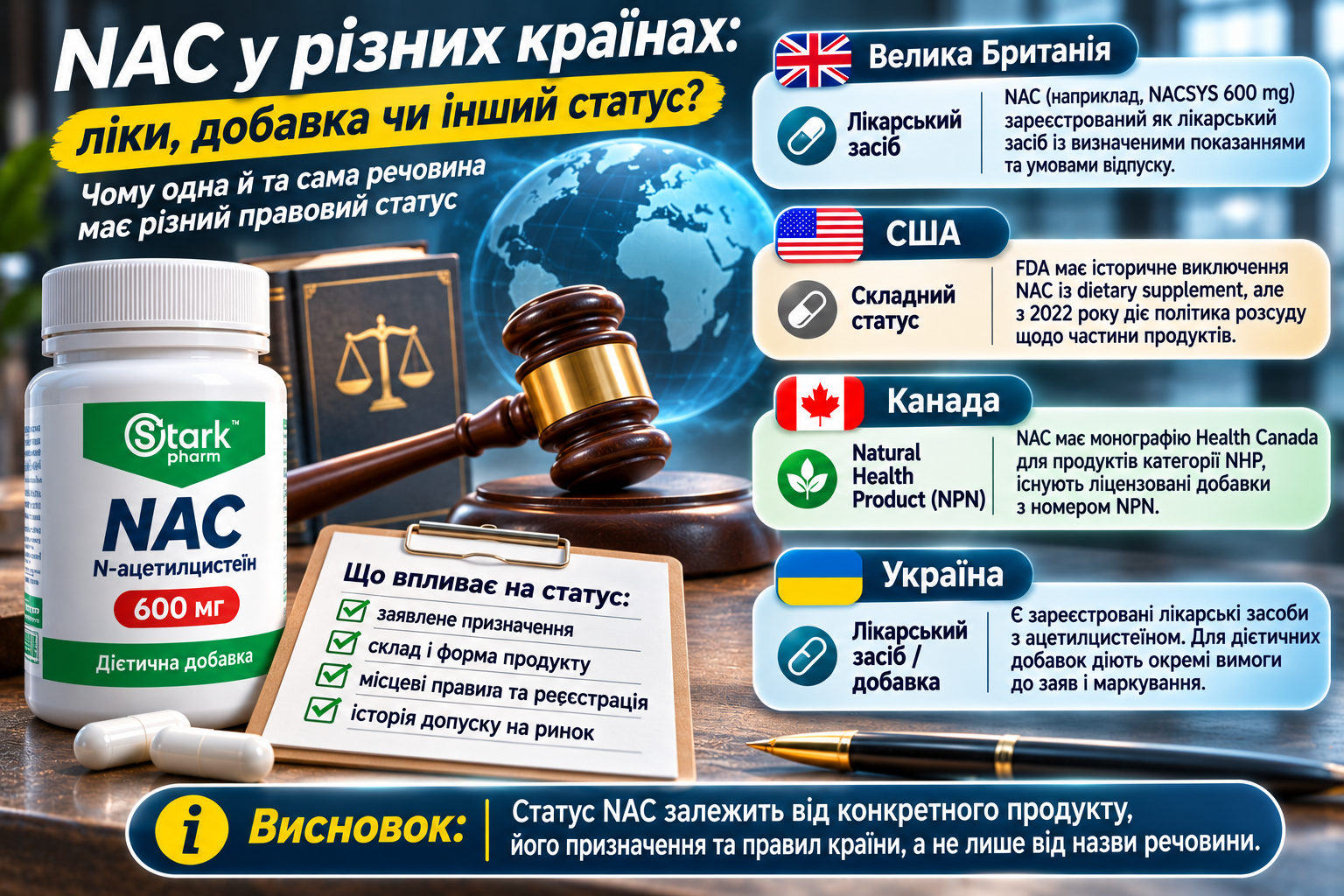
NAC (N-acetylcysteine) is an example of a substance whose status cannot be determined by its label alone. In the UK, acetylcysteine is a registered drug, in Canada it is a licensed Natural Health Product, and in the US its use in products labeled as dietary supplements has its own complex legal history. This is not because the molecule varies across borders. The legal categories, market approval history, and product-specific requirements differ.
To understand this difference, it is necessary to separate three concepts: what is a substance , in which category a particular product is registered or approved, and what the manufacturer has the right to write about its purpose. It is the mixing of these issues that gives rise to statements like “NAC is a medicine everywhere” or “if it is sold in capsules, it is necessarily a supplement.” Both conclusions are oversimplified.
Why can one substance be included in different product categories?
Countries classify finished products according to established rules. Not only the name and chemical formula of the ingredient are taken into account, but also the declared purpose, composition, dosage form, route of administration, manufacturer's documents and approval history. For example, a capsule for oral use and a solution for medical use do not become the same product because of a common active ingredient.
A medicinal product undergoes a prescribed evaluation procedure, after which it has approved characteristics and indications. A product in a different category is subject to different labeling and marketing rules. Here is an important distinction: the presence of a registered medicinal product with NAC does not mean that every product with NAC is automatically a medicinal product. But the word “supplement” on the packaging cannot by itself legalize the product if local requirements state otherwise.
For the consumer, this means that the legal status should be checked for the specific product and country of sale. For the manufacturer, it is a matter of documentation, classification and permitted formulations, not just the marketing name.
NAC in different countries: comparison based on real examples
| Market | What official sources confirm | How to correctly understand the status of NAC |
|---|---|---|
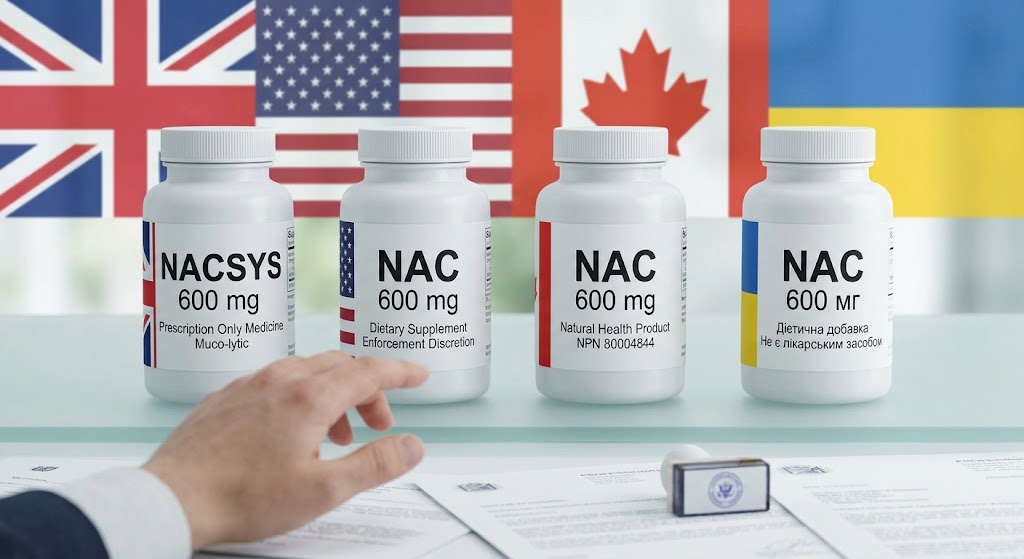
| Great Britain | NACSYS 600 mg is registered as a medicinal product; medical indications and dispensing conditions are established for the specific form. | This is about the status of a specific registered drug, not about any product containing this substance. |
| USA | The FDA recognizes the historical exclusion of NAC from the definition of a dietary supplement, but since 2022 has applied a discretionary enforcement policy for some products. | “NAC is completely banned” is an incorrect generalization; however, the FDA policy does not eliminate the underlying legal problem. |
| Canada | Health Canada has a monograph on N-Acetyl-L-Cysteine for Natural Health Products and licenses NAC products from NPN. | This is a separate Canadian category and cannot be automatically translated as Ukrainian or American status. |
| Ukraine | There are medicines in the state register with the active ingredient acetylcysteine. Separate requirements for applications and labeling apply to dietary supplements. | The presence of acetylcysteine in the drug registry is not a conclusion regarding the legal status of any particular NAC capsule. |
The table does not compare the benefits of drugs or supplements, but their legal circulation models. It does not replace checking the registration status of a specific product: rules and assortment change.
United Kingdom: NAC as an active ingredient in a registered drug
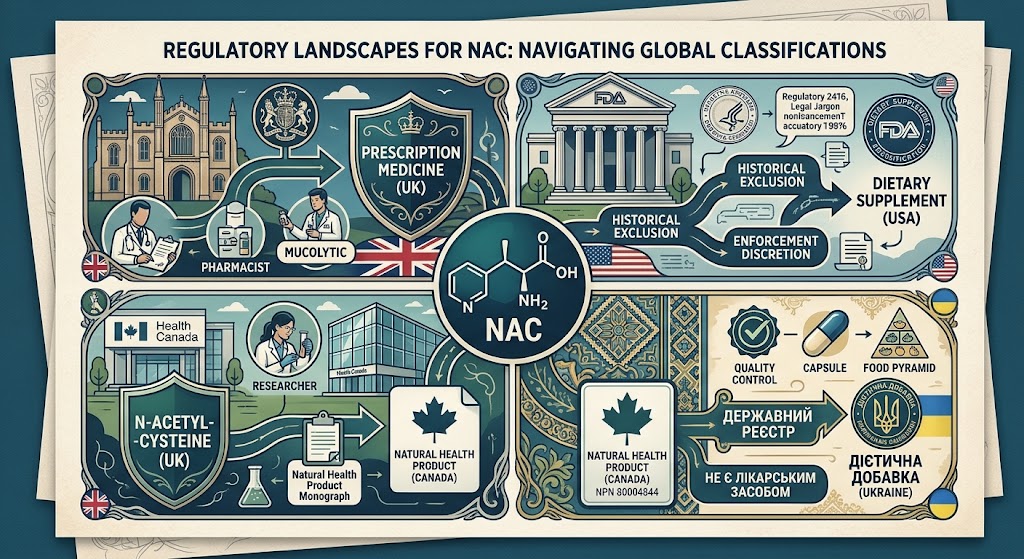
The UK Summary of Product Characteristics (SPC) for NACSYS 600 mg Effervescent Tablets is available. It identifies acetylcysteine as the active substance and the product as a prescription-only medicinal product. The SPC describes its use as a mucolytic, i.e., a product that alters the properties of bronchial secretions in medical practice.
It is important that such a document belongs to a specific drug: it indicates its form, auxiliary components, conditions of use and warnings. This status cannot be transferred to another NAC capsule just because of the same inscription “600 mg”. Chemical identity of the active substance does not mean the same legal category of the finished product.
It is also important to distinguish between the officially approved characteristics of a drug and the scientific review of an active substance. The former relate to the authorized use of the respective medicinal product, while the latter may describe a much broader range of experiments and hypotheses.
USA: Why the NAC story is more complicated than the words "allowed" or "forbidden"
In March 2022, the FDA released responses to industry requests and reaffirmed its position on the NAC exemption. But that wasn’t the end of the story. In August 2022, the agency issued final guidance on enforcement discretion, a policy under which it would not take action based solely on the exemption for some NAC products marketed as supplements under certain circumstances.
This is a significant legal distinction. The discretionary enforcement policy is not the same as changing the definition of a dietary supplement in the law. Nor does it mean that any product with any claim is permissible on the market. The FDA expressly limits its policy to products that otherwise comply with the law.
So, the headlines “FDA Bans NAC” and “FDA Finally Allows NAC as a Supplement” are equally misleading without detail. A more accurate conclusion: In the American system, a historical legal position on the exclusion of an ingredient and a separate policy for a portion of the products on the market coexist.
Canada: NAC among Natural Health Products
The Canadian model shows a different approach. Health Canada maintains a Natural Health Products Ingredient Database and a separate monograph for N-Acetyl-L-Cysteine, which is used in the preparation of applications for licensing products in this category. The updated monograph is dated December 19, 2025. It sets out the conditions that a manufacturer must consider for the relevant product category, including warnings.
Having a monograph does not automatically make every package of NAC licensed. For example, the Canadian registry lists NAC 600 mg with its own Natural Product Number (NPN). The NPN is a licensed product identifier, not a universal certification for all NACs sold worldwide.
The word medicinal ingredient in the Canadian Natural Health Products entries also needs to be read correctly: it describes the role of the active ingredient within this category, but does not in itself mean that the finished product is classified in the same way as a British prescription drug.
This example clearly demonstrates why translating terms between countries can be confusing. Each system has its own names, procedures, and implications for the manufacturer and the buyer.
Ukraine: what is the difference between a registered medicinal product and a dietary supplement?
In Ukraine, the existence of pharmaceutical forms of acetylcysteine is confirmed by the State Register of Medicines. It allows you to check the names of the drugs, the active substance, the holders of registration certificates and other data. This is an official confirmation of the medicinal status of certain registered products, and not all possible products containing NAC.
A separate system of requirements for composition, marketing, labelling and advertising applies to dietary supplements. The principle limit is that the supplement cannot be attributed properties that the legislation reserves for medical purposes. Even if the active substance is also used in medicine, the transfer of the approved indications of the drug to the description of the supplement does not automatically become permissible.
Therefore, the reader should distinguish between the availability of scientific studies on NAC, registered in Ukraine medicines with acetylcysteine and legitimate claims about a specific dietary supplement. These are three different levels of information. A conclusion about the legal status of a particular product requires its documents and current information, and not a comparison with foreign sales pages.
Why the form and numerical quantity of NAC do not determine status
The same active ingredient designations and similar numerical values may appear on the packages. However, the content of the substance is only one of the parameters. Of particular importance are auxiliary components, dosage or food form, manufacturing technology, purpose, permissible claims and the route of product admission to the market.
A comparison of a British registered drug and a Canadian licensed NHP clearly illustrates this difference: a common ingredient and even a similar quantity designation do not erase the differences between the categories. The principle of “same substance, same status” cannot be used to infer sales rules or acceptable advertising descriptions.
Similarly, the instructions for the drug should not be transferred to the supplement. The document with medical indications is intended for a specific registered product and the specified conditions of its use.
Can medical research results be used in the description of a supplement?
NAC studies may evaluate biochemical markers, antioxidant processes, bronchial secretion properties, or results of drug formulations. The mere publication of results does not constitute permission to translate them into a promise of the properties of all NAC products.
In a popular science article, it is appropriate to explain the mechanisms and limitations of the research: who participated, what form of substance was used, what exactly was measured, and how cautiously the conclusions can be generalized. In a product description, there are additional restrictions on permissible wording. Scientific fact, legal permission for an advertising claim, and personal advice are not the same thing.
In particular, the results of trials of a particular drug do not mean that a dietary supplement with the same molecule has a proven medical indication for it. The same applies to comparing different forms of NAC and extrapolating results from one group of people to another.
How to check which category a product belongs to
Instead of drawing conclusions based only on the color of the label, the name, or the shape of the capsule, it is worth checking several pieces of information in sequence:
- Country of market. Look at the rules of the country where the product is being marketed, not the foreign online store.
- The full name of the finished product. It is more important than the common name of the active ingredient.
- Category on the label. Compare it with local legal requirements.
- Official database. For medicines, check the state register; in countries with a separate system for additives, check the corresponding register of licensed products.
- Declared properties. Separate general information about the substance and approved claims about a specific product.
Official databases help avoid two opposite mistakes: unreasonably calling any NAC a drug or believing that the registration of a product as a supplement automatically allows repeating medical indications.
What does this mean for the consumer in practice?
First of all, legal classification should not be interpreted as a rating of usefulness or safety. The words “medicine” and “dietary supplement” communicate the product category and its legal path to market. They do not allow us to assess the quality of unknown packaging in absentia or predict individual reactions.
It is only correct to compare NAC products after establishing their actual status and characteristics. If there are questions about the combination with medications, chronic conditions, pregnancy or breastfeeding, the decision to use supplements should be discussed with a doctor. You should not independently replace a registered drug with a food product, focusing only on the name of the active ingredient.
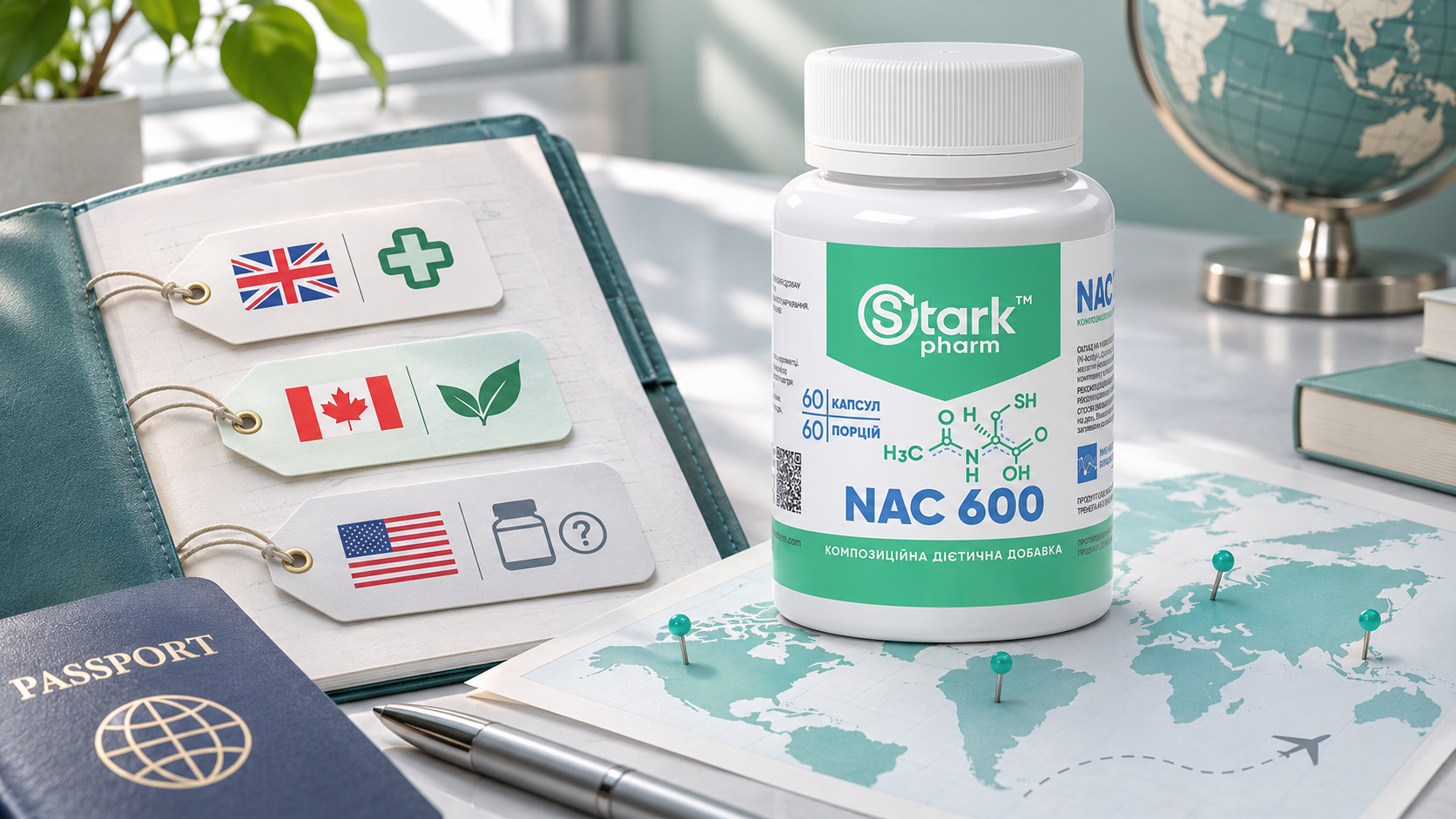
The main conclusion is simple: the same molecule can be present in products with different legal statuses. To understand what exactly is allowed to be sold, described and used in a particular country, it is necessary to check not only NAC as an ingredient, but also the documentation of the specific product.
Frequently asked questions
Is NAC a drug or a dietary supplement?
This is the name of the substance. The legal category is a specific product in a specific market. Different countries have different models for its approval.
Why is NAC sold as a medicine in one country and as a supplement in another?
Countries have different definitions of product categories, ingredient regulation history, and finished product approval procedures.
Is NAC banned in the US?
This wording is incorrect. The FDA recognizes the legal exclusion of NAC from the definition of a dietary supplement, but has a specific enforcement policy for certain products.
Can I buy NAC in Canada as a Natural Health Product?
Yes, there are licensed NAC products with individual NPNs in the Canadian database. However, this does not mean that every package is automatically approved.
Is acetylcysteine a registered medicinal ingredient in Ukraine?
Yes, the state register includes medicines containing acetylcysteine. The status of other products must be checked separately.
Does the amount of 600 mg mean that it is definitely a medicine?
No. The numerical content of a substance does not in itself determine the category, the approval procedure and the permitted claims.
Can the instructions for the drug be transferred to a NAC supplement?
No. Approved drug information belongs to the specific registered product and does not automatically become a property of the additive.
How to check the real status of a NAC product?
Find the full name, country of sale, and labeling, and then check the product with the appropriate official database or documentation.
Sources
- US Food and Drug Administration (2022). Guidance for Industry: Policy Regarding N-acetyl-L-cysteine. FDA.
- US Food and Drug Administration (2022). FDA Issues Response to Two Citizen Petitions on NAC in Dietary Supplements. FDA.
- Alturix Limited (2023). NACSYS 600 mg Effervescent Tablets: Summary of Product Characteristics. Electronic Medicines Compendium, UK. SmPC.
- Health Canada (2025). N-Acetyl-L-Cysteine: Natural Health Products Monograph. Health Canada.
- Health Canada. Licensed Natural Health Products Database: NAC 600 mg, NPN 80004844. Health Canada.
- Ministry of Health of Ukraine. State Register of Medicinal Products of Ukraine. State Register.
- Verkhovna Rada of Ukraine. Law of Ukraine "On Advertising", Article 21, Part Nine. Legislation of Ukraine.
Dietary supplement. Not a medicine. Consult a doctor before use.
Products related to this post
Related Posts
Comments
Information
Customer Service
Extras
My Account


Sports nutrition manufacturer in Ukraine StarkPharm © 2026


