Your shopping cart is empty!

Magnesium Citrate 9-hydrate vs Anhydrous: what is the difference and what to choose
Published: 01/06/2026
Times Read: 1668
Comments : 1
Stark Pharm offers two products with the same active ingredient — magnesium citrate — but in different crystalline forms: anhydrous (Stark Magnesium Citrate Soluble Powder) and 9-hydrate/nonahydrate (Stark Magnesium Citrate). This is not a “better version — worse version.” The forms differ in their behavior in water, taste experience, and nature of the effect on the gastrointestinal tract, but the amount of magnesium that ultimately enters the bloodstream is equivalent . Below is how to choose between them for your scenario.
Comparison of forms in the main
| Parameter | Soluble Powder (anhydrous) | Magnesium Citrate (9-hydrate) |
|---|---|---|
| Solubility in water | Dissolves completely to a clear solution | Forms a stable suspension - does not dissolve completely, requires stirring before use |
| Taste | Strongly sour - full taste contact as a solution; may require masking with juice or mixing with an electrolyte drink | Less noticeable - the suspension is quickly swallowed, easily disguised in porridge, yogurt or smoothie |
| Predominant effects in the gastrointestinal tract | Milder osmotic effect - magnesium is released quickly and absorbed mainly in the upper small intestine | More pronounced osmotic effect - gradual dissolution results in longer presence of Mg²⁺ in the lumen, possible softer stool |
| Bioavailability | High | High - equivalent to anhydrous form: both salts dissociate to Mg²⁺ before absorption |
| How to use | Stir into a glass of water, juice or electrolyte shaker - drink as a regular beverage | Stir in water and drink immediately while still in suspension, or add to porridge/yogurt/smoothie |
| When to use | Anytime; convenient to divide into 2 doses; goes well with a training drink | One dose per day, regardless of meals; in the evening practically - a weak laxative effect occurs during rest |
Solubility in water - why is it different?
Magnesium citrate 9-hydrate (nonahydrate) has 9 water molecules in its crystal lattice. The anhydrous form has none. At first glance, it seems that the “hydrate” should dissolve better because the water is already “built in.” In fact, a different logic works: the crystal lattice of the nonahydrate is thermodynamically stable at room temperature, so the salt slowly and incompletely releases cations into water, forming a characteristic suspension.
The anhydrous form in the Stark Magnesium Citrate Soluble Powder format undergoes technological preparation for rapid dissolution — a fine fraction, appropriate surface treatment. Therefore, when stirred in a glass of water, we obtain a clear solution without sediment.
That is, the difference in behavior in the glass here is not a question of "which citrate is chemically more correct," but a question of the form of crystallization and the production technology of a particular powder.
Taste - what to expect
Magnesium citrate is a salt of citric acid. When fully dissolved, it is noticeably acidic , with a noticeable mineral tinge. This is a characteristic of any magnesium citrate solution, not a defect of a particular product.
Soluble Powder gives a full flavor exposure — the salt in the solution is in maximum contact with the taste buds throughout the entire intake. Therefore, you should be prepared: either drink it “as is”, or immediately plan to disguise it — lemonade, fruit juice, electrolyte drink concentrate, part of a dose of squeezed lemon. Some consumers mix it in a shaker with BCAA or with salts for rehydration — the sour note of citrate fits harmoniously there.
The 9-water form in suspension mode gives less taste contact: stirred - quickly swallowed while the powder is still suspended in water. Alternatively - add a spoonful to porridge, yogurt, smoothies or grape juice: the taste is practically not felt.
What happens in the gastrointestinal tract
Magnesium ion is osmotically active in the intestinal lumen: it attracts water. Incidentally, the effect of drugs for preparing the intestines for research is based on this property (large doses of magnesium citrate solutions are used there). In additional doses, the effect is weak and variable - in some it is not noticeable at all, in others it manifests itself in the form of slightly softer stools.
There is a real difference between the two forms here — not in the overall osmotic "power" (it depends on the amount of magnesium), but in the localization of the effect along the tract :
- Anhydrous (fast-dissolving) form. Mg²⁺ is released early - in the stomach and upper small intestine. It is mainly absorbed from there. Fewer ions reach the lower sections - there is less osmotic effect there.
- 9-Aqueous (suspension) form. Dissolves gradually in the intestinal lumen. Mg²⁺ is present in a dissolved state for longer and further along the tract - and therefore retains water longer before being absorbed.
Hence the difference in sensations: for some consumers, the 9-water form gives a slightly more pronounced "wet" effect. For some, this is neutral, for others it is undesirable, and for those who are prone to constipation, it is even desirable as a mild correction.
Bioavailability — why it’s the same despite the rest
The gastrointestinal tract is an aqueous and acidic environment. Both forms of magnesium citrate — anhydrous and 9-hydrated — undergo the same transition in it: dissociation to Mg²⁺ + citrate³⁻ ions. It is in the ionic form that magnesium is absorbed by enterocytes. The crystalline form in which the salt entered the stomach no longer matters at the time of absorption — both have dissociated.
Therefore, the research base on magnesium citrate (comparison with oxide, assessment of bioavailability by serum and urine levels - Kappeler et al., 2017; Walker et al., 2003; summary of the NIH Office of Dietary Supplements) does not discriminate against the hydrate form - studies usually use the nonahydrate as the pharmacologically standard form, and conclusions about the bioavailability of magnesium citrate are transferable to both options.
In other words: different sensations in the glass and in the gastrointestinal tract do not mean different amounts of magnesium in the blood.
How to use
Stark Magnesium Citrate Soluble Powder. Stir a portion in a glass of water, juice or in a shaker. Dissolves completely - no sediment, can be drunk slowly. The format goes well with electrolyte drinks, BCAA, creatine in a training cocktail. To mask the taste - add lemon juice or a portion of fruit concentrate.
Stark Magnesium Citrate (9-hydrate). Two scenarios:
- Quick shot: stir in a small amount of water (≈100–150 ml), don't wait - drink while the powder is still in suspension, otherwise it will settle to the bottom of the glass.
- In food: add a spoon directly to porridge, yogurt, cottage cheese, homemade smoothie. In this format, the taste is not felt at all, and the consistency of the suspension becomes irrelevant.
Serving size - according to the instructions on the package.
When to use and who will benefit from it
Soluble Powder is suitable for those who:
- If you want a full-fledged drink format, take it with a training shaker, electrolytes, or just a glass of lemon water.
- Plan to divide the daily portion into 2 doses throughout the day.
- Sensitive to soft stools and wants to minimize osmotic effects on the lower intestines.
- Not against sour taste or has a familiar way to balance it.
9-water is suitable for those who:
- He wants the “one spoon and forget it” format, without calculating the number of doses during the day.
- I'm used to adding supplements to food (porridge, yogurt, smoothies) - it masks the taste and eliminates the issue of suspension.
- Has a tendency to constipation and views the mild laxative effect as a beneficial bonus, not a side effect.
- Wants an exact daily serving of 67% RDI of magnesium in one scoop.
Time of day. The anhydrous form is flexible — on an empty stomach, with food, around training, throughout the day. The 9-hydrate is convenient to take in the evening: if a weak laxative effect is manifested — it falls on the time of rest, not on an active day.
Frequently asked questions
Which is better: aqueous or anhydrous magnesium citrate? There is no objectively "better" form - it's a matter of the scenario. For a drink with complete dissolution - anhydrous; for one dose per day with the ability to mask in food - 9-hydrate. The amount of magnesium in the blood does not depend on the form.
Why is magnesium citrate 9-hydrate poorly soluble in water? The crystal lattice of the nonahydrate is stable at room temperature - the salt slowly and incompletely releases cations into water. This is a normal physical property of the form, not a defect.
Is the bioavailability of the two forms different? No. In the gastrointestinal tract, both forms dissociate to Mg²⁺ ions, and it is in the ionic form that magnesium is absorbed. By the time of absorption, the initial crystalline form is no longer relevant.
Does magnesium citrate have a taste? Yes, it is distinctly sour — this is a characteristic feature of the citric acid salt. In the anhydrous (fully soluble) form, the taste is more noticeable, in the 9-hydrated (suspension or in food) — weaker.
Can magnesium citrate cause a laxative effect? In large doses, yes (this is the basis for the action of bowel cleansing drugs). In standard supplemental doses, the effect is weak and variable - for some it does not appear at all, for others it manifests itself in the form of softer stools.
Which form is gentler on the gastrointestinal tract? The anhydrous, fast-dissolving form tends to be the preferred form. Mg²⁺ is released early, absorbed in the upper gut, and fewer ions reach the lower gut, where they could exert an osmotic effect.
What should I do if I get a laxative effect? Reduce the single serving (take gradually, increasing), divide the dose into two doses, or switch to the anhydrous form, which usually has a milder effect on the intestines.
Can it be mixed with food? The 9-hydrate form — yes, it is even a convenient way to take it. The anhydrous form is better to drink as a solution — the benefits of its solubility are lost with food.
Can I take it on an empty stomach? Yes, but if you have a tendency to loose stools or a sensitive stomach, it is more comfortable with food or immediately after a meal.
How to store? In a dry place, protected from sunlight, at a temperature of 5–25 °C, relative humidity no more than 75%. After opening, close the jar tightly. Do not remove or use the desiccant bag in the jar.
Select product
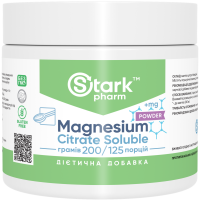
Stark Magnesium Citrate Soluble Powder 200 g — anhydrous instant form, drink format.
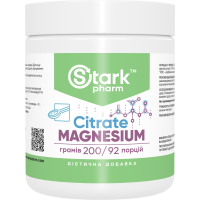
Stark Magnesium Citrate 200 g — 9-hydrate form, one dose per day, convenient to add to food.
Dietary supplement. Not a medicine. Consult a doctor before use.
Products related to this post
Comments
Information
Customer Service
Extras
My Account


Sports nutrition manufacturer in Ukraine StarkPharm © 2026