Your shopping cart is empty!

Creatine Retains Water: Where Exactly and Does It Cause Swelling?
Published: 16/09/2026
Times Read: 389
Comments : 0
Creatine can indeed change the amount of water in the body, especially at the beginning of intake. It is from this fact that the popular phrase “creatine retains water” has grown. But it is too crude: water in the body is distributed between different compartments, and an increase in total or intracellular water is not synonymous with pathological edema.
To properly read the research, you need to distinguish between at least three metrics: total body water (TBW), intracellular water (ICW), and extracellular water (ECW). It is at this level that it becomes clear why body weight can change slightly after creatine without it being “swelling” in the medical sense.
Why does water change after creatine?
Most of the body's creatine is found in skeletal muscle. When its concentration in a muscle cell increases, the osmotic environment of the cell changes. Water is involved in maintaining this balance, so changes in the muscle creatine pool may be accompanied by changes in the water compartments.
This does not mean that creatine "sucks" water out of the blood or other tissues. Real-world studies measure not only intracellular water, but also total body water and extracellular water. And the results show a more complex picture than a simple "all the water goes into the muscles" scheme.
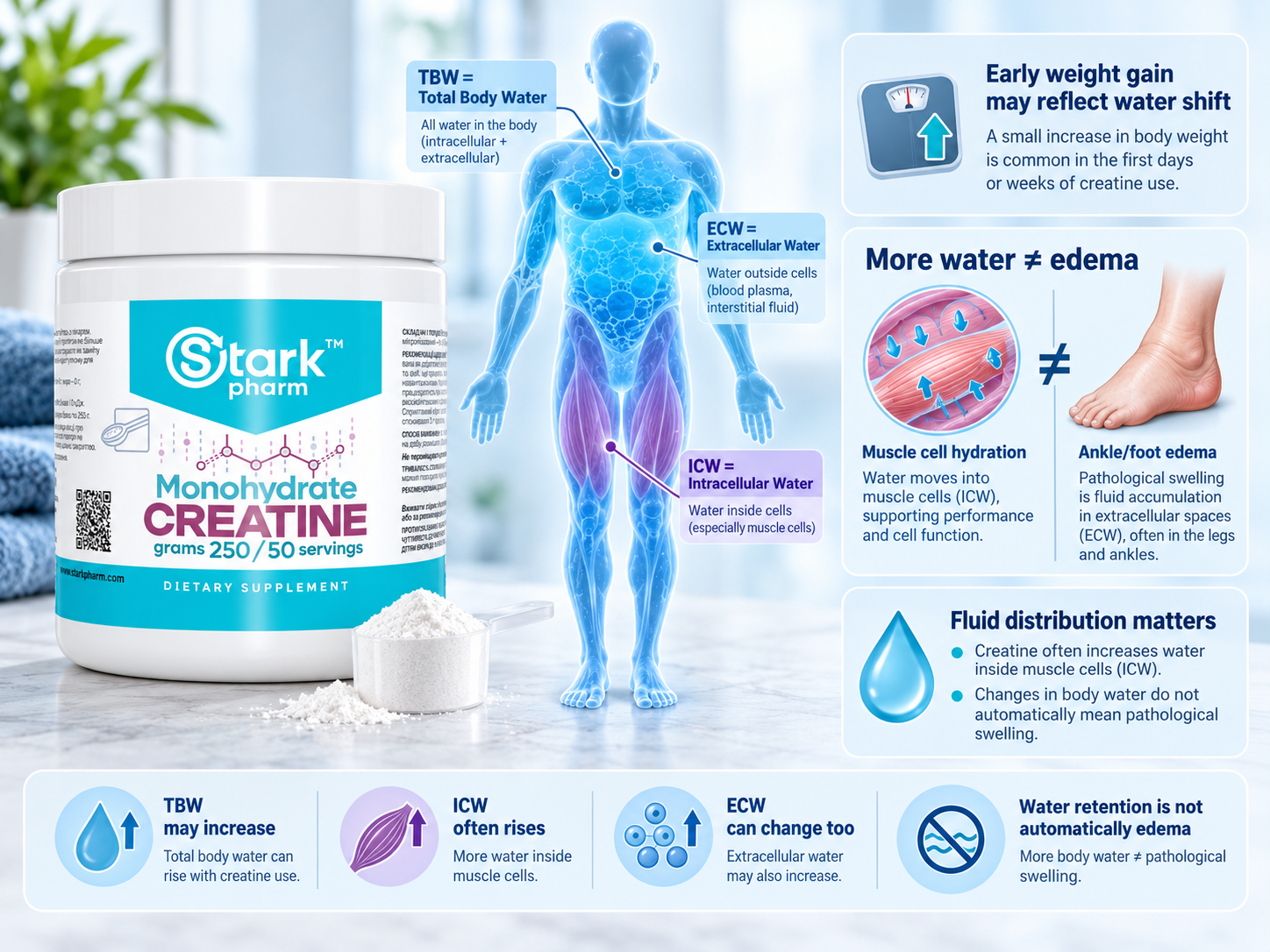
TBW, ICW and ECW are three different metrics
Total body water (TBW) is all the water in the body. It consists of water inside the cells and water outside them. Therefore, an increase in TBW by itself does not tell us anything about which compartment the main change occurred in.
Intracellular water (ICW) is the water inside cells. This is of particular interest for creatine due to the accumulation of creatine in skeletal muscle. Extracellular water (ECW) is the water outside cells, which includes blood plasma and interstitial fluid.
In everyday life, the word "water retention" is often used for any change in body weight, but in scientific work it is important to see which compartment was measured and by what method.
What direct measurements of water distribution showed
Powers et al. (2003) studied 32 men and women who were strength training. The creatine group used 25 g/day for seven days, followed by 5 g/day for another 21 days. The researchers measured muscle creatine, body weight, TBW, ICW, and ECW.
Muscle creatine, body weight, and total body water increased in the creatine group after the protocol. However, the authors found no change in the distribution of fluid between intracellular and extracellular compartments. That is, the increase in TBW was not accompanied by evidence that water disproportionately "flowed" into only one space.
This work is also important because it shows the limitations of the popular explanation of exclusively intracellular water retention. This mechanism is biologically plausible, but the actual distribution of water depends on the duration, protocol, population, and measurement method.
Does water always increase only inside cells?
No. In a study by Ribeiro et al. (2020) in men with resistance training experience, changes in skeletal muscle mass, TBW, ICW, and ECW were assessed during resistance training. The creatine group showed greater changes in muscle mass, total water, and intracellular water, but extracellular water also changed and did not differ between groups such that the entire effect could be attributed to ICW alone.
Moore et al. (2023) separately studied 30 physically active women at different phases of the menstrual cycle. After a five-day loading phase with creatine in the luteal phase, TBW, extracellular fluid, and intracellular fluid increased. In the other phases of the cycle, the picture was different.
This doesn't mean that the menstrual cycle always determines the response to creatine. The study is small. But it does demonstrate a key principle: water changes can span multiple compartments and are not the same for all people.
Why weight can increase at the beginning
Rapid weight changes over a few days cannot be automatically equated to either fat or new muscle tissue. Water can change weight much faster than structural hypertrophy occurs.
This is why early changes in DXA or lean mass should be interpreted with caution. In our article on why early lean mass gains don’t translate to the same amount of new muscle, we discussed an RCT where just seven days of creatine without resistance training changed lean mass. For the water topic, this is an important example: some of the early “mass gain” may reflect fluid changes, not new contractile tissue.
How is a water change different from swelling?
In medicine, edema is not just any increase in body water. Edema refers to a pathological or clinically significant accumulation of fluid in the interstitial space of tissues. Its mechanisms may be related to changes in capillary pressure, vascular permeability, oncotic pressure, lymphatic drainage, and various diseases.
Therefore, the phrase “creatine causes water retention” should not automatically translate to “creatine causes edema.” Studies of water compartments show changes in tissue hydration, not the typical pattern of pathological edema.
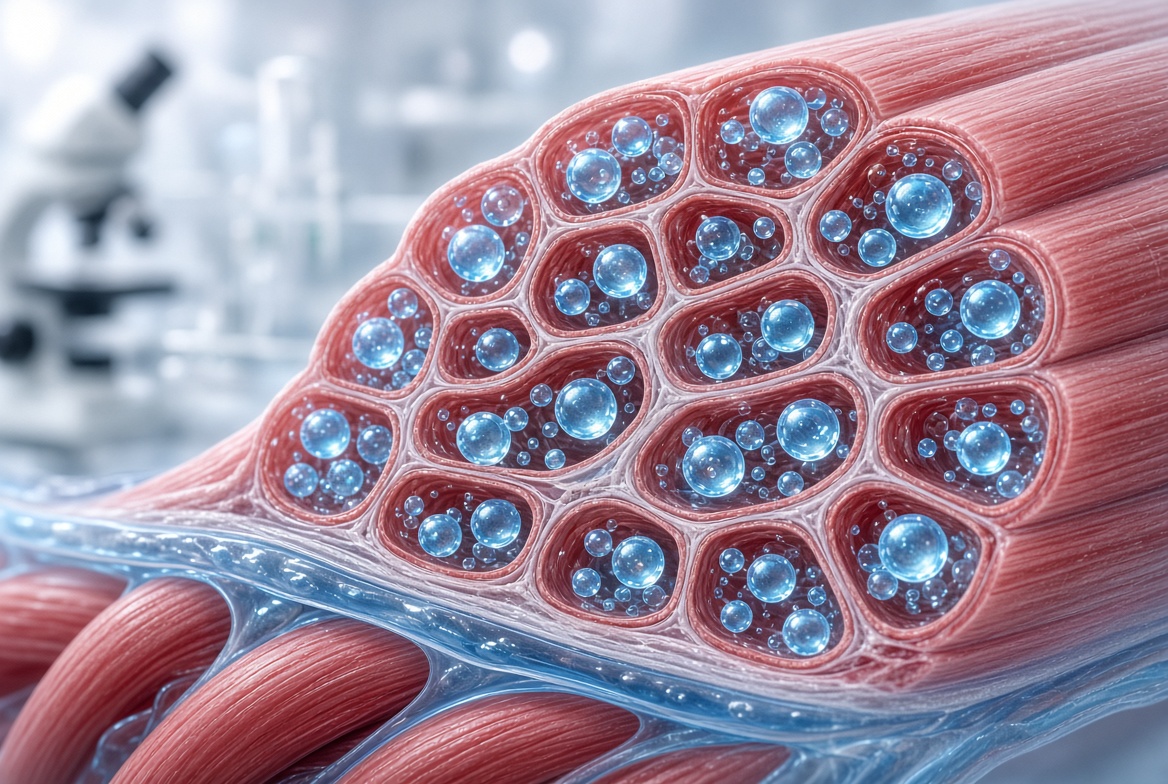
Can the face or body look "flooded"?
Subjective appearance and medical edema are not the same thing. If body mass and total water change, a person may notice a difference in muscle fullness, weight, or appearance. But there is no reason in the creatine studies to interpret typical changes in body water as pathological peripheral edema.
Similarly, there is no guarantee that each person's appearance will remain completely unchanged. The response depends on nutrition, sodium, carbohydrates, menstrual cycle, exercise, initial hydration, and other factors that can alter water independently of creatine.
Water after creatine without confusion
| Concept | Where is the water? | What does increase mean? |
|---|---|---|
| TBW — total body water | All body water | The total amount of water has increased; the indicator itself does not show where it has been distributed |
| ICW — intracellular water | Inside the cells | May increase with changes in intramuscular creatine pool |
| ECW — extracellular water | Outside the cells: plasma and interstitial space | May vary depending on conditions; increased ECW alone does not establish pathological edema |
| Swelling (edema) | Excess fluid in the interstitial space of tissues | Clinical condition with separate mechanisms and causes; not synonymous with increased TBW after creatine |
Why increasing water intake doesn't mean dehydration
An increase in intracellular or total water does not automatically mean that the body has lost its ability to maintain normal hydration. This is a separate issue that has been tested during exercise and in hot environments.
We have separately analyzed data on hydration status, cramps, and thermoregulation in the article on whether creatine is associated with dehydration and cramps. In CR022, we do not duplicate these mechanisms: changing water compartments and the risk of dehydration are different issues.
When swelling should not be attributed to creatine
- severe or persistent swelling of the legs, feet, hands, or face;
- unilateral swelling of a limb, especially with pain, redness, or a feeling of warmth;
- edema along with shortness of breath, chest pain, and a sharp decrease in exercise tolerance;
- rapid unexplained weight gain along with severe tissue swelling;
- the appearance of edema against the background of known heart, kidney, liver diseases or new drug therapy.
Such situations should not be explained solely by a dietary supplement without medical evaluation. The cause of the edema may be completely different and require separate diagnosis.
Frequently asked questions
Does creatine cause water retention?
Creatine may increase total body water and, in some studies, intracellular water. The magnitude and distribution of changes depend on the protocol, duration, and individual characteristics.
Where exactly does water accumulate after creatine?
Some of the changes may be in the intracellular space, especially in muscles, but studies do not show a universal scenario of “all water goes only into the cells.” In some studies, several water compartments were changed.
Does weight gain after creatine mean I gained fat?
No. Rapid weight gain over a few days is often partly due to water weight. A longer-term energy surplus is required to accumulate fat tissue.
Does weight gain mean new muscle?
Neither. Early weight change or DXA lean mass may include water and other non-fat components. Structural hypertrophy develops more slowly and requires training stimulus.
Can creatine cause facial swelling?
The typical increase in body water in studies is not the same as pathological edema. If severe or persistent facial edema occurs, especially along with other symptoms, it should not be automatically attributed to creatine.
Does creatine change water the same in men and women?
Not necessarily. A small 2023 RCT in women showed that changes in TBW, ICF, and ECF varied by cycle phase, so individual response may vary.
Does water in the muscles mean that creatine dehydrates the body?
No. Intracellular water changes do not equal total body water loss. Hydration and thermoregulation are assessed by separate methods.
Sources
- Antonio J. and others (2021). Common questions and misconceptions about creatine supplementation: what does the scientific evidence really show? Journal of the International Society of Sports Nutrition. PubMed
- Powers ME and others. (2003). Creatine Supplementation Increases Total Body Water Without Altering Fluid Distribution. Journal of Athletic Training. PubMed
- Ribeiro AS and others. (2020). Creatine Supplementation Does Not Influence the Ratio Between Intracellular Water and Skeletal Muscle Mass in Resistance-Trained Men. International Journal of Sport Nutrition and Exercise Metabolism. PubMed
- Moore SR and others. (2023). A Randomized Controlled Trial of Changes in Fluid Distribution across Menstrual Phases with Creatine Supplementation. Nutrients. PubMed
- Koirala A. and others. (2023). Etiology and Management of Edema: A Review. Advances in Kidney Disease and Health. PubMed
Dietary supplement. Not a medicine. Consult a doctor before use.
Products related to this post

Related Posts
Comments
Information
Customer Service
Extras
My Account


Sports nutrition manufacturer in Ukraine StarkPharm © 2026