Your shopping cart is empty!

Does Creatine Cause Dehydration and Cramps? Where Does This Myth Come From?
Published: 13/09/2026
Times Read: 571
Comments : 0
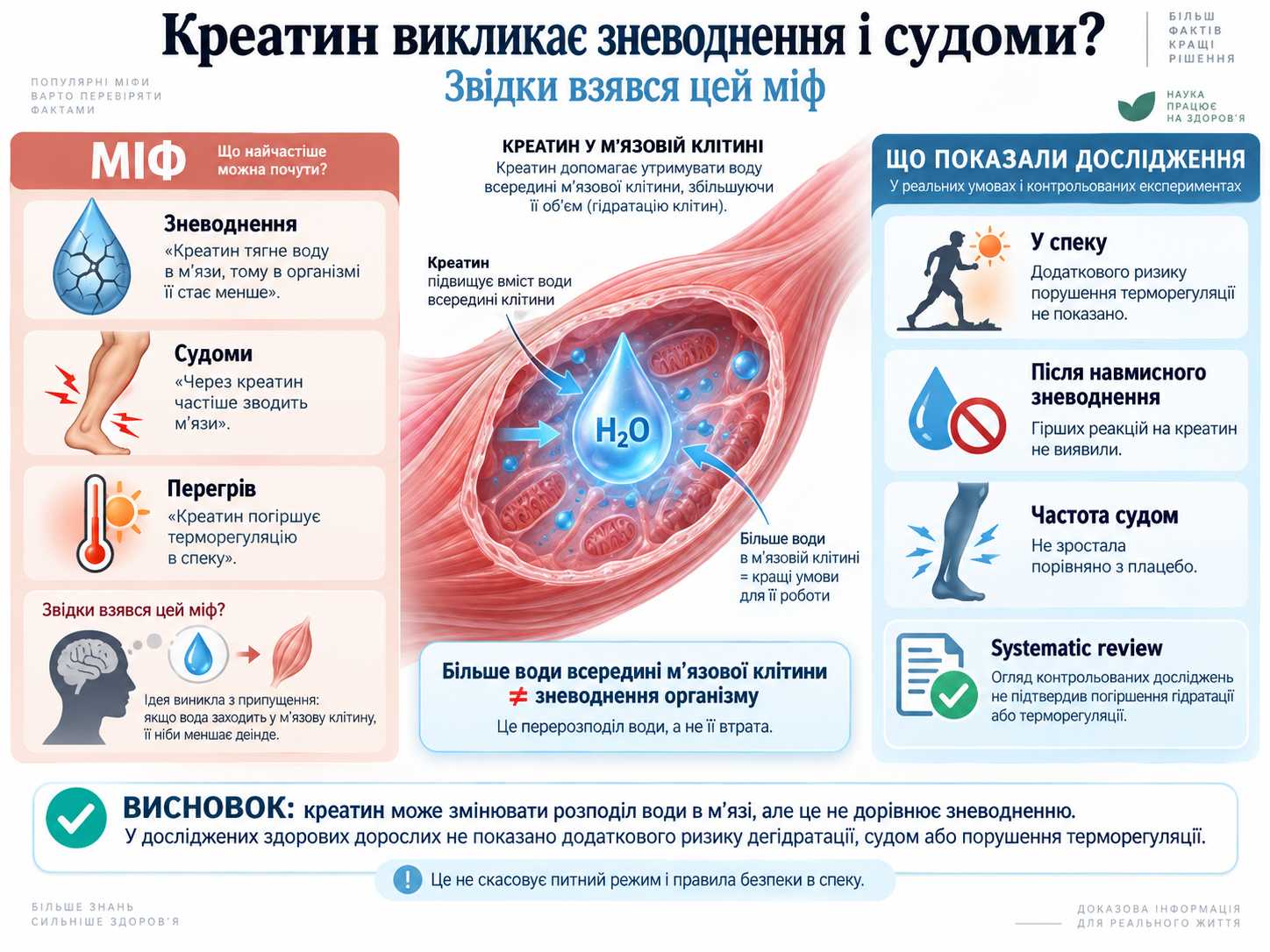
The myth that creatine “pulls water” out of the body, causing dehydration, cramps, and an increased risk of overheating has persisted for decades. At first glance, it seems logical: creatine can increase the amount of water inside muscle cells, so somewhere in the body there must be less of that water. It is from this assumption that much of the early caution grew.
When this hypothesis was tested in controlled studies—during exercise in the heat, after intentional dehydration, and by assessing body temperature, fluid loss, and water balance—the expected negative effects were not found. This does not mean that creatine makes a person invulnerable to heat or that drinking can be ignored. The data only show that creatine supplementation alone did not show an additional risk of dehydration, seizures, or thermoregulation disorders in the healthy adults studied.
Why the idea that creatine "pulls out water" arose
Creatine is an osmotically active substance. When its concentration in a muscle cell increases, intracellular water can increase with it. This has led to a simple, but not entirely correct, interpretation: if water has moved into the muscle, then there must be not enough of it in the plasma or other tissues.
This is why early discussions about creatine were often based on theoretical models rather than direct measurements of dehydration. This was later compounded by reports of athlete cramps and concerns from sports organizations about the use of creatine during intense exercise in hot weather. Dalbo et al. (2008) described how these claims became entrenched despite the lack of a convincing experimental basis.
The basic mechanism of water change in a muscle cell is discussed in more detail in the article on why creatine increases water in a muscle cell. Another important point for the topic of dehydration is that intracellular water movement is not equivalent to water loss by the body.
Intracellular water and dehydration are different concepts
Dehydration refers to a deficiency of total body water relative to needs, most often due to losses through sweat, urine, respiration, or inadequate fluid intake. An increase in water within a muscle cell is a change in its distribution, not automatically a loss of fluid from the body.
In studies of short-term creatine loading, body weight often increased, consistent with water retention. Antonio et al. (2021), reviewing frequently asked questions about creatine, noted that early water retention is primarily related to the intracellular space, but long-term changes in total, intracellular, and extracellular water are not consistent across studies.
The key to the dehydration myth is not whether water distribution changes, but whether hydration status worsens during actual exercise. This is what the work in hot conditions tested.
What happens when you exercise in the heat?
During physical activity in a hot environment, the body must simultaneously maintain blood flow to working muscles and dissipate heat through the skin and sweating. If creatine were indeed pulling a critical volume of water from plasma, it would be logical to expect higher body temperature, worse sweating, or a more rapid deterioration in hydration status.
Kilduff et al. (2004) studied 21 endurance-trained men who performed exercise to exhaustion at temperatures around 30 °C. After seven days of 20 g/day of creatine, intracellular water increased, but thermoregulatory and cardiovascular responses were not impaired. In Mendel et al. (2005), participants performed a 40-minute exercise at 39 °C after five days of 20 g/day; no negative effects on body temperature or other thermoregulatory parameters were found.
These protocols used short, high loading doses, so they should not be translated into a dosage recommendation. For our question, they are important as a stress test of the hypothesis: even under these conditions, the expected deterioration in heat output was not observed.
What a systematic review of hydration research showed
Lopez et al. (2009) systematically reviewed randomized controlled trials that assessed hydration or thermoregulation in the context of creatine. Of the 95 publications found, 15 were relevant to this topic and 10 met the inclusion criteria. The methodological quality of the selected studies was rated 7–10 out of 10 on the PEDro scale.
The overall conclusion of the review was consistent within the available evidence: there was no evidence that creatine impairs the body's ability to dissipate heat or negatively affects water balance in athletes. Controlled trials of exercise in hot weather showed no additional adverse effects on hydration or thermoregulation.
This is a stronger type of evidence than a single study, but it also has a time context: the main trials were relatively small, mostly involving young, healthy men. Therefore, it is correct to speak of no confirmed increased risk in the populations studied, rather than of absolute safety for any person in any setting.
The work of Watson et al. (2006) is particularly instructive because participants were intentionally hypohydrated before a heat test. Twelve active men in a randomized crossover design were given 21.6 g of creatine monohydrate or placebo for seven days. They then lost about 2% of their body weight through exercise at 33.5 °C and underwent an additional 80 min of heat-tolerance testing.
Rectal temperature, heart rate, thirst, hot flashes, and total body weight loss due to dehydration were similar between creatine and placebo. The authors found no increase in heat stress symptoms or worsening of hydration status with creatine.
This doesn't mean that dehydration itself is any less dangerous. The participants still reached a significant fluid deficit. The result just suggests that creatine didn't make the response to this stress noticeably worse.
What about cramps?
Cramps are often automatically attributed to dehydration or electrolyte depletion, but exercise-associated muscle cramps are more complex in nature. Fatigue, neuromuscular control, exercise intensity, previous cramps, and individual predisposition may also play a role. Therefore, even the original scheme of "creatine → dehydration → cramp" is too simplistic.
Data that directly compared seizure frequency did not show an increase in seizure frequency. Greenwood et al. (2003) followed 72 college football players during the season. Thirty-eight voluntarily used creatine, while the others did not. The users group reported fewer seizures, heat illness/dehydration, muscle stiffness, and sprains.
This result should not be interpreted as proof that creatine prevents cramps. The study was open-label and non-randomized: the athletes themselves decided whether to use the supplement, so the groups could differ on other factors. But another important part of testing the myth: field data also did not show a higher incidence of cramps in creatine users.
Myth and what was actually measured
| Assertion | What was checked? | What the data showed |
|---|---|---|
| "Creatine takes water from the body" | Body weight, total and intracellular water, hydration indicators | The increase in intracellular water was not accompanied by evidence of deterioration in overall water balance. |
| "It makes it easier to overheat" | Rectal and skin temperature, thermal sensations, heart rate | Controlled studies in heat have not shown any impairment of thermoregulation. |
| "Creatine prevents normal sweating" | Sweating and body weight changes during exercise | No consistent negative effect was found. |
| "Creatine causes cramps" | Seizure frequency in field and controlled observations | An increase in seizure frequency has not been shown. |
| "Creatine is especially dangerous in the heat" | Hydration status and heat tolerance during exercise in hot environments | A systematic review of controlled studies did not confirm an additional risk. |
Why the absence of additional risk does not cancel the drinking regime
The most dangerous mistake is to replace one myth with another. Just because creatine has not been shown to increase the risk of dehydration, doesn’t mean you can drink less water or ignore the heat during exercise. Fluid loss is determined by temperature, humidity, duration and intensity of exercise, sweat rate, clothing, acclimatization, and access to fluids.
During prolonged or intense exercise in hot environments, the risk of overheating exists regardless of creatine. A person who begins training already dehydrated, works in unusually hot weather, or ignores signs of heat stress is not protected simply because studies have not linked creatine to an additional risk.
Who should not automatically transfer these results?
- Most controlled studies have been conducted in healthy young adults, often male and trained athletes.
- Data should not be automatically extrapolated to children, pregnant women, people with severe chronic diseases or thermoregulatory disorders.
- Medications, kidney disease, cardiovascular conditions, and other factors can individually affect water balance and the response to heat.
- Field observations in athletes do not prove a preventive effect of creatine against seizures or heat illness.
If you have chronic conditions or ongoing medication, decisions about dietary supplements and training in the heat should be discussed with your doctor.
Frequently asked questions
Does creatine cause water retention?
At the beginning of treatment, body weight and intracellular water may increase. This is not the same as edema due to pathological fluid retention, and does not automatically mean dehydration of other tissues.
Can creatine cause dehydration?
Controlled studies and systematic reviews have not shown any impairment of water balance due to creatine in healthy athletes studied. Dehydration can still occur due to insufficient fluid intake, heavy sweating, heat, or prolonged exercise.
Does creatine cause muscle cramps?
The data do not show an increase in the incidence of cramps in creatine users. The causes of exercise-associated muscle cramps are complex and cannot be reduced to water or electrolytes alone.
In controlled trials, exercise in hot environments with creatine was not associated with worse thermoregulation. But heat itself remains a risk factor, so the rules of hydration and thermal safety remain the same.
Do I need to specifically drink a lot more water because of creatine?
Studies do not provide evidence to establish a universal amount of additional water intake through creatine alone. Fluid needs depend on temperature, duration of exercise, sweating, nutrition, and other individual factors.
Does creatine increase body temperature during exercise?
In controlled studies at approximately 30–39 °C, no negative effects on body temperature or ability to dissipate heat have been shown.
Does research mean that creatine protects against seizures and overheating?
No. The absence of increased risk is not evidence of a preventive effect. Creatine is not a substitute for hydration, acclimatization, and normal safety precautions during exercise in the heat.
Sources
- Antonio J. and others (2021). Common questions and misconceptions about creatine supplementation: what does the scientific evidence really show? Journal of the International Society of Sports Nutrition. PubMed
- Lopez RM and others. (2009). Does creatine supplementation hinder exercise heat tolerance or hydration status? A systematic review with meta-analyses. Journal of Athletic Training. PubMed
- Dalbo VJ and others. (2008). Putting to rest the myth of creatine supplementation leading to muscle cramps and dehydration. British Journal of Sports Medicine. PubMed
- Greenwood M. and others. (2003). Cramping and injury incidence in collegiate football players are reduced by creatine supplementation. Journal of Athletic Training. PubMed
- Kilduff LP and others. (2004). The effects of creatine supplementation on cardiovascular, metabolic, and thermoregulatory responses during exercise in the heat in endurance-trained humans. International Journal of Sport Nutrition and Exercise Metabolism. PubMed
- Mendel RW and others. (2005). Effects of creatine on thermoregulatory responses while exercising in the heat. Nutrition. PubMed
- Watson G. and others. (2006). Creatine use and exercise heat tolerance in dehydrated men. Journal of Athletic Training. PubMed
Dietary supplement. Not a medicine. Consult a doctor before use.
Products related to this post

Related Posts
Comments
Information
Customer Service
Extras
My Account


Sports nutrition manufacturer in Ukraine StarkPharm © 2026