Your shopping cart is empty!

Creatine for sleep deprivation: can it support brain function after a sleepless night?
Published: 27/09/2026
Times Read: 622
Comments : 0
After a sleepless night, attention, reaction time, and the ability to perform complex mental tasks usually deteriorate. It is in this situation that creatine has become particularly interesting to researchers: not as a “brain stimulant,” but as a possible additional energy buffer at a time when the nervous system is working under increased load.
Several controlled studies have indeed shown a positive signal: against the background of acute sleep deprivation, creatine partially reduced the deterioration of certain cognitive indicators. But the evidence base is still small, and the most recent positive studies used high single experimental doses, which are not recommended for self-administration.
What happens to the brain with prolonged sleep deprivation?
When a person is sleep-deprived for a long time, the brain continues to remain active despite increasing fatigue. This can impair alertness, processing speed, working memory, and the ability to perform complex, multi-step tasks.
Sleep deprivation also creates a metabolic burden: neural tissue needs to maintain energy balance in a situation where the recovery that normally occurs during sleep is absent. That is why researchers are checking not only behavioral tests, but also indicators of high-energy metabolism in the brain.
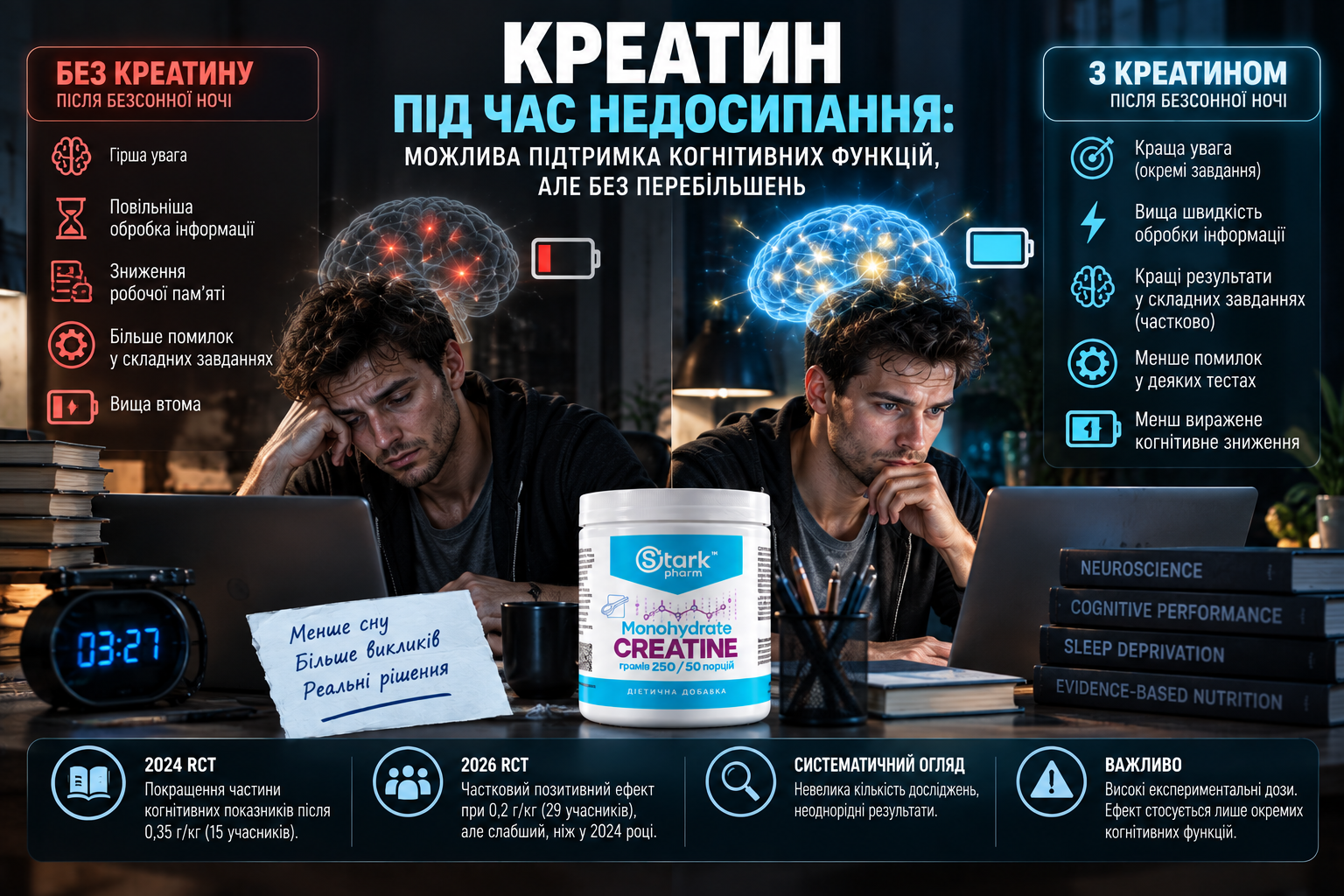
Why did they start testing creatine after a sleepless night?
Phosphocreatine is involved in the rapid regeneration of ATP from ADP and works as a short-term energy buffer. Under normal conditions, the brain has its own mechanisms for synthesizing and regulating creatine, so additional intake does not necessarily have a noticeable functional effect.
During acute sleep deprivation, the situation is different: the energy load is higher, so theoretically, additional creatine supply may be more beneficial. This hypothesis has been tested in studies where cognitive tests were combined with magnetic resonance spectroscopy of the brain.
2024 Research: What exactly was done
Gordji-Nejad et al. (2024) conducted a double-blind, randomized, crossover study in 15 healthy young adults. Each participant received both a creatine and a placebo condition, allowing for comparison of responses within the same individual.
Participants were awake for approximately 21 hours. During the experiment, 0.35 g of creatine per kilogram of body weight was used as a single dose. Measurements were taken at baseline and at several time points after administration.
This is a very high experimental dose. For a 70 kg person, this would be approximately 24.5 g in a single dose. This figure is given in the article only as a characteristic of the research protocol, not as a recommendation.
What has changed in brain energy metabolism?
Using magnetic resonance spectroscopy, the authors assessed phosphocreatine, inorganic phosphate, ATP, total creatine, and indicators of intracellular acid-base status.
During sleep deprivation, these parameters changed, and after creatine, some of the metabolic changes were less pronounced. This supports the mechanistic idea of the study: additional creatine in a state of energy stress may affect the brain's high-energy phosphate system.
Importantly, this is not just a change in a laboratory marker. In the same experiment, the authors also assessed cognitive performance in parallel to test whether the metabolic response was associated with functional changes.
What happened to cognitive performance?
After creatine, some tasks were performed better than after placebo. The most noticeable differences were in information processing speed and certain complex cognitive tasks.
The effect did not mean an improvement in “all brain functions.” Different tests responded differently, and the sample itself was small. Therefore, it is more correct to speak of a partial reduction in the deterioration of individual indicators against the background of sleep deprivation, rather than a universal restoration of cognitive performance.
What the new 2026 study with a lower dose showed
In 2026, the same research team tested whether the effect would be maintained with a lower single dose. The study involved 29 healthy people who also underwent approximately 21 hours of sleep deprivation.
This time, 0.2 g/kg was used. For a 70 kg person, this is approximately 14 g in one dose—still well above normal daily intakes and again, just a characteristic of the laboratory protocol.
The positive signal persisted for some tasks: logical and numerical operations, speed of verbal information processing, and psychomotor alertness. The authors reported that the effect was generally weaker than in the previous study with 0.35 g/kg.
Why the second study is important, but the question is not yet closed
The repeated positive signal is important because it reduces the likelihood that the 2024 result was a chance finding. In addition, the sample size in the new study was almost twice as large.
But 29 participants is still a small study. Both studies were conducted by the same research team, used a very specific scenario of acute laboratory sleep deprivation, and the effect only affected a subset of cognitive tests.
Therefore, even two positive experiments do not yet provide grounds to speak of an established universal effect for all people who lack sleep.
Williams et al. (2026) conducted a systematic review of studies of creatine specifically in acute sleep deprivation. Of the 160 records found, only 5 studies met the inclusion criteria.
The overall trend was encouraging: in some studies, creatine attenuated the decline in cognitive or psychomotor performance. But the results depended on the specific test, the duration of sleep deprivation, and the dosing protocol.
The fact that there are only five direct studies is very important for interpretation. This is an early evidence base, not a closed question with dozens of large independent trials.
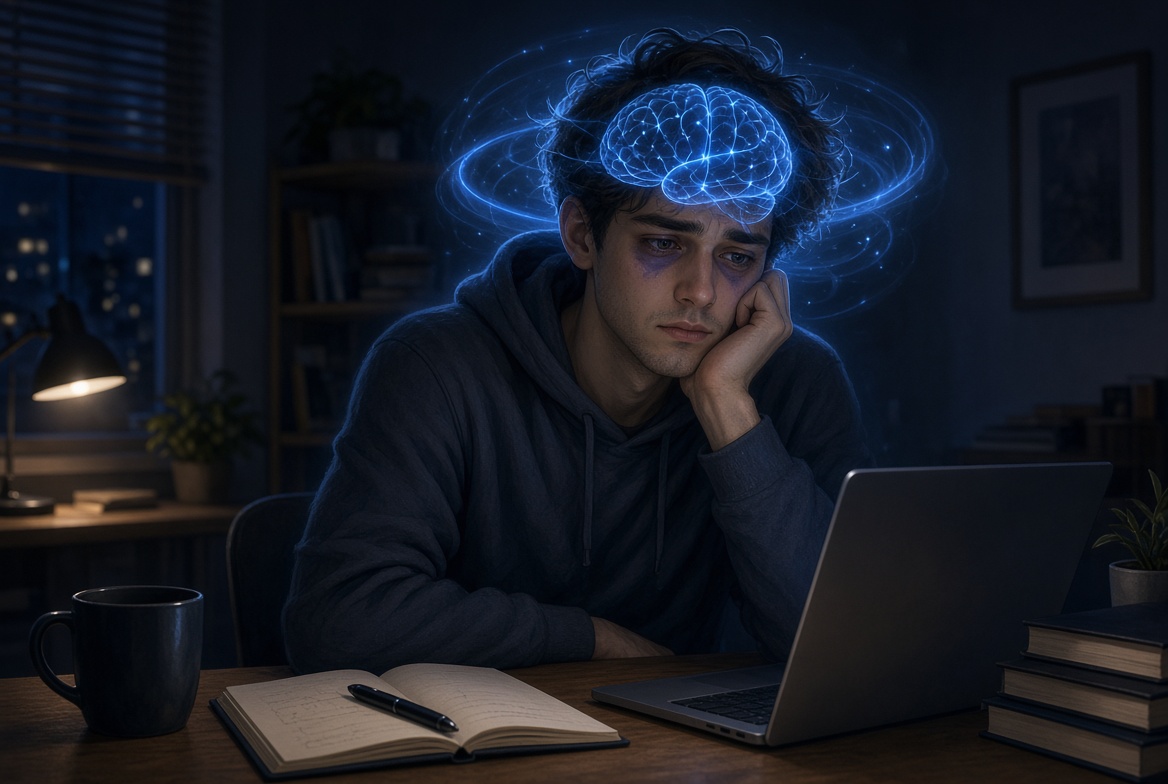
Early positive data appeared as early as 2006
McMorris et al. (2006) investigated the effects of a seven-day pre-treatment with creatine before 24 hours of sleep deprivation, during which participants also performed light exercise.
The study involved 19 young adults. Compared to placebo, creatine reduced impairment in selected tests of random movement generation, reaction time, balance, and mood.
This work was much earlier than modern studies with magnetic resonance spectroscopy, but even then it showed that the effect can manifest itself precisely under conditions of stress, and not necessarily in well-rested healthy people.
What has already been shown and what is still unknown
| Question | What the data shows | Conclusion limit |
|---|---|---|
| Can creatine partially reduce cognitive decline after sleep deprivation? | In several small controlled studies, yes. | The evidence base so far consists of only a few studies. |
| Does the brain's energy metabolism change? | A 2024 study recorded changes in phosphocreatine, ATP, and other indicators | Mechanistic data obtained on a small sample |
| Does a lower single dose work? | In a 2026 study, 0.2 g/kg also gave a positive signal | The effect was weaker, and the sample size was 29 people |
| Do all cognitive functions improve? | No, the positive changes only affected some of the tests. | There is no such thing as universal “brain enhancement” |
| Can creatine replace sleep? | No | None of the studies show this. |
Why a positive result after sleep deprivation does not mean a universal effect
Sleep deprivation is a state of increased metabolic load. That is why a positive result in such a model cannot be automatically transferred to a healthy person who has had enough sleep on a normal day.
In broader studies of memory and other cognitive functions, the results of creatine remain mixed. That is, the “brain under acute energy stress” scenario may be a unique situation where the effect is more likely.
Why creatine shouldn't be called a sleep replacement
Even if some cognitive tests deteriorate less, creatine does not eliminate sleep deprivation itself. It does not restore normal sleep architecture, circadian processes, hormonal changes, or all the physiological consequences of prolonged wakefulness.
The study participants remained sleep-deprived, and the authors only assessed selected metabolic and cognitive measures during a limited laboratory period.
Can these results be transferred to night shifts, studying or driving?
Not directly. A laboratory test of attention or processing speed is not equivalent to the real-world safety of driving a car, operating machinery, or making critical decisions after a sleepless night.
It is especially dangerous to interpret these results as a way to "compensate" for sleep deprivation before an expensive or demanding job. This has not been tested or confirmed by research.
What can be said today?
- There is an early positive signal: in several controlled studies, creatine partially reduced the deterioration of certain cognitive indicators during acute sleep deprivation.
- There is mechanistic support: a 2024 study showed changes in the brain's high-energy phosphate system concomitant with cognitive changes.
- The result was partially repeated in 2026: a lower single dose also gave a positive signal, although the effect was weaker.
- The evidence base is still small: a 2026 systematic review found only five direct studies.
- Creatine does not replace sleep: it does not eliminate all the effects of sleep deprivation and does not make prolonged wakefulness safe.
Frequently asked questions
Can creatine help after a sleepless night?
In a few small controlled studies, creatine has partially reduced the decline in certain cognitive measures during acute sleep deprivation. However, the evidence base is still weak.
Does this mean that creatine replaces sleep?
No. It does not eliminate sleep deprivation, restore normal circadian processes, or reverse all the physiological effects of prolonged wakefulness.
What did the 2024 study show?
In 15 healthy individuals, after approximately 21 hours of sleep deprivation, a single experimental protocol of 0.35 g/kg altered brain energy metabolism and partially improved performance on selected cognitive tests compared to placebo.
What did the 2026 study show?
In 29 healthy subjects, a lower single dose of 0.2 g/kg also partially reduced the deterioration in logical, numerical, and psychomotor tasks, but the effect was weaker.
Should the 0.35 or 0.2 g/kg doses be repeated on one's own?
No. These are high single experimental doses from laboratory protocols, not a recommendation for everyday use.
Does creatine improve all cognitive functions after sleep deprivation?
No. The positive changes only affected some of the tests, so we cannot speak of a complete restoration of cognitive performance.
Can I rely on creatine before a night shift or driving?
No. Laboratory cognitive tests do not prove the safety of driving or operating machinery after sleep deprivation. The most reliable way to recover from sleep deprivation is to sleep.
Sources
- Gordji-Nejad A. and others. (2024). Single dose creatine improves cognitive performance and induces changes in cerebral high energy phosphates during sleep deprivation. Scientific Reports. PubMed
- Gordji-Nejad A. and others. (2026). Single-Dose Creatine Reduces Sleep Deprivation-Induced Deterioration in Cognitive Performance. Nutrients. PubMed
- Williams J. and others. (2026). Creatine supplementation and cognitive performance during acute sleep deprivation: a systematic review. PubMed
- McMorris T. and others. (2006). Effect of creatine supplementation and sleep deprivation, with mild exercise, on cognitive and psychomotor performance, mood state, and plasma concentrations of catecholamines and cortisol. Psychopharmacology. PubMed
- McMorris T. and others. (2024). Creatine supplementation research fails to support the theoretical basis for an effect on cognition: Evidence from a systematic review. Behavioral Brain Research. PubMed
- Candow DG and others. (2026). Creatine Supplementation and the Brain: Have We Put the Cart Before the Horse? Journal of Dietary Supplements. PubMed
Dietary supplement. Not a medicine. Consult a doctor before use.
Products related to this post

Related Posts
Comments
Information
Customer Service
Extras
My Account


Sports nutrition manufacturer in Ukraine StarkPharm © 2026