Your shopping cart is empty!

Creatine for the brain: why does the nervous system need the creatine-phosphocreatine system?
Published: 26/09/2026
Times Read: 529
Comments : 0
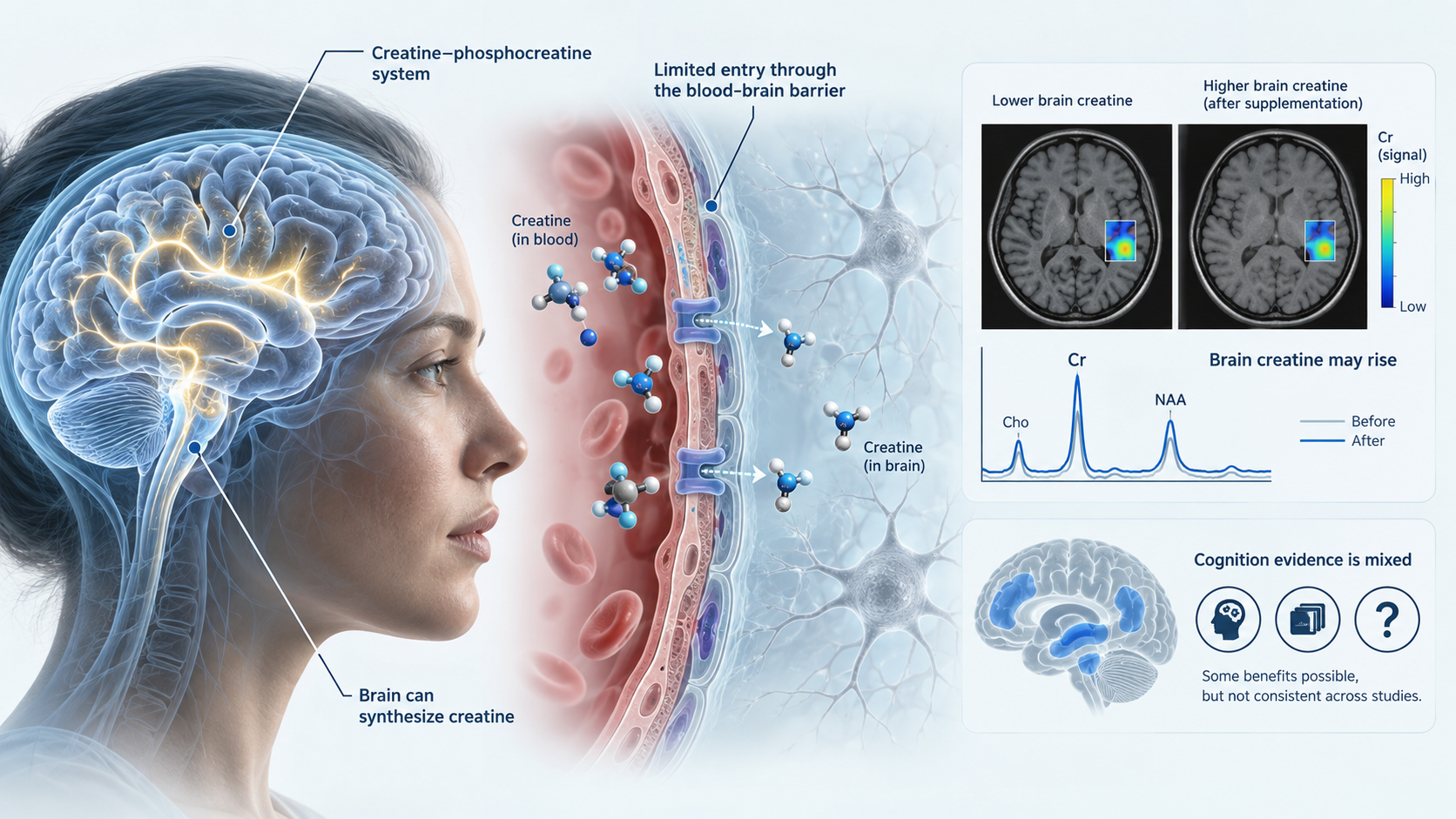
The brain consumes a lot of energy but does not store a large supply of ready-made ATP. Therefore, the nervous system needs mechanisms that help to quickly maintain energy balance when neuronal activity changes dramatically. One of them is the creatine-phosphocreatine system.
This does not mean that additional creatine automatically “gives the brain more energy” or improves memory. The biology here is more complex than in skeletal muscle: the brain synthesizes some creatine itself, its entry from the blood is limited by the blood-brain barrier, and increasing creatine concentration according to magnetic resonance spectroscopy does not yet guarantee better results in cognitive tests.
Why does the brain need the creatine-phosphocreatine system?
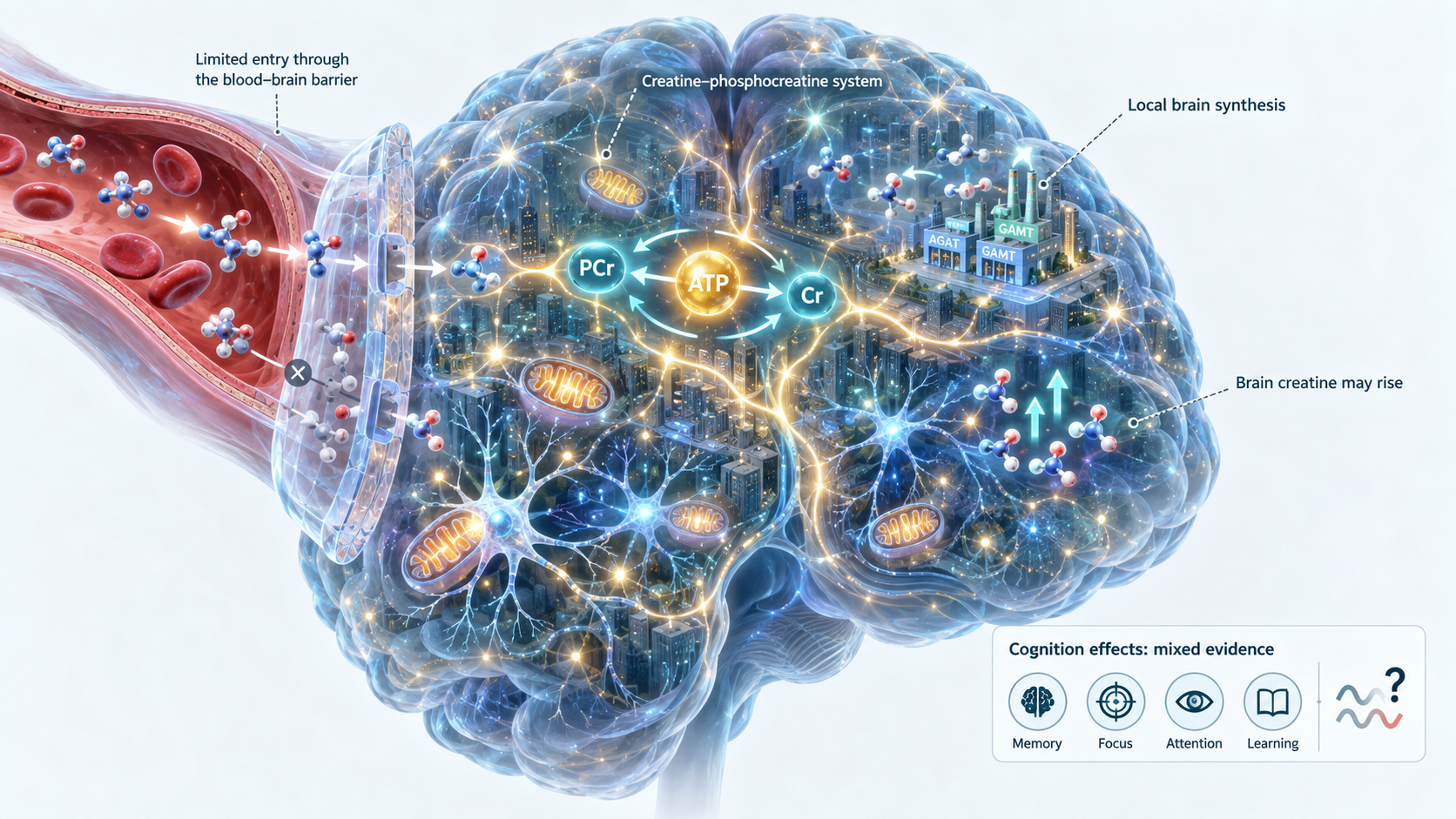
ATP is the main molecule from which the cell directly obtains energy. When ATP gives up a phosphate group, it is converted to ADP. Phosphocreatine can quickly transfer this phosphate group back to ADP and regenerate ATP; the reaction is catalyzed by the enzyme creatine kinase.
Therefore, it is more correct to think of the system not as a separate “fuel” but as a rapid energy buffer. It helps temporarily equalize the difference between the places and moments where ATP is formed and where it is consumed particularly quickly.
This is important for nervous tissue due to its high and variable energy needs: maintaining membrane potential, functioning of ion pumps, signal transmission, and recovery from neuronal activity.
Where does the creatine kinase system work in the nervous system?
Both cytosolic and mitochondrial forms of creatine kinase exist in the brain, allowing us to link energy production in mitochondria to areas of the cell where ATP is needed most immediately.
This spatial and temporal buffer is particularly important for tissues where energy demands can change rapidly. However, the mere presence of this system does not prove that increasing dietary creatine intake will necessarily improve brain function.
The brain synthesizes some of the creatine itself
Previously, brain creatine was often considered to be predominantly a peripherally derived substance. Current data show a more complex picture. The central nervous system expresses the enzymes AGAT and GAMT, which are required for creatine synthesis, as well as the transporter SLC6A8, which is involved in its transfer between cells and from the blood.
Hanna-El-Daher and Braissant describe the brain as a system where creatine synthesis and transport are distributed among different cell types, meaning that the brain pool is not simply a copy of what occurs in the blood or skeletal muscle.
This is why lower dietary creatine intake does not necessarily translate to the same difference in the brain as it does in muscle. We discussed this separately in our article on why lower muscle stores in vegetarians do not translate to the same difference in the brain.
The blood-brain barrier limits the entry of creatine
Creatine from the blood can enter the central nervous system via SLC6A8, but this pathway is limited. Braissant (2012) shows that the transporter is present in the microcapillary endothelial cells of the blood-brain barrier, but its distribution in adjacent cells makes permeability for peripheral creatine much more difficult than simple free passage from the blood to the brain.
Therefore, the brain simultaneously uses two sources: limited peripheral supply and its own synthesis. This is one reason why the brain's response to supplementation is less predictable than that of skeletal muscle.
Is it really possible to increase creatine levels in the brain?
Yes. This has been shown directly by magnetic resonance spectroscopy (MRS) studies. Dechent et al. (1999) gave six healthy volunteers an experimental protocol of 20 g of creatine monohydrate per day for four weeks. On average, total creatine in the brain regions studied increased by approximately 8.7%.
The response was variable: between individuals, the increase ranged from about 3.5 to 13.3%, and between brain regions, from about 4.7% in the gray matter to 14.6% in the thalamus. This clearly shows that “brain creatine” is not a single, uniform measure for the entire brain.
Lyoo et al. (2003) also reported an increase in brain creatine of approximately 8–9% in the frontal region after a two-week experimental protocol. At the same time, some high-energy phosphate parameters were changed by MRS.
These high doses describe specific research protocols and are not recommendations for self-administration.
Why the brain doesn't respond the same way as muscles
In skeletal muscle, the increase in creatine stores after regular intake is reproduced quite reliably. For the brain, the picture is less stable: dose, duration, baseline level, brain region, and even measurement technique are important.
The general muscle mechanism and why stores in skeletal muscle respond more predictably are explained separately in the article on how creatine works in muscles and how the brain differs from them.
Muscle and brain react differently to creatine
| Parameter | Skeletal muscles | Brain |
|---|---|---|
| Creatine intake | Largely through blood and the SLC6A8 transporter | Through blood in limited quantities plus its own synthesis in the CNS |
| Local synthesis | Not a major source of total muscle pool | AGAT and GAMT have an important role in maintaining the brain pool |
| Barrier to entry | There is no analogue to the blood-brain barrier | The blood-brain barrier limits input from the periphery |
| Response to additional revenue | Usually more predictable inventory increases | Smaller, regionally and individually variable response |
| What does increasing inventory mean? | Well-aligned with the mechanism of repeated high-intensity efforts | Does not in itself guarantee improved memory or other cognitive functions |
Higher creatine levels in the brain do not necessarily mean better memory
This is a central limitation of the whole topic. MRS can show that creatine concentration in a particular area has increased, but cognitive function is a much more complex endpoint. Memory, attention, processing speed, and executive functions depend on different neural networks and are not reducible to a single energy marker.
A systematic review by McMorris et al. (2024) confirmed that supplementation can increase brain creatine, but called the results for cognitive function ambiguous. The authors specifically noted that there may be a stronger potential under conditions of metabolic stress, but the designs of the available studies and dosing regimens vary considerably.
A large crossover RCT by Sandkühler et al. (2023) also illustrates the extent of uncertainty. 123 participants received 5 g/day for six weeks. The result was close to statistical significance for the reverse digit series test, not for Raven's matrices, and there was no advantage in most additional cognitive tests. The authors assessed the possible effect as small and warranted further study.
Why the 2024 reviews gave mixed impressions
A meta-analysis by Xu et al. (2024) included 16 RCTs and 492 participants. The authors found small positive mean effects for memory, attention span, and processing speed, but no significant effects on general cognitive function or executive function.
At the same time, EFSA separately assessed the evidence base for the health claim about improving cognitive function in 2024. The panel considered 21 interventional studies and two more recent studies and concluded that a cause-and-effect relationship between creatine consumption and improving one or more cognitive functions had not been established.
One methodological issue that EFSA has highlighted is the way in which multiple related cognitive tests from the same participants are combined in meta-analyses. If such measurements are treated as completely independent, the effective sample size may appear larger than it actually is.
Therefore, the presence of a positive meta-analytic signal for a single domain does not yet constitute sufficient basis for the general statement “creatine improves cognitive function.”
When the effect on the brain seems most plausible
Modern reviews pay special attention to conditions where the brain's energy system is under additional strain: sleep deprivation, prolonged mental fatigue, or hypoxia. Under such conditions, the theoretical value of the phosphocreatine buffer is higher than that of a healthy, well-rested adult during a normal day.
Candow et al. (2026) describe metabolic stress as one of the areas where the results look most interesting. But this does not mean that the effect is the same for all stress conditions or that high experimental doses should be transferred to everyday use.
Sleep deprivation is a prime example, but not a universal rule.
Gordji-Nejad et al. (2024) investigated a single high experimental dose of 0.35 g/kg during 21 hours of sleep deprivation. MRS data showed changes in high-energy phosphate and brain creatine, and some cognitive tests deteriorated less than after placebo.
In 2026, the same research group tested a lower single dose of 0.2 g/kg in 29 healthy participants during the same 21-hour sleep deprivation and also received a signal of benefit on some cognitive measures.
This is an interesting model of "energy stress," but it does not answer the question of whether memory will be better in a person who sleeps normally and takes the usual amount of creatine daily. It is logical to do a detailed analysis of sleep deprivation separately, so we do not transfer these results to everyday cognitive enhancement here.
Why memory, sleep deprivation, and aging need to be addressed separately
That is why CR011 should be a mechanistic hub, not an attempt to close all scenarios with one conclusion. Individual domains require their own RCTs and meta-analyses.
What we know for sure and what we don't yet
- It is well established that the creatine–phosphocreatine system operates in the brain and creatine kinase is involved in rapid buffering of energy metabolism.
- Well-confirmed: the brain has its own mechanisms for creatine synthesis via AGAT and GAMT and uses the SLC6A8 transporter.
- Confirmed in MRS studies: oral creatine can increase its concentration in the brain, but the response is smaller and more variable than in muscle.
- It is not universally established that increasing brain creatine automatically improves memory, attention, or intelligence in healthy adults.
- It is still unknown: the optimal dose and duration specifically for increasing brain creatine and whether different regimens are needed for different cognitive or clinical scenarios.
Frequently asked questions
Is there creatine in the brain?
Yes. Creatine and phosphocreatine are part of the energy buffering system of nervous tissue, and creatine kinase helps to quickly regenerate ATP from ADP.
Does creatine pass through the blood-brain barrier?
Yes, but in limited quantities through the SLC6A8 transporter. The brain also synthesizes some creatine on its own.
Can the brain produce creatine itself?
Yes. The central nervous system expresses the enzymes AGAT and GAMT, which are necessary for creatine synthesis, and transport between cells is also important.
Does taking creatine increase its levels in the brain?
In some MRS studies, yes. For example, classic work showed an average increase of about 8–9%, but the response varied significantly between people and brain regions.
Is creatine proven to improve memory?
No, there is no universal conclusion for all adults. Individual meta-analyses show a small positive signal for memory, but systematic reviews and EFSA point to heterogeneity and methodological limitations of the evidence.
Can creatine help with sleep deprivation?
There are positive RCTs in acute sleep deprivation, where high single experimental doses reduced the deterioration of some cognitive indicators. This does not mean a proven daily cognitive-enhancing effect in sleep-deprived people.
Does creatine work for the brain the same way it does for muscles?
No. The brain has its own synthesis, limited transport across the blood-brain barrier, and a more variable response. Therefore, data from skeletal muscle cannot be mechanically transferred to the nervous system.
Sources
- Candow DG and others. (2026). Creatine Supplementation and the Brain: Have We Put the Cart Before the Horse? Journal of Dietary Supplements. PubMed
- McMorris T. and others. (2024). Creatine supplementation research fails to support the theoretical basis for an effect on cognition: Evidence from a systematic review. Behavioral Brain Research. PubMed
- Xu C. and others. (2024). The effects of creatine supplementation on cognitive function in adults: a systematic review and meta-analysis. Frontiers in Nutrition. PubMed
- EFSA Panel on Nutrition, Novel Foods and Food Allergens (2024). Creatine and improvement in cognitive function: Evaluation of a health claim pursuant to Article 13(5) of Regulation (EC) No. 1924/2006. EFSA Journal. PubMed
- Roschel H. and others. (2021). Creatine Supplementation and Brain Health. Nutrients. PubMed
- Braissant O. (2012). Creatine and guanidinoacetate transport at blood-brain and blood-cerebrospinal fluid barriers. Journal of Inherited Metabolic Disease. PubMed
- Hanna-El-Daher L., Braissant O. (2016). Creatine synthesis and exchanges between brain cells: What can be learned from human creatine deficiencies and various experimental models? Amino Acids. PubMed
- Dechent P. and others. (1999). Increase of total creatine in human brain after oral supplementation of creatine monohydrate. American Journal of Physiology. PubMed
- Lyoo IK and others. (2003). Multinuclear magnetic resonance spectroscopy of high-energy phosphate metabolites in human brain following oral supplementation of creatine monohydrate. Psychiatry Research. PubMed
- Sandkühler JF and others. (2023). The effects of creatine supplementation on cognitive performance — a randomized controlled study. BMC Medicine. PubMed
- Gordji-Nejad A. and others. (2024). Single dose creatine improves cognitive performance and induces changes in cerebral high energy phosphates during sleep deprivation. Scientific Reports. PubMed
- Gordji-Nejad A. and others. (2026). Single-Dose Creatine Reduces Sleep Deprivation-Induced Deterioration in Cognitive Performance. Nutrients. PubMed
Dietary supplement. Not a medicine. Consult a doctor before use.
Products related to this post

Related Posts
Comments
Information
Customer Service
Extras
My Account


Sports nutrition manufacturer in Ukraine StarkPharm © 2026