Your shopping cart is empty!

Creatine for memory and cognitive function: what clinical studies show
Published: 26/09/2026
Times Read: 467
Comments : 0
Creatine is often touted as a potential “nootropic,” but that label is ahead of the evidence. There are positive signals in clinical trials for certain types of memory, attention, and processing speed, but results are inconsistent across studies, populations, and tests.
The most important thing is not to lump all cognitive functions into one measure. A positive result on a working memory test does not automatically mean improved executive functions, attention, or “general intelligence.” This is why modern meta-analyses can look positive for one domain and neutral for another.

“Cognitive function” is not just one indicator
Clinical studies of creatine have assessed working and long-term memory, attention, reaction time, information processing speed, logical reasoning, and executive function. These tests measure different processes and are not interchangeable.
Therefore, the statement “creatine improves cognitive function” is too broad if a positive result is obtained in only one or two tests. A strong general conclusion requires reproducibility of results across studies and across validated cognitive domains.
What the 2024 meta-analysis showed
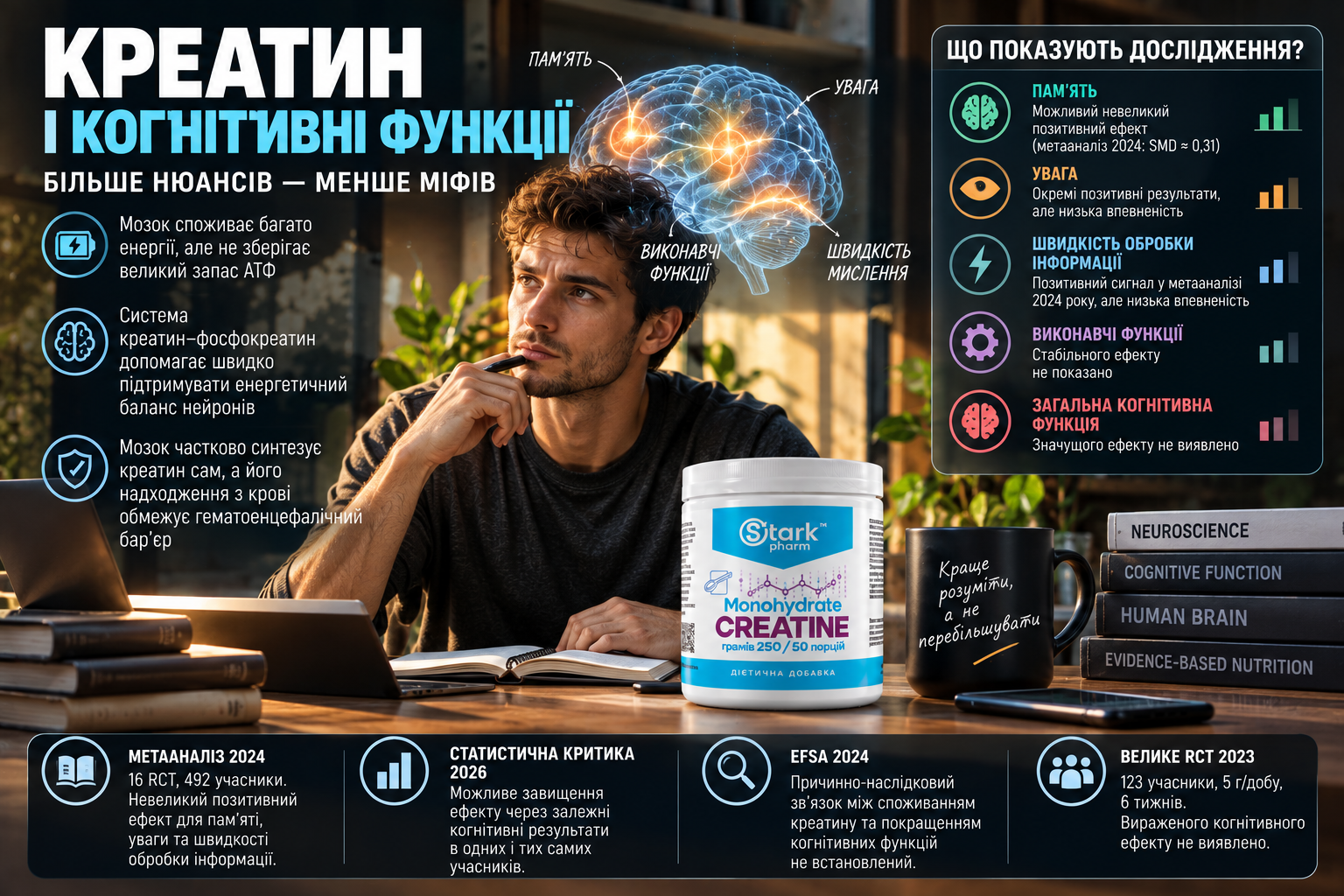
Xu et al. (2024) included 16 randomized controlled trials with 492 participants. For memory, the authors found a small positive effect: the standardized mean difference (standardized mean difference) was approximately 0.31.
Positive results were also obtained for attention span and processing speed, but there was no significant effect on general cognitive function or executive function.
The authors rated the certainty of the evidence for memory as moderate, but for a number of other measures as low. A correction was published to the article in 2025, so it is correct to refer to the corrected version of the meta-analysis.
Why the positive result of a meta-analysis should be read with caution
Cognitive studies often use multiple tests on the same participants. For example, a group may perform multiple memory tasks, each of which produces a separate numerical result. These results are correlated, so they cannot always be interpreted as if they came from different independent individuals.
Furthermore, the included studies varied in terms of participant age, diet, duration of supplementation, doses, and the cognitive tests themselves. As a result, the pooled effect describes a very heterogeneous set of experiments.
What the statistical criticism of 2026 changed
Citherlet (2026) separately analyzed the methodology of Xu's meta-analysis and the previous memory meta-analysis. The main observation was that multiple related cognitive outcomes from the same participants could be erroneously counted as independent effect estimates.
This approach can artificially increase the effective sample size and make confidence intervals narrower than they should be. The author of the critical analysis recommended using multilevel models or other statistical methods that take into account the dependence between the results.
For the reader, this does not mean that the positive signal for memory has been "disproven," but that its exact magnitude and statistical reliability are less certain than a single summary figure might suggest.
The 2024 systematic review was much more restrained
McMorris et al. (2024) conducted a systematic review focusing on whether cognitive outcomes were consistent with the theoretical model of increasing brain creatine. The authors agreed that supplementation may increase brain creatine concentrations, but described the findings on cognitive function as equivocal.
The data for healthy young people without additional stress were particularly weak. The authors considered populations where the energetic load on the brain is potentially higher—for example, with sleep deprivation, hypoxia, or in older age—to be more promising.
What EFSA said after assessing the evidence base
In 2024, EFSA assessed the claim that creatine improves cognitive function. The panel considered 21 intervention studies, as well as more recent work available at the time of the assessment.
Some studies have shown positive results—for example, for working memory or inhibitory control at high, short-term experimental doses. But these effects have not been consistently reproduced in other studies and cognitive domains.
The overall conclusion of EFSA was clear: a cause-and-effect relationship between creatine consumption and the improvement of one or more cognitive functions has not been established by the available data.
A large randomized trial in 2023 is a useful reality check
Sandkühler et al. (2023) conducted the largest randomized trial of creatine and cognitive performance to date. 123 participants participated in a double-blind crossover trial of 5 g of creatine per day for six weeks with a matching placebo period.
There was also no convincing advantage in eight additional exploratory cognitive tests. Therefore, the authors did not find strong evidence for a large universal effect and assessed the possible cognitive impact as small.
Why early positive studies became so famous
Rae et al. (2003) studied 45 young vegetarian adults in a double-blind crossover design. After 5 g of creatine per day for six weeks, there were improvements in the Reverse Digit Row and Raven's Matrices tests. This has become one of the most well-known arguments in favor of a cognitive effect.
Benton and Donohoe (2011) studied 128 young women, some of whom were vegetarians. A brief five-day protocol did not affect verbal speed or alertness, but memory improved in vegetarians but not in omnivorous participants.
This work has led to the hypothesis that people with lower dietary intake of creatine may respond more strongly. However, subsequent large studies have not confirmed a universally greater effect in vegetarians. This is discussed in more detail in why vegetarians don't necessarily respond more.
What the data shows in older people
Results in older samples are also mixed. McMorris et al. (2007) in a short study of older adults found improvements in most of the used tests of memory and cognitive performance after creatine.
But Alves et al. (2013) conducted a 24-week randomized, double-blind study in older women with groups of “creatine,” “placebo,” “creatine + resistance training,” and “placebo + training.” Neither creatine regimen provided a significant additional benefit on a comprehensive battery of memory, selective attention, and inhibitory control tasks.
Therefore, older age may be an interesting subgroup, but the available data is not sufficient to call creatine a proven tool for supporting memory in aging.
A new randomized controlled trial in 2026 also showed no cognitive benefit
In 2026, a study of 40 young, healthy, physically active men and women tested a short, one-week protocol of 20 grams of creatine per day. Physical performance on the 30-second Wingate test improved, but Stroop and route-finding tests were unchanged.
This example is particularly useful for interpretation: the same scheme can produce a distinct physical effect and at the same time not produce a measurable cognitive effect.
What is better confirmed and what is weaker
| Cognitive domain | What current data shows | How confident is the conclusion? |
|---|---|---|
| Memory | Meta-analyses yield a small positive average signal | Possible effect, but its accuracy is limited by heterogeneity and the problem of dependent outcomes |
| WARNING | There are some positive results, but they are not consistently reproduced. | Low confidence |
| Information processing speed | A 2024 meta-analysis showed a positive signal | Low confidence |
| Executive functions | No stable overall effect shown | Not confirmed |
| General cognitive function | There was no significant pooled effect in the 2024 meta-analysis | Not confirmed |
Why there is no one "right dose for memory"
Cognitive studies have used very different regimens, with some using 5 g/day for several weeks, others using short protocols of 20 g/day, and some metabolic stress experiments using weight-dependent single doses.
These schemes were created for specific research questions and do not provide grounds for forming a universal “cognitive dose.” It is especially incorrect to transfer high short experimental protocols to everyday use.

Who may be more likely to be affected?
The literature most often discusses older adults, vegetarians, people with sleep deprivation, and other conditions with potentially higher energy demands on the brain. But the evidence base is different for each of these groups.
Therefore, it is more correct to consider these subgroups as a direction for separate studies, rather than as an already proven list of people for whom creatine "definitely improves memory."
What can really be said today?
- There is a possible small positive signal for memory , but the exact effect size is less reliable due to study heterogeneity and dependent cognitive outcomes.
- No consistent positive effect has been shown for executive functions and general cognitive function.
- Some positive randomized controlled trials exist, but alongside them are large or long-term studies with no significant benefit.
- Vegetarianism, older age, and metabolic stress remain interesting potential effect modifiers but do not guarantee a response.
- Creatine should not be presented as a proven universal nootropic or as a treatment for cognitive impairment.
Frequently asked questions
Does creatine improve memory?
Meta-analyses show a small positive mean signal for memory, but their precision is limited by study heterogeneity and methodological issues. Therefore, there is no universally proven effect for all healthy adults.
Does creatine improve attention?
Individual studies and a 2024 meta-analysis have provided a positive signal for attention span, but the certainty of the evidence is low and the results are not consistently reproducible.
Does creatine improve thinking speed?
There is a small positive signal for information processing speed, but it does not mean an overall increase in intelligence or all cognitive functions.
Is creatine a proven nootropic?
No. EFSA concluded in 2024 that a cause-and-effect relationship between creatine consumption and the improvement of one or more cognitive functions has not been established.
Does creatine have a stronger effect on memory in vegetarians?
Early studies gave such a signal, but later data do not support a universally greater cognitive response in vegetarians.
Could creatine be more beneficial in older age?
Some early studies and subgroup analyses are positive, but there are also long-term randomized controlled trials with no cognitive benefit. So this is a promising but not yet closed topic.
Is there a set dose of creatine specifically for memory?
No. Studies have used very different protocols, and to date there is no universal dose that has been proven to consistently improve memory or other cognitive functions.
Sources
- Xu C. and others. (2024). The effects of creatine supplementation on cognitive function in adults: a systematic review and meta-analysis. Frontiers in Nutrition. PubMed
- Xu C. and others. (2025). Corrigendum: The effects of creatine supplementation on cognitive function in adults: a systematic review and meta-analysis. Frontiers in Nutrition. PubMed
- Citherlet T. (2026). Commentary: The effects of creatine supplementation on cognitive function in adults: a systematic review and meta-analysis. Frontiers in Nutrition. PubMed
- McMorris T. and others. (2024). Creatine supplementation research fails to support the theoretical basis for an effect on cognition: Evidence from a systematic review. Behavioral Brain Research. PubMed
- EFSA Panel on Nutrition, Novel Foods and Food Allergens (2024). Creatine and improvement in cognitive function: Evaluation of a health claim pursuant to Article 13(5) of Regulation (EC) No. 1924/2006. EFSA Journal. PubMed
- Sandkühler JF and others. (2023). The effects of creatine supplementation on cognitive performance — a randomized controlled study. BMC Medicine. PubMed
- Prokopidis K. and others. (2023). Effects of creatine supplementation on memory in healthy individuals: a systematic review and meta-analysis of randomized controlled trials. Nutrition Reviews. PubMed
- Rae C. and others. (2003). Oral creatine monohydrate supplementation improves brain performance: a double-blind, placebo-controlled, cross-over trial. Proceedings of the Royal Society B. PubMed
- Benton D., Donohoe R. (2011). The influence of creatine supplementation on the cognitive functioning of vegetarians and omnivores. British Journal of Nutrition. PubMed
- McMorris T. and others. (2007). Creatine supplementation and cognitive performance in elderly individuals. Aging, Neuropsychology, and Cognition. PubMed
- Alves CRR and others. (2013). Creatine supplementation associated or not with strength training upon emotional and cognitive measures in older women: a randomized double-blind study. PLOS ONE. PubMed
- Creatine monohydrate improved cycling Wingate performance but not cognitive function in young active males and females (2026). PubMed
Dietary supplement. Not a medicine. Consult a doctor before use.
Products related to this post

Related Posts
Comments
Information
Customer Service
Extras
My Account


Sports nutrition manufacturer in Ukraine StarkPharm © 2026