Your shopping cart is empty!

Creatine after menopause: muscle, strength, and bone tissue
Published: 26/09/2026
Times Read: 2922
Comments : 0
It's not just hormones that change after menopause. As you age and estrogen levels decline, your muscle mass, strength, and bone mass can gradually change. But these are three different endpoints, and creatine studies don't give an equally strong signal for each of them.
The most recent meta-analysis of postmenopausal women showed a small additional benefit in lean mass and strength, especially when creatine was combined with resistance training. However, no overall significant improvement in bone mineral density was found. Therefore, creatine after menopause should be considered not as a “bone supplement” but as a separate issue regarding muscle adaptations to training.
Why postmenopause is a separate population
After menopause, the hormonal environment changes, and with age, strength loss, muscle loss, and bone changes can accelerate. Therefore, results from young, active women cannot automatically be transferred to the postmenopausal period.
We have separately reviewed the overall female evidence base in our article on what is known about the effects of creatine in women in general. In this article, we focus only on postmenopausal women and studies that assessed muscle, strength, physical function, and bone parameters.
What the 2026 meta-analysis showed
Naddafha et al. (2026) pooled 7 randomized controlled trials with 608 postmenopausal women. The mean age of participants was approximately 62 years and the duration of interventions ranged from 12 to 104 weeks.
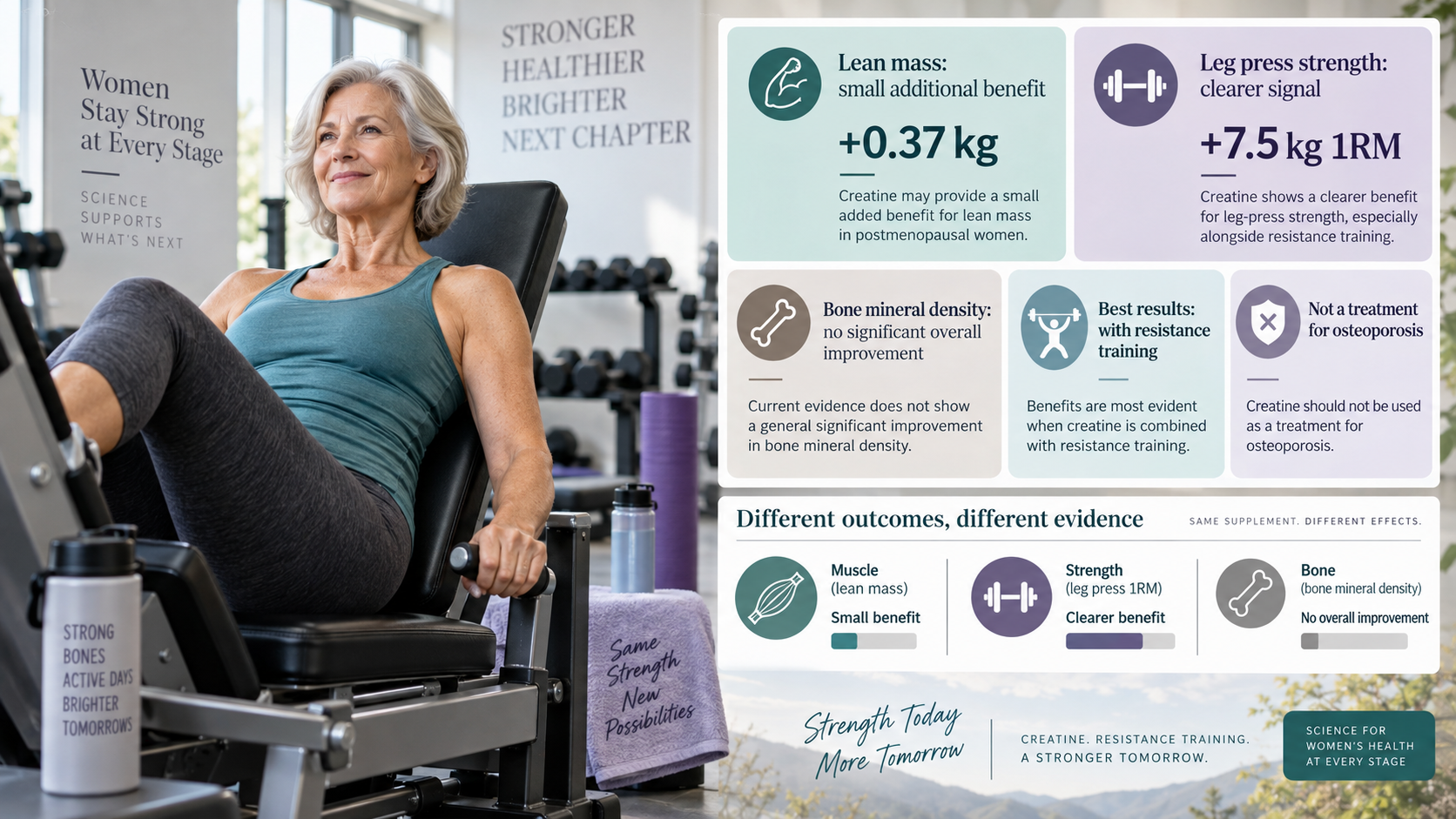
For lean mass, creatine produced a mean additional difference of approximately +0.37 kg compared with control. The 95% confidence interval was approximately +0.05 to +0.69 kg. Heterogeneity was low, but the prediction interval included the possibility of very small or no effect in a future, separate study.
The signal was stronger for strength: for the one-rep maximum in the leg press, the mean between-group difference was approximately +7.5 kg, with a 95% confidence interval of +2.2 to +12.8 kg. There was virtually no statistical heterogeneity in this analysis.
However, bone mineral density did not improve overall. This is an important distinction: a positive strength result does not automatically mean a benefit for BMD.
What does +0.37 kg of lean mass mean?
Lean mass is not the same as “net new muscle tissue.” In DXA measurements, it includes all non-fat soft tissue, and water can also affect the result. Therefore, the +0.37 kg from the meta-analysis should not be reported as +0.37 kg of new muscle fibers.
However, the direction of the effect was positive, and studies with creatine and resistance training were more likely to yield better results than studies without resistance training, consistent with the idea that creatine may complement, but not replace, training adaptations.
Force looks more convincing than mass change
The leg press performance in the 2026 meta-analysis was based on three studies with a total of 111 participants. The average additional 1RM gain of about 7.5 kg is a notable group effect, but not predictive for an individual woman.
Results vary based on initial strength, training experience, program, duration, and commitment to the exercise. Therefore, it is not expected that every postmenopausal woman will gain exactly 15 pounds on a particular exercise machine.
Some RCTs support this trend. In a study by Aguiar et al. (2013), 18 women with a mean age of about 65 years performed resistance training for 12 weeks; the creatine group showed greater increases in several 1RM tests, training volume, lean and muscle mass, and better results on some functional tests.
Why the best signal occurs with strength training
In a 2026 meta-analysis, positive results were most evident in studies that combined creatine with resistance training, while lower doses without a training program showed no measurable benefit.
This should not be interpreted as a dosage recommendation. The studies varied in dose, training, and duration, so it is impossible to say that a single dose figure explains the result.
Gualano et al. (2014) used a factorial design in older vulnerable women: creatine without training, placebo without training, creatine + resistance training, and placebo + resistance training. The best gains in lean mass and some strength parameters were observed in the creatine + training group.
What do bone tissue studies show?
Bone is the weakest area for marketing hype on this topic. A 2026 meta-analysis found no overall significant improvement in bone mineral density.
There was also no additional benefit in microarchitecture, bone markers, number of falls and fractures, lean mass, or muscle function. This is an important negative result because it shows that creatine alone did not demonstrate an osteogenic effect in this population.
Why some bone studies still look interesting
In a 12-month RCT by Chilibeck et al. (2015), postmenopausal women who performed strength training three times a week and received either creatine or placebo experienced less loss of femoral neck BMD in the creatine group and also improved one of the femoral geometric measures related to flexion resistance.
However, a larger 2-year RCT in 2023 of 237 postmenopausal women did not show any benefit for BMD at the femoral neck, total hip, or lumbar spine. However, creatine did appear to better preserve some geometric characteristics of the femoral neck, including section modulus and buckling ratio.
These geometric measures are interesting, but they are not the same as BMD and are certainly not direct evidence of reduced fracture risk. Therefore, the correct wording is “separate signals by bone geometry” rather than “creatine strengthens bones.”
Where the data is stronger and where it is weaker
| Indicator | What current data shows | How to interpret this |
|---|---|---|
| Lean mass | Meta-analysis 2026: approximately +0.37 kg | Small additional benefit; does not equal +0.37 kg of lean muscle tissue |
| Leg press 1RM | Meta-analysis 2026: approximately +7.5 kg | The clearest power signal, but this is the average between-group difference |
| Bone mineral density | No significant overall benefit shown | There is no basis for claiming to treat or prevent osteoporosis |
| Bone geometry | Individual long-term RCTs have shown positive changes in some parameters | A promising sign, but it's not the same as improved BMD or fewer fractures |
| Physical function | There are positive individual results, but the evidence base is smaller and heterogeneous | The conclusion is weaker than for strength |
Why this article is not about treating osteoporosis or sarcopenia
Postmenopause does not in itself mean diagnosed osteoporosis or sarcopenia. There are separate diagnostic criteria, risk assessments, and medical approaches to treatment for these conditions.
Even if creatine, when combined with resistance training, provides a small additional gain in strength or lean mass, this does not make it a treatment for sarcopenia. Similarly, the lack of overall improvement in BMD does not make it a treatment or prevention of osteoporosis.
To whom these results cannot be transferred automatically
- Women with diagnosed osteoporosis, pathological fractures, or high risk of fractures without separate medical evaluation.
- Women with severe frailty, diagnosed sarcopenia, or significant functional limitations, if the specific population did not match the study participants.
- People with severe chronic diseases or complex ongoing drug therapy without consulting a doctor.
- You should not transfer the average group figures of +0.37 kg or +7.5 kg to a specific person as a prediction.
- Doses from individual RCTs describe research protocols and are not a universal regimen for self-administration.
If you have already been diagnosed with osteoporosis, have had a fracture, have significant functional impairment, or other chronic conditions, decisions regarding supplements and strength training should be discussed with your doctor.
Frequently asked questions
Does creatine help after menopause?
A 2026 meta-analysis found small additional gains in lean mass and strength, especially in studies where creatine was combined with strength training.
Does creatine increase muscle mass after menopause?
Lean mass in the meta-analysis was on average about 0.37 kg higher. This does not mean 0.37 kg of net new muscle tissue, as DXA assesses all non-fat soft tissue.
Does creatine increase strength after menopause?
For example, for the 1RM leg press, a 2026 meta-analysis found an average additional benefit of approximately 15 pounds. This is a group average difference, not a prediction for a specific individual.
Does creatine improve bone mineral density?
Overall, no: current meta-analyses and large long-term RCTs have not shown consistent improvements in BMD. Individual studies have provided signals by bone geometry, but that is a different endpoint.
Can creatine be used instead of strength training?
No. The best positive results in postmenopausal women were obtained against the background of strength training, and a large 2-year study without such a program showed no additional muscle or bone effect.
Does creatine prevent osteoporosis?
This conclusion is not supported by the data. No overall improvement in BMD has been shown, and the studies do not support the use of creatine as a means of preventing or treating osteoporosis.
Does creatine work the same without strength training?
No. In a 2026 meta-analysis, the best signals were in studies with strength training, while studies without it did not show the same benefit.
Sources
- Naddafha S. and others. (2026). Creatine monohydrate for lean mass, strength, and bone density in postmenopausal women: a systematic review and meta-analysis. PubMed
- Aguiar AF and others. (2013). Long-term creatine supplementation improves muscular performance during resistance training in older women. European Journal of Applied Physiology. PubMed
- Gualano B. and others. (2014). Creatine supplementation and resistance training in vulnerable older women: a randomized double-blind placebo-controlled clinical trial. Experimental Gerontology. PubMed
- Chilibeck PD and others. (2015). Effects of Creatine and Resistance Training on Bone Health in Postmenopausal Women. Medicine & Science in Sports & Exercise. PubMed
- Gualano B. and others. (2019). Creatine Supplementation (3 g/d) and Bone Health in Older Women: A 2-Year, Randomized, Placebo-Controlled Trial. Journals of Gerontology: Series A. PubMed
- Chilibeck PD and others. (2023). A 2-yr Randomized Controlled Trial on Creatine Supplementation During Exercise for Postmenopausal Bone Health. Medicine & Science in Sports & Exercise. PubMed
- Ryan AS and others. (2025). Creatine in women's health: bridging the gap from menstruation through pregnancy to menopause. PubMed
Dietary supplement. Not a medicine. Consult a doctor before use.
Products related to this post

Related Posts
Comments
Information
Customer Service
Extras
My Account


Sports nutrition manufacturer in Ukraine StarkPharm © 2026