Your shopping cart is empty!

Creatine after 50–60 years: muscle mass, strength and age-related muscle loss
Published: 18/09/2026
Times Read: 359
Comments : 0
After 50–60 years, changes in the muscular system become more noticeable: with age, strength, muscle mass, and the ability to perform familiar movements with the same ease may decrease. But these indicators do not change equally and do not mean the same thing. A person can lose strength faster than muscle mass, and functional capabilities depend not only on muscle size.
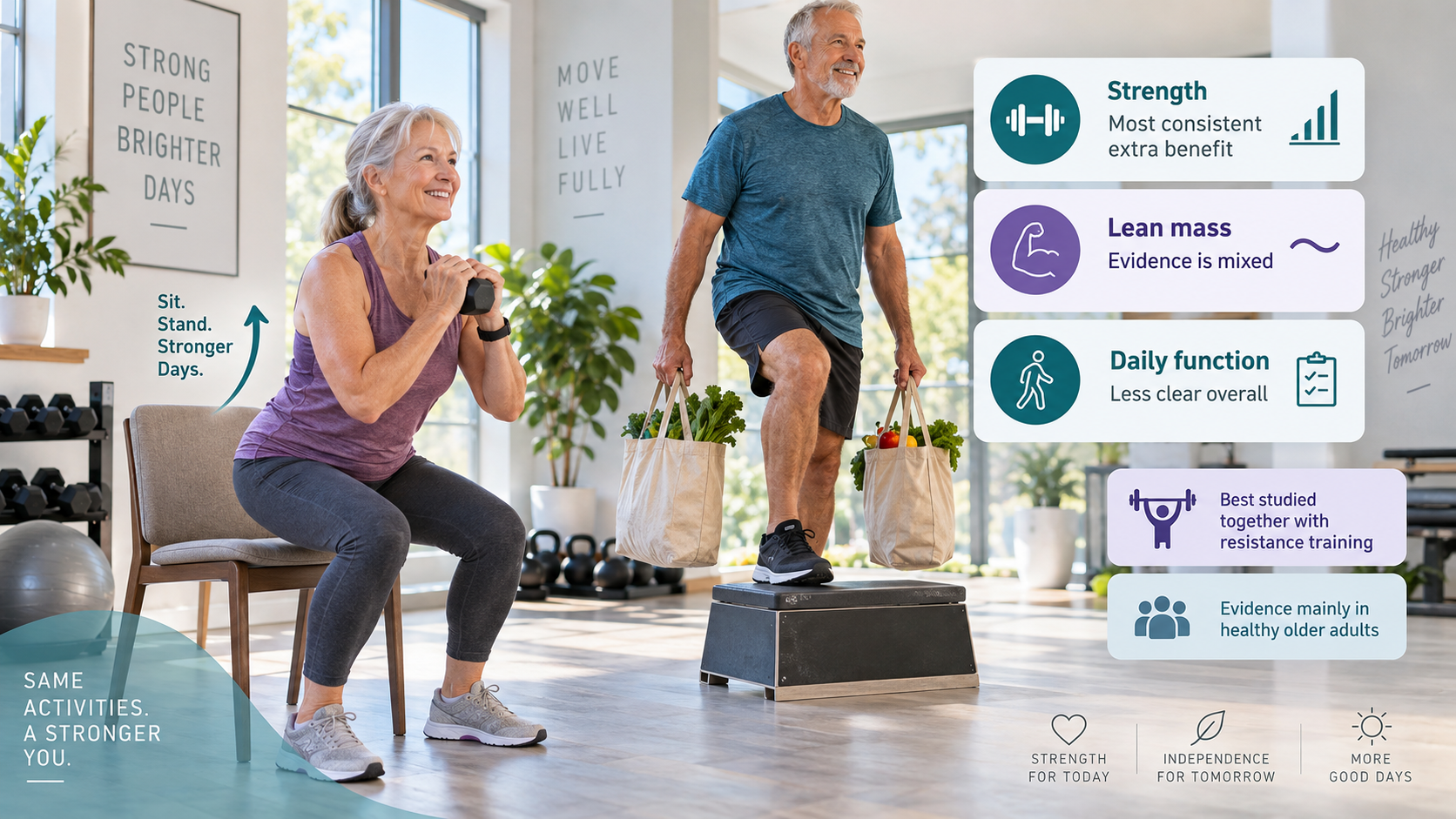
Creatine has been studied primarily in this age group, not by itself, but in conjunction with resistance training. Therefore, the correct question is whether creatine provides an additional benefit over and above the adaptations already provided by regular resistance training. The most recent meta-analyses show that the most consistent signal is for strength, while the data on muscle mass and physical function are less clear.
Muscle mass, strength and physical function — different results
Studies of older adults often assess multiple measures at once. Lean mass reflects all non-fat tissue and is not a direct measure of contractile muscle fibers alone. Strength is usually assessed by one-repetition maximum (1RM) or other standardized tests. Physical function is the ability to perform motor tasks, such as rising from a chair, walking, or other tests of daily functioning.
Therefore, a positive result on one measure does not guarantee the same effect on others. It is this difference that explains why one meta-analysis may find an additional increase in strength but not confirm a statistically significant difference in muscle mass or functional tests.
Why creatine is being studied in older adults along with strength training
Strength training itself is a powerful stimulus for maintaining and developing strength and muscle tissue. That's why in most controlled studies, both groups perform the same training program, and the only difference is creatine or placebo.
This design allows us to assess the additive effect of creatine, rather than comparing supplementation with no exercise. We have discussed the general mechanism by which creatine supplements resistance training; what is more important here is the extent to which this additive effect is confirmed specifically in older adults.
The strongest modern signal is an additional increase in strength
The most recent three-level meta-analysis from 2026 pooled randomized controlled trials in generally healthy older adults. Creatine plus resistance training had a small additional effect on muscle strength compared with the same training without creatine; the standardized effect size was approximately 0.31.
The authors assessed the certainty of this result as moderate. However, they explicitly cautioned that the conclusion should not be automatically extrapolated to people with severe frailty, diagnosed sarcopenia, or significant functional limitations, as these groups were underrepresented in the studies.
So for a relatively healthy older person who does regular resistance training, creatine may provide a small additional strength advantage. But that doesn't mean the same amount of weight gain in every exercise or guaranteed results for everyone.
What a large meta-analysis in 2025 showed
Sharifian et al. (2025) included 20 studies and 1093 participants, 69% of whom were women. In a comparison of “creatine + training” versus “placebo + training”, the mean additional difference in 1-rep max was approximately 2.12 kg.
In the same analysis, body fat percentage was slightly lower in the creatine groups, but total bone mineral density was not statistically significantly different. This is a good example of why one positive strength result should not be taken as a blanket statement about all components of “healthy aging.”
What is known about muscle mass?
Older meta-analyses were quite optimistic. Chilibeck et al. (2017) pooled 22 studies with 721 participants aged approximately 57–70 years and found an average of 1.37 kg greater lean body mass gain when combining creatine with resistance training compared to placebo and the same training.
A meta-analysis by Liu et al. (2025), which included 8 randomized trials and 482 participants, also found a small positive effect on lean mass and lower limb strength. The signal was particularly strong in trials lasting up to 32 weeks.
But a 2026 three-level meta-analysis found a different conclusion: for muscle mass, the overall effect was positive in direction but not statistically significant—the confidence interval included the possibility of no additional effect. Therefore, it is more accurate to say today that the data for mass are mixed, while the signal for strength is more stable.
It is important to note that lean mass does not equal kilograms of pure new muscle tissue. The methodology for such measurements and the role of water are discussed in more detail in the article on how muscle mass gains are measured in studies.
The difference between the reviews does not mean that the new work simply “disproved” the old. Meta-analyses differ in inclusion criteria, age of participants, duration of programs, methods of measuring muscle mass, types of strength tests, and statistical models.
For example, one review may combine multiple measures from the same study as separate effects, while another may use a multilevel model that accounts for the relationship between them. Also, different analyses may work differently with shorter and longer programs or different populations.
So the best way to read the current body of evidence is not to look for one “right” number, but for a result that is replicated across different methodological approaches. For older adults, this result currently looks best as a small additional strength advantage when combining creatine with strength training.
What studies show in women and men
Data are available for both sexes, but results from individual studies are not consistent. A meta-analysis by Dos Santos et al. (2021), specifically focusing on older women, included 10 randomized trials and 211 participants. Overall, creatine combined with resistance training provided additional gains in upper body strength, while there was no overall significant effect on muscle mass. In sub-analyses of studies with a duration of at least 24 weeks, a positive signal emerged for both upper and lower body.
However, a 12-month study by Candow et al. (2021) in men aged 49–69 years showed no benefit of creatine over placebo in terms of lean mass, muscle thickness, or strength against the same training program.
So, gender, duration, and specific sample may influence the result, but the available data is not enough for a simple rule like “after 50, creatine works better in men” or “in women.”
Where the evidence is stronger and where it is weaker
| Result | What current data shows | How confident is the conclusion? |
|---|---|---|
| Muscle strength | Creatine with strength training provides a small additional advantage over the same training without creatine | Most stable signal; confidence assessed as moderate in 2026 meta-analysis |
| Lean/muscle mass | Older and some newer meta-analyses are positive, but the most recent three-level analysis did not confirm a statistically significant additional difference | The data is mixed. |
| Physical function | There are positive results from individual studies, but the overall effect in a 2026 meta-analysis did not reach statistical significance | Unspecified |
| Bone mineral density | Meta-analyses do not show convincing additional gains in overall or key regional density indicators | Overall effect not confirmed |
Creatine and bone tissue - a separate issue
For bone, the evidence is less conclusive than for strength. A meta-analysis by Forbes et al. (2018) found no additive effect of creatine in combination with strength training on bone mineral density at the whole body, hip, femoral neck, or lumbar spine.
Some long-term studies have provided interesting signals in terms of bone geometry. For example, in a one-year RCT by Candow et al. (2021), there were changes in the area of individual tibial areas and in the density of calf muscles. In a two-year study by Chilibeck et al. (2023), in 237 postmenopausal women, femoral neck, hip and lumbar spine mineral density did not improve, but some measures of femoral neck geometry were better preserved.
These results should not be generalized as evidence that creatine “strengthens bones.” Bone tissue requires a separate analysis, as density, geometry, and fracture risk are different endpoints.

Why “after 50” doesn’t mean “creatine instead of training”
The most convincing positive data in older adults has been obtained when creatine was added to systematic resistance training. Training itself remains the primary stimulus for muscular adaptation.
The review by Candow and Moriarty (2024) also considers creatine as a possible addition to a training strategy for older adults, rather than a replacement. This is an important practical limitation: the results of studies on “creatine + resistance training” cannot be automatically extrapolated to people who do not perform similar physical work.
To whom these results cannot be transferred automatically
- For people with severe frailty, diagnosed sarcopenia, or significant functional limitations: the latest meta-analysis directly warns against such extrapolation of results.
- People with severe chronic diseases or complex ongoing medication therapy without individual medical assessment.
- For those who don't do strength training: the main evidence base of this article is specifically about combining creatine with training.
- Average results from meta-analyses should not be interpreted as a prediction for a specific person: individual responses may vary significantly.
In older age, it is especially important to consider general health, exercise tolerance, kidney function, comorbidities, and prescribed medications. If there are chronic conditions or significant limitations in physical activity, decisions about supplements and training programs should be coordinated with a doctor.
Frequently asked questions
Is there any point in taking creatine after 50–60 years of age?In relatively healthy older adults who perform resistance training, current meta-analyses show a small additional benefit for muscle strength. The data on muscle mass and physical function are less clear.
Does creatine increase strength after age 60?
In the pool of randomized trials, creatine plus strength training produces small additional strength gains compared to the same training without creatine. The size of the effect varies by test and population.
Does creatine increase muscle mass in older people?
Some meta-analyses show a small additional gain in lean mass, but the most recent three-level analysis from 2026 did not confirm a statistically significant overall effect on muscle mass. Therefore, the conclusion remains cautious.
Does creatine work after age 50 without strength training?
The main evidence base is specifically for combining creatine with strength training. The data do not allow us to expect the same results without a training stimulus.
Can we say that creatine prevents sarcopenia?
No. Studies show possible additional strength benefits from exercise, but this does not support the use of creatine as a prevention or treatment for sarcopenia. Furthermore, data from healthy older adults cannot be automatically extrapolated to people with diagnosed sarcopenia.
Does creatine improve bone density after age 50?
Overall, meta-analyses do not show a convincing additional increase in bone mineral density. Some long-term studies have found changes in some geometric characteristics of bone, but this is a different endpoint.
Are the results the same for men and women?
No. Studies in both sexes exist, but the samples, duration, and outcomes vary. A separate meta-analysis in older women showed a positive signal for strength but not for muscle mass, and some long-term RCTs in men found no additional benefit.
Sources
- Effects of resistance training combined with creatine supplementation on muscle strength, physical function, and muscle mass in older adults: a systematic review and three-level meta-analysis (2026). PubMed
- Sharifian G. and others. (2025). Impact of creatine supplementation and exercise training in older adults: a systematic review and meta-analysis. PubMed
- Liu S. and others. (2025). The impact of creatine supplementation associated with resistance training on muscular strength and lean tissue mass in the aged: a systematic review and meta-analysis. PubMed
- Candow DG, Moriarty T. (2024). Effects of Creatine Monohydrate Supplementation on Muscle, Bone and Brain — Hope or Hype for Older Adults? PubMed
- Chilibeck PD and others. (2017). Effect of creatine supplementation during resistance training on lean tissue mass and muscular strength in older adults: a meta-analysis. PubMed
- Devries MC, Phillips SM (2014). Creatine supplementation during resistance training in older adults — a meta-analysis. PubMed
- Dos Santos EEP and others. (2021). Efficacy of Creatine Supplementation Combined with Resistance Training on Muscle Strength and Muscle Mass in Older Females: A Systematic Review and Meta-Analysis. PubMed
- Forbes SC and others. (2021). Meta-Analysis Examining the Importance of Creatine Ingestion Strategies on Lean Tissue Mass and Strength in Older Adults. PubMed
- Forbes SC and others. (2018). Creatine Supplementation During Resistance Training Does Not Lead to Greater Bone Mineral Density in Older Humans: A Brief Meta-Analysis. PubMed
- Candow DG and others. (2021). Effect of 12 months of creatine supplementation and whole-body resistance training on measures of bone, muscle and strength in older males. PubMed
- Candow DG and others. (2021). Efficacy of Creatine Supplementation and Resistance Training on Area and Density of Bone and Muscle in Older Adults. PubMed
- Chilibeck PD and others. (2023). A 2-yr Randomized Controlled Trial on Creatine Supplementation During Exercise for Postmenopausal Bone Health. PubMed
Dietary supplement. Not a medicine. Consult a doctor before use.
Products related to this post


Related Posts
Comments
Information
Customer Service
Extras
My Account


Sports nutrition manufacturer in Ukraine StarkPharm © 2026