Your shopping cart is empty!

Creatine for women: is the effect different from men?
Published: 20/09/2026
Times Read: 189
Comments : 0
Creatine has been studied for decades, but women have historically been significantly underrepresented in this literature. As a result, the answer to the question, “Does creatine work the same for women?” is more complicated than it might seem. There is enough data to say that creatine can affect strength and athletic performance in women, but much less data to accurately estimate the average effect size and prove that it is truly different from men.
It is especially important not to confuse two different situations: “in the male subgroup the result is statistically significant, but in the female one it is not” and “the effect in men is statistically proven to be greater than in women”. The second conclusion requires a direct comparison or a statistical test of the interaction between gender and the effect. In many studies, such evidence is lacking.
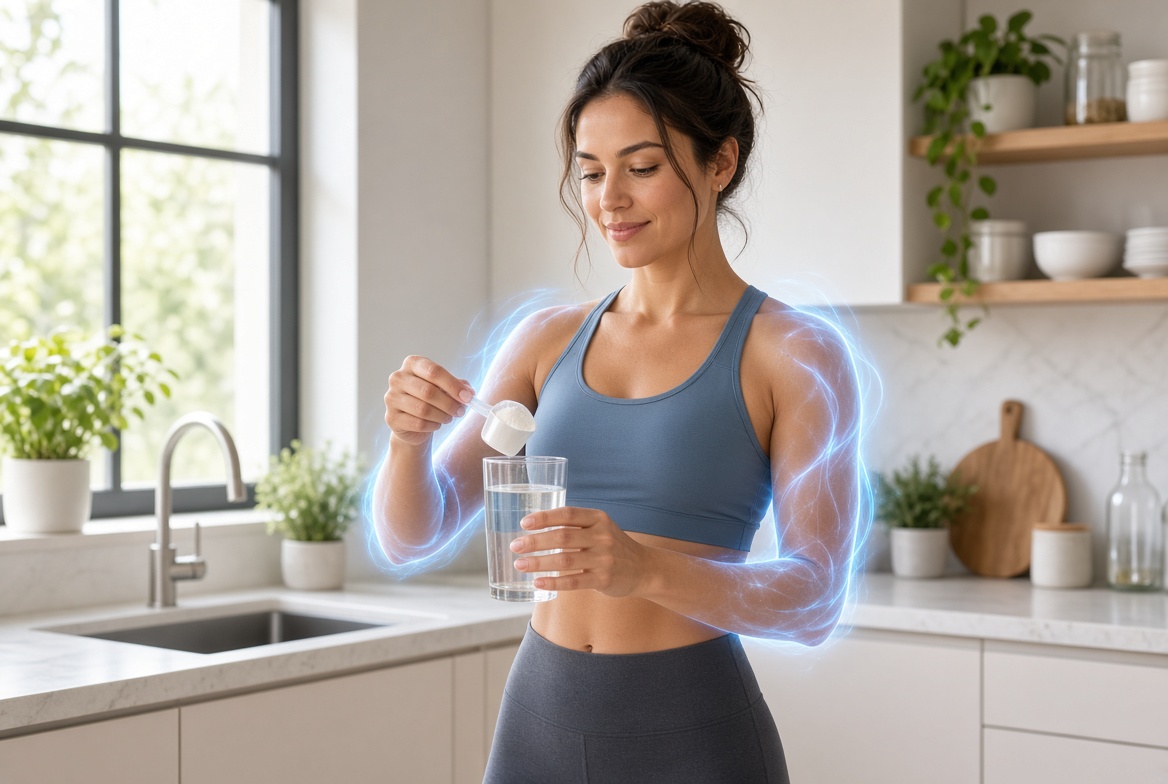
Why women need a separate analysis
In sports science, female samples are often smaller, and some older studies have included only men. This does not mean that the result is automatically different, but that the estimate for women has wider margins of uncertainty.
The systematic review by Tam et al. (2025) specifically highlighted methodological issues in female studies: varying levels of training, short and long protocols, different performance tests, and poor accounting for female-specific factors. Therefore, the general picture from the parent material about what the creatine training studies generally show cannot be simply mechanically transferred to the female subgroup without separate verification.
What a systematic review of active women in 2025 showed
Tam et al. included 27 studies involving physically active women, ranging from recreationally active to high-level athletes. Protocols ranged in duration from five days to 12 weeks and varied considerably in dosage and type of testing.
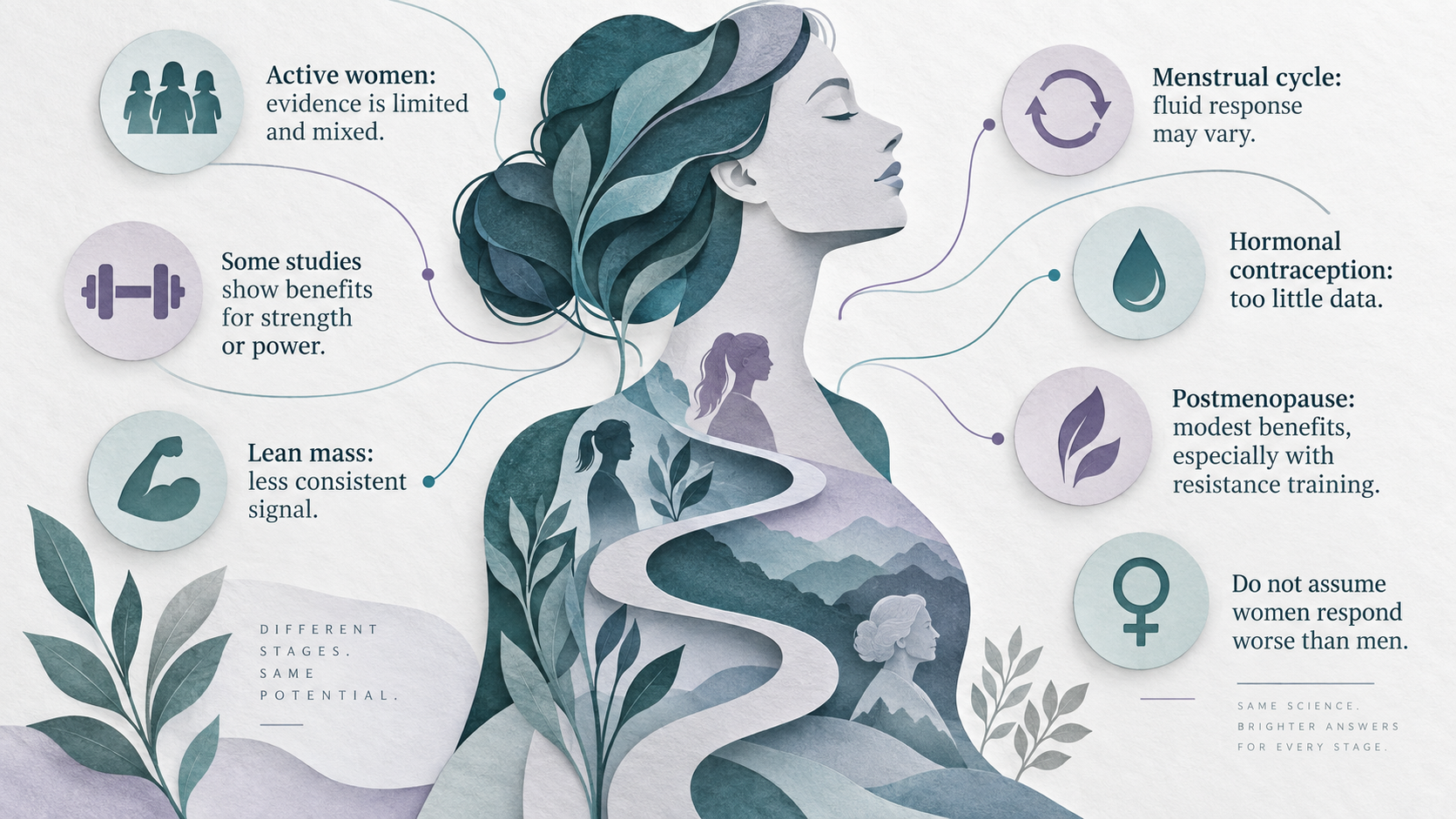
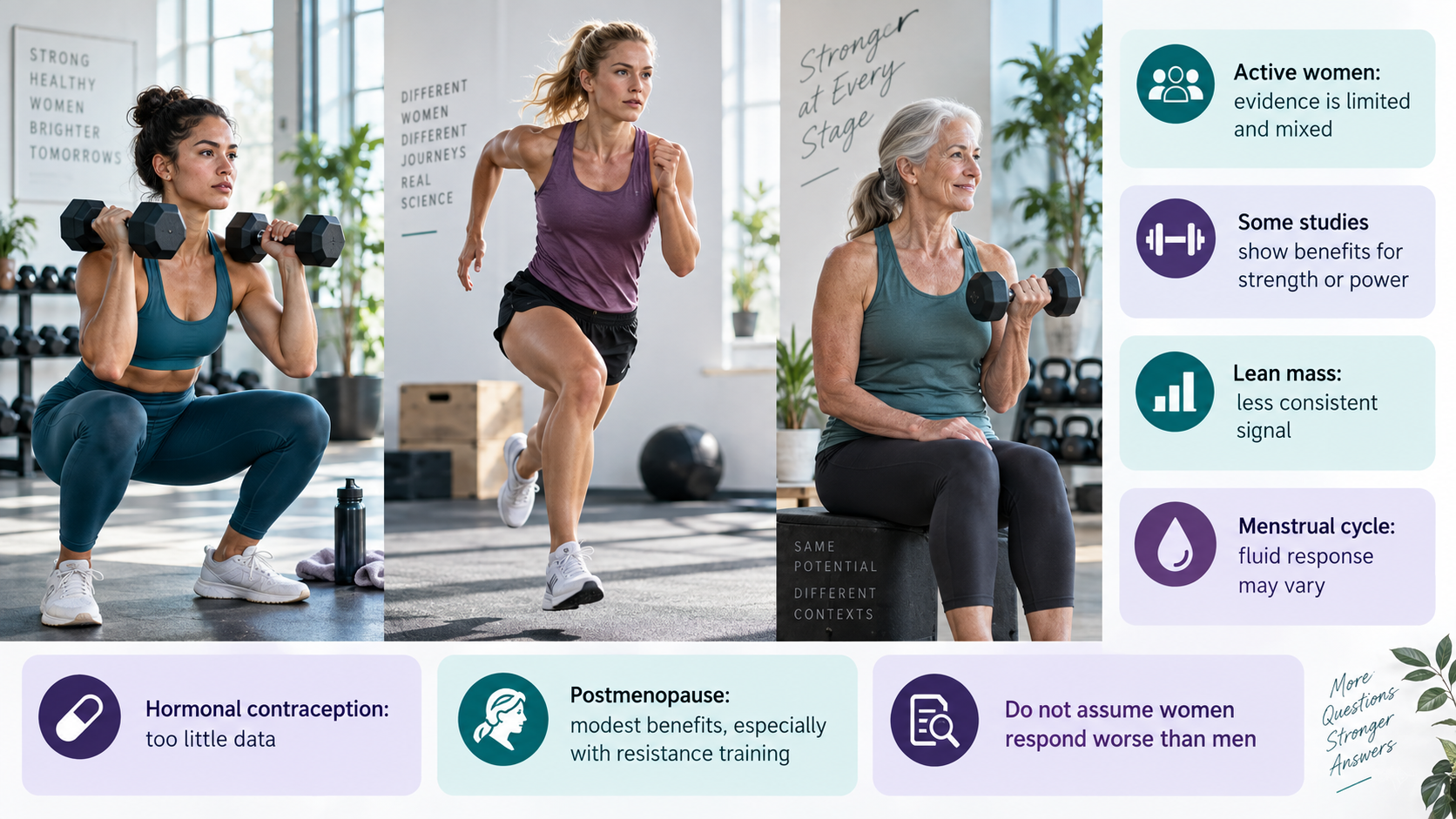
Compared to placebo, only 3 out of 11 studies had a positive effect on strength or power. For anaerobic measures, 4 out of 17 studies had a positive effect, and for aerobic measures, 1 out of 5 studies had a positive effect.
This is not to say that creatine “doesn’t work” in women. Most of the individual studies had small sample sizes and the endpoints varied widely. But the review suggests that the evidence base for women is less consistent than sports marketing often suggests.
Can we conclude from this that the effect is greater in men?
Not automatically. A meta-analysis by Kazeminasab et al. (2025), which included 69 studies, conducted subgroup analyses by gender. For some tests, including squats, leg presses, vertical jumps, and peak power in the Wingate test, a statistically significant effect was found in men, while no such signal was found in the female subgroups.
At the same time, for the bench press/chest press in the full text of this meta-analysis, a significant effect was recorded in both the female and male subgroups, although the absolute score in women was significantly lower. That is, even within one meta-analysis, the picture depended on the specific strength test.
Another meta-analysis by Wang et al. (2024) in adults under 50 years of age showed significant gains in upper body strength in men but not in women; however, the between-group comparison only approached statistical significance. This is a good example of why “significant here, insignificant there” cannot automatically be translated into a proven sex difference.
What does muscle and lean mass data show?
A meta-analysis by Delpino et al. (2022) included 35 randomized trials and 1192 participants. Overall, creatine increased lean mass, especially when combined with resistance training.
In a subgroup analysis, men on creatine had an average of approximately 1.46 kg greater lean mass gain, while in women the average difference was approximately 0.29 kg and was not statistically significant. The authors interpreted this as a more favorable response in men.
But here too, caution is needed. The subgroups were drawn from different studies, not from a large, head-to-head experiment where men and women underwent an identical protocol. In addition, there were fewer studies in women. So this is an important signal, but not a definitive answer to the question of biological differences in effect.
Individual women's studies yield varying results
Ferguson and Syrotuik (2006) studied 26 women with experience in strength training for 10 weeks. Both the creatine and placebo groups increased lean mass and one-rep max in the bench press and leg press, but they found no additional benefit of creatine over placebo on the main measures.
In another study, Kambis and Pizzedaz (2003) found that short-term supplementation improved maximal quadriceps contraction in young women. Ayoama et al. (2003) studied trained female softball players and also assessed strength and endurance performance after a short loading phase.
Ramírez-Campillo et al. (2016) conducted a six-week randomized, double-blind study in female soccer players where creatine was combined with plyometric training. Some maximal intensity measures were improved, but the design also included a strong training stimulus, so the results cannot be attributed to the supplement alone.
The Menstrual Cycle: What is Already Known and What is Still Just a Hypothesis
Female hormonal levels can affect energy metabolism, water, and other physiological processes, so it makes sense to study the phases of the cycle separately. However, there is still a lack of studies that prove a clinically important difference in the sports effect of creatine between the phases of the cycle.
Moore et al. (2023) evaluated fluid distribution after a short loading phase in 30 physically active women at different phases of the cycle. In the luteal phase, creatine increased total, intracellular, and extracellular water, but body weight was not statistically different between groups.
This is useful evidence that physiological response can vary depending on the phase of the cycle. But it does not prove that strength, power, or hypertrophy on creatine is significantly better on certain days of the cycle.
Does hormonal contraception alter the response to creatine?
In the same RCT, Moore et al. found no significant differences between naturally cycling women and hormonal contraceptive users on the water parameters studied.
However, this is not enough to draw broad conclusions about all athletic endpoints. There is significantly less data on strength, power, and long-term hypertrophy with specific contraceptive use than there is on creatine alone in mixed or male samples.
What changes after menopause?
Postmenopausal women are a distinct population and should not be confused with young, active women. In a systematic review and meta-analysis by Naddafha et al. (2026), there were 7 randomized trials and 608 participants with a mean age of about 62 years.
Creatine produced a small additional gain in lean mass of about 0.37 kg, and the one-rep max in the leg press was on average about 7.5 kg higher. There was no improvement in overall bone mineral density. The best signal was in studies where creatine was combined with resistance training.
These numbers cannot be extrapolated to younger women, nor should they be used to make a blanket statement that “women respond better after menopause.” This is a different age group with different physiology and different research protocols.
Where women's data is stronger and where it is weaker
| Question | What the data shows | How confident is the conclusion? |
|---|---|---|
| Strength and power in active women | There are positive individual RCTs, but most of the work in the 2025 systematic review did not show an advantage over placebo | Limited; larger studies specifically in women are needed |
| Lean/muscle mass | In the 2022 meta-analysis, the female subgroup had a smaller and statistically insignificant mean effect, but direct gender comparisons are limited | Unspecified |
| Menstrual cycle | There is evidence of differences in water compartments, but little evidence of strength, power, or hypertrophy between phases | Very limited |
| Hormonal contraception | In a small RCT, did not alter the studied water response; data for sports endpoints are insufficient | Very limited |
| Postmenopause | A 2026 meta-analysis showed small positive changes in lean mass and strength, especially in conjunction with strength training | Promising, but applies to a specific age group |
Is there any reason to believe that women need more creatine?
Reviews by Smith-Ryan et al. (2021) and Ryan et al. (2025) discuss possible sex differences in creatine metabolism, hormonal regulation, and requirements at different life stages. These are important biological hypotheses and argue for more research specifically in women.
But a review hypothesis does not amount to proof that women generally “need more creatine” or that they are guaranteed to get a greater effect. Such claims require direct comparative RCTs with sufficient numbers of women, controlled for cycle phases, training, and nutrition.
What is known about safety specifically in women?
De Guingand et al. (2020) systematically reviewed creatine studies in women. Of the 656 studies where creatine was the primary intervention, only 58 were female-only studies. Of these, 29 specifically monitored adverse events; a total of 951 participants.
The meta-analysis did not show a statistically significant increase in the overall incidence of adverse events or gastrointestinal complaints compared with controls. However, this basis does not imply that the data are equally complete for all life stages or clinical conditions.
To whom these results cannot be transferred automatically
- Pregnant and lactating women: Sports RCTs with active adults are not evidence-based for these conditions.
- Adolescents: Results from adult female samples should not be automatically extrapolated to minors.
- Women with severe chronic diseases or complex ongoing medication therapy without individual medical assessment.
- Women with clinically significant endocrine or metabolic disorders, unless the specific population was represented in the study.
- One should not conclude about a separate “female dose” just because the effect was smaller or larger in certain subgroups.
Frequently asked questions
Does creatine work for women?
Yes, there are positive studies in women, but the overall evidence base is smaller and less consistent than in men. In a 2025 systematic review, most individual performance studies showed no advantage over placebo.
No, there is no universal direct evidence of such a difference. Some meta-analyses show smaller or non-significant female subgroup effects, but this is not always accompanied by a statistically significant difference between the sexes.
Does creatine increase muscle mass in women?
The data are mixed. In a 2022 meta-analysis, the mean increase in lean mass in the female subgroup was small and not statistically significant, while in postmenopausal women, a 2026 meta-analysis showed a small positive effect.
Does the menstrual cycle affect the effects of creatine?
There is evidence that water distribution after a short loading protocol may differ between phases of the cycle, but there is currently insufficient evidence that strength or performance changes significantly depending on the phase.
Does hormonal contraception affect the effect of creatine?
Data are limited. One RCT found no differences in the water parameters studied between naturally cyclic women and hormonal contraceptive users, but this is not enough to draw conclusions about all athletic performance.
Does creatine make sense after menopause?
In a 2026 meta-analysis, creatine, especially in combination with resistance training, provided a small additional increase in lean mass and strength. This was a separate age population, so these figures do not apply to younger women.
Is there a separate universal “female dose” of creatine?
No. The available studies use different protocols, and there is no evidence for a single specific dose that all women would need based on their gender.
Sources
- Tam R. and others. (2025). Does Creatine Supplementation Enhance Performance in Active Females? A Systematic Review. PubMed
- Kazeminasab F. and others. (2025). The Effects of Creatine Supplementation on Upper- and Lower-Body Strength and Power: A Systematic Review and Meta-Analysis. PubMed
- Wang Z. and others. (2024). Effects of Creatine Supplementation and Resistance Training on Muscle Strength Gains in Adults <50 Years of Age: A Systematic Review and Meta-Analysis. PubMed
- Delpino FM and others. (2022). Influence of age, sex, and type of exercise on the efficacy of creatine supplementation on lean body mass: A systematic review and meta-analysis of randomized clinical trials. PubMed
- Ferguson TB, Syrotuk DG (2006). Effects of creatine monohydrate supplementation on body composition and strength indices in experienced resistance trained women. PubMed
- Kambis KW, Pizzedaz SK (2003). Short-term creatine supplementation improves maximum quadriceps contraction in women. PubMed
- Ayoama R., Hiruma E., Sasaki H. (2003). Effects of creatine loading on muscular strength and endurance of female softball players. PubMed
- Ramírez-Campillo R. and others. (2016). Effects of plyometric training and creatine supplementation on maximal-intensity exercise and endurance in female soccer players. PubMed
- Moore SR and others. (2023). A Randomized Controlled Trial of Changes in Fluid Distribution across Menstrual Phases with Creatine Supplementation. PubMed
- Smith-Ryan AE and others. (2021). Creatine Supplementation in Women's Health: A Lifespan Perspective. PubMed
- Ryan AS and others. (2025). Creatine in women's health: bridging the gap from menstruation through pregnancy to menopause. PubMed
- De Guingand DL and others. (2020). Risk of Adverse Outcomes in Females Taking Oral Creatine Monohydrate: A Systematic Review and Meta-Analysis. PubMed
- Naddafha S. and others. (2026). Creatine monohydrate for lean mass, strength, and bone density in postmenopausal women: a systematic review and meta-analysis. PubMed
Dietary supplement. Not a medicine. Consult a doctor before use.
Products related to this post


Related Posts
Comments
Information
Customer Service
Extras
My Account


Sports nutrition manufacturer in Ukraine StarkPharm © 2026