Your shopping cart is empty!

Creatine and the brain after 55: does it help cognitive aging?
Published: 27/09/2026
Times Read: 256
Comments : 0
The idea of using creatine to support the brain in old age seems biologically plausible: nervous tissue constantly needs energy, and the creatine-phosphocreatine system is involved in rapidly maintaining the brain's energy metabolism. But there is a big difference between a plausible mechanism and proven slowing of cognitive aging.
The results so far look promising, but the evidence base is small. The most important limitation is that much of the positive data after age 55 comes not from clinical trials of supplementation, but from observations of how much creatine people get from their regular diet. The general data for memory, attention, and other cognitive functions, regardless of age, are discussed separately in the article on clinical trials of creatine for memory and cognition.

Why are people over 55 considered separately?
Memory, attention, processing speed, and other cognitive functions can gradually change with age. At the same time, physical activity, muscle mass, nutrition, cardiovascular health, and many other factors also change, which are also related to brain function.
Therefore, results from young, healthy participants cannot be automatically extrapolated to older adults. Separate studies are needed for this group, where age, nutrition, comorbidities, and baseline cognitive status are directly taken into account.
What the 2026 systematic review actually contained
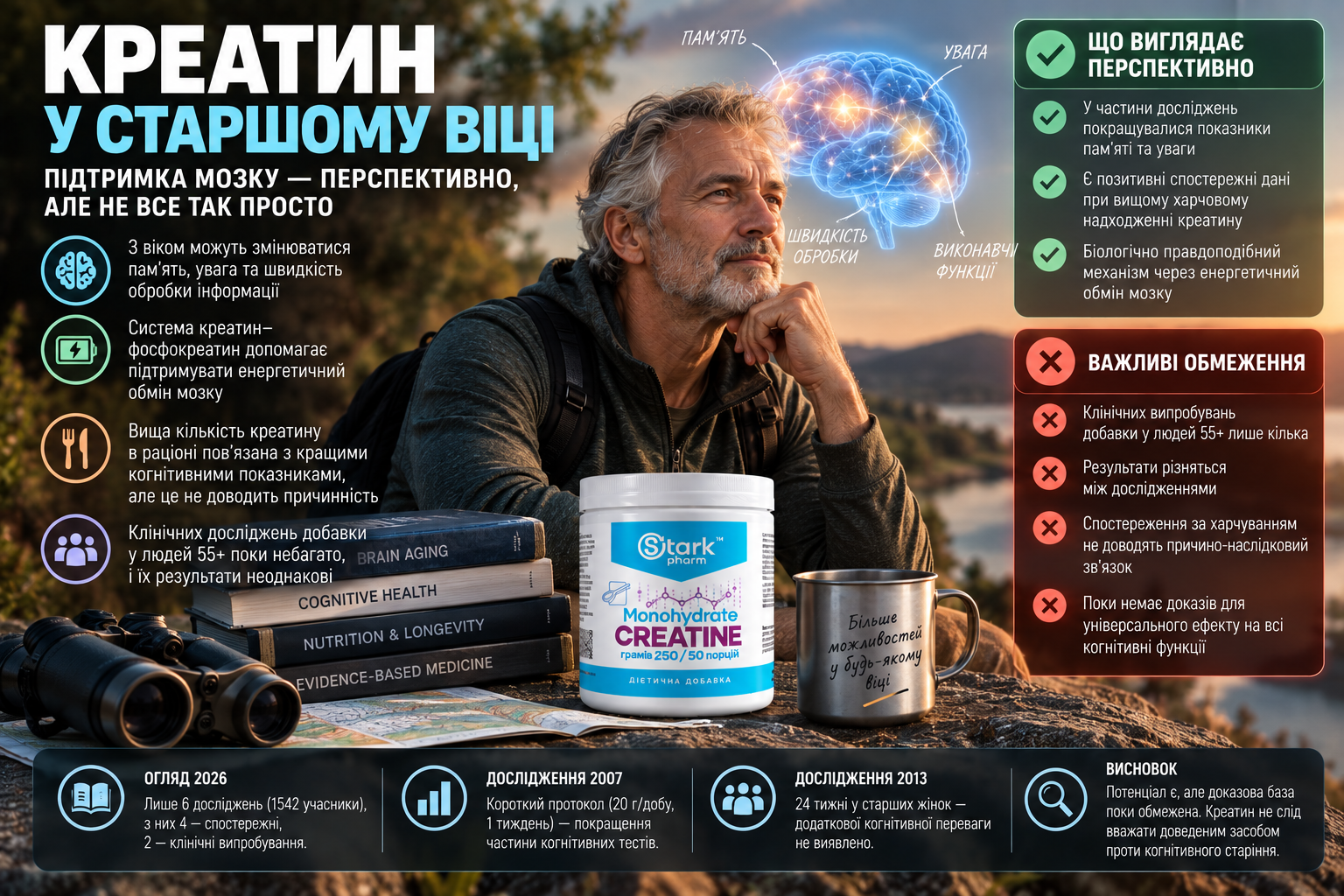
Marshall et al. (2026) conducted a systematic review of studies on creatine and cognitive function in people aged 55 years and older. The review included only 6 studies with a total of 1542 participants; 55.7% of the sample were women.
At first glance, the results looked very positive: 5 out of 6 studies reported a beneficial relationship or effect, especially for memory and attention. But the design of these studies was fundamentally different.
Four of the six studies were cross-sectional observational studies that assessed habitual dietary intake of creatine. Only two studies were double-blind interventions with creatine monohydrate.
Methodological quality was also mixed: only one study was rated as good quality by the authors, two as fair, and three as weak. Therefore, the phrase “5 out of 6 studies are positive” cannot be read as “five clinical trials have proven the benefit of the supplement.”
Why dietary observations don't prove causality
One of the largest examples is an analysis of a US sample of people aged 60 and over. In it, 1,340 participants reported on their diet and cognitive function was assessed using a test of speed of matching symbols and numbers.
People with higher dietary creatine intake had better results on this test, on average. The relationship remained even after some statistical adjustments.
But this study doesn't randomly assign people to take creatine. Higher creatine intake usually means a different mix of foods and may be related to protein, overall diet quality, physical activity, income, education, health status, and other factors.
Therefore, an observational relationship answers the question "are these indicators related?", but does not prove that creatine was the cause of the better cognitive outcome.
Eating creatine and taking supplements are not the same thing
This is a fundamental distinction for the whole topic. In an observational study, a person is not given a controlled amount of a single substance: researchers are merely assessing their usual diet and looking for statistical relationships.
In a randomized trial, participants are assigned to either creatine or placebo. This design is much better at testing whether the creatine is the cause of the result, rather than underlying differences between people.
Therefore, positive observational data can be an argument for further trials, but does not replace them.
What a short 2007 study showed
McMorris et al. (2007) studied 32 older adults. Participants completed tests of memory, spatial recall, and random number generation.
The experimental regimen included 20 grams of creatine per day for one week. After that, the creatine group improved on most tests, except for one task involving reverse number reproduction.
This is an interesting early positive study, but it was short and small. The high dose here is just a characteristic of the study protocol, not a recommendation for self-administration.
A 24-week study in older women yielded a different result
Alves et al. (2013) conducted a much longer double-blind randomized trial in older women. Participants were divided into four groups: placebo, creatine, placebo plus resistance training, and creatine plus resistance training.
Cognitive function was assessed using a battery of tests of memory, selective attention, and inhibitory control at baseline, 12, and 24 weeks.
At 24 weeks, creatine did not provide a significant additional benefit on any cognitive measure. Strength training improved strength and emotional state, but also did not change cognitive outcomes.
This work is particularly important because it shows that the positive short-term result in 2007 was not automatically replicated in a longer study with a different sample.
New 2026 study: a positive signal, but not a definitive answer
A 12-week, double-blind study of people aged 45–65 was published in August 2026. The analysis was completed by 64 participants, whose average age was about 54.5 years.
Creatine was associated with improvements in certain measures of memory and cognitive function in both participants without a training program and those who combined exercise with dietary changes.
But there are two important limitations here. First, part of the sample was younger than 55 years old, so this work cannot be considered a pure study of people 55+. Second, the authors themselves explicitly noted that some cognitive results are preliminary and need to be confirmed.
Therefore, this work increases interest in the topic, but does not turn it into a proven effect for all older people.
When creatine is combined with strength training, the causes of the changes are harder to separate
A large study of 103 people with an average age of about 68 was also published in 2026, where creatine was combined with various high-intensity resistance training programs.
The training itself produced significant changes in physical function, strength, and a number of biological markers. Creatine had additional effects on some of the markers, but this design makes it much more difficult to draw a clear conclusion about the independent cognitive effect of the supplement.
This is one reason why the systematic review by Marshall et al. did not include studies where creatine was evaluated only in conjunction with another intervention.
Observational and clinical trials provide varying degrees of evidence
| Data type | What they show | What is not allowed to be stated |
|---|---|---|
| Nutritional monitoring | Higher dietary creatine intake in part of work is associated with better individual cognitive performance | What exactly made the difference was creatine |
| Brief study 2007 | Positive result in most tests used | That the effect lasts for months or years |
| 24-week study 2013 | Creatine showed no additional cognitive benefit | Does not support universal positive effect |
| 2026 study at age 45–65 | Positive changes in individual memory and cognitive function indicators | The results are preliminary, and some of the participants are younger than 55 years old. |
| Data in dementia | There is an early positive signal from one pilot study | Not proven to prevent or treat dementia |
What is known about dementia?
This issue requires special caution. In August 2026, Whitford et al. published a review of the data on creatine and cognitive outcomes in dementia.
After screening 8,317 records, only six studies met the criteria, with most of the evidence being preclinical: one in cells and four in animal models. There was only one pilot project in humans, described in two publications.
The review found no adequate controlled randomized clinical trials in people with dementia. Therefore, it is not possible to speak of creatine as a proven prevention or treatment of dementia.
Why the Alzheimer's pilot study is interesting but insufficient
The pilot study involved 20 people with Alzheimer's disease who received 20 grams of creatine monohydrate per day for eight weeks—a high research dose that should not be taken for self-administration.
During this time, the total concentration of creatine in the brain increased by approximately 11%, and improvements were recorded in some cognitive tests.
But the study was open-label and did not have a placebo control group, so it is impossible to separate the effects of creatine from repeated testing, natural fluctuations in condition, participant expectations, or other factors.
This is good evidence that the topic is worth investigating further, but not proof of the effectiveness of the treatment.

What does "cognitive aging support" mean?
Improving a single test score after a week or 12 weeks and slowing down years of cognitive aging are different endpoints.
To claim that a particular intervention slows cognitive aging, long-term controlled studies are needed that show a consistent difference over time. The available studies with creatine are mostly much shorter.
Similarly, a positive result in healthy older adults does not prove dementia prevention, and a pilot signal in patients with Alzheimer's disease does not prove a therapeutic effect.
What can be said today?
- There is an encouraging signal: some research in older people shows positive associations or changes in memory and attention.
- Much of the positive data is observational: it relates to dietary creatine intake and does not prove causality.
- Direct clinical trials have produced mixed results: a short 2007 study was positive, while a 24-week 2013 study was not.
- The new data from 2026 are interesting but preliminary: individual cognitive results need to be confirmed by independent, larger studies. There is no proven prevention or treatment of dementia: there are no relevant controlled randomized clinical trials in this area yet.
Frequently asked questions
Does creatine help memory after age 55?
There are positive signals in some research, but direct clinical trials have yielded mixed results. Therefore, a stable effect for all people after age 55 has not been proven.
Why does the 2026 systematic review look so positive?
Five of the six included studies reported a favorable association or effect. But four of the six were observational nutritional studies, not clinical trials of supplementation.
Does more creatine in the diet mean better memory?
Some observational data suggest a link, but it does not prove causation. People with different diets may differ in many other characteristics.
Is there new clinical data in 2026?
Yes. A 12-week study of people ages 45–65 showed improvements in some measures of memory and cognitive function, but the authors called these results preliminary, and some of the sample was younger than 55.
Is creatine proven to slow cognitive aging?
No. The available studies are too short and inconsistent to prove a slowdown in long-term age-related cognitive decline.
Can creatine prevent dementia?
There is no such evidence. A current review of the evidence in dementia found no relevant controlled randomized trials in humans.
What did the pilot study show in Alzheimer's disease?
After eight weeks of the high experimental dose, brain creatine concentrations increased by about 11%, and some cognitive measures improved. But the study had no control group, so it does not prove a treatment effect.
Sources
- Marshall S. and others. (2026). Creatine and Cognition in Aging: A Systematic Review of Evidence in Older Adults. Nutrition Reviews. PubMed
- Ostojic SM, Korovljev D., Stajer V. (2021). Dietary creatine and cognitive function in US adults aged 60 years and over. Aging Clinical and Experimental Research. PubMed
- McMorris T. and others. (2007). Creatine supplementation and cognitive performance in elderly individuals. Aging, Neuropsychology, and Cognition. PubMed
- Alves CRR and others. (2013). Creatine supplementation associated or not with strength training upon emotional and cognitive measures in older women: a randomized double-blind study. PLOS ONE. PubMed
- Chun J. and others. (2026). Effects of creatine supplementation with and without exercise and diet intervention on body composition, cognitive function, and markers of health in middle-aged and older adults. Journal of the International Society of Sports Nutrition. PubMed
- Fernandez-Garrido J. and others. (2026). Effects of high-load, velocity-intentional variable resistance training combined with creatine supplementation on neuroplasticity, oxidative stress, inflammation, physical function, cognitive performance and quality of life in older adults. Experimental Gerontology. PubMed
- Whitford T. and others. (2026). The cognitive effects of creatine supplementation in older adults and preclinical models of dementia: A scoping review. Aging Research Reviews. PubMed
- Smith AN and others. (2025). Creatine monohydrate pilot in Alzheimer's: Feasibility, brain creatine, and cognition. Alzheimer's & Dementia: Translational Research & Clinical Interventions. PubMed
Dietary supplement. Not a medicine. Consult a doctor before use.
Products related to this post

Related Posts
Comments
Information
Customer Service
Extras
My Account


Sports nutrition manufacturer in Ukraine StarkPharm © 2026