Your shopping cart is empty!

Creatine and Bones: Does It Really Increase Bone Mineral Density?
Published: 29/09/2026
Times Read: 265
Comments : 0
The idea that creatine might be good for bones makes sense. As muscles get stronger, they put more mechanical stress on the skeleton, and that stress is one of the stimuli for bone remodeling.
But strong benefits for muscle do not automatically mean benefits for bone. For older people, the evidence for the effects of creatine on muscle mass and strength after age 50–60 is more convincing than the evidence for bone mineral density. Current meta-analyses do not show a consistent overall increase in bone density.
Mineral density, bone geometry, and fracture risk are different things
Bone mineral density is usually assessed by dual-energy X-ray absorptiometry. This measure reflects the amount of mineral tissue in a particular area, but does not describe all the properties of the bone.
Mechanical strength is also affected by the shape, thickness of the cortical layer, and geometry of the bone. Therefore, it is possible that the mineral density is almost unchanged, but certain geometric indicators look better.
Another level is actual fractures. Even a positive change in a laboratory or imaging test does not automatically prove that the risk of fracture has become lower.
An early study in 2015 gave a positive signal
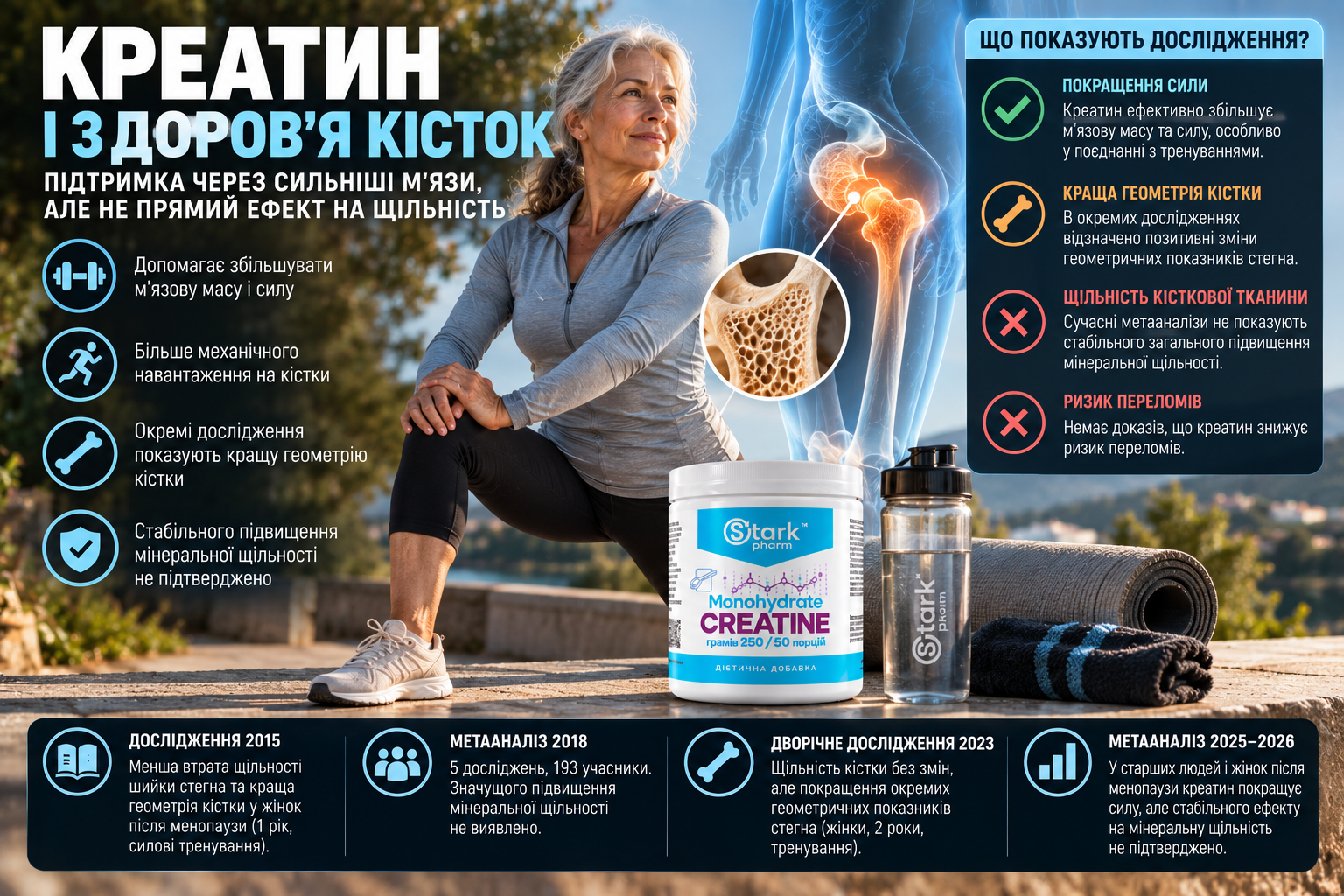
Chilibeck et al. (2015) studied postmenopausal women who completed a year of resistance training. Creatine was added to the training program, and bone changes were assessed by bone mineral density and geometric characteristics of the femur.
In the creatine group, there was less loss of bone mineral density at the femoral neck and one measure of bone geometry changed favorably. At the time, this seemed like an interesting argument for a possible bone effect.
But after 12 months, a small number of participants completed the study, so the result needed confirmation in larger and longer studies.
A 2018 meta-analysis did not confirm an overall increase in density
Forbes et al. (2018) pooled five controlled studies with 193 participants. The authors separately analyzed total bone mineral density, lumbar spine, total hip, and femoral neck.
No significant additional benefit of creatine was found for any of these key domains, suggesting that the early positive signal is not consistently reproduced when data from multiple studies are considered together.
Two-year study in women with osteopenia was neutral
In a large study by Sales et al., 200 postmenopausal women with osteopenia were given either creatine or placebo for two years without a specific exercise program.
The study used 3g of creatine per day. This figure is provided here only as a characteristic of a specific protocol, not as a recommendation.
After two years, lumbar spine, femoral neck, and total hip bone mineral density decreased over time, but there was no significant difference between groups. There was also no significant benefit for markers of bone turnover, falls, or fractures.
This is an important result because the study was long, so the lack of a clear effect cannot be explained simply by the fact that bone tissue changes slowly.
Two-year study in 2023: density unchanged, but geometry interesting
In 2023, Chilibeck et al. published another large two-year study involving 237 postmenopausal women. All completed a strength training and walking program, and creatine was compared to placebo.
Bone mineral density at the femoral neck, total hip, and lumbar spine did not differ between groups, meaning that even with a long-term exercise program, there was again no convincing increase in density.
At the same time, two geometric parameters of the proximal femur changed favorably. They are related to how the bone can resist bending and compression.
Why positive bone geometry does not equal higher density
It is important not to lose this result, but also not to exaggerate it. The bone can have better geometric characteristics without a noticeable increase in mineral density.
Theoretically, this could have an impact on mechanical strength, but the study did not show that this change leads to fewer fractures. Therefore, the statement “creatine makes bones stronger” would be stronger than the available data allow.
What the 2025 meta-analysis showed in older people
Sharifian et al. (2025) pooled 20 studies in 1093 older adults. Creatine had a positive effect on strength performance, especially when combined with training.
But there was no significant benefit for overall bone mineral density. This is a very clear example of why a positive muscle effect cannot automatically be transferred to bone.
The most recent meta-analysis included seven randomized trials in 608 postmenopausal women. There were positive signals for lean mass and strength, but no overall significant effect on bone mineral density.
The muscle and strength outcomes of this population have already been discussed in more detail in the article on creatine after menopause. Another important finding for CR019 is that even where muscle responds, bone density does not necessarily change.
Can the length of the study explain the neutral result?
Bone tissue rebuilds more slowly than muscle tissue, so it really requires long-term studies. Short experiments may simply not have time to record a noticeable change.
But there are already two-year controlled studies on this topic. They did not show a convincing increase in key indicators of mineral density. Therefore, the explanation of "just waiting longer" does not have sufficient support at present.
Creatine alone and creatine with training
It is logical to assume that the potential bone effect would be stronger when combined with strength training, because mechanical loading itself is an important stimulus for bone tissue.
However, a two-year study of creatine without exercise was neutral, and a large two-year study with exercise also failed to show any increase in basal mineral density. That is, exercise has not made creatine a consistently effective intervention for this measure.
What is really shown for bone tissue
| Data | Mineral density | What else did you see? | Correct conclusion |
|---|---|---|---|
| 2015 study, 12 months | Less loss in the femoral neck | Positive geometric exponent | Interesting early signal, but small sample |
| 2018 meta-analysis | There is no overall advantage. | — | The early positive signal was not stable |
| Osteopenia study, 2 years | There is no advantage. | Falls, fractures and markers without a convincing difference | Creatine alone did not improve key bone parameters |
| Research 2023, 2 years + exercises | There is no advantage. | Positive changes in individual femoral geometry parameters | Bone geometry does not equal bone density gain |
| Meta-analysis 2025 | Total density without significant effect | Power function improved | The muscular effect is not automatically transferred to the bone. |
| Meta-analysis 2026 | Density overall without significant change | Positive signal for muscle mass and strength | For bones, the evidence base is much weaker. |
Can we talk about osteoporosis or fracture prevention?
No. Such a claim requires evidence that the intervention actually reduces bone loss or fracture rate in the relevant population.
The available studies on creatine do not support its use as a means of preventing or treating osteoporosis, nor can a single geometric parameter change be a substitute for clinical fracture outcome.
What can be said today?
- The hypothesis makes sense: stronger muscles can create more mechanical stress on bones.
- No overall increase in bone mineral density has been shown: current meta-analyses and two-year controlled studies are mostly neutral.
- There are some positive signals: primarily regarding the geometric characteristics of the femur in long-term studies.
- Geometry does not equal fracture prevention: the clinical significance of such changes has not yet been established.
- The muscle effect is stronger than the bone effect: the benefits of creatine for strength cannot be automatically transferred to bone mineral density.
Frequently asked questions
Does creatine increase bone mineral density?
Current meta-analyses do not show a convincing overall increase in bone mineral density.
Why then is creatine even being studied for bones?
The main hypothesis is that stronger muscles create more mechanical stress on the skeleton, which can stimulate bone remodeling.
Have there been positive studies?
Yes. Some studies have reported less loss of femoral neck density or favorable changes in femoral geometry. However, these results have not been consistent for total mineral density.
What does improved bone geometry mean?
These are changes in the shape or distribution of bone tissue that theoretically could affect mechanical properties. But they do not automatically prove a reduction in fracture risk.
Does strength training with creatine help?
For strength and muscle function, this combination has significantly better data. For bone mineral density, no consistent additional benefit of creatine has been shown.
Can creatine be used to prevent osteoporosis?
There is currently insufficient evidence to support this conclusion. Creatine should not be considered a proven means of preventing or treating osteoporosis.
Does creatine reduce the risk of fractures?
This has not been proven. Available studies do not show a convincing clinical reduction in fracture rates.
Sources
- Chilibeck PD and others. (2015). Effect of creatine supplementation during resistance training on lean tissue mass and muscular strength in older adults: a meta-analysis and related bone findings. PubMed
- Forbes SC and others. (2018). Effects of creatine supplementation on bone mineral density and bone mineral content in aging adults: a systematic review and meta-analysis. PubMed
- Sales LP, etc. (2020). Creatine supplementation in postmenopausal women with osteopenia: a randomized, double-blind, placebo-controlled trial. PubMed
- Chilibeck PD and others. (2023). Creatine supplementation and bone health in postmenopausal women during a 2-year resistance training and walking program. PubMed
- Sharifian M. and others. (2025). Effects of creatine supplementation on muscle strength, body composition, and bone mineral density in older adults: a systematic review and meta-analysis. PubMed
- Naddafha M. and others. (2026). Effects of creatine supplementation on body composition, muscle strength, and bone mineral density in postmenopausal women: a systematic review and meta-analysis. PubMed
Dietary supplement. Not a medicine. Consult a doctor before use.
Products related to this post

Related Posts
Comments
Information
Customer Service
Extras
My Account


Sports nutrition manufacturer in Ukraine StarkPharm © 2026