Your shopping cart is empty!

Citicoline and attention: what studies on healthy people show
Published: 22/10/2026
Times Read: 6
Comments : 0
Citicoline and attention are the subject of small clinical studies that assessed not abstract “brain function,” but specific measures: the number of errors, reaction speed, ability to sustain attention, and inhibit impulsive responses. In some studies, the results in the citicoline groups were better than placebo. However, there are few studies in healthy people, participants vary in age, and the effect in a single computer test cannot be equated with a stable improvement in concentration during work or study.
Citicoline (CDP-choline) is a compound involved in choline metabolism and the synthesis of cell membrane phospholipids. The biochemical role of this substance is well described, but the question of whether its additional intake provides noticeable changes in attention in healthy people requires separate clinical evidence. Below, we will consider what exactly the researchers tested and how far their conclusions can be extended.
What studies call attention and concentration
In everyday language, “concentrating better” means not being distracted, working longer, and not losing your mind. In a scientific experiment, these complex sensations have to be broken down into measurable components. Sustained attention is the ability to respond to the right signals for a long time. Selective attention is the ability to filter out unimportant stimuli. Response control is the ability to refrain from making a wrong click or reacting prematurely.
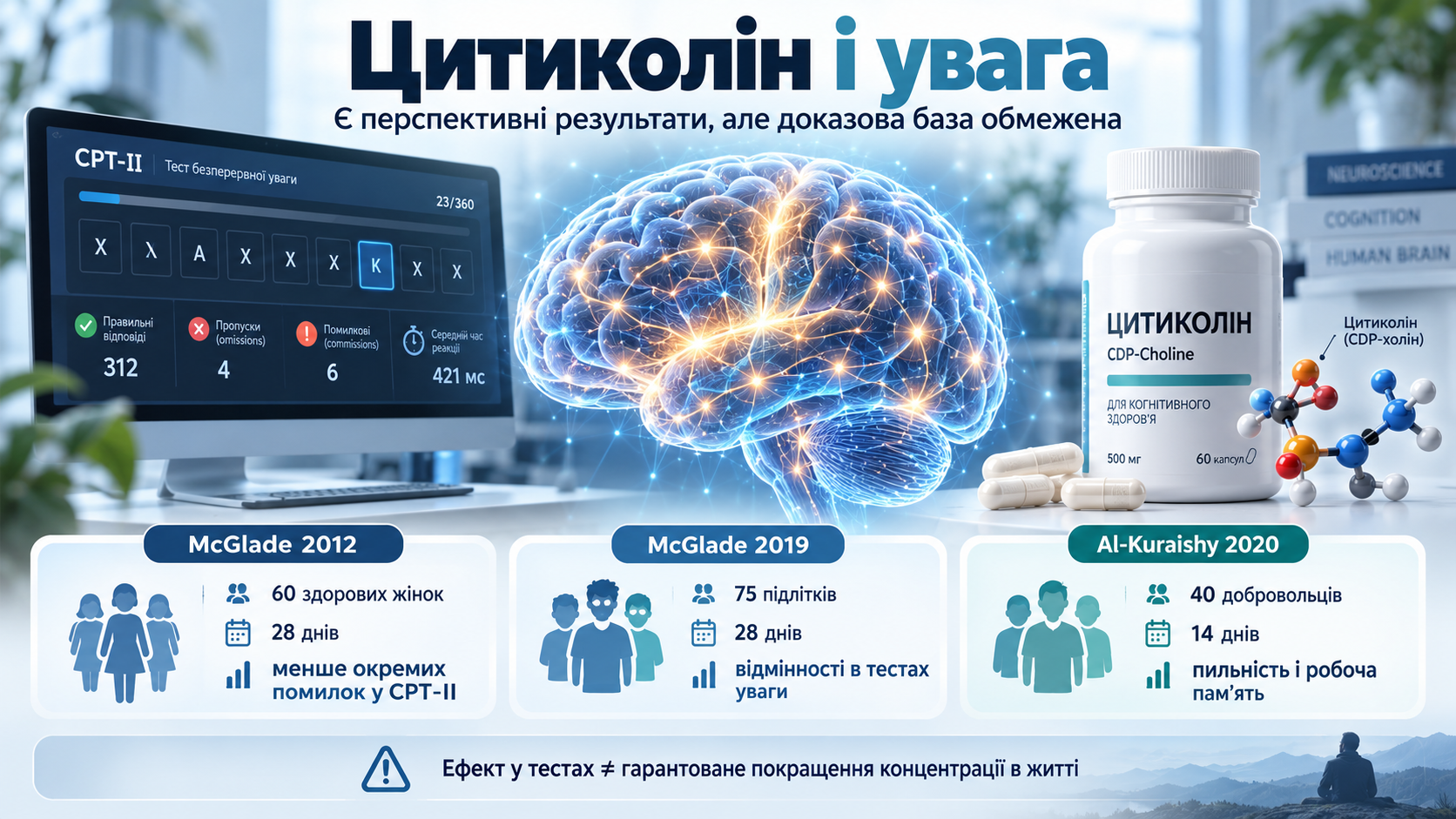
A Continuous Performance Test (CPT) is often used to test attention: the participant sees a series of stimuli and must respond only to certain ones. An omission error means that the desired signal is left unanswered. An error of incorrect response (commission) is a response to a stimulus that should not be responded to. Such indicators help to study attention, but are not a direct measure of job performance, productivity, or academic performance.
Citicoline and attention in healthy women: a study by McGlade et al.
In a study by McGlade et al. (2012), 60 healthy women aged 40–60 years were randomly assigned to receive 250 mg/day, 500 mg/day, or placebo for 28 days. Attention was assessed using the CPT-II.
The authors reported fewer specific types of errors in the citicoline groups compared to placebo. Specifically, the 250 mg group had fewer omissions and false responses, and the 500 mg group had fewer false responses. This is a result of a specific test task after four weeks of use, and not evidence that the substance will work the same way for all people or in all living conditions.
The study is notable for its placebo-controlled design, but the sample was limited to middle-aged women. In addition, the authors included representatives from companies involved in the production of the ingredient, so independent replication of the results is important. Even a positive result on individual CPT indicators does not allow us to claim that a broad improvement in cognitive abilities has been proven.
What the study showed in healthy adolescents
McGlade et al. (2019; first published online 2015) studied attention and psychomotor function in 75 healthy adolescent boys. Participants received either placebo or citicoline in study groups at doses of 250 and 500 mg/day for 28 days. The researchers used selective attention tests, the computer-based CPT-II, and a motor response speed task.
Compared with placebo, participants receiving citicoline showed statistically significant differences in measures of attention and psychomotor speed. The authors also described associations between body weight-adjusted dose and some test scores. However, these data do not establish an individual “optimal dose” and are not a recommendation for adolescent use.
This is an important limitation: the results of a study involving minors describe the scientific protocol, but do not determine the safety or appropriateness of dietary supplements for children to take on their own. Nor can they be extrapolated to adult students, office workers, or older adults without appropriate research.

Psychomotor alertness and working memory research
In a study by Al-Kuraishy and Al-Gareeb (2020), 40 healthy volunteers were evaluated, divided into two groups of 20. One group received 500 mg of citicoline per day for two weeks, while the other received a placebo. The researchers measured psychomotor alertness, visual working memory, and selected markers of oxidative stress.
The authors reported improvements in a number of test scores in the citicoline group compared to placebo. However, only 40 participants and the short duration do not allow for far-reaching conclusions about the long-term effect or its practical significance. In addition, working memory and vigilance are related to attention, but they are not identical measures.
What can be compared between studies?
The studies presented differ in participants, duration, and tests. A compact comparison shows both a common feature — the presence of individual positive results — and the limits of their generalization.
| Research | Participants and protocol | What was observed? | The main limitation |
|---|---|---|---|
| McGlade et al., 2012 | 60 healthy women, 40–60 years old; 250 or 500 mg/day, 28 days | Fewer individual errors in CPT-II | Small specific sample; independent confirmation needed |
| McGlade et al., 2019 | 75 healthy adolescent boys; 250 or 500 mg/day, 28 days | Differences in attention and psychomotor speed tests | Data from minors is not a basis for recommending supplements to them. |
| Al-Kuraishy and Al-Gareeb, 2020 | 40 healthy volunteers; 500 mg/day, 14 days | Changes in vigilance and visual working memory scores | Small sample and short period |
The amounts and times listed are just parameters of the research protocols, not a dosing schedule for the reader. The results of different cognitive tests also cannot be summed up into one universal assessment of “improved concentration.”
Why a lab result doesn't mean better concentration every day
For a convincing practical conclusion, not only statistical differences between groups are needed, but also an answer to the question of whether a person experiences changes in ordinary activities. The difference in the number of clicks in the CPT-II may be interesting for science, but its significance for performing professional tasks or learning must be proven separately.
In small studies, pre-specified baseline values, correction for multiple comparisons, and independent replication of the experiment are particularly important. If many parameters are assessed in a single protocol, some statistically significant results may arise by chance. Therefore, it is more correct to say that individual studies have found promising signals, rather than that the effectiveness of citicoline for attention in healthy people has been definitively proven.
In 2024, EFSA experts separately assessed the evidence base for citicoline for memory in middle-aged and older adults and did not establish a cause-and-effect relationship for the claim. This decision was for memory, not all aspects of attention directly. It should not be mistaken for a separate negative trial of citicoline on concentration, but it does illustrate the strength of evidence requirements for claims of cognitive benefits.

Who should be especially careful when interpreting this data?
The absence of disease in a single study does not mean that every healthy person needs the supplement. Complaints of inattention may be related to sleep deprivation, stress, work schedule, or other factors or conditions that require medical evaluation. Clinical trials with citicoline are not a substitute for determining the cause of persistent difficulty concentrating.
It is especially important not to transfer research doses to children and adolescents. During pregnancy, breastfeeding, chronic diseases and taking medications, the issue of any supplements should be discussed with a doctor. Even in adults, individual adverse reactions are possible; short-term tolerability in a small sample does not confirm the safety of unlimited use.
So, citicoline has been studied in healthy people specifically in the context of attention, and some tests have shown positive differences. But for now, a cautious conclusion about the limited and heterogeneous evidence base is more justified than the promise of sustained improvements in concentration in everyday life.
Frequently asked questions
Has citicoline been proven to improve attention in healthy people?
A few small controlled studies have found positive changes in attention tests, but this is not enough to say that the effect occurs in all healthy people.
What exactly did the researchers measure?
Specifically, the number of missed signals and false responses, selective attention, psychomotor speed, and alertness. These are standardized test scores, not direct measures of job performance.
Are attention, concentration, and memory the same?
No. They are related, but reflect different cognitive processes. The result of a memory test does not prove the same effect on sustained attention.
Has citicoline been studied in healthy adults?
Yes. Specifically, a controlled study included healthy women aged 40–60 years; another small study included healthy volunteers. Their results need to be confirmed in larger, independent trials.
Do the doses from the studies represent the recommended amount to take?
No. The doses in scientific publications describe the experimental protocol. They are not individual recommendations for supplementation.
Can the results of research on adolescents be applied to children?
No. The presence of an experiment involving minors does not mean that the supplement is recommended for children or adolescents.
Do studies of citicoline drinks prove the effectiveness of citicoline itself?
Not necessarily. When a beverage has multiple active ingredients, it is impossible to separate the contribution of each component without special design.
Sources
- McGlade E. et al. (2012). Improved Attentional Performance Following Citicoline Administration in Healthy Adult Women. Food and Nutrition Sciences. DOI.
- McGlade E. et al. (2019; online 2015). The Effect of Citicoline Supplementation on Motor Speed and Attention in Adolescent Males. Journal of Attention Disorders. PubMed.
- Al-Kuraishy H. M., Al-Gareeb A. I. (2020). Citicoline Improves Human Vigilance and Visual Working Memory: The Role of Neuronal Activation and Oxidative Stress. Basic and Clinical Neuroscience. PubMed.
- EFSA NDA Panel (2024). ‘Citicoline’ and support of the memory function: Evaluation of a health claim pursuant to Article 13(5) of Regulation (EC) No 1924/2006. EFSA Journal. DOI.
Dietary supplement. Not a medicine. Consult a doctor before use.
Products related to this post
Related Posts
Comments
Information
Customer Service
Extras
My Account


Sports nutrition manufacturer in Ukraine StarkPharm © 2026


