Your shopping cart is empty!

Citicoline or Alpha-GPC: What's the Difference Between the Two Forms of Choline?
Published: 24/10/2026
Times Read: 78
Comments : 0
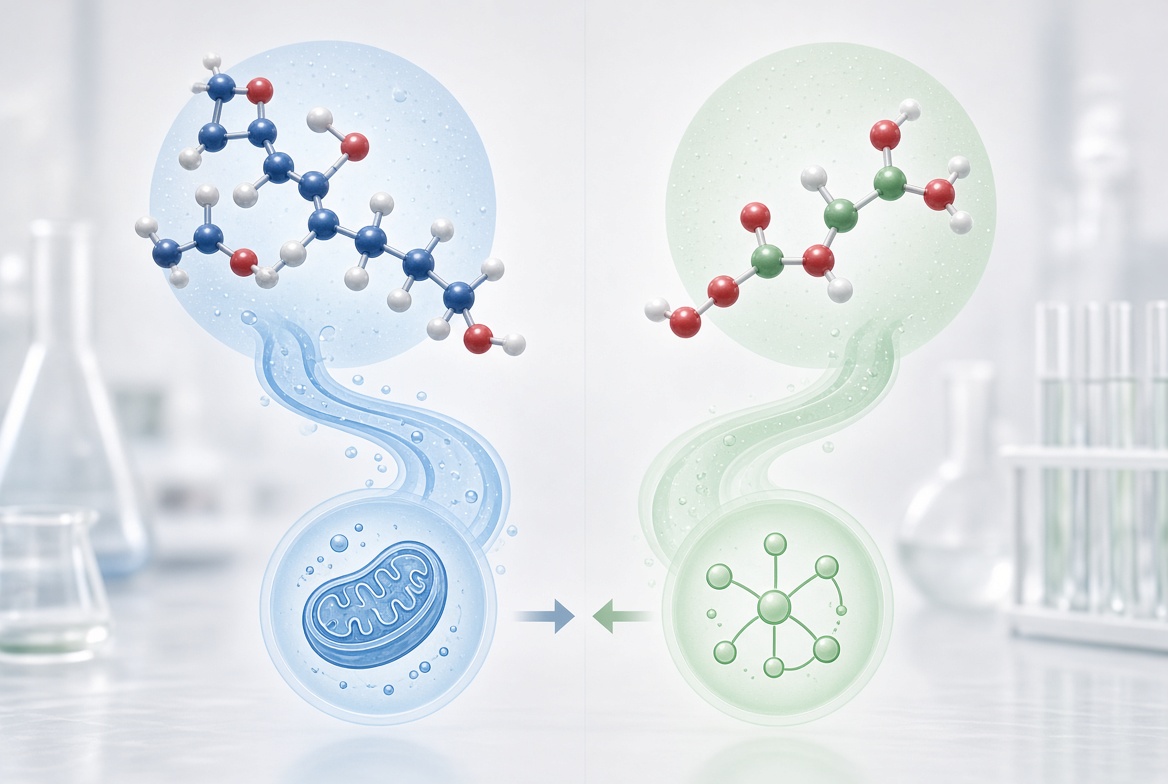
Citicoline or alpha-GPC is not a choice between two names for the same substance. Citicoline (CDP-choline) and alpha-GPC (L-alpha-glycerylphosphorylcholine, choline alfoscerate) are compounds related to choline metabolism, but differ in structure, metabolism in the body, and clinical studies. Both substances have been studied in the context of the nervous system, but biochemical similarity does not mean the same action, and the presence of a single positive study does not prove the superiority of one form over the other.
The key to making a proper comparison is to separate what is known about the molecules from what has been tested in humans. For citicoline, there are studies on memory and attention, and for alpha-GPC, there is primarily work in patients with cognitive impairment. These results cannot be directly compared as if both substances had undergone the same tests.

Citicoline and Alpha-GPC: The Main Differences
| Parameter | Citicoline (CDP-choline) | Alpha-GPC (choline alfoscerate) |
|---|---|---|
| Structure | Compound of cytidine diphosphate and choline component | Compound of choline with a glycerophosphate residue |
| Metabolic context | Intermediate link in the phosphatidylcholine synthesis pathway | Intermediate product of phosphatidylcholine metabolism, source of choline component |
| After oral administration | Metabolites related to choline and cytidine/uridine metabolism | Metabolism is related to choline and glycerophosphate |
| Clinical data | Studies in healthy people and various clinical groups; results are mixed | Much work with patients with cognitive impairment; not all can be transferred to healthy people |
| What is not proven | General memory improvement for all consumers | Overall advantage over citicoline in healthy subjects |
The percentage of choline by weight is often discussed. This arithmetic may describe the chemical composition, but it does not by itself indicate how much choline will end up in a particular tissue or how a cognitive test will change. This requires bioavailability measurements and well-designed clinical trials.
How the two compounds are related to choline and cell membranes
Choline is a nutrient that cells use in several processes. One of them is the formation of phosphatidylcholine, an important component of membranes. In the so-called Kennedy pathway, choline is sequentially converted to phosphocholine, then to CDP-choline, and then participates in the formation of phosphatidylcholine. Therefore, citicoline is not just “another dose of choline,” but a specific intermediate in this pathway.
Alpha-GPC is involved in the other side of phospholipid metabolism: it can be formed during the breakdown of phosphatidylcholine and be a source of the choline component. Both processes are part of normal cellular metabolism, but their pathways are not identical. In addition, acetylcholine is a neurotransmitter that also requires choline for its formation; this does not mean that taking any precursor automatically improves attention or memory.
Research reviews have examined citicoline in relation to membrane phospholipid synthesis and choline metabolite availability (Grieb, 2014). Alpha-GPC's role in choline metabolism is important, but a theoretical mechanism cannot replace verification of specific clinical benefit.
What citicoline studies have shown
Results vary by sample and test. A randomized, placebo-controlled trial by Nakazaki et al. (2021) included 100 people aged 50–85 years with subjective age-related memory complaints. The researchers administered 500 mg of citicoline daily for 12 weeks. They found a positive effect compared to placebo on one measure of episodic memory; however, this did not translate into improvements in all types of memory.
An independent scientific assessment by EFSA (2024) analysed the body of relevant work. The experts noted that a positive result from one study was not confirmed in another trial using 1 g per day for three months; data from studies in dementia patients also did not confirm a generalised effect. EFSA concluded that a cause and effect relationship had not been established between the consumption of citicoline and the improvement, preservation or slowing of memory loss in the relevant group of adults.
Attention studies are a different field. They should not be confused with work on memory or used as evidence that citicoline has the same effect on different cognitive skills. What is important in this comparison is that the evidence base for citicoline exists, but does not support the broad promise.
What is known about alpha GPC research?
A 2023 systematic review and meta-analysis included seven randomized trials and one prospective cohort study. The authors reported positive results for certain cognitive and functional measures, particularly when alpha-GPC was combined with donepezil. However, the effect of the combination cannot be attributed solely to alpha-GPC. Furthermore, studies in patients with pre-existing disorders do not prove the efficacy of the supplement in healthy individuals.
Therefore, the comparison of "citicoline vs. alpha-GPC" cannot be resolved by simply counting positive trials. Some studies have examined memory in healthy participants, while others have involved patients with specific diseases. The duration of the studies, doses, concomitant medications, and endpoints have also varied.
Is there evidence that alpha-GPC is better than citicoline?
To claim superiority, a high-quality direct comparison in the same sample is required: identical conditions, pre-specified cognitive measures, sufficient numbers of participants, and control for adverse events. The available disparate studies do not provide grounds to call one form universally superior for memory, concentration, or general mental performance.
Improved performance in patients with a particular disease is not equivalent to faster task performance in healthy individuals. Similarly, the biochemical ability to deliver choline to cells is not an indicator of real-world performance. It is also important not to compare milligrams of two different molecules as if they were the same amount of pure choline.
Alpha-GPC and Citicoline Safety: What to Watch Out for
There is a separate long-term safety signal for alpha-GPC. In a large Korean retrospective cohort study by Lee et al. (2021) of over 12 million people aged 50 years and older, alpha-GPC use was associated with a higher incidence of stroke during follow-up. In the matched groups, the adjusted hazard ratio was 1.43. This is an observational association, not proof that alpha-GPC caused the stroke: baseline health status, reasons for use, and other factors could have influenced the outcome.
These data do not automatically make citicoline “safer”: a fair comparison requires studies with the same risk assessment methods. However, the signal for alpha-GPC should not be ignored or presented as a definitive causal effect. For both substances, individual tolerance, medication use, and general health should be considered.
People with chronic medical conditions, those who are pregnant or breastfeeding, or those taking medications that affect the nervous system should discuss any supplements with a healthcare professional. This clinical study data should not be used as a stand-alone guideline for dosage or duration of intake.
How to choose between two forms of choline
It is worth starting not with the advertising rating, but with the question of what outcome was studied in general: episodic memory, attention, general cognitive assessment in patients or biochemical indicators. The evidence base has different strengths for different purposes. It is also necessary to take into account the population studied and how much it corresponds to a specific person.
Citicoline and alpha-GPC share a common link to choline metabolism, but have different chemical structures and clinical histories. At this time, it is more scientifically sound to discuss the differences in evidence and the limits of conclusions than to declare a winner. A complete diet remains the primary source of choline, and decisions about supplemental intake should be made based on actual needs and medical circumstances.
Frequently asked questions
Are citicoline and alpha-GPC the same substance?
No. Both contain a choline component, but differ in chemical structure and metabolic pathways.
What is CDP-choline?
This is another name for citicoline, an intermediate in the phosphatidylcholine synthesis pathway.
Is it true that alpha-GPC contains more choline?
The mass fraction of choline can vary between compounds. However, a higher fraction alone does not prove better results for memory or attention.
Which shape is better for memory?
There is not enough data to say which form is universally best. Studies have been conducted in different groups and have measured different outcomes.
Has alpha-GPC been studied in healthy people?
The main clinical basis concerns people with cognitive or neurological disorders. It is incorrect to transfer such results to healthy people.
Has alpha-GPC been proven to cause stroke?
No. A large observational study found a statistical association but did not establish causation.
Can 500 mg of citicoline and 500 mg of alpha-GPC be compared?
Not as equivalent doses of choline: these are different molecules with different structures, and the amount of substance does not equal the proven clinical effect.
Sources
- Grieb P. (2014). Neuroprotective properties of citicoline: facts, doubts and unresolved issues. CNS Drugs. PubMed .
- Nakazaki E. et al. (2021). Effect of Citicoline on Memory Function in Healthy Older Adults: A Randomized, Double-Blind, Placebo-Controlled Clinical Trial. The Journal of Nutrition. PubMed .
- Moreno MDJ (2003). Cognitive improvement in mild to moderate Alzheimer's dementia after treatment with the acetylcholine precursor choline alfoscerate: a multicenter, double-blind, randomized, placebo-controlled trial. Clinical Therapeutics. PubMed .
- Activity of Choline Alphoscerate on Adult-Onset Cognitive Dysfunctions: A Systematic Review and Meta-Analysis (2023). PubMed .
- Lee G. et al. (2021). Association of L-α Glycerylphosphorylcholine With Subsequent Stroke Risk After 10 Years. JAMA Network Open. PubMed .
Dietary supplement. Not a medicine. Consult a doctor before use.
Products related to this post
Related Posts
Comments
Information
Customer Service
Extras
My Account


Sports nutrition manufacturer in Ukraine StarkPharm © 2026


