Your shopping cart is empty!

Creatine for beginners and experienced athletes: who gets a greater effect
Published: 28/09/2026
Times Read: 220
Comments : 0
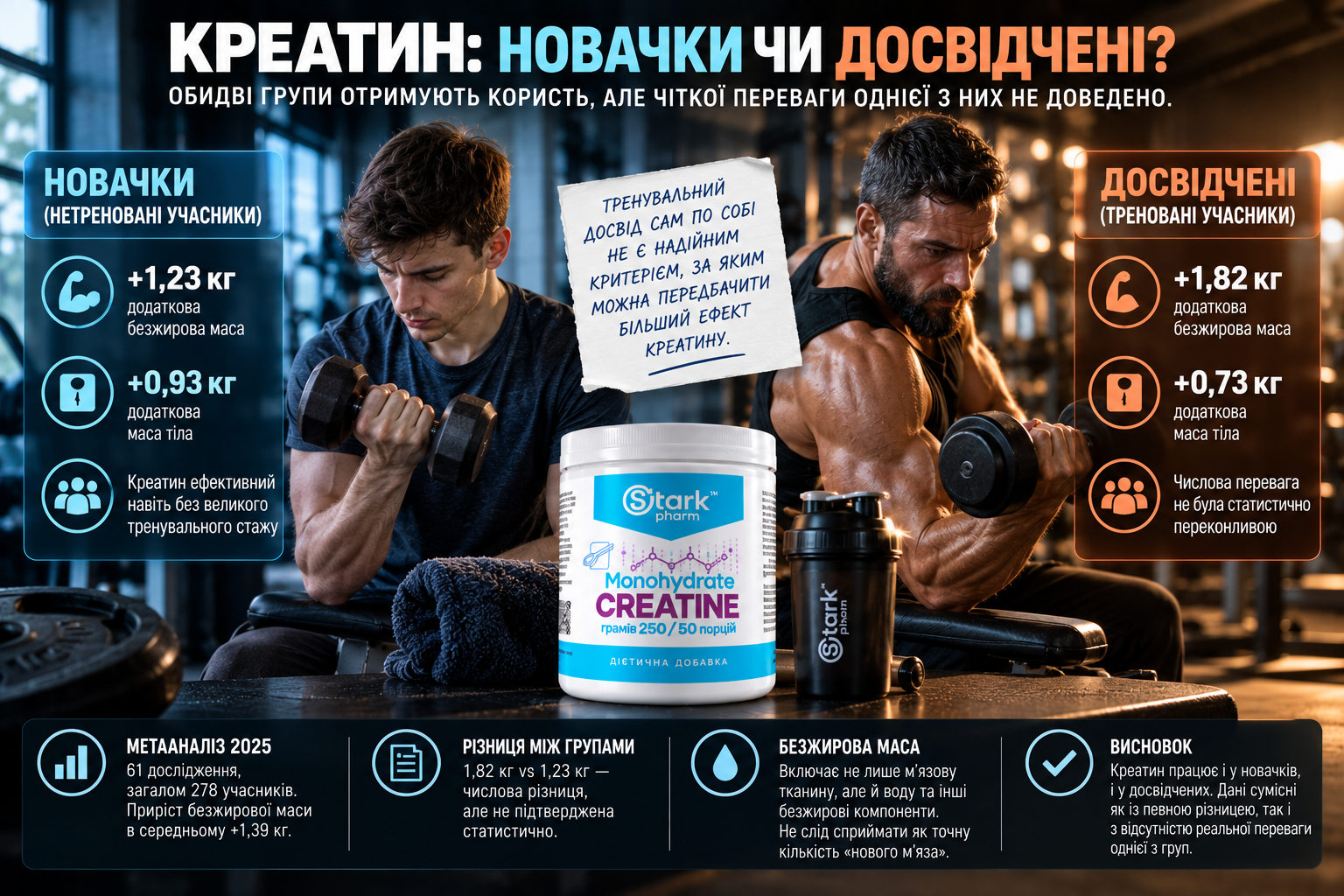
Creatine works in both novice and experienced athletes, but current evidence does not allow us to say with certainty that one group benefits more. In a large 2025 meta-analysis, the average increase in lean mass was numerically greater in experienced participants, but the difference between subgroups was not statistically significant.
So the main answer is simple: training experience alone does not seem to be a reliable criterion for predicting “who will benefit from creatine.” In general, what creatine actually improves during training is worth discussing separately; here we are only interested in the difference between beginners and experienced.

What exactly did the 2025 meta-analysis compare?
Ashtary-Larky et al. (2025) reviewed 61 controlled trials that combined creatine with resistance training and compared it to a control condition. The authors separately tested whether the outcome differed depending on training experience.
Overall, creatine plus resistance training was associated with greater gains in lean mass compared to training without creatine. The average additional difference was approximately 1.39 kg.
Key to this article is the subgroup analysis, in which the authors separately assessed untrained and experienced participants.
What did beginners and untrained participants get?
In untrained participants, the additional gain in lean mass on the background of creatine was approximately 1.23 kg compared to the control groups.
For total body mass, the average additional difference was about 0.93 kg. This shows that even without prior extensive training experience, creatine can enhance changes in body composition during a strength program.
What experienced athletes received
In experienced participants, the average additional gain in lean mass was approximately 1.82 kg. For total body weight, the difference was approximately 0.73 kg.
At first glance, 1.82 kg versus 1.23 kg looks like a clear advantage for the experienced. But it is important not to confuse the difference between the two averages with a proven difference between the groups.
Why 1.82 vs. 1.23 kg doesn't mean "experienced works better"
To claim that one subgroup responds more strongly than another, it is not enough to see a higher average number. You need to separately test whether the difference between subgroups is large enough and stable enough to account for statistical uncertainty.
In a 2025 meta-analysis, such a test did not provide conclusive evidence of an experienced advantage. In other words, the data are consistent with both some real difference and a situation where the difference between 1.82 and 1.23 kg was partly due to chance due to the composition of the specific studies.
Therefore, the correct conclusion is: both groups benefited, and the numerical advantage of the experienced does not prove that training experience enhances the effect of creatine.
What does the confidence interval mean in such a comparison?
A confidence interval shows not just a single mean estimate, but a range of values that are compatible with the available data. The wider this range, the less precisely we know the true effect size.
If the ranges for two subgroups overlap significantly, and a separate test of the difference between them is not statistically convincing, it cannot be honestly claimed that one group responds better.
That's why the headline "experienced people gain 0.6 kg more" would be too strong: it would turn an unstable numerical difference into a supposedly established fact.
Lean mass is not the same as pure new muscle tissue
Lean mass includes more than just contractile muscle proteins. It also includes water and other non-fat components of the body. This is especially important for creatine because it can increase intramuscular water content in the early stages.
Therefore, the numbers 1.23 and 1.82 kg should not be read as an exact amount of “new lean muscle.” We have already separately analyzed how much additional lean mass creatine provides in studies and why this figure should be interpreted with caution.
Can the higher number in experienced people be explained by physiology?
The authors of the meta-analysis discussed possible explanations. One is that in untrained individuals, part of the early change in lean mass may more strongly reflect changes in water balance, whereas in experienced athletes, a larger proportion of the result could theoretically be attributed to true training adaptations.
But that's just a hypothesis. The included studies didn't directly measure how much of the extra fat-free mass was water and how much was new muscle tissue in each subgroup.
Therefore, it is incorrect to write: "For beginners, it's water, and for experienced people, it's muscle." The available data does not prove this.
Older data also didn't show a simple rule
In the Branch (2003) meta-analysis, the authors tested whether baseline training status affected creatine results. They found no convincing modifying effect of training status.
What a large 2024 meta-analysis added
Pashayee-Khamene et al. (2024) pooled 143 studies on the effects of creatine on body composition. Overall, creatine was associated with greater gains in lean mass, especially when combined with exercise.
Subgroup analysis did not show that the positive effect existed only in the untrained or only in the experienced. That is, at the level of a large body of work, training experience did not appear to be a necessary condition for the increase in lean mass.
A new meta-analysis from 2026 also failed to confirm a consistent advantage for one group.
A 2026 meta-analysis analyzed 63 studies with 1,489 participants. The authors evaluated the effects of creatine combined with resistance training on body composition and examined potential confounders that could alter the magnitude of the outcome.
Training experience did not appear to be a consistent factor that reliably explained the magnitude of body composition changes. This is in good agreement with the cautious interpretation of the 2025 meta-analysis: the numerical difference between subgroups is interesting, but not sufficient to rule out the rule of “experienced does better.”
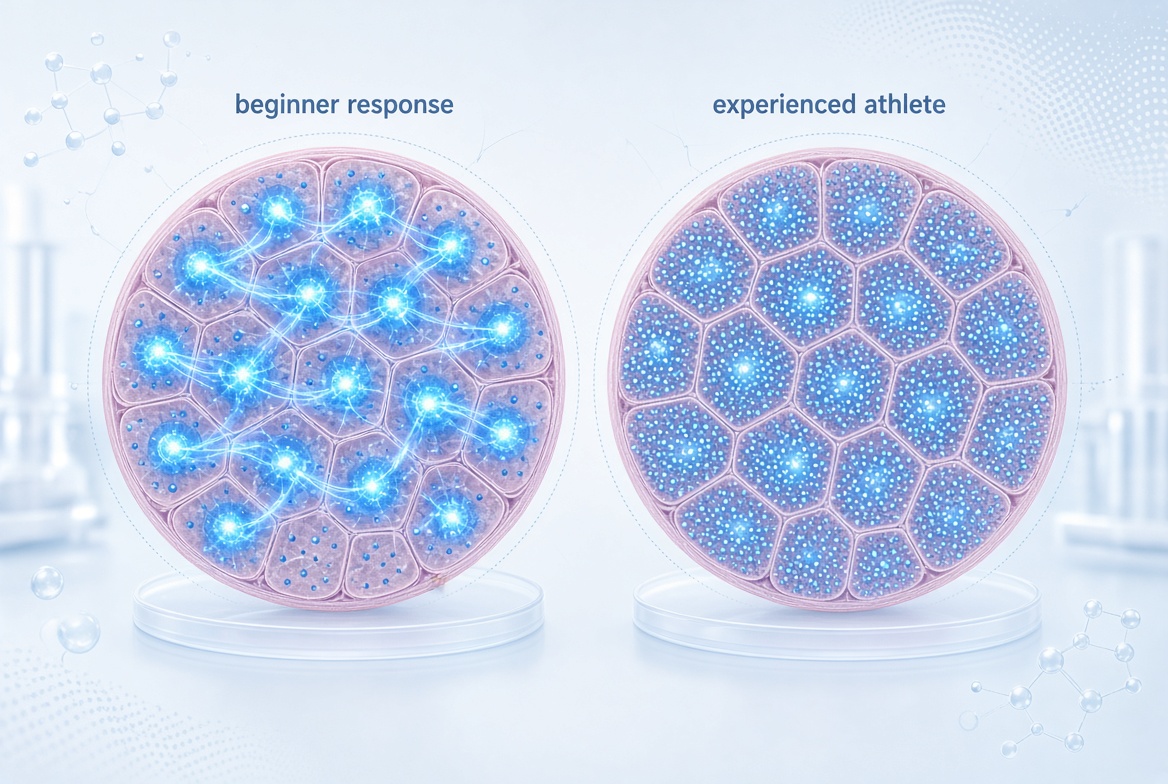
Beginners vs. Experienced: What the Data Shows
| Indicator | Beginners / untrained | Experienced | Is the difference between the groups proven? |
|---|---|---|---|
| Fat-free mass | ≈ +1.23 kg | ≈ +1.82 kg | No |
| Body weight | ≈ +0.93 kg | ≈ +0.73 kg | No |
| Fat mass | No convincing additional change shown | No convincing additional change shown | There is no stable difference. |
| Fat percentage | No convincing additional change shown | No convincing additional change shown | There is no stable difference. |
What does this mean in practice?
There is no need to wait for a certain training experience for creatine to “start working.” Current data shows positive results in both untrained and experienced participants during strength training.
Similarly, there is no reason to promise an experienced athlete greater results simply because of their experience. The real answer depends on many factors: training program, nutrition, starting muscle mass, initial creatine stores, duration of the study, and individual response.
What can be said today?
- Creatine works in both groups: additional gains in lean mass were observed in both untrained and experienced participants.
- The experienced had a higher average figure: approximately +1.82 kg versus +1.23 kg in the 2025 meta-analysis.
- But the advantage of the experienced was not proven: the between-group difference was not statistically convincing.
- Fat-free mass does not equal net new muscle tissue: water also affects this indicator.
- Training experience does not appear to be a reliable predictor of response: current meta-analyses do not support a simple rule of "novices are better" or "experienced are better."
Frequently asked questions
Does creatine work better for beginners or experienced athletes?
Current data does not show a clear advantage for one group. Both novice and experienced exercisers experienced additional gains in lean mass.
Why did the gains in the experienced group in the meta-analysis increase more?
The average number was indeed higher, but the difference between subgroups was not statistically significant. Therefore, it may be partly explained by the design of the specific studies and random variability.
How much lean mass did beginners gain?
In a 2025 meta-analysis, the additional difference was approximately 1.23 kg compared to control groups.
How much lean mass have experienced athletes added?
The average additional difference was about 1.82 kg, but this does not prove that creatine works better for experienced athletes.
Does an increase in lean mass mean the same increase in lean muscle?
No. Fat-free mass includes water and other non-fat components, so it cannot be equated to an exact amount of new muscle tissue.
Do you have to be an experienced athlete for creatine to be effective?
No. The positive effect on fat-free mass was also observed in untrained participants in studies.
Can training experience predict how well a person will respond to creatine?
Not yet. Training experience does not appear to be a stable and reliable factor determining effect size in current meta-analyses.
Sources
- Ashtary-Larky D. and others. (2025). Effects of creatine supplementation combined with resistance training on body composition: systematic review and meta-analysis with subgroup analyzes by training status. PubMed
- Pashayee-Khamene F. and others. (2024). Creatine supplementation and body composition: a systematic review and meta-analysis. PubMed
- Wang C. and others. (2026). Effects of creatine supplementation combined with resistance training on body composition and potential moderators: a systematic review and meta-analysis. PubMed
- Branch JD (2003). Effect of creatine supplementation on body composition and performance: a meta-analysis. International Journal of Sport Nutrition and Exercise Metabolism. PubMed
Dietary supplement. Not a medicine. Consult a doctor before use.
Products related to this post

Related Posts
Comments
Information
Customer Service
Extras
My Account


Sports nutrition manufacturer in Ukraine StarkPharm © 2026