Your shopping cart is empty!

Creatine for Endurance: Why It Doesn't Work Well in All Sports
Published: 22/09/2026
Times Read: 302
Comments : 0
Creatine is well-known in strength and speed-strength sports, but the word “endurance” is often confusing. A 10K, a marathon, a long bike ride, a series of short sprints, and a finishing lunge at the end of a race are all different physiological tasks. That’s why the same supplement can be beneficial in one scenario and nearly neutral in another.
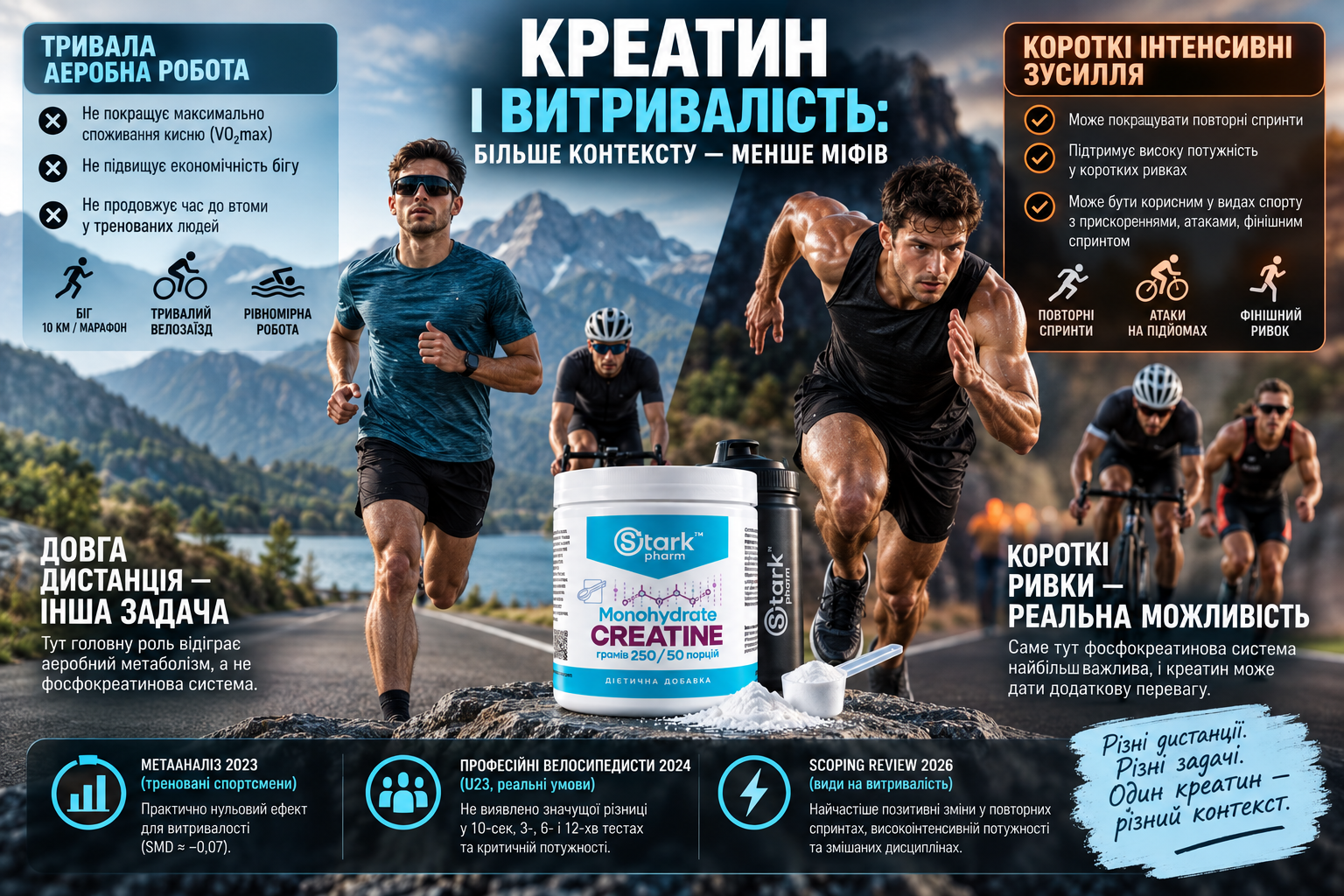
The best current evidence does not show a significant improvement in long-term aerobic endurance in trained individuals with creatine monohydrate. However, there is a distinct positive signal for repeated short bursts of high intensity effort, accelerations, and some finishing sprints. So the question is not whether creatine works for endurance or not, but rather which component of athletic performance is being assessed.

Why short intense efforts are a different challenge
The phosphocreatine system is particularly important when the muscle needs to regenerate ATP very quickly during short bursts of high-intensity exercise. This is why the effects of creatine are best demonstrated for repeated bursts of power and explosiveness, rather than for hours of steady-state exercise.
We have separately discussed the basic difference between strength, power and training volume accumulation in the material on why creatine works best with short intense efforts. For endurance, something else is important: as the duration of continuous work increases, the energy contribution of aerobic processes becomes much more important, and the role of phosphocreatine as the main source of rapid energy resynthesis decreases.
Why long aerobic work is not required to improve
During steady-state exercise—such as long-term running or steady-state cycling—the body relies primarily on oxidative metabolism to sustain performance. Creatine may increase the intramuscular supply of readily available energy, but this does not automatically translate into increased maximal oxygen uptake, running efficiency, or the ability to sustain aerobic pace for longer.
This is fundamentally different from strength performance. Just because creatine provides an additional advantage in 1RM or rep testing does not mean that the same advantage will show up in marathon distance running. The quantitative results of strength research are discussed separately in the article on what strength research shows.
What did the meta-analysis of trained athletes show?
Fernández-Landa et al. (2023) conducted a systematic review and meta-analysis specifically for trained populations. It included 13 controlled trials comparing creatine monohydrate with placebo on endurance performance.
The overall effect was virtually zero: the standardized mean difference was approximately −0.07, with a 95% confidence interval of −0.32 to 0.18. There was no statistically significant advantage for creatine. After additional analysis for possible publication bias, the result remained almost the same.
For practical purposes, this means that in trained individuals, creatine has not shown consistent improvements in overall endurance performance. This is not to say that it is “useless in all endurance sports”—just that sustained aerobic performance as a single endpoint has not generally improved.
Professional cyclists: a strong test in real conditions
Barranco-Gil et al. (2024) studied 23 U23 professional cyclists during a rigorous six-day training camp. The creatine group received 20 g/day during a short, high-dose study protocol, while the control group received the same recovery drink without creatine.
The workload during the camp increased dramatically, signs of fatigue appeared, and critical power decreased. But there was no statistically significant difference between the groups in the 10-second sprint, the 3-, 6-, and 12-minute tests, critical power, or recovery markers.
This is an important negative work: even in a situation where cyclists regularly perform high-intensity episodes within a large volume of aerobic work, a short creatine loading did not provide a sustained advantage.
Where creatine can be useful in "endurance" sports
Endurance sports are rarely just about steady work. A bike race might involve attacks and short climbs, a cross-country race might involve acceleration, a rowing race might involve a powerful start and finish, and a team sport might involve dozens of short bursts of effort between periods of lower intensity.
It is in such episodes that the creatine mechanism becomes more relevant. A review by Forbes et al. (2023) pointed out that the potential benefit for endurance athletes is more logically expected not as a higher baseline aerobic capacity, but as the ability to perform short accelerations, attacks or finishing sprints.
A new scoping review from 2026, which included 38 studies in endurance and mixed disciplines, reached a similar picture: the most beneficial changes were observed in repeated sprints, high-intensity power and mixed aerobic-anaerobic work. However, the results were mixed, and for recovery and purely aerobic adaptations, the conclusions were less convincing.
Glaister and Rhodes (2022) combined studies of short-term creatine supplementation and repeated-sprint performance. On average, creatine increased average power output during bursts of sprints, but showed no statistically significant effect on peak power or fatigue index.
This is an important clarification: even in the scenario where creatine is theoretically most relevant, the effect does not cover all indicators. A positive result in average power does not mean that the first sprint will necessarily be faster or that the athlete will tire more slowly in each test.
Similarly, individual RCTs have yielded mixed results. Finn et al. (2001) showed that in triathletes, intramuscular creatine increased after a five-day loading phase, but performance in four 20-second maximal cycling sprints was not generally improved. Delecluse et al. (2003) also found no improvement in single or repeated 40 m sprints in highly trained sprinters.
Finishing sprint after long work: data is conflicting
Vandebuerie et al. (1998) studied 12 elite cyclists. After 2.5 hours of standardized cycling, participants performed five maximal 10-second sprints. Five days of creatine loading did not change the time to exhaustion in the endurance portion, but increased peak and average power output in all five final sprints by approximately 8–9%.
This demonstrates very well the separation of the two effects: the long aerobic part did not improve, while the short high-intensity episodes at the end of the load did.
However, this result is not always reproducible. In van Loon et al. (2010), cyclists had higher muscle total creatine and phosphocreatine after 28 days of 3 g/day. At the end of a 2-hour simulated road race, submaximal oxygen consumption decreased by approximately 10%, but the final sprint to exhaustion was not superior to placebo.
Therefore, even the formulation "creatine helps in the finishing sprint" should be left conditional: there are positive individual trials, but there is no reason to consider the effect guaranteed in every discipline and every protocol.
Short races don't always get faster either
Nemezio et al. (2015) studied a 1 km time trial. After a five-day loading phase, creatine altered the energy profile: oxygen consumption at the beginning of the test was lower and the calculated anaerobic contribution was higher.
However, the 1km time itself did not improve. This is another example of why changing a physiological mechanism does not necessarily translate into better athletic performance.
Where the effect is expected and where it is not
| Scenario | What the data shows | How likely is the practical benefit? |
|---|---|---|
| Marathon or long, flat run | Meta-analysis of trained people showed no improvement in overall endurance performance | Low |
| Long, flat bike ride | Overall effect on aerobic performance not confirmed | Low |
| Repeated short sprints | There is a positive average effect on mean power, but not on all sprint performance | Possible |
| The finishing touch after a long day of work | Some trials are positive, others show no benefit | Depends on the context |
| Team and mixed disciplines | More potential if outcome depends on repeated high-intensity episodes | Higher than in pure steady-state endurance |
Why gaining weight can be a disadvantage for some athletes
Short creatine loading protocols are often accompanied by weight gain, primarily due to changes in water balance. In a meta-analysis of repeated-sprint studies, the average weight gain was about 0.79 kg.
For a strength athlete, this isn't necessarily a problem. But in running, long climbs in cycling, or other disciplines where you have to move your own weight against gravity, even a small increase in mass can potentially reduce the practical value of a small increase in anaerobic power.
This doesn't mean that creatine necessarily impairs endurance performance. A 2023 meta-analysis found a more neutral overall effect. But for an individual athlete, the relationship between the potential sprinting benefit and the added mass may be more important than the group average.

Who is this information most relevant to?
- For long-distance runners: don't expect a direct improvement in steady-state endurance from creatine alone.
- For cyclists: the potential interest is more in attacks, short climbs and finishing accelerations, but even among professional cyclists the results are mixed.
- For triathletes: Creatine may increase muscle stores without a guaranteed improvement in repeated-sprint performance.
- For team athletes: the potential is higher if the match consists of a large number of short, high-intensity bursts between periods of lower intensity.
- For rowers, skiers, and other mixed-sport athletes: it is important to separate the effect on the short power phase from the effect on overall aerobic performance.
Precautions for sports use
Creatine is not recommended for children under 18 years of age and pregnant women. Do not exceed the recommended daily serving of a specific product. If you have a chronic illness, ongoing medication, or other condition that may affect your tolerance to exercise or supplements, consult your doctor before use.
Frequently asked questions
Does creatine help you run long distances faster?
In a meta-analysis of trained humans, creatine did not improve overall endurance performance. Therefore, a direct ergogenic effect has not been confirmed for long-distance running.
Does creatine increase VO₂max?
The available data do not show a consistent increase in maximal oxygen uptake from creatine. Its underlying mechanism is much better suited to short bursts of high intensity effort.
Does creatine make sense for cyclists?
It may have if the outcome depends on short attacks, climbs, or finishing sprints. But studies of professional cyclists show no consistent benefit for overall performance or recovery.
Does creatine help in the finishing sprint?
In some studies, yes, but the effect is not replicated in all studies. Therefore, it should be considered context-dependent, not guaranteed.
Is creatine useful in team sports?
The potential is higher than in pure long-duration aerobic work, because team sports often involve many repeated high-intensity bursts. But the specific effect depends on the sport and the structure of the load.
Can weight gain hinder an athlete's endurance?
Potentially so in disciplines where performance is highly dependent on power to mass ratio. However, the average effect of creatine on overall endurance performance in the meta-analysis was neutral, not negative.
If the meta-analysis showed no effect on endurance, is creatine useless for such athletes?
Not necessarily. A zero average effect on long-term endurance performance does not rule out benefits for individual short high-intensity episodes within a race or mixed sport.
Sources
- Fernández-Landa J. and others. (2023). Effects of Creatine Monohydrate on Endurance Performance in a Trained Population: A Systematic Review and Meta-analysis. Sports Medicine. PubMed
- Wesołowski K. and others. (2026). Creatine Supplementation in Endurance and Mixed-Sport Contexts: A Scoping Review of Performance, Recovery, and Body Composition. PubMed
- Forbes SC and others. (2023). Creatine supplementation and endurance performance: surges and sprints to win the race. PubMed
- Barranco-Gil D. and others. (2024). High-dose short-term creatine supplementation without beneficial effects in professional cyclists: a randomized controlled trial. Journal of the International Society of Sports Nutrition. PubMed
- Glaister M., Rhodes L. (2022). Short-Term Creatine Supplementation and Repeated Sprint Ability—A Systematic Review and Meta-Analysis. PubMed
- Vandebuerie F. and others. (1998). Effect of creatine loading on endurance capacity and sprint power in cyclists. International Journal of Sports Medicine. PubMed
- van Loon LJC and others. (2010). Effect of 28 days of creatine ingestion on muscle metabolism and performance of a simulated cycling road race. PubMed
- Finn JP and others. (2001). Effect of creatine supplementation on metabolism and performance in humans during intermittent sprint cycling. European Journal of Applied Physiology. PubMed
- Delecluse C. and others. (2003). Effect of creatine supplementation on intermittent sprint running performance in highly trained athletes. Journal of Strength and Conditioning Research. PubMed
- Nemezio KMA and others. (2015). Effect of Creatine Loading on Oxygen Uptake during a 1-km Cycling Time Trial. Medicine & Science in Sports & Exercise. PubMed
Dietary supplement. Not a medicine. Consult a doctor before use.
Products related to this post

Related Posts
Comments
Information
Customer Service
Extras
My Account


Sports nutrition manufacturer in Ukraine StarkPharm © 2026