Your shopping cart is empty!

Creatine for strength: how much does it improve strength training results?
Published: 16/09/2026
Times Read: 333
Comments : 0
Creatine has a reputation as a “strength” supplement, but even that wording needs to be clarified. Strength in research can refer to one-rep max in the bench press or squat, maximum effort on a machine, grip strength, or the ability to perform more reps with submaximal weights. The result depends on the test used.
Current meta-analyses generally show a benefit of creatine in conjunction with strength training, but do not provide a single universal figure such as “+10% strength.” In different analyses, the additional gains differ for bench press, squat, leg press, and other tests. This is not a contradiction, but a consequence of different exercises, samples, program durations, and ways of combining results.

What does "getting stronger" mean in research?
The most common metric is the one-repetition maximum (1RM), which is the heaviest weight a person can technically lift once. It is a good measure of maximal strength in a particular exercise, but it is highly dependent on technique and familiarity with the movement.
Another type of test evaluates not maximum weight, but the number of repetitions at a given percentage of 1RM, total work performed, or barbell speed. Such indicators are more indicative of the ability to maintain performance in repeated sets. This is important for creatine, because its acute effect is most logically manifested where series of short intense efforts are repeated with incomplete recovery.
Short reception does not necessarily immediately increase 1RM
Wang et al. (2021) tested short-term creatine loading in 11 men with experience in strength training. After seven days of supplementation, maximal 1RM strength did not change significantly. The load-velocity profile did not change either.
However, during the submaximal test to failure, total work performed in the creatine group increased, and the effect size for repetitions was larger than in the placebo group. Due to the small sample size and the lack of a significant between-group difference, this result should not be overstated, but it does illustrate the difference between the two effects: creatine may affect the ability to perform repetitions before this becomes apparent as an increase in maximal strength.
The classic study by Volek et al. (1997) provided a similar signal. After one week of high-dose loading, participants performed more repetitions in bench presses and sustained higher peak power in jump squats. This was not a test of long-term 1RM gains, but it did show why creatine can alter the quality of repeated high-intensity work.
Why a few extra reps can affect strength months later
Maximal strength is not built from the supplement itself, but from training adaptation. If a person can sustain a slightly higher volume or quality of work in a training session, over the weeks and months this potentially increases the accumulated training stimulus.
This chain explains why a short experiment and a long-term program can produce different results. The mechanism of repeated sets and training volume is discussed in more detail in the material on how creatine affects training volume.
In a 12-week study by Volek et al. (1999), men performed a periodized heavy resistance training program. The creatine group had greater gains in bench press and squat than the placebo group, and participants also performed a higher bench press volume midway through the program. This does not mean that additional volume is the sole mechanism, but it is consistent with a long-term pattern of effect.
What a meta-analysis of strength training in adults under 50 showed
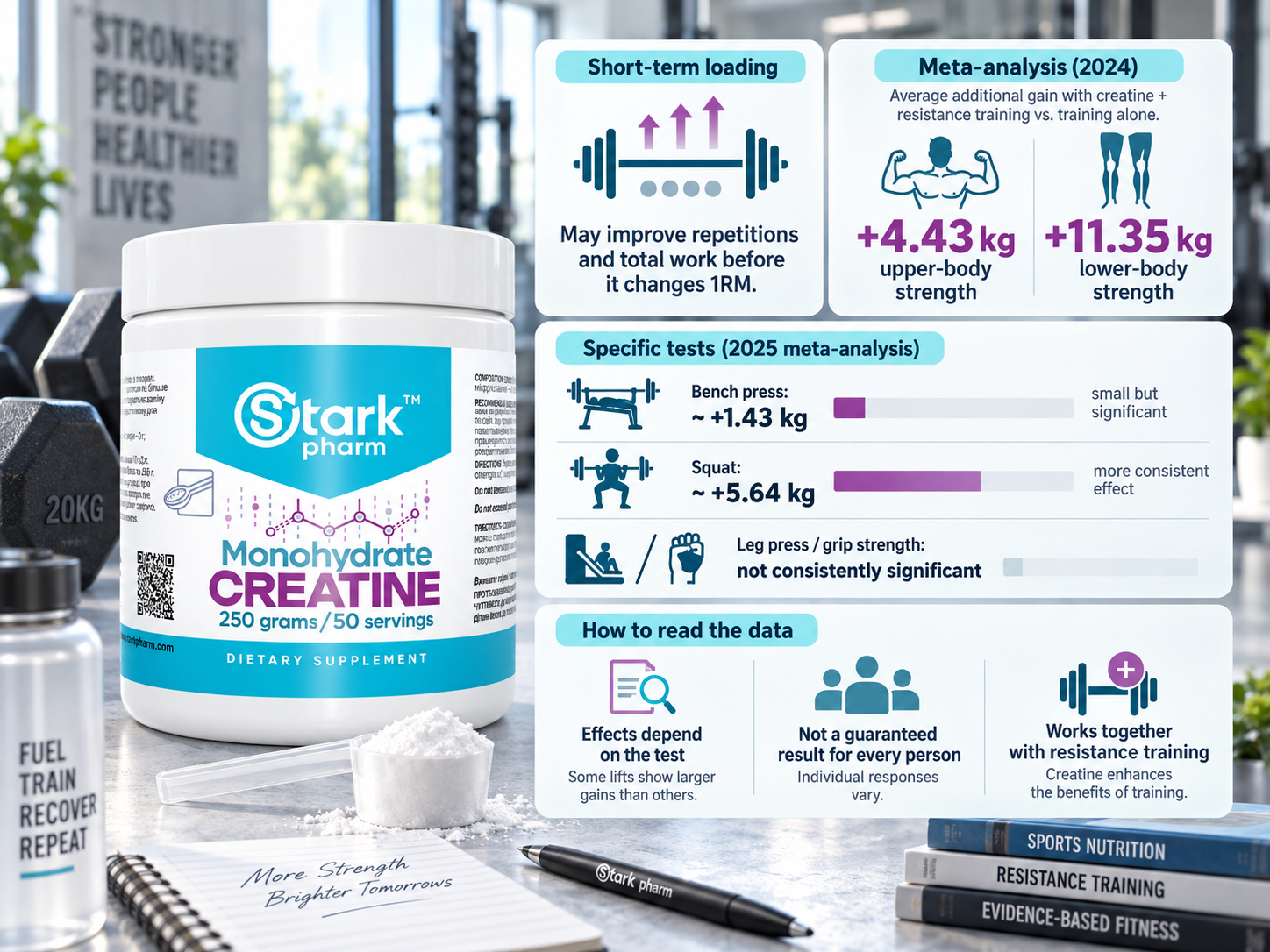
Wang et al. (2024) included 23 studies comparing creatine with resistance training to placebo and resistance training alone. In the pooled analysis, the average additional strength gain was 4.43 kg for the upper body and 11.35 kg for the lower body.
These numbers do not mean that creatine adds 10 pounds to each person's bench press or 25 pounds to their squat. The authors combined different upper and lower body tests. The average from the meta-analysis describes the difference between groups in a set of studies, not an individual's prediction or a specific exercise.
In the same analysis, larger effects were seen in some subgroups, but the number of women was significantly smaller than that of men: of the included studies, 20 studied men, only 2 studied women, and 1 studied both sexes. Therefore, the lack of equally precise estimates for all groups partly reflects the composition of the evidence base.
Why meta-analyses of individual exercises give different numbers
Kazeminasab et al. (2025) included a much larger sample—69 studies and 1937 participants—and analyzed specific strength tests separately. Creatine plus training provided a small but statistically significant additional benefit for the bench press/chest press and a more significant one for the squat.
Subgroup analyses in this study also showed stronger signals in younger participants and men. However, these results should be read in conjunction with the uneven representation of women and older adults in the original studies, and not as evidence that creatine “doesn’t work” for other groups.
What do basic strength tests show?
| Test | Average additional effect in meta-analysis 2025 | How to interpret this |
|---|---|---|
| Bench press/chest press | approximately +1.43 kg | Small but statistically significant advantage of creatine over placebo |
| Squatting | approximately +5.64 kg | Statistically significant additional benefit |
| Leg press | approximately +3.13 kg | The overall difference did not reach statistical significance. |
| Grip strength | approximately +4.26 kg | The overall difference did not reach statistical significance. |
New data from 2026 confirms that the outcome depends on the test
Gu et al. (2026) conducted a systematic review and meta-analysis in healthy young men. After the published correction, the main strength estimates remained as follows: for the 1RM squat, the mean additional difference was 11.9 kg with moderate certainty of evidence, while for the leg press, it was 3.58 kg with a confidence interval crossing zero and low certainty of evidence.
This is in good agreement with the 2025 meta-analysis, with the positive effect for squats being more consistent, while leg presses are less consistent. However, the effect size for squats varies between analyses due to different inclusion criteria, populations, and statistical models.
Older meta-analyses showed the same general trend
Branch (2003) pooled 16 controlled studies and found an approximately 15.5 lb (6.85 kg) greater increase in maximum weight in the bench press and 22.5 lb (9.76 kg) greater increase in maximum weight in the squat for creatine compared to placebo. Most of the maximum weight data at that time came from young men who were strength training.
A review by Rawson and Volek (2003) analyzed 22 studies that used creatine in conjunction with resistance training. On average, strength gains were about 8 percentage points greater and repetition performance gains were about 14 percentage points greater than with placebo. The authors also emphasized the high individual variability.
Later separate meta-analyses by Lanhers et al. confirmed small positive effects for both the lower body in 2015 and the upper body in 2017. For squat, leg press, bench press, and total upper body strength, the direction of the effect was generally in favor of creatine, although the specific magnitude depended on the test.
Does it work the same for women and older adults?
There is less evidence in women and the results of individual studies are mixed. In an RCT by Ferguson and Syrotuik (2006), 26 strength-trained women improved their 1RM in the bench press and leg press over 10 weeks, but no additional statistically significant advantage of creatine over placebo was found for strength.
This does not mean that creatine cannot affect strength in women. Rather, the small sample sizes and fewer studies make the estimate less precise. This is why subgroup results in large meta-analyses should be interpreted with caution.
There is a separate evidence base for older adults. A meta-analysis by Chilibeck et al. (2017), which included 22 studies and 721 participants aged approximately 57–70 years, found greater gains in chest and leg press strength when creatine was combined with resistance training. This suggests that the effect is not limited to young men, although the magnitude and strength of the effect may vary between age groups.
Strength and muscle mass are not the same adaptation
An increase in maximal strength cannot be directly translated into pounds of new muscle. Strength performance is influenced by neural adaptation, exercise technique, coordination, training specificity, and the ability to generate force in a particular movement.
Therefore, a person can significantly improve their 1RM without a proportional increase in muscle mass. Conversely, changes in lean mass do not guarantee the same percentage increase in strength. Separate quantitative data on body composition and hypertrophy are discussed in the material on how much additional muscle mass studies show.
Why you can't say "creatine adds X% strength"
- various studies use bench press, squat, leg press, grip strength, and other tests;
- the initial strength and training experience of the participants differ significantly;
- programs last from a few days to many weeks or months;
- the result depends on whether acute performance, 1RM after a training cycle, or the average effect of several exercises is assessed;
- Women, older adults, and certain training groups are unevenly represented in the literature.
Therefore, for practical reading of the data, it is more correct to speak not of a guaranteed percentage, but of a small to moderate additional advantage on top of the strength training itself. For specific exercises, current meta-analyses most consistently show an advantage in the bench/chest press and squat, while for leg press or grip strength, the results are less consistent.
If a person without creatine increased their squat by 20 kg during a certain program, this does not mean that creatine would have guaranteed to add another 5.64 or 11.9 kg. The figures from meta-analyses describe the average difference between groups in many studies. In an individual person, the result may be smaller, larger, or almost imperceptible.
Similarly, short-term improvements in repetitive work should not be interpreted as an established increase in maximal strength. The most convincing picture emerges when creatine is combined with systematic strength training over a sufficient period of time, and the result is assessed in a specific standardized test.
Frequently asked questions
How much does creatine increase strength?
There is no single universal number. In meta-analyses, the additional gain depends on the exercise: for bench/chest press and squats, the effect is more often statistically significant, while for leg press and grip strength, the results are less consistent.
Does creatine increase strength in just a few days?
Short bursts of training can improve the ability to perform repeated high-intensity work, but 1RM does not necessarily increase in one week. Long-term gains in maximal strength occur with training adaptation.
Does creatine help with bench press?
Yes, in large meta-analyses for bench press and chest press, the overall effect was in favor of creatine. But the mean between-group difference is not predictive for an individual.
Does creatine help with squats?
Squats are one of the tests where the positive effect is quite consistent. Meta-analyses from 2025 and 2026 showed a statistically significant additional benefit, although the average magnitude of this benefit varied between studies.
Why is the result less convincing for the leg press?
In large modern meta-analyses, the mean difference was positive, but the confidence intervals did not rule out the absence of an effect. This may be due to differences in simulators, testing techniques, samples, and protocols.
Does creatine affect beginners and experienced athletes the same way?
There is no reason to claim that one group is guaranteed to have a greater effect in all conditions. Training status may affect the result, but the data of the subgroups are heterogeneous and depend on the specific strength test.
Does greater strength mean that the muscles have grown stronger?
Not necessarily. Strength gains depend not only on muscle mass, but also on neural adaptation, technique, and training specificity.
Sources
- Wang CC and others. (2024). Effects of Creatine Supplementation and Resistance Training on Muscle Strength Gains in Adults <50 Years of Age: A Systematic Review and Meta-Analysis. PubMed
- Kazeminasab F. and others. (2025). The Effects of Creatine Supplementation on Upper- and Lower-Body Strength and Power: A Systematic Review and Meta-Analysis. Nutrients. PubMed
- Gu J. and others. (2026). Creatine supplementation in young men under resistance versus non-resistance training: a systematic review and meta-analysis of strength, performance, and lean mass. Frontiers in Nutrition. PubMed
- Gu J. and others. (2026). Correction: Creatine supplementation in young men under resistance versus non-resistance training: a systematic review and meta-analysis of strength, performance, and lean mass. Frontiers in Nutrition. PubMed
- Lanhers C. and others. (2015). Creatine Supplementation and Lower Limb Strength Performance: A Systematic Review and Meta-Analyses. Sports Medicine. PubMed
- Lanhers C. and others. (2017). Creatine Supplementation and Upper Limb Strength Performance: A Systematic Review and Meta-Analysis. Sports Medicine. PubMed
- Branch JD (2003). Does oral creatine supplementation improve strength? A meta-analysis. Journal of Family Practice. PubMed
- Rawson ES, Volek JS (2003). Effects of creatine supplementation and resistance training on muscle strength and weightlifting performance. Journal of Strength and Conditioning Research. PubMed
- Volek JS and others. (1997). Creatine supplementation enhances muscular performance during high-intensity resistance exercise. Journal of the American Dietetic Association. PubMed
- Volek JS and others. (1999). Performance and muscle fiber adaptations to creatine supplementation and heavy resistance training. Medicine & Science in Sports & Exercise. PubMed
- Wang CC and others. (2021). Short-Term Creatine Loading Improves Total Work and Repetitions to Failure but Not Load-Velocity Characteristics in Strength-Trained Men. Nutrients. PubMed
- Ferguson TB, Syrotuk DG (2006). Effects of creatine monohydrate supplementation on body composition and strength indices in experienced resistance trained women. Journal of Strength and Conditioning Research. PubMed
- Chilibeck PD and others. (2017). Effect of creatine supplementation during resistance training on lean tissue mass and muscular strength in older adults: a meta-analysis. Open Access Journal of Sports Medicine. PubMed
Dietary supplement. Not a medicine. Consult a doctor before use.
Products related to this post

Related Posts
Comments
Information
Customer Service
Extras
My Account


Sports nutrition manufacturer in Ukraine StarkPharm © 2026