Your shopping cart is empty!

Why inositol was called vitamin B8 and why it is no longer considered a vitamin
Published: 20/10/2026
Times Read: 37
Comments : 0
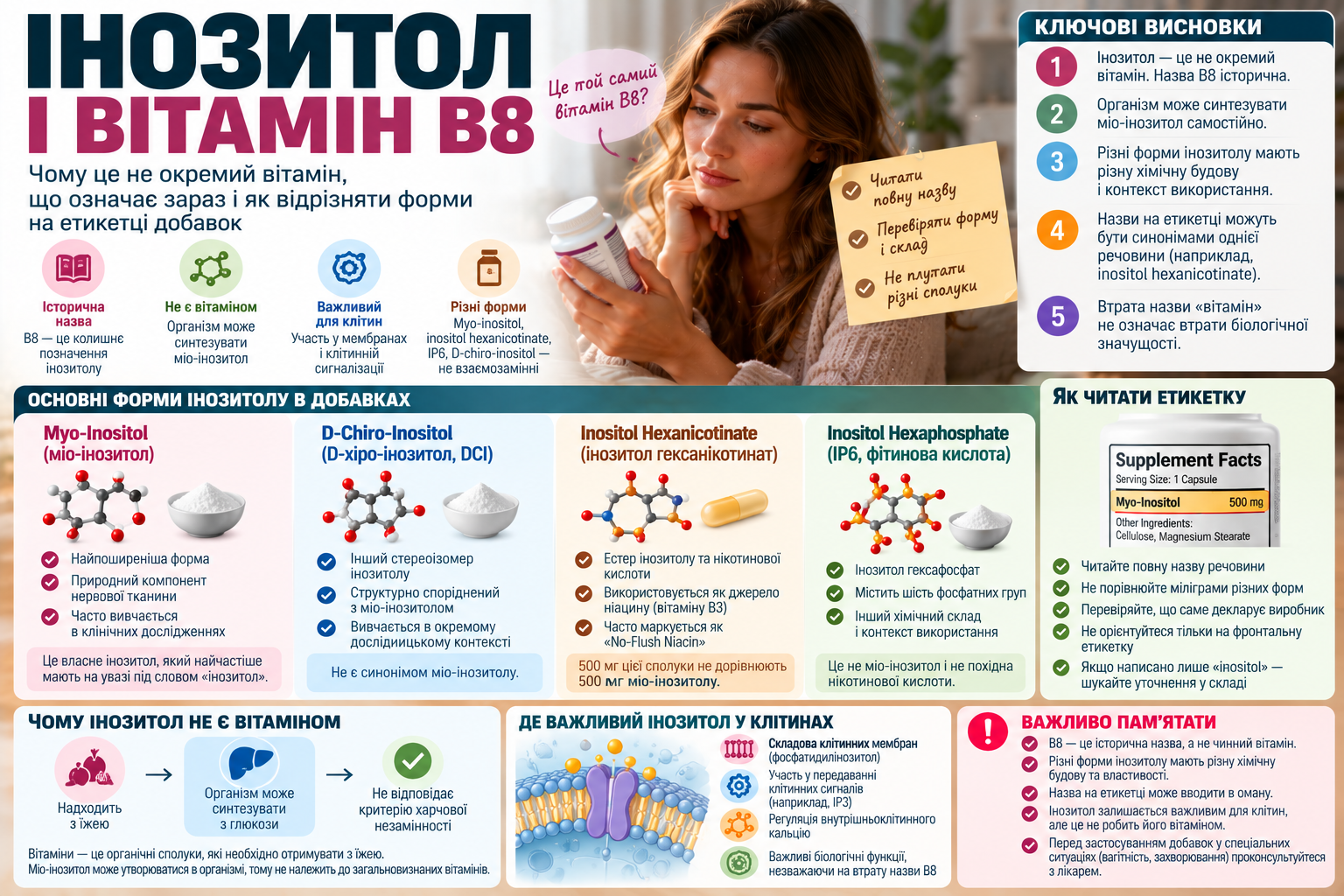
Inositol can still be found under the name “vitamin B8”, although there is no such item in the modern classification of vitamins. These are not two different substances: the name B8 remained from the period when inositol was considered together with the B vitamins. Over time, it became clear that the human body can synthesize myo-inositol independently, in particular from glucose derivatives. Therefore, it does not meet the usual criteria for a vitamin as an organic compound that must be obtained with food in a certain amount. The loss of the name “vitamin” does not mean the loss of biological significance: inositol and its derivatives are involved in the structure of cellular components and the transmission of signals within cells.
Where did the name "vitamin B8" come from?
The history of inositol began long before scientists fully understood its functions. The substance was isolated from biological materials, its chemical structure was determined, and its presence in tissues was studied. A historical review by Irvine (2016) describes the path from early chemical studies of inositol to discoveries related to inositol lipids and cell signaling.
In the past, inositol was included in a broader group of compounds related to the B vitamins. This is where the name "vitamin B8" came from. It can still be found in popular materials and descriptions of dietary supplements, but this is a historical name, not a current designation for a separate vitamin. A scientific review by Caputo et al. (2020) explicitly states that myo-inositol was previously included in the B vitamin family, but is no longer considered an essential dietary component in the classical sense.
There is no need to look for a single date for the "cancellation of B8": the change in terminology reflects the accumulation of biochemical knowledge, and not necessarily a separate official decision regarding the name.
What distinguishes a vitamin from a vitamin-like substance?
Vitamins are usually called organic compounds necessary for normal physiological processes, which the body does not produce in sufficient quantities and therefore must be obtained with food. It is not just the benefit of the molecule that is important, but its nutritional irreplaceability. If a person cannot meet the need for such a substance, its insufficient intake can cause characteristic disorders.
Vitamin-like substances are sometimes called substances with important biological functions that resemble vitamins in some respects but do not meet all the criteria. This is a descriptive term, not a separate universal category with the same requirements for each compound. Inositol is an example of such historical confusion: participation in vital processes does not automatically make it a vitamin.
Therefore, the statements “inositol is necessary for cells” and “inositol is vitamin B8” are not equivalent. The first refers to the biochemical role, the second to the classification according to the principle of indispensable intake with the diet.
Why modern science does not classify inositol as a vitamin
The main reason is the endogenous synthesis of myo-inositol. Mammalian cells obtain it in two ways: by uptake from the external environment and by synthesis from glucose-6-phosphate. The second process involves an enzymatic pathway associated with the ISYNA1 gene. These mechanisms are described in a review by Su, Ko, and Saiardi (2023) on the regulation of myo-inositol content in cells.
It is the ability to form inositol in the body that has changed its place in the classification. Dietary sources remain part of the general metabolism, but the presence of inositol in food is not in itself evidence that it should belong to the list of vitamins. In the scientific literature, inositol is described as a cyclic polyhydric alcohol — a polyol — with several spatial forms; the most common in the body is the myo-form.
At the same time, the ability to synthesize does not mean that the concentration of inositol in all tissues is always the same or that its metabolism cannot be disturbed. Cells regulate the synthesis, transport and excretion of the substance, and these processes can change under different physiological conditions. This is a question of cellular metabolism, and not evidence of the existence of a separate vitamin B8.
Why inositol remains important for the body
Inositol is a component of some membrane lipids. For example, phosphatidylinositol is a component of cell membranes, and its derivatives are involved in signaling processes. When a cell receives a signal from a receptor, certain inositol-containing compounds can change and form mediator molecules. One well-studied example is inositol-1,4,5-triphosphate (IP3), which is involved in the regulation of intracellular calcium.
This mechanism does not mean that supplementing with inositol automatically improves all the processes in which it is involved. There is a fundamental difference between the established biochemical function of a molecule and the proven benefit of a particular supplement. It is important to keep this in mind when reading descriptions of the properties of inositol.
The history of inositol lipid research, summarized by Irvine (2016), illustrates how a compound once considered primarily in a nutritional context has become an important focus of cell biology. The current significance of inositol is primarily due to its specific functions, rather than its former position in the B group.
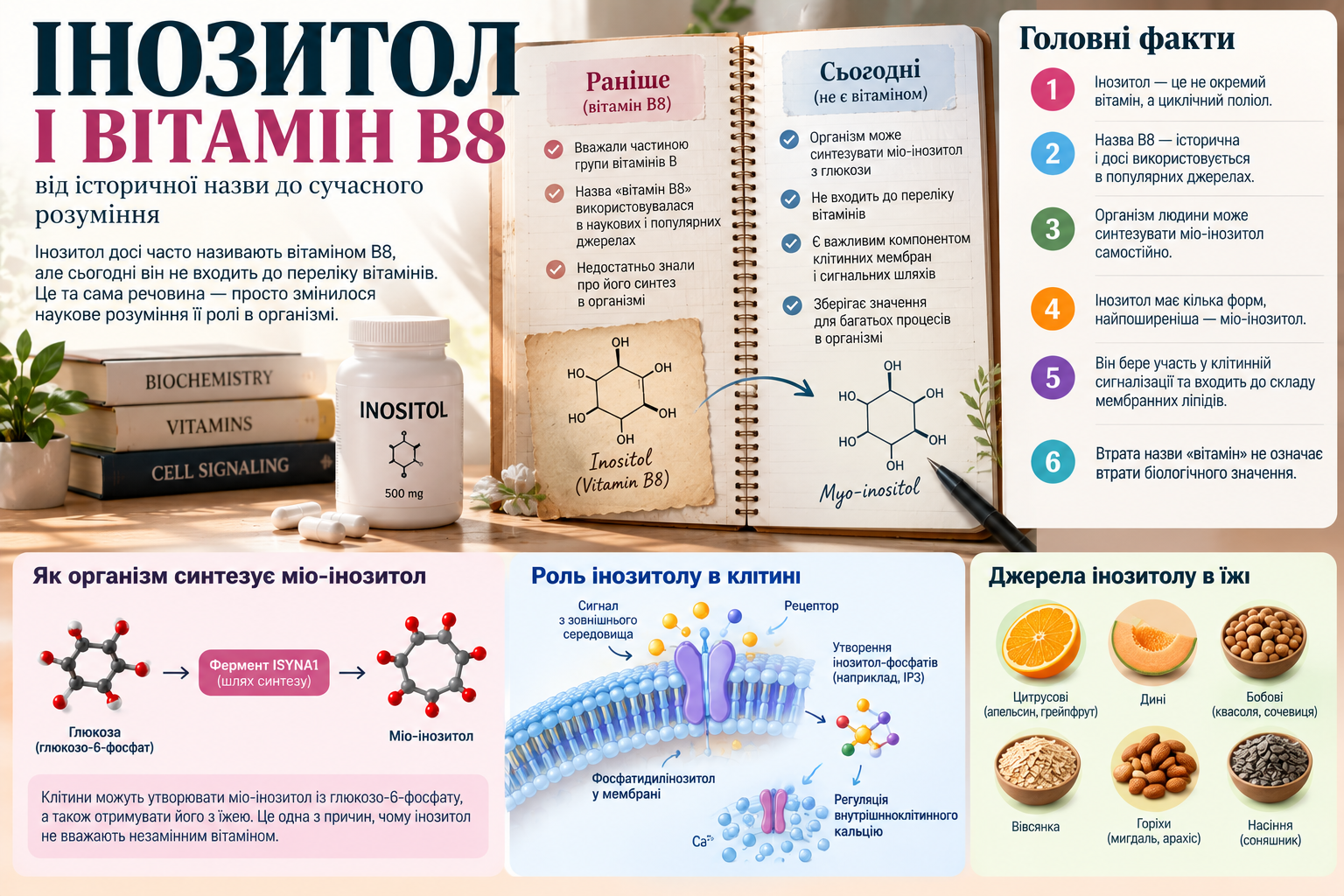
As a historical synonym or explanation for the reader, the wording "inositol, formerly known as vitamin B8," correctly conveys the origin of the term. However, without qualification, the name "vitamin B8" may create the misconception that there is a generally accepted daily allowance for this vitamin and a separate type of avitaminosis, analogous to a deficiency of the established vitamins.
In scientific literature, it is more accurate to use the name "myo-inositol" when referring to the most common biological form, or "inositol" when describing a broader group of isomers. The name B8 does not specify the chemical form of the substance, its quantity, or the properties of the finished supplement. Therefore, the specific ingredient name and label information are important for understanding the composition, not the historical designation.
Is there a vitamin B8 deficiency?
It is incorrect to speak of a classic “vitamin B8 deficiency,” because inositol is not a generally recognized vitamin. There is no standard pattern of nutritional vitamin deficiency for it that could be directly equated to a deficiency of real vitamins. Therefore, popular lists of nonspecific symptoms that supposedly clearly indicate a deficiency of B8 should be evaluated critically.
This does not rule out the possibility of changes in inositol concentration or disturbances in its synthesis, transport or metabolism in individual tissues. Scientific authors study such phenomena in the context of metabolism, but they do not prove that a person necessarily needs a supplement simply because of the existence of the former name B8. The need for additional consumption is not determined by the name of the substance and should be considered taking into account individual circumstances.
So inositol hasn't "ceased to be important" after the classification change. What has changed is the understanding of where it comes from in cells and why it shouldn't automatically be equated with essential vitamins.
Frequently asked questions
Are inositol and vitamin B8 the same substance?
The name "vitamin B8" was historically applied to inositol, primarily myo-inositol. Today, this is an outdated designation and not the name of an officially recognized vitamin.
Why was inositol no longer considered a vitamin?
It turned out that the human body is able to independently synthesize myo-inositol from glucose derivatives. Therefore, it is not considered an essential dietary vitamin in the classical sense.
Is B8 included in the modern list of vitamins?
No. Inositol is not included in the generally recognized list of human vitamins as a separate vitamin B8.
Can the body produce inositol itself?
Yes. Cells can synthesize myo-inositol from glucose-6-phosphate, as well as obtain it from the extracellular environment.
Does vitamin B8 deficiency exist?
Classical B8 avitaminosis is not defined as a deficiency of an officially recognized vitamin. At the same time, disorders of inositol metabolism are a separate topic of scientific research.
Does the name B8 mean that inositol must be taken?
No. The historical name is not a reason for mandatory intake of the supplement. The issue of its use should be decided individually, taking into account the state of health and the recommendations of a specialist.
Sources
- Caputo M. and others. (2020). Inositols and metabolic disorders: From farm to bedside. Journal of Traditional and Complementary Medicine. PubMed.
- Su XB, Ko A.-LA, Saiardi A. (2023). Regulations of myo-inositol homeostasis: Mechanisms, implications, and perspectives. Advances in Biological Regulation. PubMed.
- Irvine RF (2016). A short history of inositol lipids. Journal of Lipid Research. PubMed.
- Greene NDE, Leung K.-Y., Copp AJ (2017). Inositol, neural tube closure and the prevention of neural tube defects. Birth Defects Research. PMC.
Dietary supplement. Not a medicine. Consult a doctor before use.
Products related to this post
Related Posts
Information
Customer Service
Extras
My Account


Sports nutrition manufacturer in Ukraine StarkPharm © 2026


