Your shopping cart is empty!

Myo-inositol: what is it and where is it found in food?
Published: 10/10/2026
Times Read: 7
Comments : 0
Myo-inositol is a natural compound found in the human body and in common foods. It is often called “vitamin B8,” but this name is historical and not entirely accurate: the body is able to synthesize inositol itself, so it does not meet the classic definition of an essential vitamin.
Myo-inositol is the most common biologically significant form of inositol. It is a component of cellular structures and is a precursor to molecules involved in intracellular signaling. However, inositol can be present in different forms in food, so a simple number “how much inositol is in a product” does not always mean the same amount of free myo-inositol.
What is myo-inositol?
Chemically, inositol belongs to the cyclic polyols. There are several spatial forms of it, but it is myo-inositol that is the most abundant in human tissues and the most studied in nutrition.
The myo-inositol molecule can exist in free form or be part of more complex compounds. In particular, it is used to form phosphatidylinositol and inositol phosphates, which perform important functions in the cell.
Why do cells need inositol?
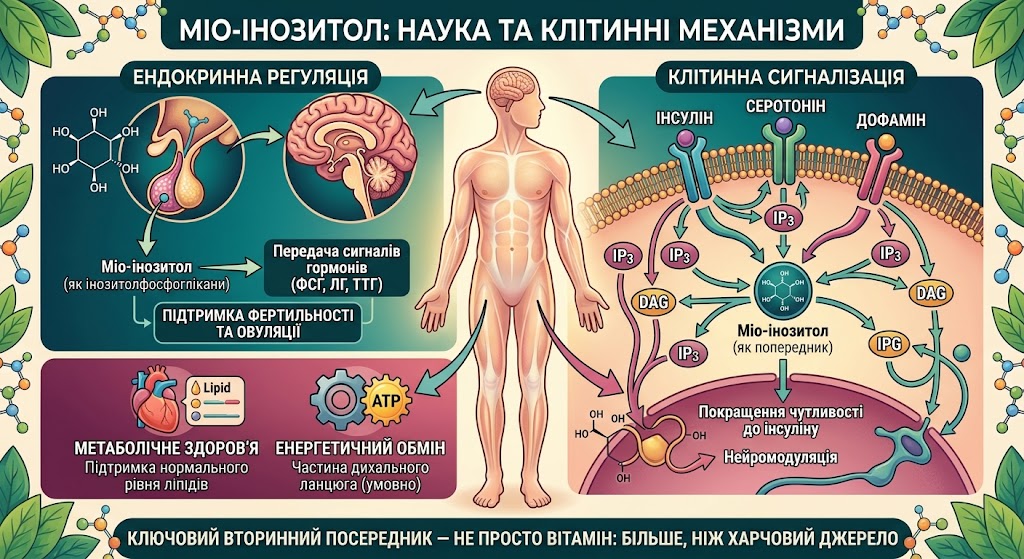
Inositol derivatives are part of cell membranes and intracellular signaling systems. They participate in the functioning of enzymes, the transport of signals from receptors, and the regulation of various cellular processes.
It is important for the basic article not to overstate this role. The mere fact that inositol is involved in signaling pathways does not mean that additional inositol will automatically improve all processes in which these pathways are involved. Such effects need to be evaluated separately in clinical trials.
Why is inositol called "vitamin B8"?
The name "vitamin B8" is still found in popular materials and on labels, but it is not an accurate modern classification. Unlike classic vitamins, myo-inositol can be synthesized in the body from glucose derivatives.
Therefore, it is more correct to call it myo-inositol or inositol, and to perceive the historical name "B8" only as a common household term.
In what forms does inositol occur in food?
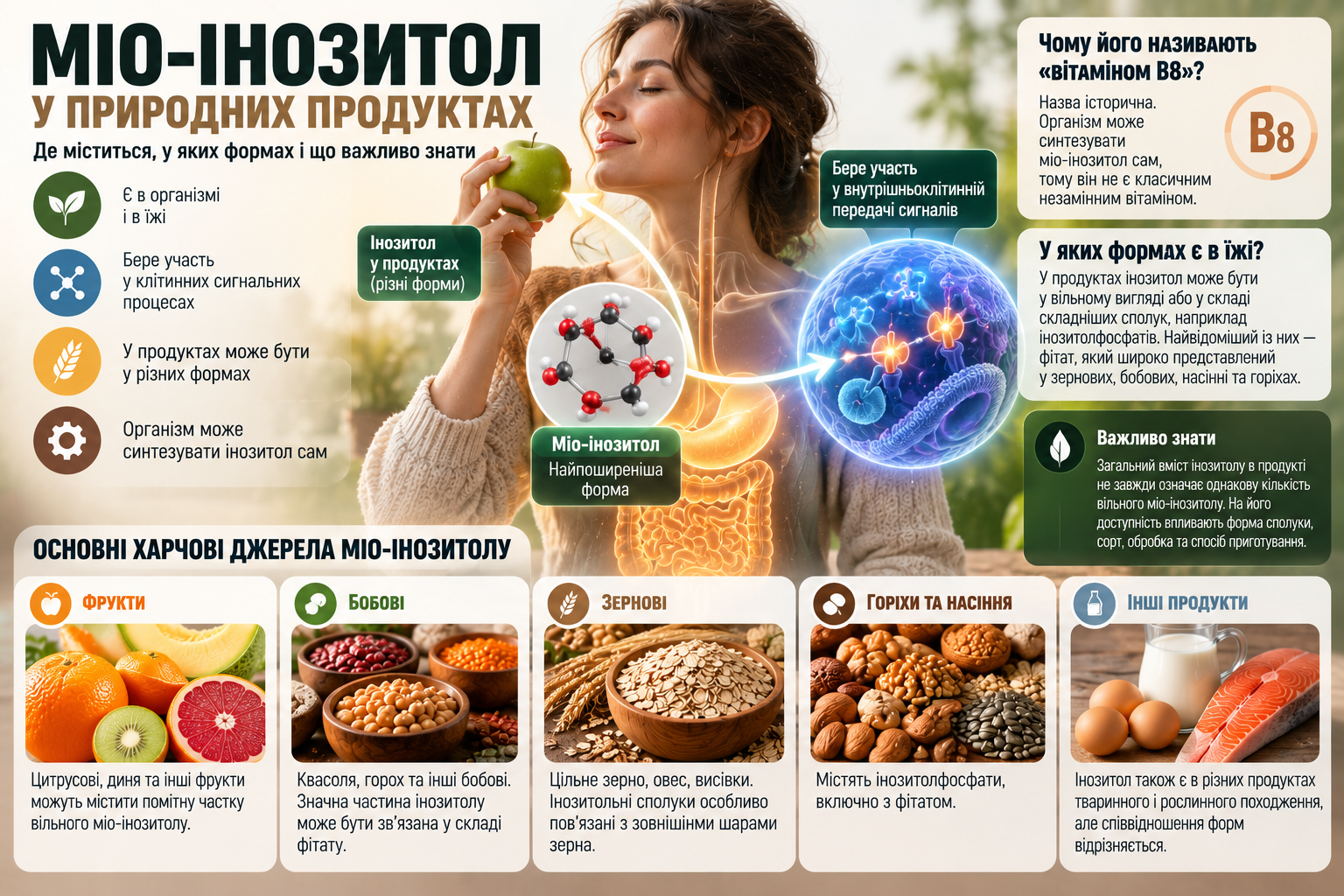
Inositol is not only present in free form in foods. In plant foods, a significant part of it can be bound in the form of inositol phosphates. The most famous of these is phytate, or a salt of phytic acid.
This is an important nuance when reading food labels. Two foods may have similar total inositol content but different ratios of free myo-inositol to phytate.
Where is the most myo-inositol in the diet?
A classic study by Clements and Darnell analyzed 487 foods. The authors found the highest amounts of myo-inositol in fruits, legumes, grains, and nuts.
They also found that processing method matters: fresh produce in certain categories may contain more myo-inositol than frozen or canned counterparts. This is one reason why the exact numbers from different tables should not be taken as universal for every variety and preparation method.
Fruits as a source of free myo-inositol
Fruit is one of the notable dietary sources of myo-inositol. In older analytical tables, citrus fruits and some types of melons were particularly often highlighted.
But making a rating with milligram accuracy is not very accurate: the content depends on the variety, maturity, storage, and method of laboratory analysis.
Legumes, grains, nuts and seeds
Legumes, whole grains, nuts, and seeds can also contain significant amounts of inositol compounds. The phytate form is particularly important in these foods.
Phytate naturally accumulates in plant seeds as a phosphorus reserve. During digestion and food processing, some inositol phosphates can be broken down, so the actual availability of inositol depends not only on the initial content in the product.
What is known about the main food sources
| Product group | Examples | What is important to know |
|---|---|---|
| Fruits | Citrus, melon and other fruits | May contain a significant proportion of free myo-inositol |
| Legumes | Beans, peas and other legumes | A significant portion of inositol can be bound in phytate. |
| Crops | Whole grains, oats, bran | Inositol compounds are particularly associated with the outer layers of the grain |
| Nuts and seeds | Various nuts and seeds | Contains inositol phosphates, including phytate |
| Other products | Various products of animal and plant origin | The ratio of free inositol and its derivatives varies |
Why “inositol in a product” doesn’t always mean free myo-inositol
Phytate is an inositol ring with multiple phosphate groups. It is widely present in grains, legumes, seeds, and nuts, but is not the same as free myo-inositol.
Therefore, when comparing food sources, it is important to look at what the authors measured: free myo-inositol, total inositol compounds, or phytate. Without this, two numbers from different sources may not describe exactly the same thing.
Does the body produce inositol itself?
That is why myo-inositol is not considered a classic essential vitamin. The detailed pathway of its formation, regulation of synthesis and metabolism should be considered separately, and not mixed with a basic overview of food sources.
Does the presence of inositol in food mean that supplements are pointless?
Neither dietary sources nor the body's own synthesis provide grounds for a universal conclusion about the need or non-need of supplements. These are different sources of intake, and clinical studies of supplements are conducted in specific populations and with specific endpoints.
Therefore, the question of "do you need additional myo-inositol" cannot be answered by a list of products alone. It depends on the goal, diet, health status, and what data is available for a specific scenario.
Precautions regarding additives
The amount of inositol in a regular diet and the amount in a concentrated supplement are not the same. Research doses from individual clinical studies should not be transferred to a self-administered regimen.
For supplements, follow the instructions on the package. If you have a chronic condition, are taking medication regularly, or have other medical conditions, you should discuss the appropriateness of using a supplement with your doctor.
Frequently asked questions
Is myo-inositol vitamin B8?
The name "vitamin B8" is used historically, but myo-inositol is not a classic essential vitamin because the body can synthesize it itself.
Where is the most myo-inositol in food?
In a classic analysis of 487 foods, the highest amounts were found in fruits, legumes, grains, and nuts.
Is inositol in fruits?
Yes. Fruits are one of the main dietary sources, and some of the inositol may be present in free form.
Is inositol in grains and nuts?
Yes, but in plant foods, a significant portion of inositol may be bound as phytate and other inositol phosphates.
Are phytate and myo-inositol the same thing?
No. Phytate is a phosphorylated derivative of inositol. During digestion, some of the inositol phosphates may be broken down, but phytate should not be equated with free myo-inositol.
Does the body produce myo-inositol itself?
Yes. It is synthesized from glucose derivatives, and the kidneys and other tissues play an important role in this process.
Can you get enough inositol from food alone?
There is no universal “daily requirement” for myo-inositol that can be simply compared to a food menu. Food is a natural source, but the issue of supplement use is evaluated individually depending on the specific purpose and evidence.
Sources
- Clements RS Jr., Darnell B. (1980). Myo-inositol content of common foods: development of a high-myo-inositol diet. American Journal of Clinical Nutrition. PubMed
- Dinicola S. and others. (2017). Nutritional and Acquired Deficiencies in Inositol Bioavailability. Correlations with Metabolic Disorders. International Journal of Molecular Sciences. PubMed
- Maffucci T., Falasca M. (2020). Signaling Properties of Inositol Polyphosphates. Molecules. PubMed
- Schlemmer U. and others. (2009). Phytate in foods and significance for humans: food sources, intake, processing, bioavailability, protective role and analysis. Molecular Nutrition & Food Research. PubMed
- Bizzarri M. and others. (2016). Pharmacodynamics and pharmacokinetics of inositol(s) in health and disease. Expert Opinion on Drug Metabolism & Toxicology. PubMed
Dietary supplement. Not a medicine. Consult a doctor before use.
Products related to this post
Comments
Information
Customer Service
Extras
My Account


Sports nutrition manufacturer in Ukraine StarkPharm © 2026