Your shopping cart is empty!

Inositol and sleep: is there any data on sleep quality?
Published: 18/10/2026
Times Read: 106
Comments : 0
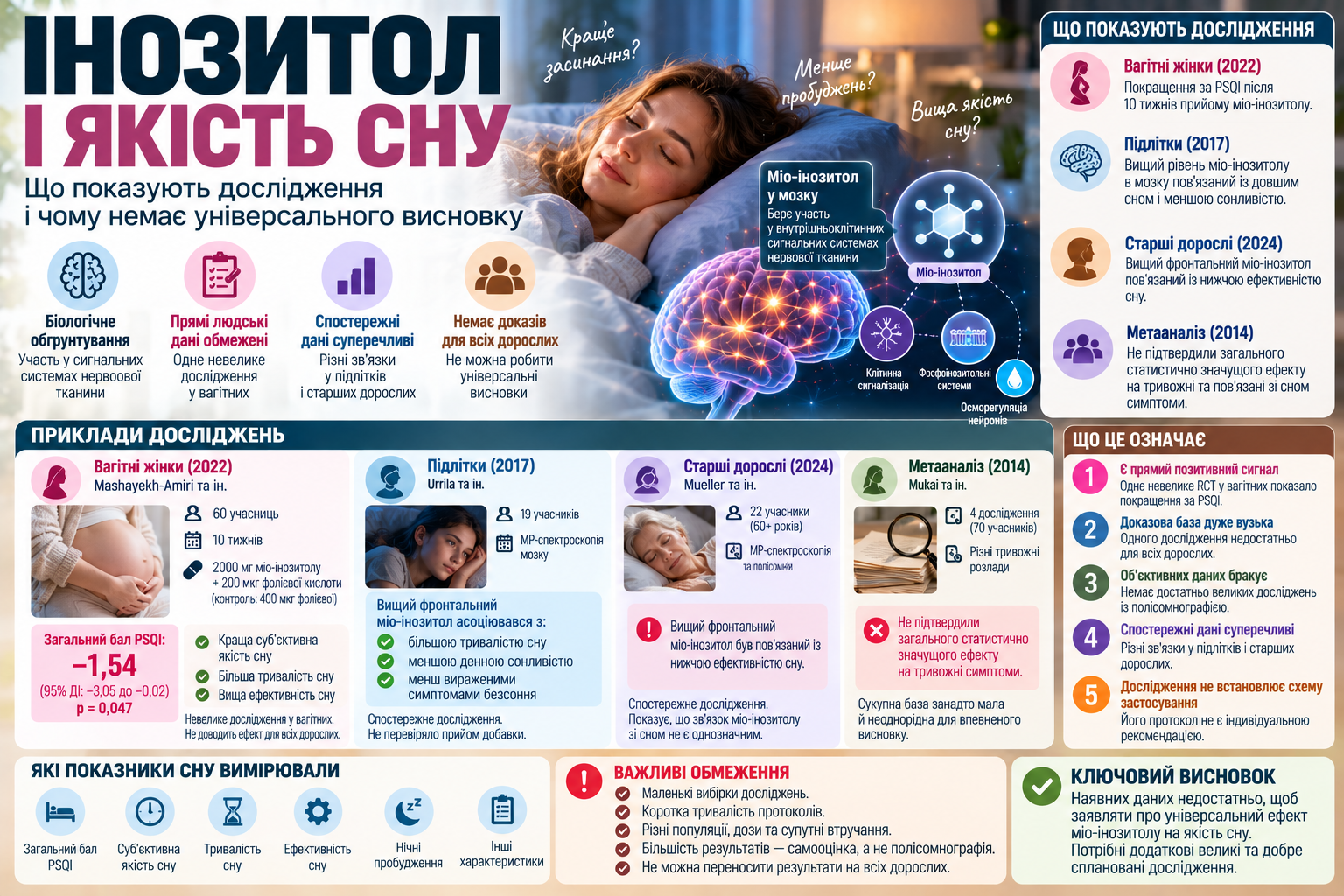
Direct human evidence on myo-inositol and sleep remains very limited. One small randomized, double-blind study in pregnant women found differences in sleep-quality questionnaire scores favoring the myo-inositol group after 10 weeks. However, a single study is insufficient to claim a universal effect in all adults.
Other studies frequently cited in this context did not test a supplement at all. Instead, they measured myo-inositol concentrations in the brain using magnetic resonance spectroscopy and examined associations with sleep parameters. Such associations are interesting, but they do not show that oral myo-inositol changes sleep.

Why inositol is associated with sleep in the first place
Myo-inositol is a natural component of nervous tissue. It participates in cellular signaling, forms part of phosphoinositide systems, and acts as an organic osmolyte.
This provides a biological rationale for nervous-system research, but the mechanism alone does not establish an effect on sleep. Demonstrating an actual effect requires controlled trials in which sleep is a predefined endpoint.
The direct randomized trial: who participated
The most direct evidence comes from a study by Mashayekh-Amiri et al. It enrolled 60 women with low-risk singleton pregnancies from 14 weeks of gestation onward.
Participants were randomly assigned to two groups. The trial was double-blind and placebo-controlled, and the intervention lasted 10 weeks.
What exactly the participants received
The active group received a powder containing 2,000 mg of myo-inositol and 200 µg of folic acid. The control group received 400 µg of folic acid.
This is an important design detail: the groups differed not only in whether they received myo-inositol but also in the amount of folic acid. The study should therefore be described as a specific protocol, not a universal supplementation model.
How sleep quality was measured
The main instrument was the Pittsburgh Sleep Quality Index (PSQI), a standardized questionnaire assessing subjective sleep quality across several components.
The PSQI includes self-reported sleep quality, duration, efficiency, disturbances, and other characteristics. It is a useful clinical instrument, but it is not polysomnography and does not directly measure sleep stages through electrophysiological signals.
What the overall PSQI score showed
After the intervention, the mean between-group difference in the total PSQI score was approximately -1.54 points in favor of the myo-inositol group. The 95% confidence interval ranged from -3.05 to -0.02, with a p-value of 0.047.
The result formally reached statistical significance, but the confidence interval nearly touched zero. This makes it a positive yet relatively fragile signal that requires independent replication.
Which sleep components differed between groups
The authors also reported statistically significant differences in subjective sleep quality, sleep duration, and habitual sleep efficiency.
However, these findings come from one small study in a highly specific population. They do not automatically imply the same outcome in men, nonpregnant women, older adults, or people with chronic sleep disorders.
What the study does not prove
The study did not test myo-inositol as a treatment for chronic insomnia. Nor did it establish an optimal time to take it before bedtime or compare morning versus evening administration.
Furthermore, the primary result came from a questionnaire rather than laboratory polysomnography. It therefore cannot establish changes in sleep stages, slow-wave sleep duration, or REM sleep.
What magnetic resonance spectroscopy showed in adolescents
In 2017, Urrila et al. studied 19 adolescents using proton magnetic resonance spectroscopy. They measured myo-inositol concentrations in frontal brain regions and compared them with sleep parameters and daytime well-being.
Higher frontal myo-inositol levels were associated with longer total sleep duration, less daytime sleepiness, and fewer insomnia symptoms.
However, this was not a supplementation trial. The researchers measured an endogenous brain metabolite, so the association does not show that taking myo-inositol would reproduce the same relationship.
What findings in older adults showed
In 2024, Mueller et al. examined 22 adults aged 60 years or older. Participants underwent brain magnetic resonance spectroscopy, laboratory polysomnography, and cognitive testing.
In this study, higher frontal myo-inositol levels were instead associated with lower sleep efficiency. This does not mean that myo-inositol worsens sleep: the study was observational and assessed a brain metabolite, not supplementation.
Nevertheless, the finding illustrates why a simple rule such as “more myo-inositol in the brain = better sleep” does not hold.
Why brain myo-inositol levels and taking a supplement are not the same thing
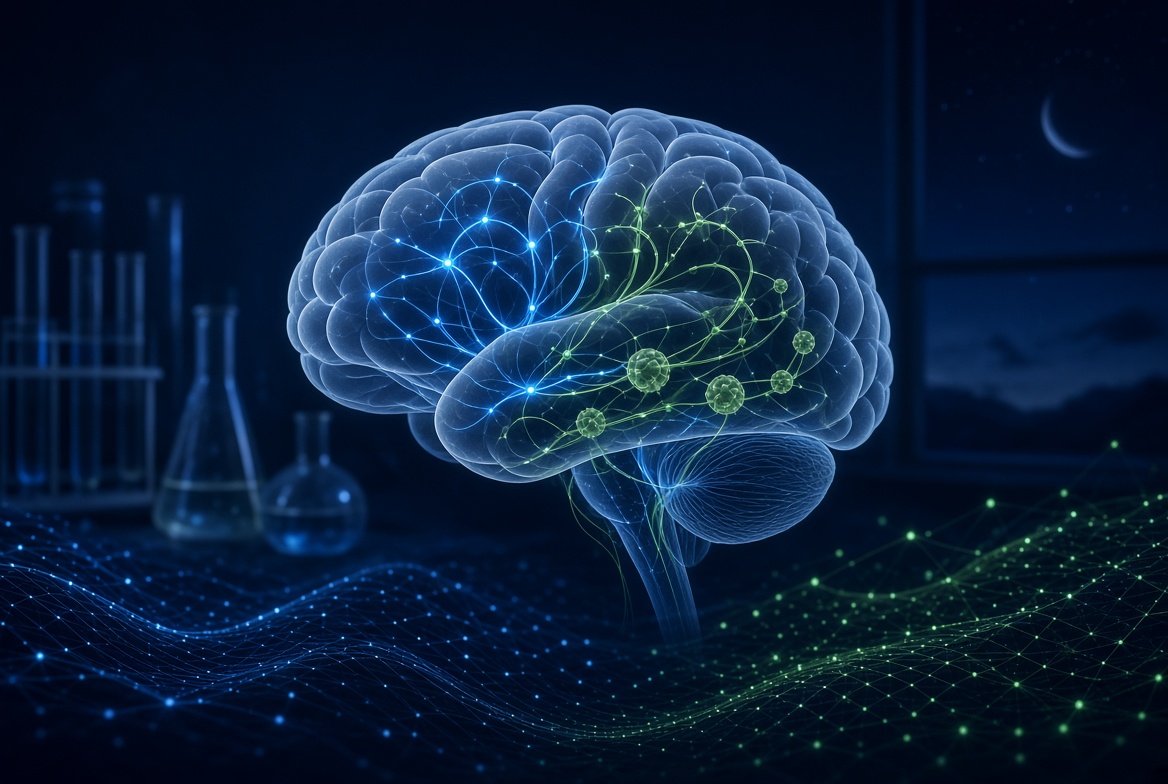
Metabolite concentrations detected by magnetic resonance spectroscopy depend on many processes, including local synthesis, transport, osmoregulation, the tissue's cellular composition, and metabolic status.
Oral intake is only one possible factor. Accordingly, an association between brain myo-inositol and sleep is not proof that the supplement has a causal effect.
What is actually known about myo-inositol and sleep
| Type of evidence | Findings | What can be concluded |
|---|---|---|
| RCT in pregnant women | Favorable difference in total PSQI after 10 weeks | A direct but narrow positive signal in a specific population |
| PSQI components | Differences in subjective sleep quality, duration, and efficiency | The findings concern self-reported components of sleep |
| Magnetic resonance spectroscopy in adolescents | Higher brain myo-inositol correlated with longer sleep and less sleepiness | An association involving a brain metabolite, not an effect of a supplement |
| Magnetic resonance spectroscopy in older adults | Higher frontal myo-inositol correlated with lower sleep efficiency | The relationship between myo-inositol and sleep is not straightforward |
| General adult population | No large body of direct evidence | A universal sleep-quality benefit cannot be claimed |
What can be said today
- A direct positive signal exists: one small RCT in pregnant women found a PSQI difference favoring myo-inositol.
- The evidence is very limited: one study is insufficient to draw conclusions for the general adult population.
- Objective sleep-architecture data after supplementation are lacking: there is no large body of direct polysomnography evidence.
- Observational evidence is mixed: associations between brain myo-inositol and sleep differed between adolescents and older adults.
- The study does not establish a dosing regimen: its protocol should not be turned into a universal recommendation.
Frequently asked questions
Are there studies of myo-inositol specifically for sleep quality?
Yes. A small randomized, double-blind, placebo-controlled trial in pregnant women assessed sleep using the PSQI questionnaire.
Has myo-inositol been proven to improve sleep in all adults?
No. The direct positive result came from one specific population and cannot automatically be generalized to all adults.
How was sleep measured in the study?
The main tool was the Pittsburgh Sleep Quality Index, a standardized questionnaire on subjective sleep quality, not laboratory polysomnography.
Have sleep stages been studied after taking myo-inositol?
There is still insufficient robust direct evidence examining sleep architecture in detail with polysomnography after oral myo-inositol supplementation.
Are brain myo-inositol levels associated with sleep?
Observational magnetic resonance spectroscopy studies found such associations, but they differed in direction across age groups and do not demonstrate a supplementation effect.
Does more myo-inositol in the brain mean better sleep?
No. In older adults, higher frontal myo-inositol was associated with lower sleep efficiency, so there is no simple linear rule.
Can these findings be used to choose a myo-inositol regimen for sleep on one's own?
No. The current evidence is too limited for a universal regimen. A research protocol is not individualized medical advice.
References
- Mashayekh-Amiri S. et al. (2022). The impact of myo-inositol supplementation on sleep quality in pregnant women: a randomized, double-blind, placebo-controlled study. Journal of Maternal-Fetal & Neonatal Medicine. PubMed
- Urrila A. S. et al. (2017). Frontal Cortex Myo-Inositol Is Associated with Sleep and Depression in Adolescents: A Proton Magnetic Resonance Spectroscopy Study. Neuropsychobiology. PubMed
- Mueller C. et al. (2024). Brain metabolites are associated with sleep architecture and cognitive functioning in older adults. Brain Communications. PubMed
- Maffucci T., Falasca M. (2023). Regulations of myo-inositol homeostasis: Mechanisms, implications, and perspectives. PubMed
- Fisher S. K. et al. (2002). Inositol and higher inositol phosphates in neural tissues: homeostasis, metabolism and functional significance. PubMed
Dietary supplement. Not a medicinal product. Consult your doctor before use.
Products related to this post
Related Posts
Comments
Information
Customer Service
Extras
My Account


Sports nutrition manufacturer in Ukraine StarkPharm © 2026


