Your shopping cart is empty!

Inositol and Body Composition: What the Research Really Shows
Published: 19/10/2026
Times Read: 59
Comments : 0
The search for “inositol for weight loss” is popular, but it can easily create the mistaken impression that inositol has a proven fat-burning effect. In fact, studies have assessed different anthropometric outcomes: body weight, body mass index, waist circumference, waist-to-hip ratio and, in some studies, fat mass.
Meta-analyses do find a small average signal for some of these outcomes. However, results vary substantially between studies, confidence in some anthropometric effects is low, and many trials included dietary changes. Therefore, these findings do not justify calling inositol a weight-loss agent.

Weight, BMI, waist size and fat mass are not the same thing
Body weight indicates a person's total mass but does not reveal how much comes from fat, muscle or other tissues. Body mass index is weight divided by height squared, making it convenient for large studies, but it does not directly measure fat mass.
Waist circumference and waist-to-hip ratio provide information about central body-size distribution, but they are not direct assessments of body composition either. Therefore, a statistically significant decrease in BMI cannot automatically be described as “fat loss.”
What the 2022 meta-analysis found
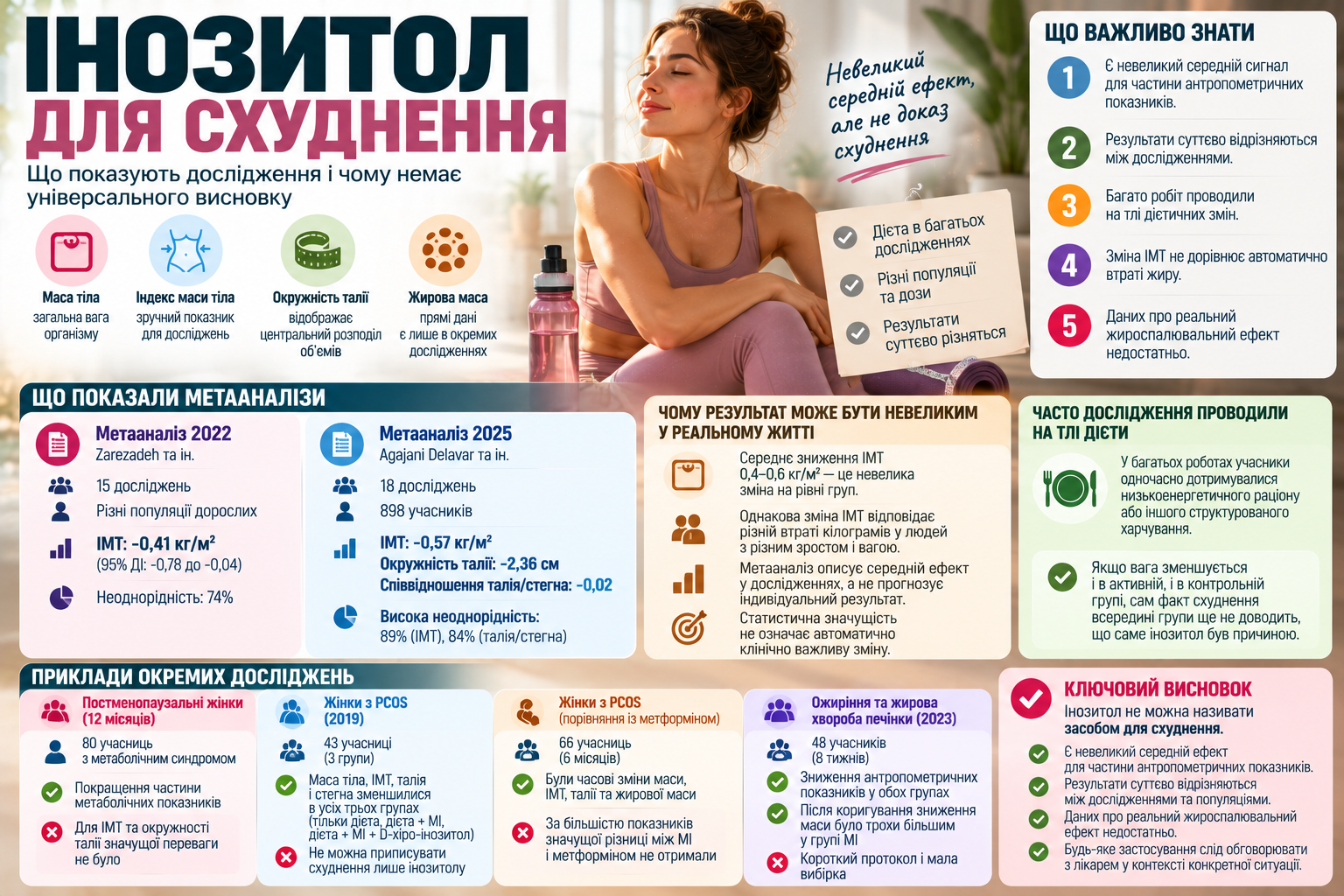
Zarezadeh et al. pooled 15 controlled clinical trials evaluating the effects of inositol on adults' BMI. The mean difference was approximately -0.41 kg/m² in favor of inositol, with a 95% confidence interval from -0.78 to -0.04 kg/m².
Heterogeneity was high, at about 74%. Results differed depending on duration, baseline BMI, age, inositol form and dose. Thus, the meta-analysis suggests a small average effect, not an identical effect across populations.
What the 2025 meta-analysis added
A newer meta-analysis by Agajani Delavar et al. included 18 randomized trials and 898 participants. On average, BMI decreased by approximately 0.57 kg/m², waist circumference by 2.36 cm, and waist-to-hip ratio by around 0.02.
At the same time, heterogeneity was about 89% for BMI and 84% for waist-to-hip ratio. The authors rated the certainty of evidence for anthropometric outcomes as low or very low.
Why a statistically significant result may be small in practice
Statistical significance does not automatically tell us how meaningful a change is in real life. An average BMI difference of around 0.4–0.6 kg/m² does not mean that every participant lost the same number of kilograms.
For people of different heights and starting weights, the same BMI change corresponds to different changes in body weight. Moreover, a meta-analysis describes an average effect across groups, not an individual prediction.
Why diet complicates interpretation
In many trials, inositol was not the only change. Participants were also advised to follow a low-energy or another structured diet.
If body weight decreases in both the active and control groups, weight loss within a group alone does not prove an effect of the supplement. The difference between groups is what matters.
Postmenopausal women: metabolic markers changed, but BMI did not
A 12-month study involved 80 postmenopausal women with metabolic syndrome. All followed a low-energy diet, and one group additionally received myo-inositol.
The authors reported favorable changes in some metabolic markers, but there was no significant between-group advantage for BMI or waist circumference. This illustrates why changes in laboratory markers do not necessarily translate into lower weight or smaller body measurements.
A three-group study: why the control matters
In 2019, Le Donne et al. studied 43 women with PCOS and overweight or obesity. Participants were assigned to three groups: diet only, diet plus myo-inositol, and diet plus a combination of myo- and D-chiro-inositol.
After six months, body weight, BMI, waist and hip circumference decreased in all three groups. Therefore, the fact that participants taking inositol lost weight does not establish that inositol caused that loss.
What is known specifically about fat mass
There is considerably less evidence on fat mass than on BMI. This matters because fat mass is closer to what people commonly mean by “losing weight.”
In a randomized study of 66 women with PCOS, myo-inositol was compared with metformin over six months. The authors observed changes over time in weight, BMI, waist circumference and fat mass, but found no significant difference between the two interventions for most outcomes.
What a short study in obesity and fatty liver disease found
In 2023, an eight-week, double-blind, placebo-controlled study enrolled 48 people with obesity and non-alcoholic fatty liver disease. Both groups received dietary advice.
Anthropometric measures decreased in both groups. After statistical adjustment, weight reduction was slightly greater in the myo-inositol group. This is a positive signal, but the study was short, small and conducted in a specific clinical population.

Why improved insulin sensitivity does not necessarily mean weight loss
Inositol is often studied because of its relationship with glucose metabolism and insulin signaling. However, even if HOMA-IR or fasting insulin changes in a trial, body weight does not necessarily decrease.
A laboratory metabolic marker and a change in body composition are different endpoints. They should be assessed separately.
What is actually known about inositol and body composition
| Measure | What it means | What the evidence shows |
|---|---|---|
| Body weight | Total body mass | Decreased in some studies, but dietary intake often changed at the same time |
| BMI | Weight relative to height | Two meta-analyses show a small average reduction |
| Waist circumference | Indirect measure of central body size | There is a small positive average signal, but certainty is low |
| Waist-to-hip ratio | Distribution of body measurements | The average change is very small and heterogeneous |
| Fat mass | Body-composition component most closely related to fat loss | Less evidence, mainly from small specialized studies |
| Fat-free mass | Body components excluding fat tissue | No reliable universal effect has been established |
Can inositol be called a fat burner?
No. That term would imply a direct and predictable fat-loss effect that has not been established by the current evidence.
The most accurate description is a small average signal for certain anthropometric outcomes in meta-analyses, bearing in mind high heterogeneity, specific populations and frequent concurrent dietary changes.
What we can say today
- BMI: Two meta-analyses show a small average reduction, but results vary markedly between studies.
- Waist circumference: There is a positive average signal, although certainty of anthropometric evidence is low.
- Fat mass: There is much less direct evidence than for BMI.
- Diet matters: In some studies, all groups changed their diet, so within-group weight loss cannot be attributed solely to inositol.
- A fat-burning effect has not been demonstrated: Inositol should not be presented as a stand-alone weight-loss agent.
Frequently asked questions
Does inositol help with weight loss?
Meta-analyses show a small average signal for BMI and waist circumference, but the evidence is heterogeneous and does not support calling inositol a stand-alone weight-loss agent.
How much does BMI decrease in studies?
In two meta-analyses, the average difference was approximately 0.4–0.6 kg/m², but this average does not predict the same change for every person.
Does inositol reduce fat mass?
Some small studies have assessed fat mass, but there is far less evidence than for BMI, and no universal effect has been established.
Why did all groups lose weight in some studies?
Because all participants were often following a structured or low-energy diet at the same time. In this situation, the between-group difference is what matters.
Does improved insulin sensitivity mean weight loss?
No. HOMA-IR, insulin and body weight are different measures. A change in one metabolic marker does not guarantee a change in anthropometry.
Can inositol be called a fat burner?
No. Current evidence does not establish a direct, predictable fat-burning effect.
How should positive meta-analysis results be interpreted?
As a small average signal across participant groups, not as a personal weight-loss prediction. Population, diet, inositol form, duration and measurement method all matter.
References
- Zarezadeh M. et al. (2022). Inositol supplementation and body mass index: A systematic review and meta-analysis of randomized clinical trials. Obesity Science & Practice. PubMed
- Agajani Delavar M. et al. (2025). Inositol supplementation efficacy in improving key cardiometabolic and anthropometric indices: a GRADE-assessed systematic review and meta-analysis of randomized controlled trials. Diabetology & Metabolic Syndrome. PubMed
- D'Anna R. et al. (2012). One-year effects of myo-inositol supplementation in postmenopausal women with metabolic syndrome. Climacteric. PubMed
- Le Donne M. et al. (2019). Effects of three treatment modalities (diet, myoinositol or myoinositol associated with D-chiro-inositol) on clinical and body composition outcomes in women with polycystic ovary syndrome. European Review for Medical and Pharmacological Sciences. PubMed
- Macut D. et al. (2021). The effect of metformin and myoinositol on metabolic outcomes in women with polycystic ovary syndrome: role of body mass and adiponectin in a randomized controlled trial. PubMed
- Myo-inositol supplementation improves cardiometabolic factors, anthropometric measures, and liver function in obese patients with non-alcoholic fatty liver disease (2023). PubMed
Dietary supplement. Not a medicinal product. Consult your doctor before use.
Products related to this post
Related Posts
Comments
Information
Customer Service
Extras
My Account


Sports nutrition manufacturer in Ukraine StarkPharm © 2026


