Your shopping cart is empty!

Inositol and sugar metabolism: what insulin sensitivity studies show
Published: 16/10/2026
Times Read: 22
Comments : 0
Inositol is often discussed in relation to insulin sensitivity, but the scientific evidence cannot be reduced to the simple claim that it “lowers blood sugar.” Clinical studies have assessed a range of measures: fasting glucose, fasting insulin, HOMA-IR, response to a glucose challenge, and glycated hemoglobin.
Recent meta-analyses do identify an average favorable signal for glucose, insulin, and HOMA-IR. However, individual study results vary considerably by population, form of inositol, duration, and accompanying interventions. An average effect should therefore not be assumed to apply to every individual.

What insulin sensitivity means
Insulin helps cells respond to rising blood glucose and either use or store it. Insulin sensitivity describes how effectively tissues respond to this signal.
When the body needs more insulin to achieve the same metabolic response, this may indicate reduced sensitivity. In clinical research, however, sensitivity is often assessed using indirect laboratory markers rather than a direct measurement.
What HOMA-IR is and why it is commonly used
HOMA-IR is a calculated index derived from fasting glucose and insulin concentrations. It is widely used in research as an indirect measure of insulin resistance.
This measure is convenient for large groups, but it does not capture every aspect of insulin action. A change in HOMA-IR is therefore an important metabolic finding, but it is not equivalent to a proven change in complication risk or long-term prognosis.
How inositol is connected to insulin signaling
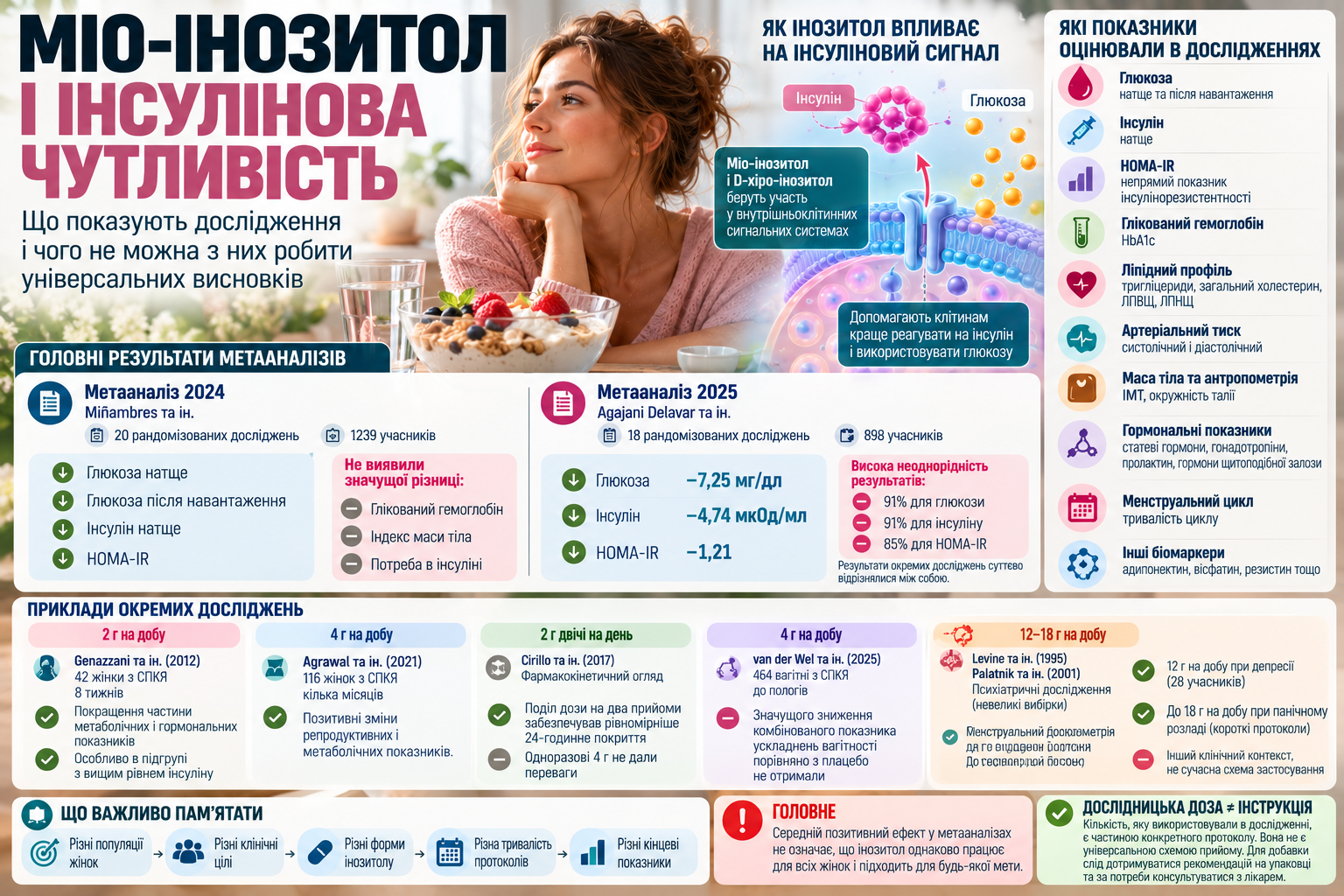
Myo-inositol and D-chiro-inositol are associated with intracellular signaling systems involved in insulin response and glucose metabolism. Their derivatives may act as second messengers in certain signaling pathways.
This provides a biological rationale for clinical research, but a mechanism alone does not establish the size of the actual effect. Controlled trials and syntheses of their findings are needed for that.
What a meta-analysis of 20 randomized trials found
A systematic review by Miñambres and colleagues included 20 randomized trials and 1,239 participants with different clinical conditions. The authors pooled studies that used compounds from the inositol family and assessed measures of glucose metabolism.
On average, the inositol groups had lower fasting glucose, two-hour glucose after an oral glucose challenge, fasting insulin, and HOMA-IR.
At the same time, no significant difference was found for glycated hemoglobin, body mass index, or the proportion of participants requiring insulin. This distinction matters: not all glycemic and clinical measures changed in the same way.
What the 2025 meta-analysis added
In 2025, Agajani Delavar and colleagues published a new meta-analysis of 18 randomized trials involving 898 participants. It covered not only glycemic measures but also other cardiometabolic outcomes.
For glucose, the mean difference was approximately − 7.25 mg/dL; for insulin, approximately − 4.74 μIU/mL; and for HOMA-IR, approximately − 1.21in favor of the inositol groups.
However, statistical heterogeneity was very high: approximately 91% for glucose, 91% for insulin, and 85% for HOMA-IR. This means that findings varied substantially between individual studies.
What high heterogeneity means
A meta-analysis provides an average result across many studies. When those studies differ substantially, one summary number can conceal a much wider range of effects.
Inositol studies differed in participants' age and metabolic status, the form of inositol, dose, duration, diet, other supplements, and the outcomes assessed.
Therefore, the average reduction in HOMA-IR reported by a meta-analysis does not mean every person will experience the same change.
Why the older and newer meta-analyses do not contradict each other
Both reviews found an average favorable signal for glucose, insulin, and HOMA-IR. They differ in the studies included, statistical approaches, and range of outcomes assessed.
The newer meta-analysis also highlights how heterogeneous the evidence remains. The repeated favorable signal increases confidence that a metabolic effect is possible, but it does not make the effect uniform across all populations.
What studies in postmenopausal women show
One example is a randomized, placebo-controlled study involving 80 postmenopausal women with metabolic syndrome. All participants followed a calorie-restricted diet, while one group also received myo-inositol.
Researchers assessed HOMA, lipid profiles, and blood pressure, reporting favorable changes in some of these measures in the myo-inositol group.
This example also illustrates a limitation of interpretation: the effect was assessed alongside a dietary intervention and in a specific group of women. It cannot automatically be generalized to anyone with elevated insulin or glucose.
Does improved HOMA-IR mean a lower risk of diabetes?
Not automatically. HOMA-IR is a surrogate laboratory marker. A change may be a useful signal, but it is not direct evidence of a lower incidence of diabetes, vascular complications, or other long-term outcomes.
Such conclusions require studies in which clinical events are the primary outcomes and follow-up is sufficiently long.
What is known about glycated hemoglobin
Glycated hemoglobin reflects average glucose over a longer period, so it differs from fasting glucose or HOMA-IR.
The meta-analysis of 20 randomized trials found no significant difference in HbA1c. This is another reason not to extend a positive finding for one glycemic marker to all others.

Why data from pregnant women should not be combined with the general population
A separate, substantial body of research concerns pregnant women at increased risk of impaired glucose metabolism. A 2023 meta-analysis included seven randomized trials and 1,319 high-risk pregnant women and reported a favorable signal for gestational diabetes incidence and glucose-challenge measures.
Pregnancy, however, markedly changes the hormonal and metabolic context. These findings should therefore not be automatically pooled with evidence from postmenopausal women, people with metabolic syndrome, or other groups.
Which measures are used in studies of glucose metabolism?
| Measure | What it reflects | What the inositol evidence shows |
|---|---|---|
| Fasting glucose | Blood glucose level after a period without food | Meta-analyses show an average signal toward a reduction |
| Fasting insulin | Insulin concentration in the fasting state | Decreased on average in pooled analyses |
| HOMA-IR | An indirect estimate of insulin resistance | One of the most consistent favorable signals, but with high heterogeneity |
| HbA1c | Average glycemia over a longer period | The earlier meta-analysis did not show a consistent benefit |
| Glucose challenge | The body's response after a standard glucose dose | Favorable signals have been observed, particularly in certain specific populations |
| Clinical events | Actual long-term health outcomes | Cannot be inferred automatically from an improvement in HOMA-IR or fasting glucose alone |
What can be said at present
- The favorable signal is repeated: two meta-analyses found average reductions in glucose, insulin, and HOMA-IR.
- Effects are heterogeneous: the newer meta-analysis found very large differences between individual studies.
- HOMA-IR is not a final clinical outcome: its improvement does not automatically prove a lower risk of long-term complications.
- Not all measures respond equally: the earlier meta-analysis found no significant benefit for HbA1c.
- Population matters: results in pregnant women, postmenopausal women, and people with other metabolic characteristics should not be mechanically combined.
Frequently asked questions
Does inositol affect insulin sensitivity?
Meta-analyses of randomized trials show an average favorable signal for insulin and HOMA-IR, but results vary substantially between individual studies.
What is HOMA-IR?
It is an index calculated from fasting glucose and insulin, used as an indirect estimate of insulin resistance.
Does inositol lower fasting glucose?
In two meta-analyses, average fasting glucose was lower in the inositol groups, but the size of the effect varied across studies and populations.
Does an improvement in HOMA-IR mean diabetes risk has decreased?
Not necessarily. HOMA-IR is a surrogate laboratory marker and does not on its own demonstrate a change in long-term clinical risk.
Does inositol change HbA1c?
A meta-analysis of 20 randomized trials found no significant difference in HbA1c, although other glycemic measures improved on average.
Why do study results differ so much?
Studies differ in the form of inositol, dose, duration, participants' ages and health status, diet, co-interventions, and outcomes.
Can people use these findings to choose their own inositol regimen for elevated glucose or insulin?
No. Research findings are not an individualized treatment plan. If you have impaired glucose metabolism or take medications, discuss whether a supplement is appropriate with your doctor.
References
- Agajani Delavar M. et al. (2025). Inositol supplementation efficacy in improving key cardiometabolic and anthropometric indices: a GRADE-assessed systematic review and meta-analysis of randomized controlled trials. Diabetology & Metabolic Syndrome. PubMed
- Miñambres I. et al. (2019). Effects of inositol on glucose homeostasis: Systematic review and meta-analysis of randomized controlled trials. Clinical Nutrition. PubMed
- Bevilacqua A., Bizzarri M. (2018). Inositols in Insulin Signaling and Glucose Metabolism. International Journal of Endocrinology. PubMed
- Giordano D. et al. (2011). Effects of myo-inositol supplementation in postmenopausal women with metabolic syndrome: a prospective, randomized, placebo-controlled study. Menopause. PubMed
- Santamaria A. et al. (2012). One-year effects of myo-inositol supplementation in postmenopausal women with metabolic syndrome. Climacteric. PubMed
- Kiani A. K. et al. (2021). From Myo-inositol to D-chiro-inositol molecular pathways. European Review for Medical and Pharmacological Sciences. PubMed
- Guo X. et al. (2023). Inositol supplementation for the prevention and treatment of gestational diabetes mellitus: a meta-analysis of randomized controlled trials. PubMed
Food supplement. Not a medicinal product. Consult your doctor before use.
Products related to this post
Related Posts
Comments
Information
Customer Service
Extras
My Account


Sports nutrition manufacturer in Ukraine StarkPharm © 2026