Your shopping cart is empty!

Myo-inositol and D-chiro-inositol: what's the difference and where the 40:1 ratio came from
Published: 10/10/2026
Times Read: 5
Comments : 0
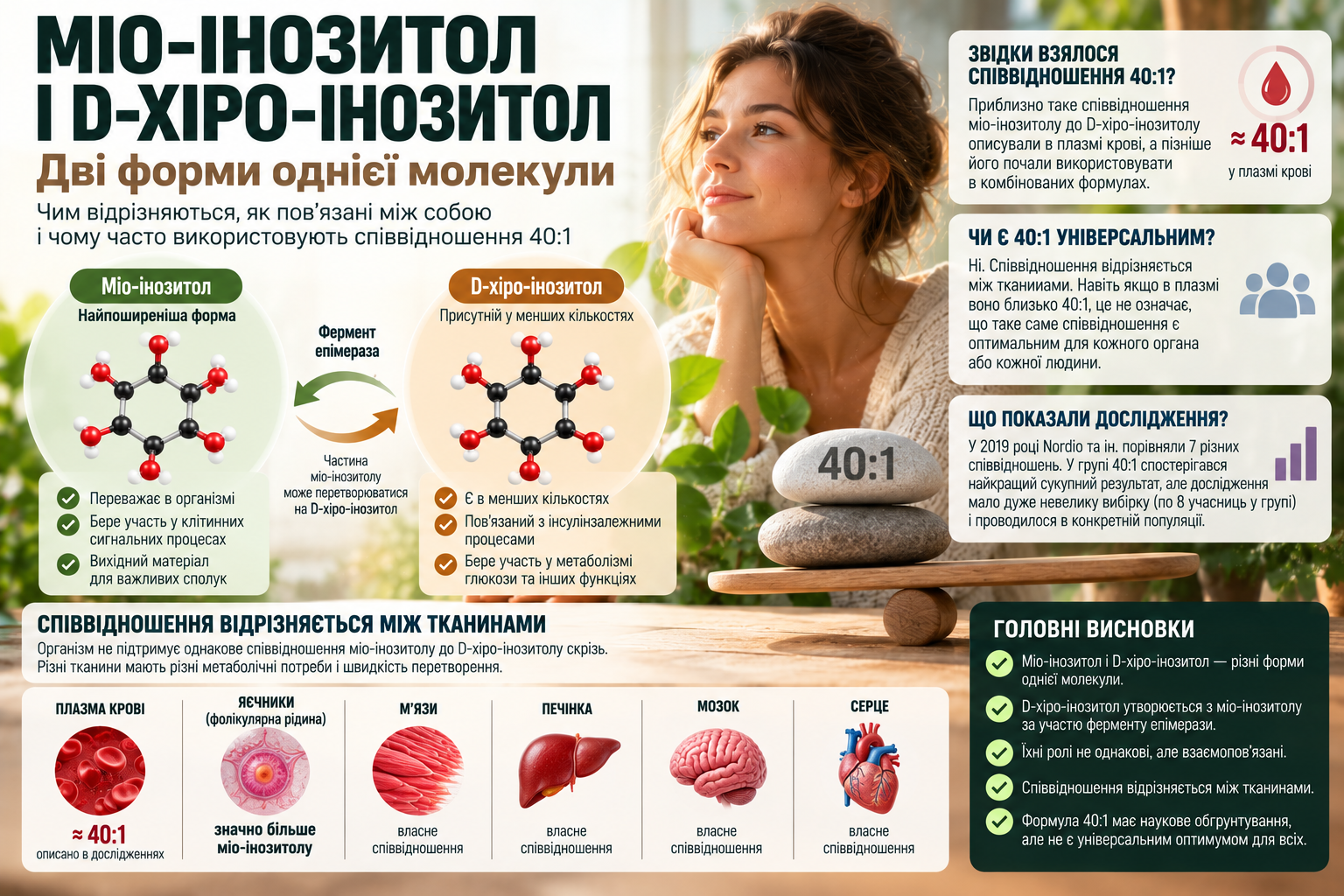
Myo-inositol and D-chiro-inositol are two different spatial forms of the same basic inositol molecule. They are related but not interchangeable names: myo-inositol is much more abundant in the body, and some of D-chiro-inositol is formed from it enzymatically.
The popular 40:1 ratio is not accidental. Scientific reviews have described approximately this ratio of myo-inositol to D-chiro-inositol in blood plasma, and later it began to be used in combination formulas. But this does not mean that 40:1 is a universally optimal ratio for every tissue or every person.
What are myo-inositol and D-chiro-inositol?
Inositol has several stereoisomers—molecules with the same composition but different spatial arrangements of atoms. The most physiologically and clinically important are myo-inositol and D-chiro-inositol.
Myo-inositol is the most abundant form in the body and is involved in the construction of derivatives that are required for cell membranes and intracellular signaling. D-chiro-inositol is present in smaller amounts and is involved in some insulin-dependent metabolic processes.
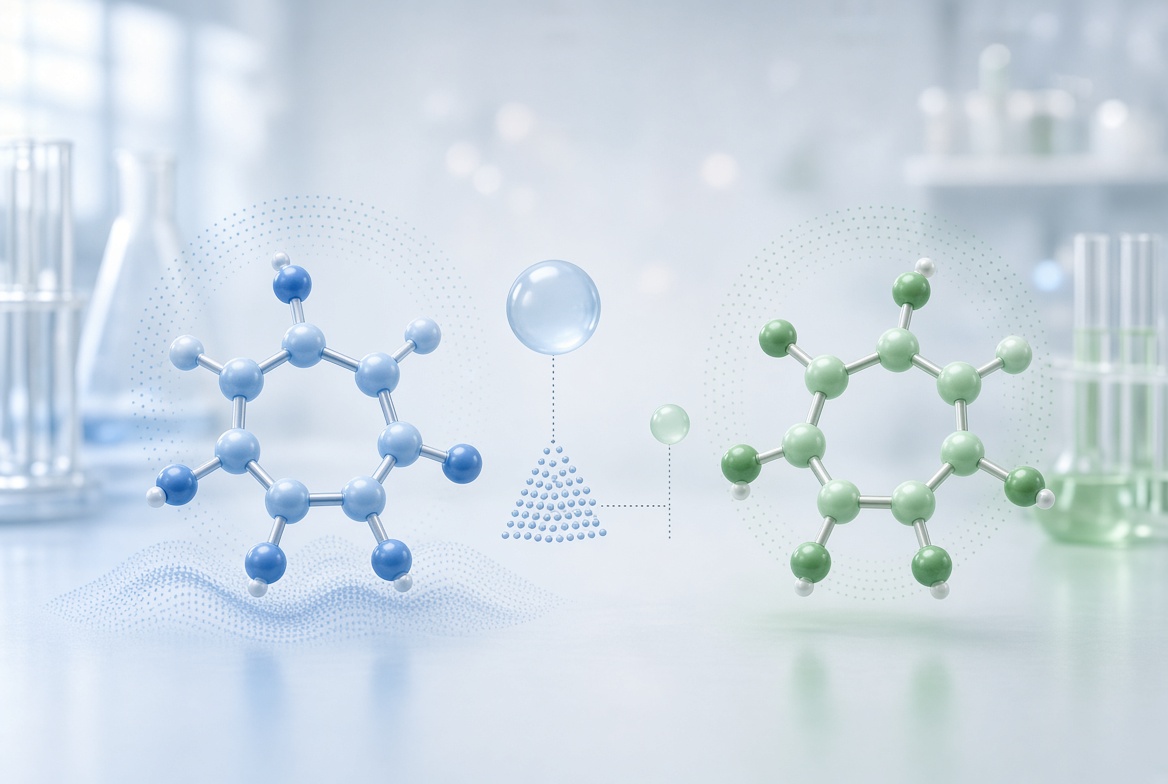
How D-chiro-inositol is formed from myo-inositol
Some of the myo-inositol can be converted to D-chiro-inositol by the enzyme epimerase. The activity of this enzyme depends on insulin signaling and differs between tissues.
Therefore, the body does not maintain the same ratio of the two isomers everywhere. Muscle, liver, brain, heart, and reproductive tissues have different metabolic needs and may differ in the rate of this conversion.
Why their physiological roles are not the same
Both isomers are involved in intracellular signaling systems, but their functions are not entirely identical. Myo-inositol is the starting material for a wide range of phosphoinositol compounds and is involved in many cellular processes.
D-chiro-inositol is also involved in signaling pathways related to insulin, glucose metabolism, and the function of certain enzymes. In reproductive tissues, its effect on steroidogenesis is also discussed.
However, the mechanistic difference should not be interpreted as meaning that one form is “better” than the other. They serve different roles, and the clinical outcome depends on the population, endpoint, and specific study design.
Why does the ratio differ between fabrics?
Reviews of inositol physiology emphasize that the ratio of myo-inositol to D-chiro-inositol is tissue-specific. Tissues with different insulin sensitivities have different rates of conversion of myo-inositol to D-chiro-inositol.
This is an important nuance for the 40:1 formula. Even if this ratio is approximately described in blood plasma, it is not a fixed ratio for all organs.
For example, some reviews report a significantly higher proportion of myo-inositol in follicular fluid. This again shows that the plasma ratio cannot automatically be called universally “physiological” for the entire organism.
Where did the 40:1 ratio come from?
A number of reviews describe the ratio of myo-inositol to D-chiro-inositol in plasma as approximately 40:1. This figure has been one of the arguments for the creation of combined formulas with two isomers.
Later, the 40:1 ratio began to be tested separately in clinical studies, mainly in women with polycystic ovary syndrome, and this is where much of the formula's popularity comes from.
But the origin of the formula from the plasma ratio does not yet prove that copying this proportion in a supplement automatically reproduces the optimal ratio within a particular tissue.
What a direct comparison of different ratios showed
In 2019, Nordio et al. compared seven different ratios of myo-inositol to D-chiro-inositol. The study included 56 women, with only eight participants in each group.
D-chiro-inositol alone and in ratios of 1:3.5; 2.5:1; 5:1; 20:1; 40:1 and 80:1 were compared. The protocol lasted three months. The main indicator was ovulation, and hormonal and metabolic indicators were additionally assessed.
In this study, the 40:1 group showed the best overall outcome. This is the study often cited as a direct argument in favor of the 40:1 formula.
Why one study is not enough to declare 40:1 the universal optimum
The main limitation is obvious: eight participants per group is too small a sample size to confidently compare seven different regimens. With such a large group size, random differences could significantly affect the results.
Additionally, the study was conducted in a specific clinical population and assessed specific outcomes over a three-month period. It did not test whether 40:1 is the best ratio for other groups of people or for other purposes.
Therefore, it is correct to say that 40:1 has a direct positive signal from a small comparative study, but it is incorrect to call it a universally proven optimum.
A 2024 review focused specifically on the combination of myo-inositol and D-chiro-inositol. The authors considered a ratio of at least 40:1 to be the most robust among the available data, but they explicitly noted that there is reason to further investigate higher ratios, approximately 66:1–100:1.
This is an important caveat: even a review that favors a combined approach does not close the issue with a single number.
What the systematic review showed for international recommendations
Fitz et al. in 2024 analyzed 30 trials with 2230 participants. The studies included different forms of inositol, different comparisons, and different clinical outcomes.
The authors concluded that there are positive signals for some metabolic measures, but the overall evidence base remains limited and inconclusive. For many outcomes, the certainty was low or very low.
This work was carried out to update the 2023 international recommendations, which specifically state: due to a lack of quality data, a specific type, dose, or combination of inositol cannot be considered sufficiently substantiated for a universal recommendation.
Myo-inositol and D-chiro-inositol: main differences
| Criterion | Myo-inositol | D-chiro-inositol |
|---|---|---|
| Prevalence | The main and much more common form of inositol in the body | Present in smaller quantities |
| Origin | Comes with food and is synthesized in the body | Partially formed from myo-inositol |
| Transformation | It is the starting form for epimerase | Formed with the participation of insulin-dependent epimerase |
| Functions | Widely involved in membrane and intracellular signaling systems | Associated with part of insulin-dependent processes and certain hormonal pathways |
| Relationship between shapes | Depends on tissue; plasma ratio is often described in reviews as close to 40:1 | |
| Has 40:1 been proven as a universal optimum? | No. There is a positive signal, but the quality of the evidence is insufficient for a universal rule | |
What does 40:1 mean in practice?
The 40:1 ratio should be viewed as one of the combination formulas being studied, not as a universal physiological constant. It has a biological basis and some positive clinical data, but its benefit has not been proven sufficiently reliably to be transferable to any person or purpose.
Similarly, a product with myo-inositol alone is not a 40:1 formula. To obtain this ratio, the composition must contain both isomers in the appropriate proportion.
Frequently asked questions
Are myo-inositol and D-chiro-inositol the same thing?
No. These are two stereoisomers of inositol with different spatial arrangements of atoms and partly different physiological roles.
Is D-chiro-inositol formed from myo-inositol?
Yes. Part of myo-inositol is converted to D-chiro-inositol by insulin-dependent epimerase, the activity of which differs between tissues.
What does a ratio of 40:1 mean?
This is 40 parts myo-inositol to one part D-chiro-inositol. This is roughly the ratio described for plasma and later used in combination formulas.
Is the 40:1 ratio natural for all tissues?
No. The ratio of the two isomers is tissue-specific and can vary significantly between organs.
Is 40:1 proven to be the best ratio?
A small direct study found a positive result specifically for 40:1, but current systematic reviews and international guidelines indicate that the quality of evidence is insufficient for a universal conclusion.
Is a product with only myo-inositol automatically a 40:1 formula?
No. The 40:1 formula involves the simultaneous presence of myo-inositol and D-chiro-inositol in the appropriate proportion.
Is it possible to determine the required ratio only based on the plasma 40:1?
No. The plasma ratio does not automatically reflect the ratio in each tissue, and clinical data do not yet provide a universal rule for all scenarios.
Sources
- Kiani AK and others. (2021). From Myo-inositol to D-chiro-inositol molecular pathways. European Review for Medical and Pharmacological Sciences. PubMed
- Milewska EM and others. (2016). Inositol and human reproduction. From cellular metabolism to clinical use. Gynecological Endocrinology. PubMed
- Laganà AS and others. (2020). New clinical targets of D-chiro-inositol: rationale and potential applications. Expert Opinion on Drug Metabolism & Toxicology. PubMed
- Nordio M. and others. (2019). The 40:1 myo-inositol/D-chiro-inositol plasma ratio is able to restore ovulation in PCOS patients: comparison with other ratios. European Review for Medical and Pharmacological Sciences. PubMed
- Lete I. and others. (2024). Update on the combination of myo-inositol/D-chiro-inositol for the treatment of polycystic ovary syndrome. Gynecological Endocrinology. PubMed
- Fitz V. and others. (2024). Inositol for Polycystic Ovary Syndrome: A Systematic Review and Meta-analysis to Inform the 2023 Update of the International Evidence-based PCOS Guidelines. Journal of Clinical Endocrinology & Metabolism. PubMed
- Teede HJ and others. (2023). Recommendations from the 2023 International Evidence-based Guideline for the Assessment and Management of Polycystic Ovary Syndrome. PMC
Dietary supplement. Not a medicine. Consult a doctor before use.
Products related to this post
Related Posts
Comments
Information
Customer Service
Extras
My Account


Sports nutrition manufacturer in Ukraine StarkPharm © 2026