Your shopping cart is empty!

Inositol and folate: why they are often combined in studies
Published: 19/10/2026
Times Read: 52
Comments : 0
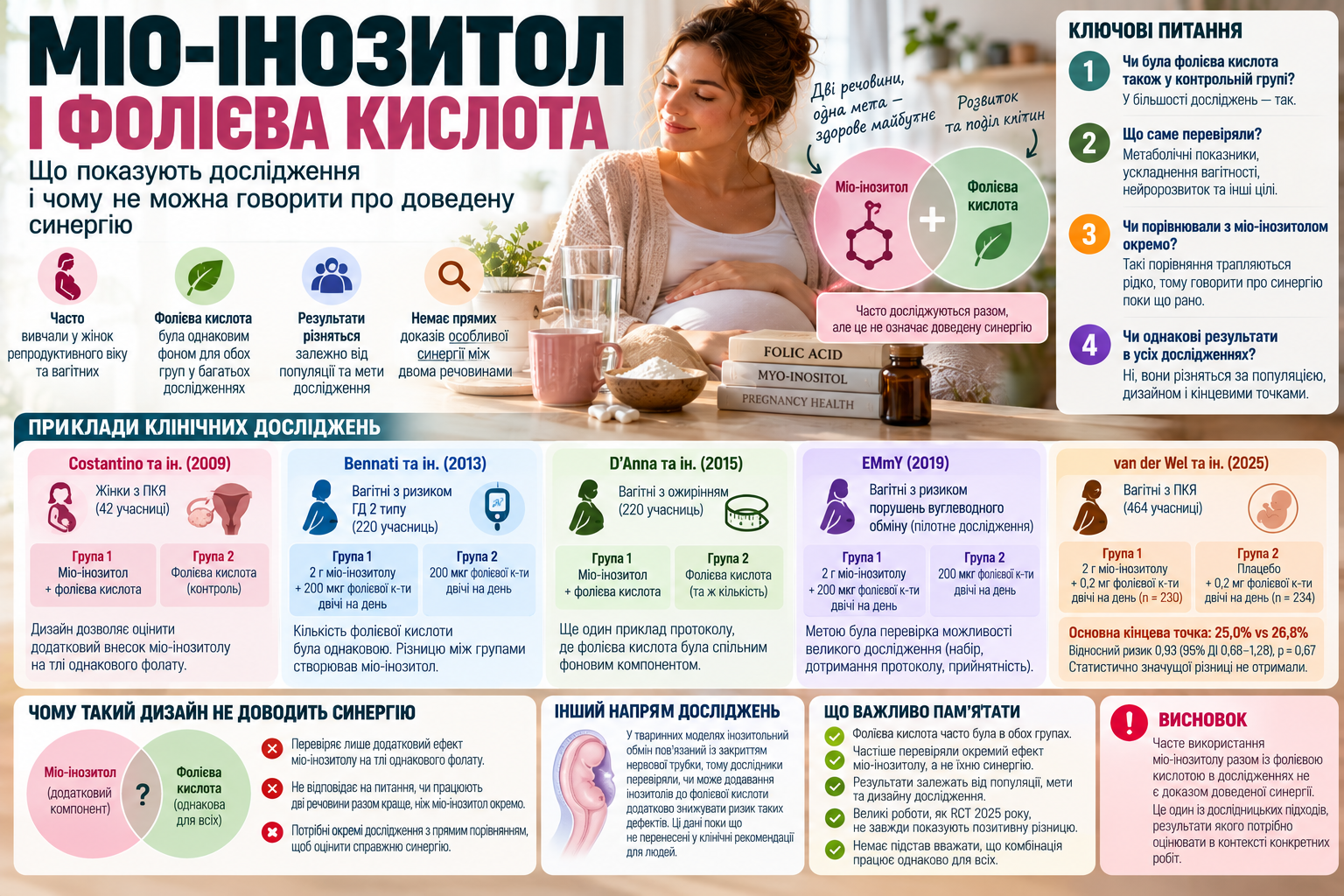
Myo-inositol and folic acid often appear together in clinical studies. However, their use in combination does not mean that science has established a special synergy between the two substances. In many trials, folic acid was a shared background treatment in both groups, and researchers were effectively testing whether adding myo-inositol provided any benefit beyond that common background.
Therefore, when a study's title or methods mention “myo-inositol + folic acid,” it is essential to look beyond the intervention group. The key question is what exactly the control group received.

Folate and folic acid are not exactly the same term
Folate is the general name for a group of vitamin B9 compounds. Folic acid is a synthetic form commonly used in supplements and clinical protocols.
In myo-inositol studies, folic acid was frequently included in both the intervention and control treatments. Its presence in both groups should therefore be understood as part of the study design, not automatic evidence that it enhances the action of myo-inositol.
Why folic acid was often included in the control group
Many myo-inositol studies involved women of reproductive age or pregnant women. In such protocols, folic acid was often a common component given to all participants.
This made the groups more comparable: if one group received myo-inositol plus folic acid and the other received the same amount of folic acid without myo-inositol, the main difference between groups was the myo-inositol itself.
An early example: MI + folic acid versus folic acid
In a double-blind study by Costantino et al., 42 women with PCOS participated. One group received myo-inositol with folic acid, while the control group received folic acid without myo-inositol.
This design is often summarized as “MI + folic acid,” but it does not actually test whether the combination is better than myo-inositol alone. It shows what happens when myo-inositol is added to a shared background component.
The 2013 study: equal folate in both groups
A randomized study conducted in 2013 included 220 pregnant women with a family history of type 2 diabetes. The intervention group received 2 g of myo-inositol plus 200 µg of folic acid twice daily.
The control group received 200 µg of folic acid twice daily without myo-inositol. Thus, the amount of folic acid was identical, and myo-inositol accounted for the difference between groups.
The same logic in a study of pregnant women with obesity
In 2015, another randomized study included 220 pregnant women with obesity. The design was very similar: myo-inositol plus folic acid was compared with the same amount of folic acid without myo-inositol.
This is another example of why “myo-inositol + folic acid” should not automatically be interpreted as “a study of synergy between two components.”
What the EMmY pilot study showed
The UK EMmY pilot study examined the feasibility of conducting a large double-blind trial among pregnant women at increased risk of impaired glucose metabolism.
The active preparation contained 2 g of myo-inositol and 200 µg of folic acid, while the placebo also contained 200 µg of folic acid; both preparations were taken twice daily.
The primary aim of this pilot was not to establish a definitive clinical effect but to assess recruitment, protocol adherence, follow-up, and the feasibility of a larger trial.
The strongest recent example: a large 2025 RCT
In 2025, a large double-blind, placebo-controlled trial involving 464 pregnant women with PCOS was published. The myo-inositol group included 230 participants, and the control group included 234.
The intervention group received 2 g of myo-inositol with 0.2 mg of folic acid twice daily. The control group received a matching placebo with the same amount of folic acid.
The primary composite endpoint occurred in 25.0% of participants in the myo-inositol group and 26.8% in the control group. The relative risk was 0.93, with a 95% confidence interval of 0.68–1.28 and p = 0.67. The difference was not statistically significant.
This is particularly relevant here: the frequent use of a combination with folic acid does not guarantee that adding myo-inositol will always change a clinical outcome.
Why this design does not establish synergy
If one group receives MI plus folic acid and the other receives folic acid alone, the study can estimate the added contribution of MI against the same folate background.
But it does not answer a different question: do MI and folic acid work better together than MI alone? Answering that requires a direct comparison with a myo-inositol-only group, or another design capable of assessing the interaction between the two components.
Therefore, claims such as “folic acid boosts inositol” or “their synergy is proven” do not automatically follow from most commonly cited studies.
When the combination was investigated as a separate scientific hypothesis
Another research area concerns neural tube defects, which can occur despite folic acid intake. Animal models link inositol metabolism with neural tube closure, prompting researchers to investigate whether adding inositol to folic acid might have an independent role.
This is a different scientific hypothesis from using folic acid as an identical background component in two groups.

What the PONTI pilot study showed
PONTI enrolled women who had previously had a pregnancy affected by a neural tube defect and were planning another. Its randomized component compared inositol plus folic acid with placebo plus folic acid.
A total of 117 women contacted the researchers, but only 47 agreed to randomization. Ultimately, only 33 randomized pregnancies were recorded: one recurrence in the placebo-plus-folic-acid group and none in the inositol-plus-folic-acid group.
These figures are interesting as a pilot signal, but the sample is far too small for a reliable conclusion. The authors explicitly emphasized the need for a large, fully powered trial.
What different studies were actually testing
| Study | Intervention group | Control group | What was actually tested |
|---|---|---|---|
| PCOS, 2009 | MI + folic acid | Folic acid | Added contribution of MI against a folate background |
| Pregnancy, 2013 | MI + folic acid | Same amount of folic acid | Added contribution of MI |
| Pregnancy with obesity, 2015 | MI + folic acid | Same amount of folic acid | Added contribution of MI |
| EMmY, 2022 | MI + folic acid | Placebo + the same folic acid | Primarily the feasibility of a large RCT |
| Large RCT, 2025 | MI + folic acid | Placebo + the same folic acid | Whether MI adds an effect to a shared folate background |
| PONTI | Inositol + folic acid | Placebo + folic acid | A separate hypothesis concerning neural tube defects |
Why findings in pregnant women cannot be generalized to everyone
Most studies of MI + folic acid were conducted in highly specific groups: pregnant women, women with PCOS or obesity, those with a family history of diabetes, or those with a previous pregnancy affected by a neural tube defect.
These populations have distinct clinical risks and outcomes. Their results therefore do not establish that everyone taking myo-inositol needs folic acid or that the combination is universally better than myo-inositol alone.
How to interpret “myo-inositol + folic acid” in a scientific paper
First, examine the control group. If both groups receive folic acid in the same amount, its role in the design is as a shared background treatment, while the main experimental difference is whether myo-inositol is present.
If a study specifically compares different combinations or individual components, it may be possible to assess an interaction between them. Without that comparison, claiming proven synergy is inappropriate.
Frequently asked questions
Why is myo-inositol often combined with folic acid in studies?
In many trials, folic acid was the same background component in the intervention and control groups. This allowed researchers to assess the additional contribution of myo-inositol.
Has folic acid been proven to enhance the effect of myo-inositol?
Not by most commonly cited RCTs. If MI plus folic acid is compared only with folic acid, the study cannot determine whether the combination is better than MI alone.
Was the amount of folic acid the same in both groups?
Yes, in many key studies. For example, in the 2013 and 2015 trials, EMmY, and the large 2025 RCT, folic acid was a shared component in both intervention and control treatments.
What did the large 2025 trial show?
Among 464 pregnant women with PCOS, adding myo-inositol to the same background folate did not produce a statistically significant difference in the primary composite endpoint.
Have inositol and folate been studied in relation to neural tube defects?
Yes. There are pilot human data and mechanistic studies, but randomized human evidence remains very limited, so larger trials are needed.
Does “MI + folic acid” in a study title imply proven synergy?
No. That conclusion requires a direct comparison capable of evaluating MI, folic acid, and their interaction separately.
Does everyone taking myo-inositol need to add folic acid?
Current studies do not provide a universal rule for all users. Most trials involved specific populations of women, including pregnant women.
References
- Costantino D. et al. (2009). Metabolic and hormonal effects of myo-inositol in women with polycystic ovary syndrome: a double-blind trial. PubMed
- D'Anna R. et al. (2013). myo-Inositol supplementation and onset of gestational diabetes mellitus in pregnant women with a family history of type 2 diabetes: a prospective, randomized, placebo-controlled study. PubMed
- D'Anna R. et al. (2015). Myo-inositol Supplementation for Prevention of Gestational Diabetes in Obese Pregnant Women: A Randomized Controlled Trial. PubMed
- Amaefule C. E. et al. (2022). Myo-inositol nutritional supplement for prevention of gestational diabetes (EMmY): a randomised, placebo-controlled, double-blind pilot trial with nested qualitative study. PubMed
- Van der Wel A. W. T. et al. (2025). Myo-inositol Supplementation to Prevent Pregnancy Complications in Polycystic Ovary Syndrome: A Randomized Clinical Trial. PubMed
- Greene N. D. E. et al. (2016). Inositol for the prevention of neural tube defects: a pilot randomised controlled trial. PubMed
- Greene N. D. E., Leung K.-Y., Copp A. J. (2017). Inositol, neural tube closure and the prevention of neural tube defects. PubMed
Dietary supplement. Not a medicinal product. Consult a healthcare professional before use.
Products related to this post
Related Posts
Comments
Information
Customer Service
Extras
My Account


Sports nutrition manufacturer in Ukraine StarkPharm © 2026


