Your shopping cart is empty!

How much EPA and DHA is in a capsule: why 1000 mg of fish oil is not 1000 mg of omega-3
Published: 28/11/2026
Times Read: 14
Comments : 0
The label “fish oil 1000 mg” on a capsule tells you the weight of the oil, not the amount of eicosapentaenoic acid (EPA) and docosahexaenoic acid (DHA). In a typical example given by the NIH Office of Dietary Supplements, 1000 mg of fish oil provides about 180 mg of EPA and 120 mg of DHA — 300 mg combined. Other formulations can contain considerably more or less of these fatty acids in the same amount of oil. Comparing omega-3 products solely by the large number on the front label is therefore misleading.
A practical way to read the label is to find EPA, DHA, the serving size, and the number of capsules per serving. Then calculate the milligrams of each acid per capsule and, if necessary, per recommended daily serving. This provides a more accurate picture than claims such as “1000 mg,” “double strength,” or “concentrated omega-3” without a numerical breakdown.
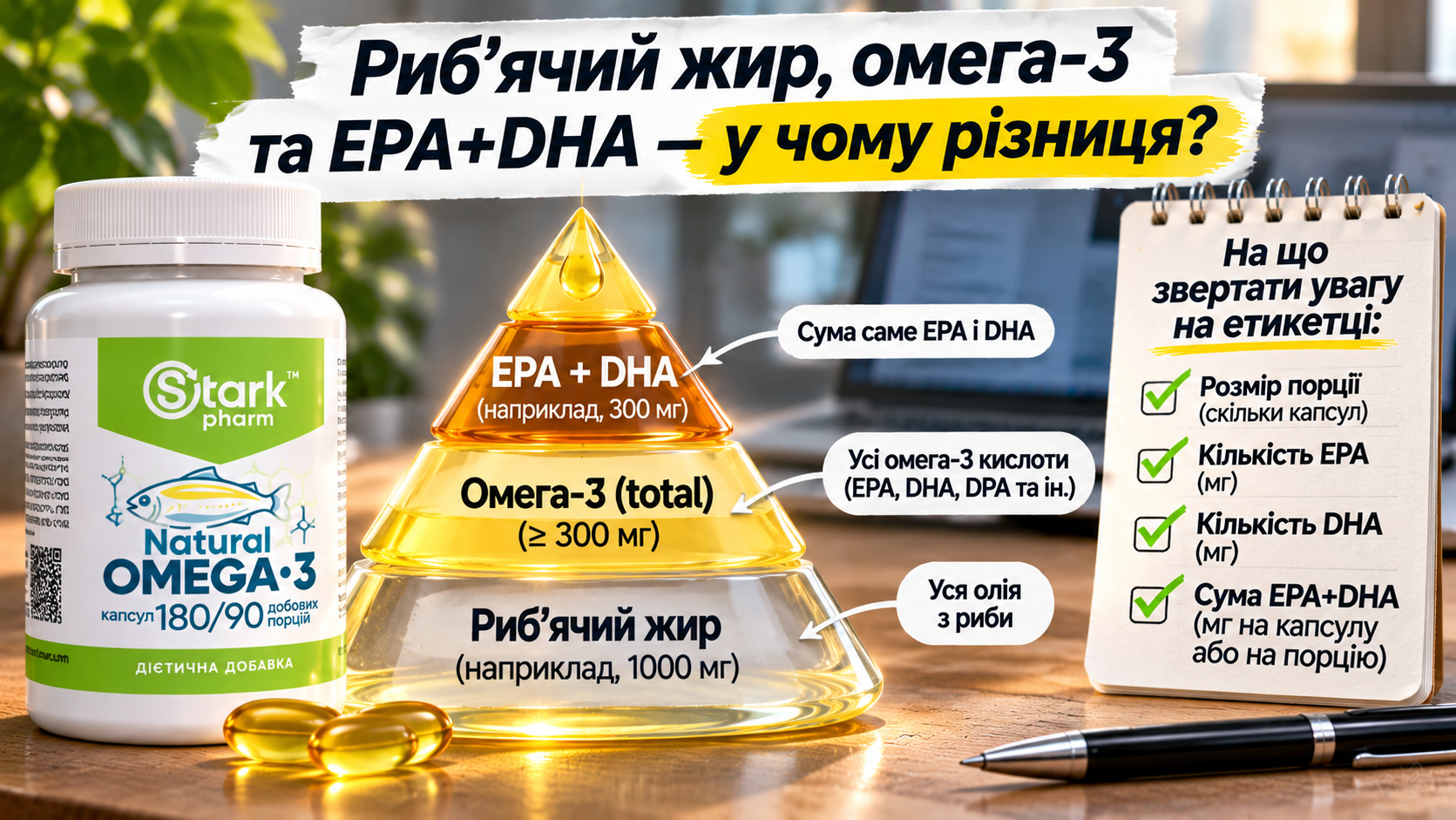
Three different figures on the label: fish oil, omega-3, and EPA+DHA
These quantities are nested but not identical. Fish oil refers to the entire oil fraction: various fatty acids and other components. Total omega-3 is the portion of the oil belonging to the omega-3 family; it may include EPA, DHA, and other omega-3 fatty acids such as DPA. EPA+DHA is the sum of two specific fatty acids most commonly studied in research on marine omega-3s.
If a label states “1000 mg fish oil, 300 mg omega-3, EPA 180 mg, DHA 120 mg,” then 1000 mg is the weight of the oil, 300 mg is the declared total omega-3 content, and 300 mg EPA+DHA is the sum of 180 and 120 mg. In this particular example, the totals match. However, total omega-3 does not always equal EPA+DHA: other omega-3 fatty acids may make up the remainder.
| Label term | What it indicates | What it does not establish |
|---|---|---|
| Fish oil — 1000 mg | Weight of fish oil in the stated unit | That it contains 1000 mg of EPA+DHA |
| Total omega-3 — 300 mg | Combined weight of declared omega-3 fatty acids | That all 300 mg consists solely of EPA and DHA |
| EPA — 180 mg | Amount of EPA | The amount of DHA |
| DHA — 120 mg | Amount of DHA | The amount of EPA |
| EPA+DHA — 300 mg | Combined amount of both fatty acids | The total weight of fish oil |
NIH ODS presents 180 mg EPA and 120 mg DHA per 1000 mg of fish oil as a typical example, not a universal standard for every manufacturer. You cannot automatically apply this calculation to other products.
How to calculate EPA and DHA per capsule: four examples
Start with the stated “serving size”: figures may be listed per one capsule or per two or three capsules. Add EPA and DHA; when the figures cover several capsules, divide the result by the number of capsules. All examples below are hypothetical and illustrate the arithmetic rather than specifications of actual products.
| Hypothetical label | EPA per serving | DHA per serving | EPA+DHA per capsule |
|---|---|---|---|
| A: 1 capsule; fish oil 1000 mg | 180 mg | 120 mg | 300 mg |
| B: 1 capsule; fish oil 1000 mg | 330 mg | 220 mg | 550 mg |
| C: 2-capsule serving; fish oil 2000 mg | 360 mg | 240 mg | 300 mg |
| D: 2-capsule serving; fish oil 2000 mg | 660 mg | 440 mg | 550 mg |
For example C: (360 + 240) ÷ 2 = 300 mg EPA+DHA in one capsule. For example D: (660 + 440) ÷ 2 = 550 mg per capsule. Thus, two labels both stating “2000 mg fish oil per serving” can conceal different combined amounts of EPA and DHA.
Another common mistake is comparing “EPA 600 mg” on one product page with “EPA 300 mg” on another without checking how many capsules those figures represent. If the first refers to a three-capsule serving, one capsule contains 200 mg of EPA. In the second product, 300 mg might apply to a single capsule — meaning it provides more EPA per capsule.
How to calculate the amount per daily serving and per entire container
Two useful figures when comparing products are EPA+DHA per capsule and EPA+DHA per recommended daily serving. The latter depends on the manufacturer's instructions. It is not a universal recommendation for everyone and does not replace individualized advice.
- Per capsule: (EPA per serving + DHA per serving) ÷ number of capsules per serving.
- Per daily serving: EPA+DHA per capsule × number of capsules specified by the current directions.
- Per entire container: EPA+DHA per capsule × total number of capsules in the container.
For instance, suppose a formula supplies 180 mg EPA and 120 mg DHA per capsule, and a bottle contains 90 capsules. Each capsule provides 300 mg EPA+DHA; all 90 capsules together provide 27,000 mg, or 27 g. This is the total content of the container, not a suggestion to consume it over a particular period.
The principle is the same for liquid fish oil, but the unit may be a teaspoon or milliliters. If EPA and DHA are listed per 5 mL, do not treat those values as the amount per 1 mL: divide them by five. Also, volume and weight cannot be equated arbitrarily — 1 mL of oil is not exactly 1 g.
What does a concentration of 30%, 50%, or 70% mean?
Concentration indicates what proportion of a specified mass of oil consists of the stated fatty acids. Exact wording matters: “omega-3 — 70%” does not necessarily mean “EPA+DHA — 70%”, since the total omega-3 fraction may include other acids.
Imagine two hypothetical capsules, each containing 1000 mg of fish oil. The first supplies 300 mg EPA+DHA, or 30% of the oil's weight. The second supplies 600 mg, or 60%. Both say “fish oil 1000 mg,” but the second has twice as much EPA+DHA. This is a mathematical illustration of the concentration difference, not an endorsement of any brand.
Manufacturers may use different declaration conventions for triglyceride forms, ethyl esters, and other chemical forms. For a detailed comparison, focus on the stated EPA and DHA quantities for the relevant unit rather than an advertising percentage alone. Comparing chemical forms and bioavailability evidence in detail is a separate topic.
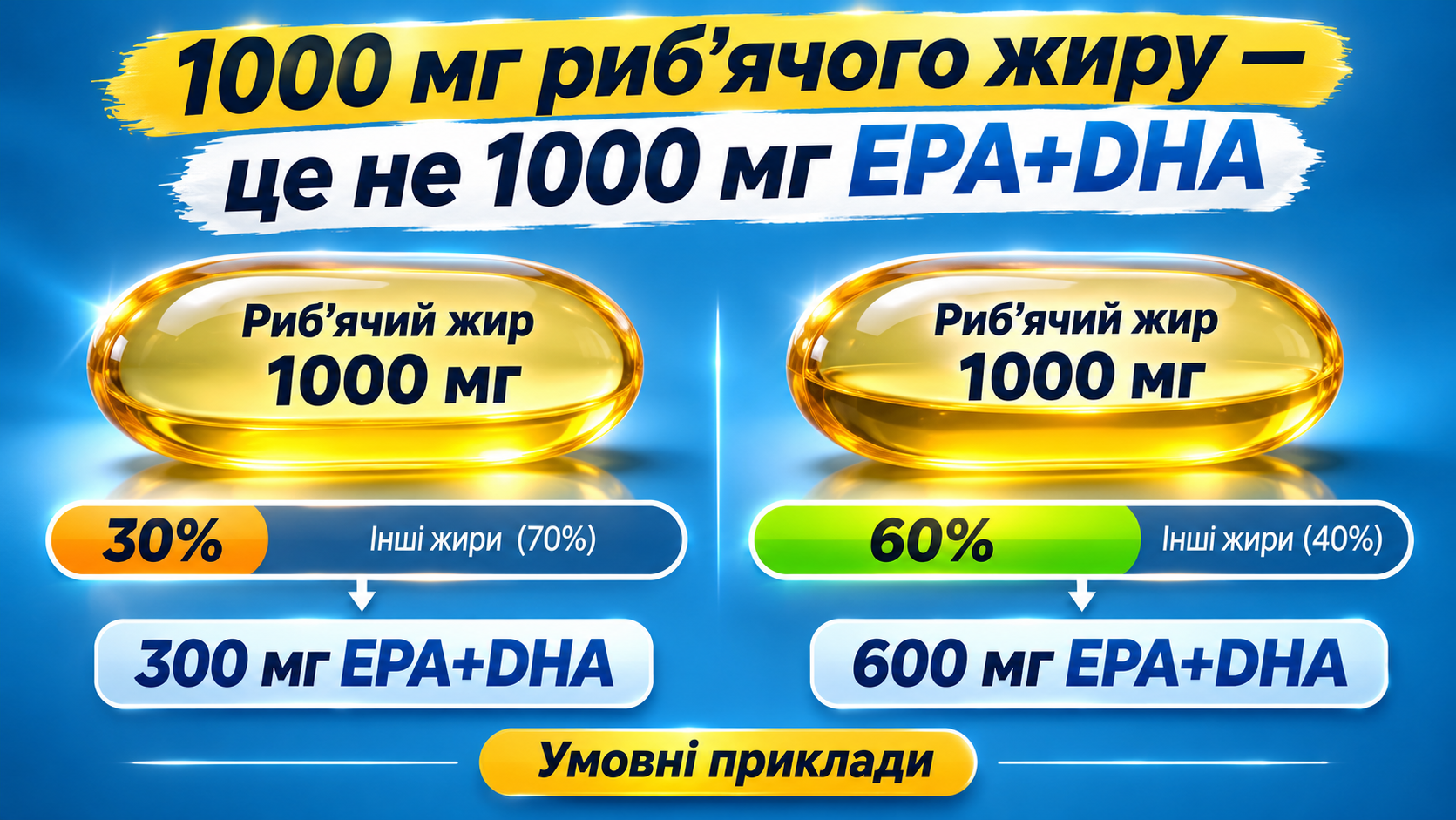
Why “1000 mg” is not a measure of effectiveness
The amount of fish oil alone determines neither the EPA+DHA dose nor the expected outcome. Two products can contain the same weight of oil but different amounts of these acids; conversely, oils of different weights can provide similar EPA+DHA totals. Even an exact EPA+DHA amount does not automatically describe all product properties: formulation, manufacturing, storage conditions, and research context also matter.
In a cross-sectional study of US supplement labels, Assadourian and colleagues (2023) analyzed 2,819 products. Among a subgroup of 255 products from leading manufacturers and retailers, the median declared daily EPA+DHA dose was 600 mg, with an interquartile range of 300–1100 mg. This illustrates the wide variation in formulations; data from US labels should not automatically be extended to all Ukrainian products.
The study Analysis of Omega-3 Fatty Acid Content in Fish Oil Products (2021) likewise highlights that actual EPA+DHA amounts in a standard serving can differ substantially among available formulas. This is why prominent numbers on the front of the container cannot replace the detailed nutrient information.
How to compare the cost of two omega-3 products without falling for marketing
If the goal is to compare the cost of EPA+DHA specifically, the price per capsule is not always the right measure. A capsule containing more fish oil may supply less EPA+DHA than another. Comparisons should be standardized to the same amount of the fatty acids of interest.
Consider a hypothetical example: formula A has 60 capsules providing 300 mg EPA+DHA each and costs UAH 300. Formula B has 60 capsules providing 600 mg each and costs UAH 450. The first contains 18,000 mg EPA+DHA in total; the second contains 36,000 mg. The calculated cost per 1000 mg EPA+DHA is therefore approximately UAH 16.67 for A versus UAH 12.50 for B.
| Metric | Hypothetical formula A | Hypothetical formula B |
|---|---|---|
| Number of capsules | 60 | 60 |
| EPA+DHA per capsule | 300 mg | 600 mg |
| EPA+DHA per entire container | 18,000 mg | 36,000 mg |
| Hypothetical price | UAH 300 | UAH 450 |
| Cost per 1000 mg EPA+DHA | UAH 16.67 | UAH 12.50 |
This comparison reflects only the cost of the declared fatty acid content. It does not assess quality, freshness, contaminant testing, chemical form, or suitability of a particular supplement. If a product's composition is incompletely disclosed, a valid calculation may be impossible.
When the label says only “omega-3” without EPA and DHA
A general label of “omega-3 — 600 mg” does not tell you what portion is EPA or DHA. This is especially relevant when comparing fish oil, algal oil, and vegetable oils, whose omega-3 fatty acid profiles can differ substantially. ALA is also an omega-3 acid, but its amount cannot simply be counted as EPA or DHA.
If the manufacturer lists only total omega-3 content without separating EPA and DHA, their combined amount cannot be reliably calculated from that figure alone. Do not assume that all of it is EPA+DHA or that the ratio matches the typical 180/120 mg example. Instead, consult the detailed composition panel or official information for that particular formula.
How reliable are the milligram amounts stated on the label?
A label is the starting point for calculation, not independent laboratory verification of every production batch. A comparative study of US commercial supplements published in the Journal of the Science of Food and Agriculture (2015) compared laboratory-measured EPA and DHA concentrations with label declarations. Results varied between products, illustrating why verifying stated content matters.
However, it would be incorrect to conclude that all supplements systematically contain less EPA or DHA than claimed. For example, a 2016 study of Australian and New Zealand products found that all 10 tested samples met their declared EPA+DHA amounts within the reported results. These studies involved different markets, samples, and batches and cannot be turned into a universal brand ranking.
The USDA/NIH Dietary Supplement Ingredient Database also provides modeled estimates of differences between laboratory fatty acid measurements and label values. It is a statistical research tool, not a certificate for an individual bottle. When additional assurance is needed, look for verifiable batch test reports rather than vague claims of “the purest fish oil.”
Other things to check before comparing products
- Serving size. The listed contents may apply to two capsules rather than one.
- Units. 1 g = 1000 mg; milliliters are not grams without accounting for density.
- Total omega-3 versus EPA+DHA. These differ when other omega-3 fatty acids are present.
- Other active ingredients. Fish liver oil may contain vitamins A and D; their amounts should be checked separately.
- Form and quality. TG, EE, rTG labels and laboratory freshness indicators do not replace EPA and DHA quantities.
- Source information. Fish oil, krill oil, and algal oil may have different fatty acid profiles.
Anyone taking medicines, living with chronic conditions, or considering high EPA+DHA intakes should discuss the appropriateness of supplementation with a qualified professional. Scientific literature, for example, examines risks associated with high omega-3 doses; that is not a reason to increase a supplement serving independently. A research dose is not a universal instruction for consumers.

Quick guide: read an omega-3 label in 30 seconds
Step 1. Find the serving size — how many capsules or milliliters the table covers. Step 2. Write down EPA and DHA separately in milligrams. Step 3. Add EPA+DHA. Step 4. If the serving contains multiple capsules, divide the sum by their number. Step 5. Compare products using the same unit, such as EPA+DHA per capsule or per 1000 mg of stated oil.
After doing the arithmetic, check the other product details: origin, verification of the stated composition, storage instructions, and warnings. The weight of fish oil describes the oil material, whereas EPA and DHA are specific quantitative measures of its composition. That is why “1000 mg” without a breakdown does not provide enough information for an informed comparison.
Frequently asked questions
Does 1000 mg of fish oil mean 1000 mg of omega-3?
No. The figure indicates oil weight, and the proportion of omega-3 fatty acids can vary. Check the individual composition values.
How much EPA and DHA is usually in a 1000 mg capsule?
NIH ODS gives a typical example of 180 mg EPA and 120 mg DHA, totaling 300 mg per 1000 mg of fish oil. Actual products can differ considerably.
How do I calculate EPA+DHA if the label values are for two capsules?
Add the EPA and DHA milligrams listed for the serving and divide the result by two. This gives EPA+DHA per capsule.
Which should I compare: total omega-3 or EPA+DHA?
If you specifically want EPA and DHA, compare their sum. Total omega-3 may include other fatty acids in the same family.
Can a 1000 mg capsule contain 600 mg of EPA+DHA?
Yes, if the oil contains these fatty acids at that concentration. Confirm this using the specific product label rather than its name.
Does more EPA+DHA always mean better quality?
Not necessarily. Concentration alone says nothing definite about freshness, accurate labeling, contaminant control, or other quality factors.
How do I calculate total EPA+DHA in the bottle?
Multiply EPA+DHA per capsule by the number of capsules. This gives the total amount in the container, not a recommended daily intake.
What if EPA and DHA are not listed separately?
Do not infer them from a general “omega-3” or “fish oil” claim. Check the manufacturer's detailed information for that exact formula.
Sources
- NIH Office of Dietary Supplements. Omega-3 Fatty Acids — Health Professional Fact Sheet. NIH ODS.
- Assadourian JN et al. (2023). Health Claims and Doses of Fish Oil Supplements in the US. JAMA Cardiology. PubMed.
- Analysis of Omega-3 Fatty Acid Content in Fish Oil Products (2021). Journal of Pharmacy Practice. PubMed.
- A comparison of actual versus stated label amounts of EPA and DHA in commercial omega-3 dietary supplements in the United States (2015). Journal of the Science of Food and Agriculture. PubMed.
- Australian and New Zealand Fish Oil Products in 2016 Meet Label Omega-3 Claims and Are Not Oxidized (2016). Nutrients. PubMed.
- U.S. Department of Agriculture and NIH Office of Dietary Supplements. Omega-3 Supplements National Study. Dietary Supplement Ingredient Database. USDA/NIH DSID.
Dietary supplement. Not a medicinal product. Consult your doctor before use.
Products related to this post
Related Posts
Comments
Information
Customer Service
Extras
My Account


Sports nutrition manufacturer in Ukraine StarkPharm © 2026


