Your shopping cart is empty!

Magnesium L-Threonate: How It's Absorbed and Why It's Unique for the Brain
Published: 25/06/2026
Times Read: 2565
Comments : 0
Magnesium L-threonate is the newest and most "niche" form of magnesium. People rarely take it "just for magnesium": it costs more than citrate or bisglycinate and requires higher doses. What it offers instead is something other forms don't — the ability to raise magnesium levels directly in brain tissue. In this article we look at how L-threonate is absorbed in the gut, why its "brain" effect stands apart, how much to take, and who really needs it.
If you are still choosing between forms in general, start with the overview comparison of all magnesium forms — here we focus on threonate specifically.
What magnesium L-threonate is
It is the magnesium salt of L-threonic acid — a substance that is a natural metabolite of vitamin C. The form was developed by researchers at the Massachusetts Institute of Technology (MIT) and first described in 2010 in the journal Neuron: they were looking for a way to deliver magnesium efficiently to the brain. The standardized, patented form is known as Magtein®. The magnesium here is the same as in other supplements — what makes it special is the carrier, threonic acid.
How magnesium L-threonate is absorbed in the gut
It is worth clearing up a common misconception here: there is no separate "threonate" absorption route in the gut. Like any soluble salt, L-threonate dissociates in the digestive tract — it breaks down into a magnesium ion and threonic acid. The magnesium is then absorbed by the usual ionic route: passively between cells in the small intestine and actively through cation channels. In other words, at the gut level this form behaves much like citrate or malate.
There are some data (including a rat study reviewed by EFSA) where the relative absorption of magnesium from L-threonate was higher than from chloride, gluconate or citrate. But these are limited data, so the main advantage of threonate should be sought not in intestinal absorption but further on — at the cellular level.
The key feature: delivering magnesium to the brain
Most forms of magnesium cross the blood–brain barrier poorly, so even when blood magnesium rises, its level in the brain changes little. L-threonate is the exception. According to research, threonate itself is naturally present in the cerebrospinal fluid, and taking L-threonate raises its concentration there. Inside neurons, threonate raises magnesium levels through glucose transporters (GLUTs) — and this is precisely what other magnesium anions do not reproduce. Put simply: the special thing about this form is not how much magnesium enters the blood, but that some of it reaches a place other forms struggle to get to.
What the research shows
Early animal work (Slutsky et al., 2010) showed that L-threonate raises brain magnesium and improves measures of learning and memory. The form was later tested in humans: in a study of adults aged 50–70, taking L-threonate was associated with better overall cognitive test scores compared with placebo; later work also looked at memory and sleep quality in adults. The results are broadly encouraging, but the samples are small and the effect is individual — so it is not something to treat as a guaranteed "smart" booster.
Dosage and elemental magnesium content
An important practical nuance: per gram of product, L-threonate contains little elemental magnesium (about 75 mg per gram of the compound). Cognitive studies usually used around 2 g of the compound per day — which is only about 140–145 mg of magnesium itself. The dose is traditionally split into two intakes (morning and evening, roughly 1–2 hours before sleep) to keep magnesium levels more even. Noticeable changes are usually expected not immediately but after a few weeks of regular use. Check the specific dosage on the product label and do not exceed it.
Who it suits and how to combine it
L-threonate is more often chosen when the goal is to support cognitive function, memory and concentration during intense mental work, as well as sleep. Because of its "evening" profile, it is often taken closer to night. If you need both a "brain" and a general magnesium effect, the forms are combined: L-threonate in the evening, and during the day a gentler-tolerated citrate or malate for general support. This covers both the nervous system and the daily magnesium requirement.
Tolerability is usually good, but some people may experience headaches, drowsiness or mild stomach discomfort — in which case a smaller starting dose and taking it with food help. If you have kidney disease, are pregnant or breastfeeding, or are taking prescription medicines, consult a doctor first. Magnesium is a complement to a balanced diet, not a substitute for it.
Frequently Asked Questions
How does magnesium L-threonate differ from other forms?
All forms supply the same magnesium ion, but L-threonate is, according to research, the only one that noticeably raises magnesium in brain tissue. That is why it is chosen for cognitive support rather than "just for magnesium".
Is L-threonate absorbed better in the gut?
In the gut it is absorbed much like other soluble salts — via the usual ionic route. Its distinctive feature is not intestinal absorption but the delivery of magnesium to the brain.
How much magnesium L-threonate should I take?
Studies usually used around 2 g of the compound per day, split into two intakes. That corresponds to roughly 140–145 mg of elemental magnesium. Follow the dosage on the label.
When is it best to take L-threonate?
Because of its profile linked to sleep and the nervous system, it is often taken in the evening, frequently splitting the daily dose between morning and evening.
Why does L-threonate contain little elemental magnesium?
The threonic acid molecule is heavy, so each gram of the compound holds less actual magnesium than, say, oxide. That is why higher doses are needed.
Can L-threonate be combined with other forms?
Yes, a common approach is L-threonate in the evening for the brain and sleep, and citrate or malate during the day for general support. The main thing is not to exceed the total daily serving.
When should I expect an effect?
Usually not immediately: in studies, changes were assessed after a few weeks of regular use. The result is individual.
Choose a product
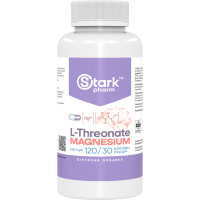
Stark Magnesium L-Threonate — L-threonate in capsules, 2000 mg of the compound per serving; convenient for evening use to support cognition and sleep.
Stark Magnesium L-Threonate Delicious — the same L-threonate as a cherry-apple flavored powder, if you prefer to drink it rather than swallow capsules.
For a general comparison with other forms, see "Forms of Magnesium: Which to Choose".
Dietary supplement. Not a medicinal product. Consult a healthcare professional before use.
Products related to this post

Comments
Information
Customer Service
Extras
My Account


Sports nutrition manufacturer in Ukraine StarkPharm © 2026