Your shopping cart is empty!

L-ergothioneine: why this amino acid is called the “longevity vitamin”
Published: 26/08/2026
Times Read: 496
Comments : 0
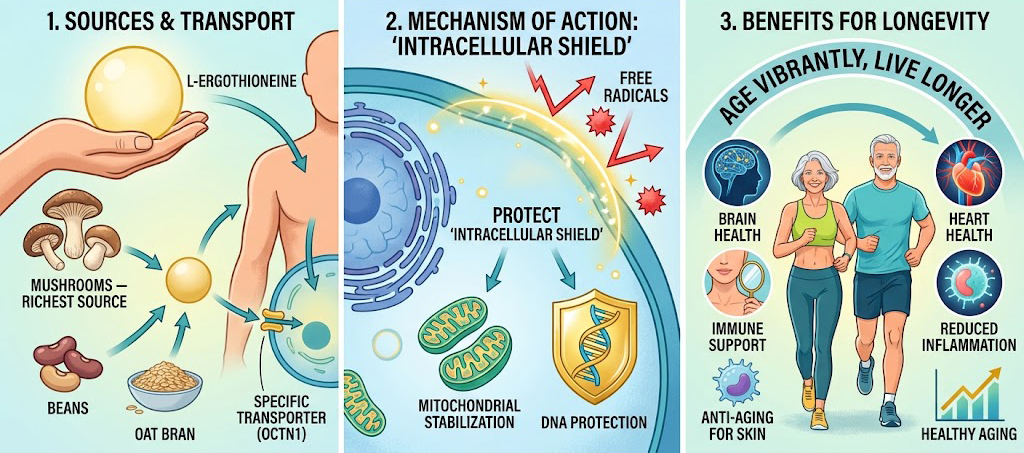
L-ergothioneine is a sulfur-containing amino acid that the human body does not synthesize on its own, but obtains exclusively from food: mushrooms, as well as some legumes and cereals, contain the most of it. In 2005, a specific transporter for this compound was discovered - OCTN1, which actively accumulates ergothioneine in tissues with increased oxidative stress. It was the presence of a separate transport mechanism, characteristic only of essential nutrients, that prompted researchers (in particular, Barry Halliwell) to hypothesize that ergothioneine could be a "longevity vitamin" - a conditional essential micronutrient, and not just one of many antioxidants.
The status of the hypothesis is just that — a hypothesis, not an established fact. Let's examine what specific human studies exist and what they show.
What is L-ergothioneine and where does the name "longevity vitamin" come from?
Ergothioneine was first discovered in the ergot fungus (Claviceps purpurea), hence the name. In humans, the specific transporter OCTN1/SLC22A4 ensures selective accumulation of the compound in tissues and cells with a high metabolic load - the liver, kidneys, lens of the eye, erythrocytes. Since the body does not produce ergothioneine itself, but has a specialized mechanism for its absorption and retention, some researchers compare this situation with essential vitamins.
One basis for the hypothesis is epidemiological data. Cheah et al. (2016) showed that plasma ergothioneine levels decrease with age and are associated with a higher incidence of cognitive decline in the elderly population. Importantly, this is a correlational observation, not proof of causation—low ergothioneine levels could be a consequence of other age-related changes, rather than a cause.
Mechanism of action: why it is an unusual antioxidant
Unlike many antioxidants that are consumed in reactions with free radicals, ergothioneine is described as a substance resistant to autoxidation - it can neutralize reactive oxygen species, remaining relatively stable. Thanks to the OCTN1 transporter, the compound accumulates selectively in tissues with increased oxidative stress, and after administration it is retained in the body for weeks: the concentration in plasma and blood cells increases gradually over several days of administration and slowly decreases after discontinuation.
Memory and Cognitive Function: 2025 Research
| Research | Dose | Duration | Population | Result |
|---|---|---|---|---|
| Zajac et al., 2025 | 10 or 25 mg/day | 16 weeks | 147 people, 55–79 years old, memory complaints | Composite Memory Improvement (CNS Vital Signs) |
| Katsube et al., 2022 | 20 mg/day | 4 weeks | Adults with anxiety and sleep complaints | Improvement of subjective sleep quality, changes in sleep structure (EEG) |
| Okumura et al., 2025 | 8 mg/day | 16 weeks | Healthy adults | Improvement in subjective sleep quality at a lower dose |
Zajac et al. (2025) conducted the first dose-dependent, double-blind, placebo-controlled study of ergothioneine in humans to date: 147 adults aged 55–79 years with memory complaints received 10 or 25 mg daily for 16 weeks. The primary outcome was change in composite memory on the CNS Vital Signs test; the researchers also assessed other cognitive domains, subjective memory ratings, and sleep quality. At the time of publication, the study is described as the first to directly compare two doses in a single protocol—important because it allows us to see whether there is a dose-dependent effect, not just the presence or absence of an effect.
Sleep: Two Studies with Different “Effective Doses”
It is worth being honest about the difference here. Katsube et al. (2022) conducted a double-blind, placebo-controlled study in adults with increased anxiety and sleep complaints: 20 mg of ergothioneine per day for 4 weeks significantly improved subjective sleep quality, and according to electroencephalography, increased the proportion of stage 2 and decreased the proportion of stage 1 slow-wave sleep.
Okumura et al. (2025), on the contrary, using a physiologically based pharmacokinetic (PBPK) model, estimated that a dose of 8 mg per day for 16 weeks was already sufficient to achieve effective plasma ergothioneine concentrations, and confirmed this in a separate placebo-controlled study: subjective sleep quality significantly improved even at this lower dose.
That is, in one study, the effect was obtained at a higher dose for a shorter period (20 mg, 4 weeks), in the other, at a lower dose for a longer period (8 mg, 16 weeks). This is not necessarily a contradiction: it is possible that the total duration of tissue accumulation is more important for sleep, rather than the instantaneous dose, but there is no direct comparative study to confirm this yet.
Cheah et al. (2017) first administered pure L-ergothioneine to healthy subjects: 5 or 25 mg/day for the first 7 days, with follow-up up to day 35. The study confirmed significant accumulation of the compound in blood cells and slow elimination, consistent with the long retention in tissues described above. However, the effect on specific biomarkers of oxidative damage and inflammation in this short study in healthy volunteers was limited—the authors emphasize that this is a safety and pharmacokinetic study rather than a confirmation of clinical effect, and it lays the foundation for further efficacy studies.
Who might be interested in this and what to consider
Ergothioneine is of interest primarily to people seeking antioxidant support for cells as part of a balanced diet, particularly in the context of age-related changes. There is no data on use in pregnant women, during lactation, and in children in the reviewed sources, so these groups should refrain from taking it without consulting a doctor. People who take medications on a regular basis or have chronic diseases should also discuss taking it with a doctor in advance - the vast majority of the studies cited were conducted on relatively small and homogeneous samples for 4–16 weeks, so data on the safety of longer and continuous use is still limited.
Frequently asked questions
What is L-ergothioneine?
This is a sulfur-containing amino acid-antioxidant that the human body does not synthesize on its own, but obtains from food — it is found most in mushrooms.
Why is ergothioneine called the "longevity vitamin"?
Due to the presence of a specific transporter, OCTN1, which selectively accumulates this compound in tissues with increased metabolic load, this resembles the mechanism of absorption of essential vitamins, although the status of ergothioneine as a true vitamin has not been definitively established.
How is ergothioneine different from other antioxidants?
Unlike many antioxidants, which are consumed in reactions with free radicals, ergothioneine is resistant to autoxidation and is retained in body tissues for weeks after ingestion.
How long did the sleep studies last?
One study lasted 4 weeks at a dose of 20 mg per day, the other 16 weeks at a dose of 8 mg per day; both showed improvements in subjective sleep quality.
Is the effective dose the same in different studies?
No: memory studies used 10–25 mg/day for 16 weeks, sleep studies used 8–20 mg/day for varying durations; no single universal "effective dose" has yet been established.
Who is not recommended to take ergothioneine without consulting a doctor?
Pregnant women, lactating women, children, and people who take medications on a regular basis - there is no data on use in these groups in the reviewed studies.
Sources
- Zajac IT et al. (2025). The Effect of Ergothioneine Supplementation on Cognitive Function, Memory, and Sleep in Older Adults with Subjective Memory Complaints. Nutraceuticals. MDPI
- Katsube M. et al. (2022). Food-derived antioxidant ergothioneine improves sleep difficulties in humans. Journal of Functional Foods. DOAJ
- Okumura H. et al. (2025). Estimation and Validation of an Effective Ergothioneine Dose for Improved Sleep Quality Using a Physiologically Based Pharmacokinetic Model. Food Science & Nutrition. PMC
- Cheah IK et al. (2017). Administration of Pure Ergothioneine to Healthy Human Subjects: Uptake, Metabolism, and Effects on Biomarkers of Oxidative Damage and Inflammation. Antioxidants & Redox Signaling. PubMed
- Halliwell B, Cheah IK, Tang RMY (2018). Ergothioneine - a diet-derived antioxidant with therapeutic potential. FEBS Letters. PubMed
Dietary supplement. Not a medicine. Consult a doctor before use.
Products related to this post
Comments
Information
Customer Service
Extras
My Account


Sports nutrition manufacturer in Ukraine StarkPharm © 2026