Your shopping cart is empty!

Creatine and hair loss: does it really increase DHT and cause baldness?
Published: 26/09/2026
Times Read: 545
Comments : 0
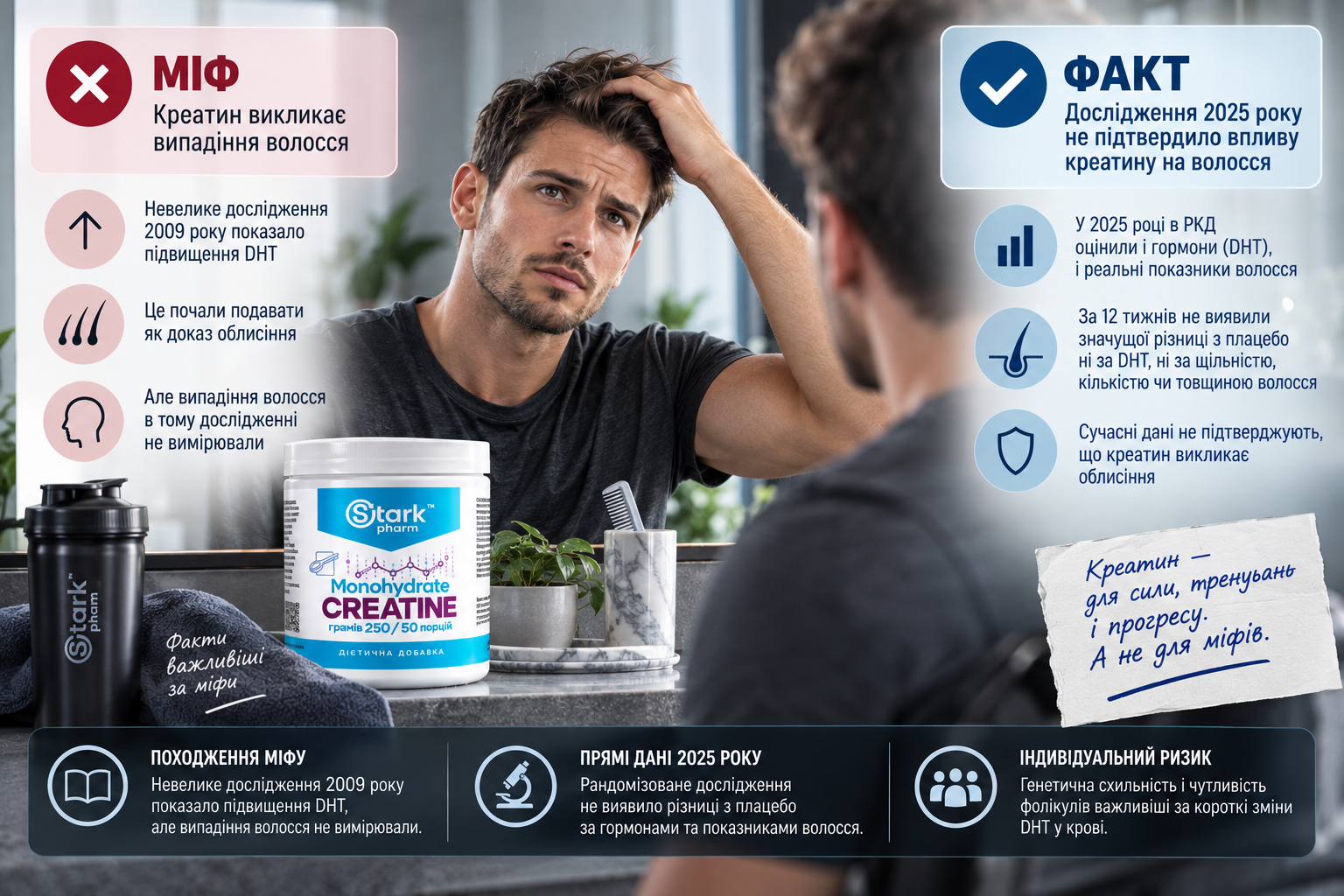
The myth that creatine causes hair loss has a specific origin. It didn’t arise from a random social media story: in 2009, a small study of young rugby players did indeed show an increase in dihydrotestosterone (DHT) after a short creatine loading phase. The problem began later, when a change in a single hormone was presented as evidence that creatine causes hair loss.
Hair loss itself was not measured in that study. In 2025, the first randomized controlled trial appeared, where hair density, follicular unit count, and total hair thickness were assessed in addition to DHT. After 12 weeks of creatine monohydrate, no significant difference was found compared to placebo. This is the most direct answer to the myth to date, but even it does not allow us to talk about “zero risk forever.”
Where did the myth about creatine and hair loss come from?
Van der Merwe et al. (2009) conducted a double-blind, placebo-controlled crossover study in 20 young rugby players. The protocol involved 25 g/day of creatine for seven days, followed by 5 g/day for a further 14 days. This was a research loading regimen and not a practical recommendation for the reader.
Total testosterone did not change significantly during the experiment. However, after seven days of loading, DHT concentrations increased by approximately 56% from baseline and remained approximately 40% above baseline after the next 14 days. The DHT to testosterone ratio also increased.
It was these numbers that became the basis for the claim that later began to circulate as "creatine increases DHT, therefore causing baldness."
What was actually measured in 2009
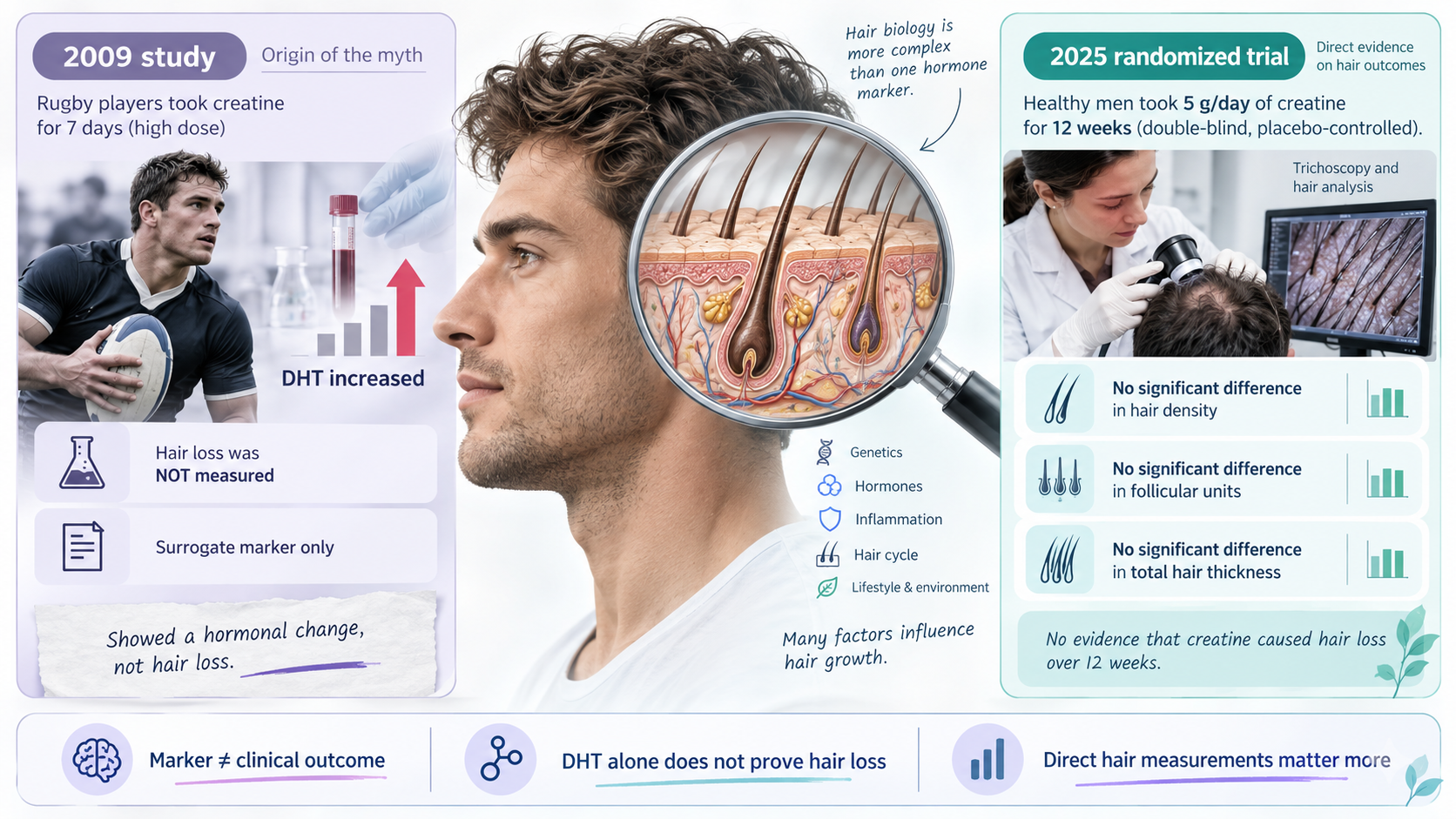
The study measured serum testosterone and DHT concentrations, their ratios, and body composition. It did not perform trichoscopy, count hairs or follicular units, measure hair thickness, or assess hair loss rate.
Therefore, the work could answer the question “did a certain hormonal marker change in this short protocol?”, but not the question “does creatine cause hair loss?”.
This is a key distinction between a surrogate marker and a clinical outcome. An increase in a measure that is theoretically associated with a particular process is not proof that the process itself actually occurred.
Why is DHT associated with androgenetic alopecia at all?
Androgenetic alopecia is the most common type of progressive hair thinning. It is associated with the action of androgens on genetically susceptible hair follicles. Under the influence of DHT, the growth phase of susceptible follicles is gradually shortened and miniaturization occurs: thick terminal hairs become thinner.
But modern genetics shows that it is not a one-switch process of “more DHT = more baldness.” Androgenetic alopecia is polygenic in nature: gene variants, androgen receptors, local enzyme activity in the follicle, and other molecular pathways are important.
DHT in the blood and follicle sensitivity are not the same thing
Serum DHT concentration is only one possible marker of the androgenic environment. The hair follicle has its own local biology: the conversion of testosterone to DHT by the enzyme 5α-reductase, the number and sensitivity of androgen receptors, and the genetically determined response to the signal.
This is why two people with similar levels of circulating androgens can have different propensities for androgenetic alopecia. This also explains why a short-term change in DHT in the blood alone is not sufficient to predict hair condition.
Why the 2009 result didn't prove hair loss
A review by Antonio et al. (2021) separately analyzed this study. The authors noted that baseline DHT in the creatine-condition was lower than in the placebo-condition, and absolute DHT values after supplementation remained within the clinical reference range. Furthermore, the DHT signal itself was not convincingly reproduced in subsequent creatine studies.
The most important limitation is even simpler: hair was not measured at all. Therefore, the 2009 study created a mechanistic hypothesis, rather than a proven causal link between creatine and baldness.
Other common questions about creatine, which are often based on a similar transfer of mechanism to clinical outcome, are collected in the material on where other myths about creatine safety come from.
What changed direct hair research in 2025
Lak et al. (2025) were the first to frame a study specifically around the issue of hair. Forty-five men aged 18–40 years who were regularly engaged in strength training were randomly assigned to receive 5 g of creatine monohydrate per day or 5 g of maltodextrin as a placebo. The duration was 12 weeks; 38 participants completed the study.
There was no significant group × time interaction for any hormonal or hair parameter. In other words, at 12 weeks, the creatine group did not differ from placebo in either DHT, DHT/testosterone, or any measured hair parameter.
This is fundamentally stronger evidence for our question than the 2009 paper, because what was measured here was exactly what the hair loss claim is about, not just a possible hormonal mediator.
Does the 2025 RCT close the issue forever?
No. The study lasted 12 weeks and involved 38 participants, all of whom were healthy, trained men aged 18–40. It cannot directly answer what happens after years of continuous use, in women or in people with already severe androgenetic alopecia.
Therefore, the phrase “creatine has never been proven to affect hair” would be stronger than the data allow. It is more accurate to say: the best direct RCT to date found no deterioration in hormonal or measurable hair parameters after 5 g/day of creatine monohydrate for 12 weeks in healthy, trained men.
Myth, marker and direct clinical outcome
| Data | What was measured? | What can we really conclude? |
|---|---|---|
| 2009 study | DHT, testosterone, DHT/testosterone ratio | In a small short protocol, DHT increased; this created the hypothesis |
| Hair in 2009 | Not measured | A direct conclusion about hair loss cannot be made. |
| 2021 Review | The body of available creatine research | The DHT signal was not convincingly reproduced; there was no direct evidence of baldness. |
| RCT 2025 | DHT, hormones, hair density, follicular units, total hair thickness | No significant difference was found between creatine and placebo over 12 weeks |
| Long-term risk for years | There are no direct multi-year hair-specific RCTs. | You can't claim proven "zero risk forever" |
And if there is a genetic predisposition to baldness
Familial predisposition to androgenetic alopecia is important independently of creatine. Current genetic reviews describe AGA as a complex polygenic condition in which the androgen receptor and other loci associated with hair follicle development and regulation play important roles.
The presence of this tendency is not evidence that creatine will accelerate the process. However, the 12-week RCT was not specifically designed for people with severe early AGA and does not provide an answer to the long-term rate of progression in this subgroup.
What to do if hair starts falling out while taking creatine
Coincidence does not prove causation. Hair loss can be associated with androgenetic alopecia, telogen effluvium after illness or stress, deficiencies, thyroid disease, medications, and other causes.
If hair loss has become noticeable, progresses, or is accompanied by changes in the scalp, it is advisable to evaluate the exact cause of the hair loss with a dermatologist, rather than drawing a conclusion based solely on the fact that creatine was taken during the same period.

Precautions for sports use
- The doses from the 2009 study, particularly 25 g/day in the loading phase, describe the experimental protocol and are not a recommendation for self-replication.
- For dietary supplements with creatine in Ukraine, a basic daily amount of 3 g has been established; for athletes, the daily dose can reach 6 g for no more than one month.
- Creatine is prohibited for children under 18 years of age and pregnant women.
- Do not exceed the recommended daily serving of a particular product.
- If you have chronic diseases or ongoing medication, you should consult a doctor before using a dietary supplement.
Frequently asked questions
Does creatine increase DHT?
One small study from 2009 showed an increase in DHT after a high-dose loading protocol. A 2025 direct 12-week RCT at 5 g/day found no significant difference in DHT between creatine and placebo.
Is creatine proven to cause baldness?
No. The 2009 study did not measure hair, and the first direct RCT in 2025 showed no deterioration in hair density, number of follicular units, or total hair thickness.
Why then is everyone talking about DHT and creatine?
Because DHT is linked to the biology of androgenetic alopecia, and a 2009 study showed a transient increase in it, this hormonal finding was later mistakenly presented as direct evidence of hair loss.
What exactly did the 2025 study show?
After 12 weeks of 5 g/day of creatine monohydrate, there was no significant difference from placebo in DHT, DHT/testosterone ratio, hair density, number of follicular units, and total hair thickness.
Can genetic predisposition make a difference?
Androgenetic alopecia is indeed highly dependent on genetics and the sensitivity of follicles to androgens. However, there is no direct evidence that creatine accelerates baldness specifically in genetically predisposed people.
If hair started falling out while taking creatine, does that mean it's the cause?
No. Coincidence does not establish causation. Hair loss has many possible causes, so it is important to evaluate them separately when the process is noticeable or progressive.
You can't make such broad statements. The 2025 RCT provides good direct data over 12 weeks in healthy, trained men, but it is not a multi-year study and does not cover all possible groups.
Sources
- Lak M. and others. (2025). Does creatine cause hair loss? A 12-week randomized controlled trial. Journal of the International Society of Sports Nutrition. PubMed
- van der Merwe J., Brooks NE, Myburgh KH (2009). Three weeks of creatine monohydrate supplementation affects dihydrotestosterone to testosterone ratio in college-aged rugby players. Clinical Journal of Sports Medicine. PubMed
- Antonio J. and others (2021). Common questions and misconceptions about creatine supplementation: what does the scientific evidence really show? Journal of the International Society of Sports Nutrition. PubMed
- Gupta AK and others. (2026). The Genetic Landscape of Androgenetic Alopecia: Current Knowledge and Future Perspectives. Biology. PubMed
- Sadasivam IP and others. (2024). Androgenetic Alopecia in Men: An Update on Genetics. Indian Journal of Dermatology. PubMed
- Martinez-Jacobo L. and others. (2018). Genetic and molecular aspects of androgenetic alopecia. Indian Journal of Dermatology, Venereology and Leprology. PubMed
- Lolli F. and others. (2017). Androgenetic alopecia: a review. Endocrine. PubMed
Dietary supplement. Not a medicine. Consult a doctor before use.
Products related to this post

Related Posts
Comments
Information
Customer Service
Extras
My Account


Sports nutrition manufacturer in Ukraine StarkPharm © 2026