Your shopping cart is empty!

Creatine and post-workout recovery: muscle soreness, damage, and strength recovery
Published: 27/09/2026
Times Read: 274
Comments : 0
The phrase “creatine speeds up recovery” sounds simple, but the scientific evidence is much more complex. In some studies, creatine supplementation was associated with lower biochemical markers of muscle damage after heavy exercise, while in others, there was no discernible difference in soreness or speed of strength recovery.
Therefore, first you need to determine what exactly you mean by recovery. The long-term athletic effectiveness of creatine is a separate topic; we have already discussed separately what creatine actually improves during training. Here the question is narrower: does the muscle return to normal faster after a damaging load?
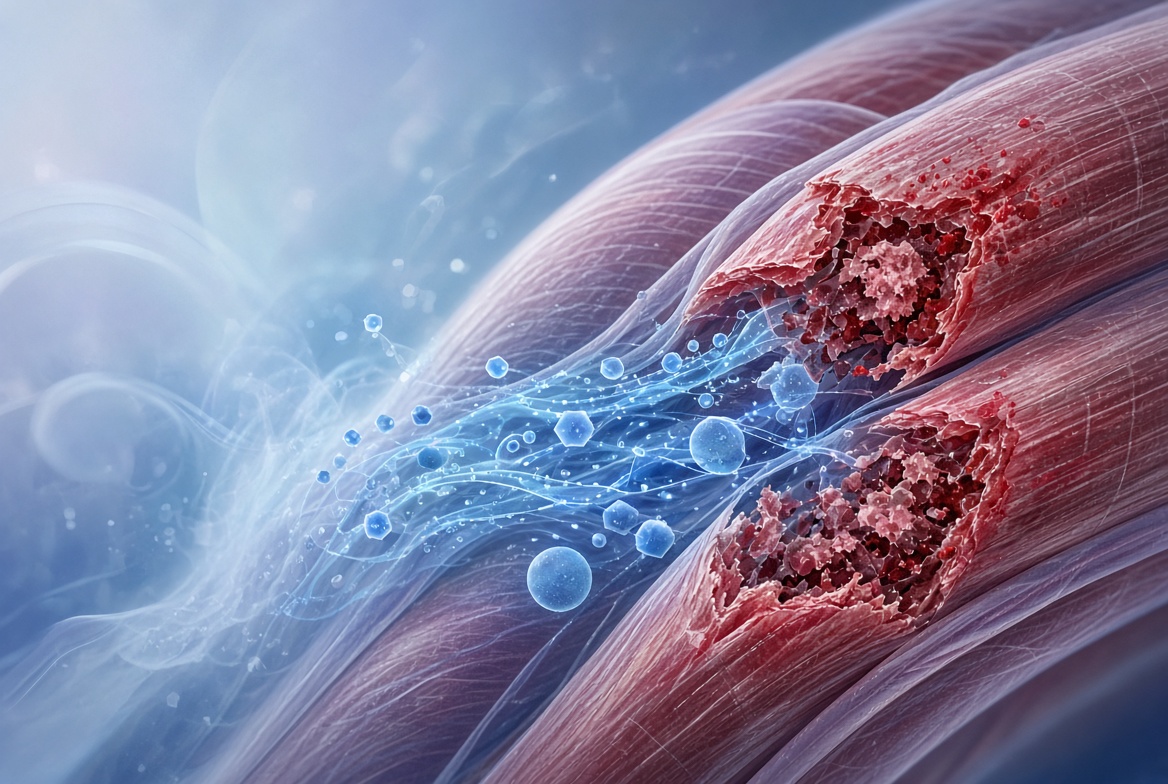
What "post-workout recovery" really means
After an unusual or very difficult workout, several different indicators can change at the same time. A person may experience pain, loss of strength, temporary limited range of motion, increased muscle stiffness, and higher concentrations of enzymes in the blood.
These changes do not necessarily occur simultaneously. For example, a laboratory marker may decrease more quickly while the pain sensation remains the same. This is why “recovery” cannot be judged by just one indicator.
Creatine kinase and lactate dehydrogenase: what do they show?
Creatine kinase and lactate dehydrogenase are enzymes that can increase in blood levels after strenuous exercise and are often used as indirect markers of muscle damage.
But lower creatine kinase does not automatically mean that a person is experiencing less pain or has fully recovered strength capabilities. It is this distinction between biochemical and functional indicators that is central to evaluating creatine after training.
Why two 2021 meta-analyses yielded contrasting conclusions
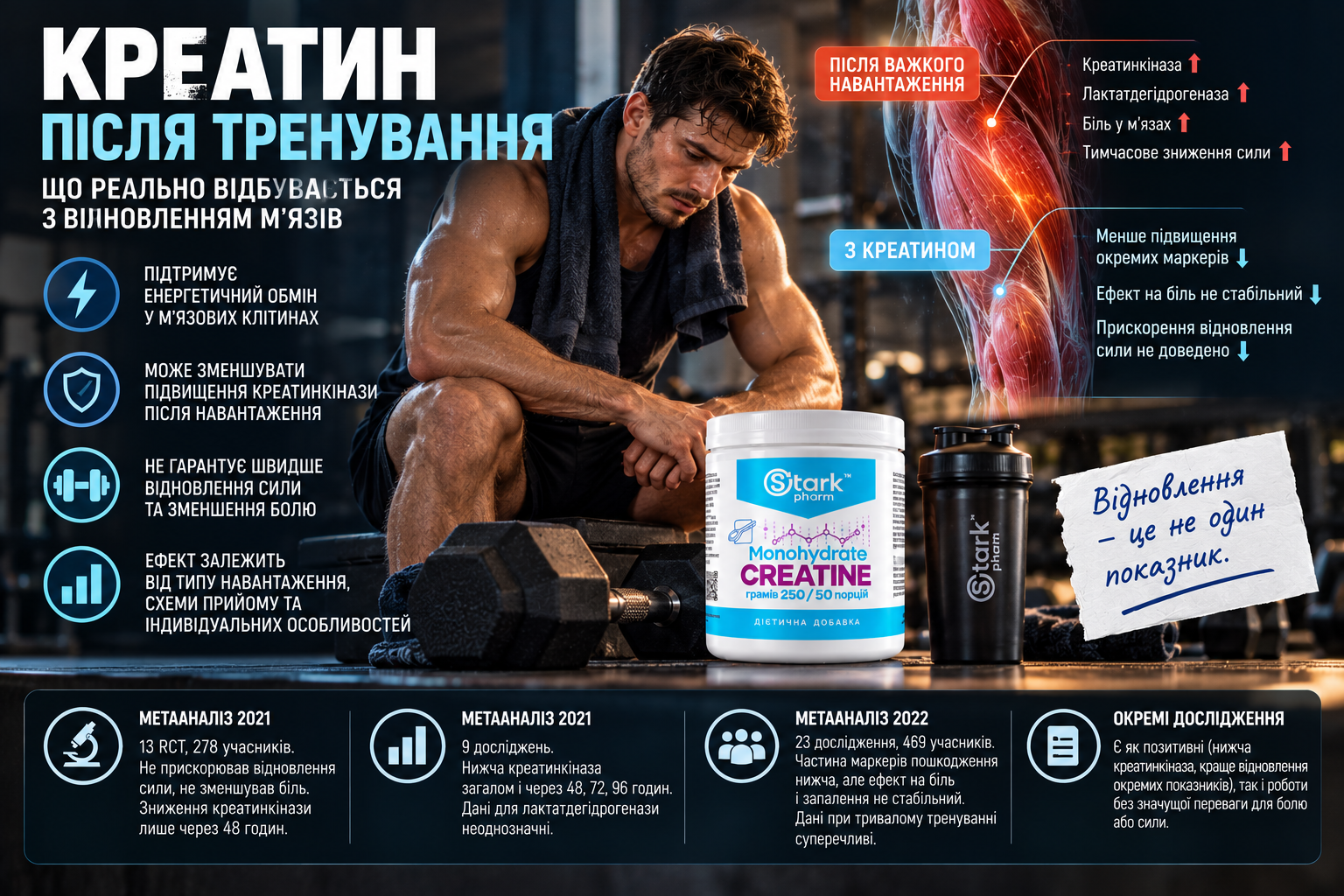
Northeast and Clifford (2021) pooled 13 randomized trials with a total of 278 participants. They separately analyzed strength, muscle soreness, range of motion, inflammation, and intracellular protein leakage into the blood.
According to their data, creatine did not accelerate strength recovery, reduce pain, or improve range of motion at key time points after exercise. For creatine kinase, a significant difference only appeared after 48 hours. There was high heterogeneity between individual studies.
Another 2021 meta-analysis included 9 studies and found a more positive result for creatine kinase: its concentration was lower overall and also after 48, 72 and 96 hours. For lactate dehydrogenase, the overall result was not convincing, although a difference appeared at individual time points.
This is not necessarily a contradiction. The meta-analyses included different sets of studies, used different outcomes and time points, and the original studies themselves varied significantly in workload and dosing schedules.
Does creatine reduce creatine kinase after heavy exercise?
There is indeed a positive signal for creatine kinase. In several individual trials and in one meta-analysis, its increase after a damaging load was smaller with creatine.
For example, in a small 2009 study of 14 untrained men, creatine was associated with lower creatine kinase activity at multiple time points after heavy eccentric exercise.
But this indicator is highly variable between people. Therefore, even a significant difference in creatine kinase should not by itself translate into the statement "muscles recovered faster."
What about muscle pain?
For delayed onset muscle soreness, the evidence is less conclusive. In the Northeast and Clifford meta-analysis, there was no significant benefit of creatine at any of the primary time points.
In a larger meta-analysis by Doma et al. (2022), pain at 24 hours after a single damaging load was numerically lower in the creatine groups, but the between-group difference generally did not reach statistical significance.
Therefore, calling creatine a "pain reliever" is incorrect. If there is an effect on subjective pain, it does not appear to be sufficiently consistent in the current body of research.
Does strength recover faster?
The return of strength is practically a more important indicator than the change in a single enzyme in the blood. And here too, the results vary.
A 2021 meta-analysis found no convincing evidence of accelerated strength recovery. A separate 2016 study also found no benefit of creatine for strength, voluntary muscle activation, or other measures after eccentric loading.
However, there is some positive research. In a 2009 study, isokinetic and isometric strength recovery was better in the creatine group, even though the sample size was only 14 people.
A 2022 meta-analysis further complicated the picture
Doma et al. (2022) included 23 studies with 469 participants. They separately examined the response after a single damaging load and changes during a longer training process.
Interestingly, the picture was not the same with chronic training. The authors even called the overall result paradoxical: a possible reduction in acute damage after a single heavy load did not translate into the same response over a long training period.
Acute injury and a normal training cycle are not the same thing
Most of these studies specifically use unusual eccentric loads to induce significant muscle damage. This is useful for a laboratory experiment because it creates a clear signal to measure.
But an adapted athlete who regularly performs his program may have a much smaller response to the same type of load. Therefore, the results of laboratory models cannot be directly transferred to every regular workout.
Newer studies have provided a positive functional signal
In a 2024 randomized trial, participants took either creatine or a placebo for 28 days and then performed eccentric exercises for the elbow flexors. The creatine group had faster recovery of maximal voluntary contraction and range of motion at some time points, as well as favorable changes in muscle stiffness and shoulder circumference.
In 2025, another double-blind, randomized study enrolled 40 healthy men and women. After 33 days of creatine or placebo, the participants performed damaging eccentric exercises.
The creatine group recovered maximal voluntary contraction more quickly; the authors also reported favorable changes in muscle stiffness and fatigue. This is an important new signal, but one study of 40 participants does not disprove the heterogeneous nature of previous studies.
Why Lower Creatine Kinase Doesn't Equal Faster Recovery
A laboratory marker, subjective pain, and actual force function are different endpoints. They can change at different times and even in different directions.
So the right question is not “does creatine work for recovery at all?” but “for which recovery metric is there data?” It is after such a division that it becomes clear why some reviews look positive and some are neutral.
What do different recovery indicators show?
| Indicator | What the data shows | How to interpret this |
|---|---|---|
| Creatine kinase | In some studies and meta-analyses, lower after damaging load | There is a positive signal for an indirect biochemical marker |
| Lactate dehydrogenase | Results are less stable and depend on the measurement time | Does not provide consistent evidence of faster recovery |
| Muscle pain | No convincing, stable reduction has been shown | Don't call creatine a cure for muscle aches |
| Restoring strength | Older aggregated data is mostly neutral, but some newer studies are positive | There is a promising signal, but not a stable effect across the entire database |
| Range of motion and stiffness | Some newer studies report favorable changes | Needs confirmation by larger independent works |
Should creatine be called a “recovery” supplement?
This formulation is too broad. For long-term enhancement of strength performance and adaptation to intense training, the evidence base for creatine is much stronger than for post-workout recovery as a separate goal.
For recovery, the most consistent positive signal is for individual indirect markers of muscle damage. For pain, range of motion, and speed of strength return, the results are much less consistent.

What can be said today?
- Creatine kinase: there is evidence of a smaller increase after a damaging load, but the result is not the same in all studies.
- Muscle pain: no consistent, convincing reduction has been shown.
- Regaining strength: older meta-analyses are mostly neutral, but newer small studies have given a positive signal.
- The conditions of the experiments are important: an unusual eccentric load is not the same as a normal training week.
- Overall conclusion: Creatine may affect individual components of recovery, but the statement “creatine speeds up recovery after training” without specifying a specific indicator is too broad.
Frequently asked questions
Does creatine speed up recovery after exercise?
Not all measures are the same. There is positive data for some biochemical markers and some newer strength recovery tests, but pain and functional recovery do not improve consistently across studies.
Does creatine reduce muscle soreness after exercise?
No consistent, convincing effect has been shown. In some studies, pain was numerically less, but the overall evidence base does not allow us to call creatine a cure for muscle soreness.
What does lower creatine kinase mean after exercise?
This may indicate less release of intracellular enzymes into the blood after injury. But this marker does not directly equate to less pain or full recovery of strength.
Does creatine help regain strength faster?
The results are mixed. Older meta-analyses did not show a consistent benefit, but some newer randomized trials have given a positive signal.
Why are the studies on creatine for recovery so different?
They use different exercises, degrees of muscle damage, duration of training, time points of measurement, and different recovery metrics, making it difficult to generalize the results into a single, universal conclusion.
Can the results of eccentric tests be transferred to regular training?
Just be careful. Laboratory protocols often intentionally create unusually severe damage, while an adapted athlete may respond to normal training much less severely.
Is the evidence base for creatine stronger for strength than for recovery?
Yes. The evidence for long-term strength performance and training adaptation is more robust and consistent than for the singular goal of “accelerating recovery.”
Sources
- Northeast B., Clifford T. (2021). The Effect of Creatine Supplementation on Markers of Exercise-Induced Muscle Damage: A Systematic Review and Meta-Analysis of Human Intervention Trials. PubMed
- Forbes SC and others. (2021). Creatine supplementation effect on recovery following exercise-induced muscle damage: A systematic review and meta-analysis of randomized controlled trials. PubMed
- Doma K. and others. (2022). The Paradoxical Effect of Creatine Monohydrate on Muscle Damage Markers: A Systematic Review and Meta-Analysis. PubMed
- Cooke MB and others. (2009). Creatine supplementation enhances muscle force recovery after eccentrically-induced muscle damage in healthy individuals. PubMed
- Veggi KFT and others. (2016). Creatine supplementation does not alter neuromuscular recovery after eccentric exercise. PubMed
- Yamaguchi S. and others. (2024). The Effect of Prior Creatine Intake for 28 Days on Accelerated Recovery from Exercise-Induced Muscle Damage: A Double-Blind, Randomized, Placebo-Controlled Trial. PubMed
- Yamaguchi S. and others. (2025). The Effects of Creatine Monohydrate Supplementation on Recovery from Eccentric Exercise-Induced Muscle Damage: A Double-Blind, Randomized, Placebo-Controlled Trial Considering Sex and Age Differences. PubMed
Dietary supplement. Not a medicine. Consult a doctor before use.
Products related to this post

Related Posts
Comments
Information
Customer Service
Extras
My Account


Sports nutrition manufacturer in Ukraine StarkPharm © 2026