Your shopping cart is empty!

Creatine monohydrate: is a loading phase necessary and when to expect results
Published: 18/09/2026
Times Read: 238
Comments : 0
A creatine loading phase is not a prerequisite to increase muscle creatine stores. Classic studies have shown two working pathways: rapid saturation over a few days at high research doses, or gradual saturation over several weeks at a much lower daily intake.
Therefore, the question "is loading necessary?" is more correctly formulated differently: how quickly do you need to increase muscle creatine stores? Loading reduces the time to saturation, but does not create a separate "stronger" final state that cannot be achieved by gradual intake.
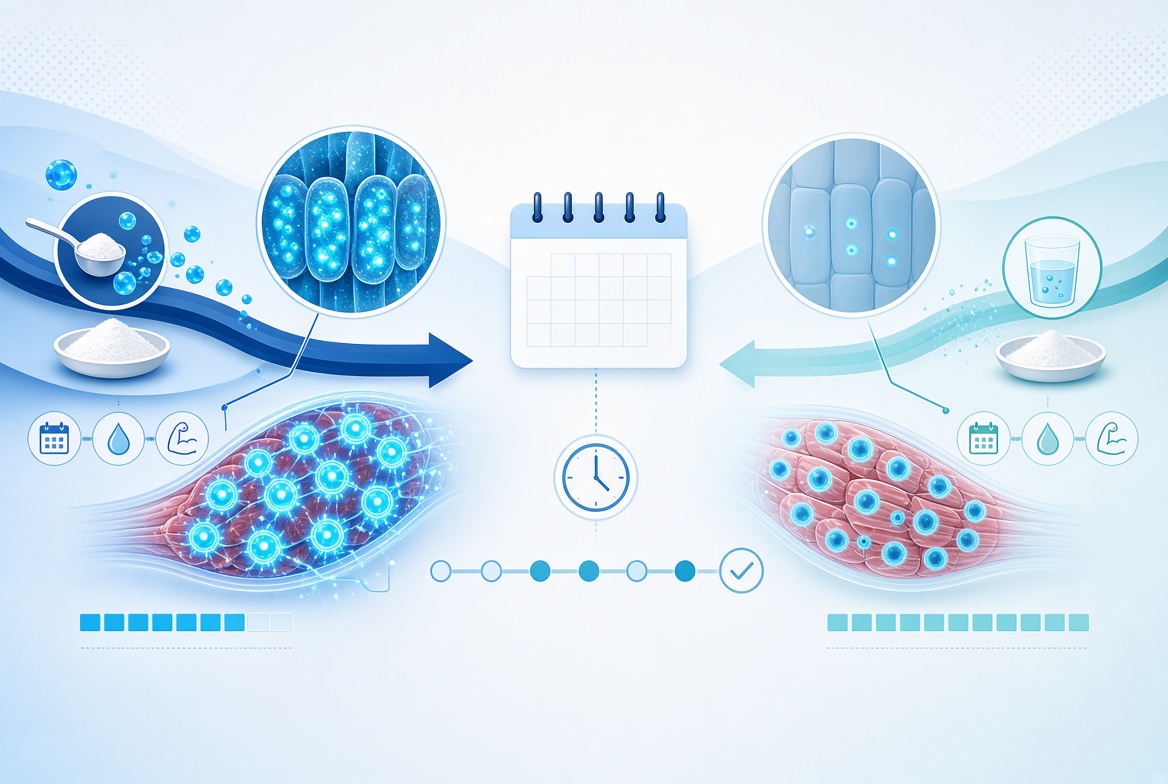
What is called the loading phase?
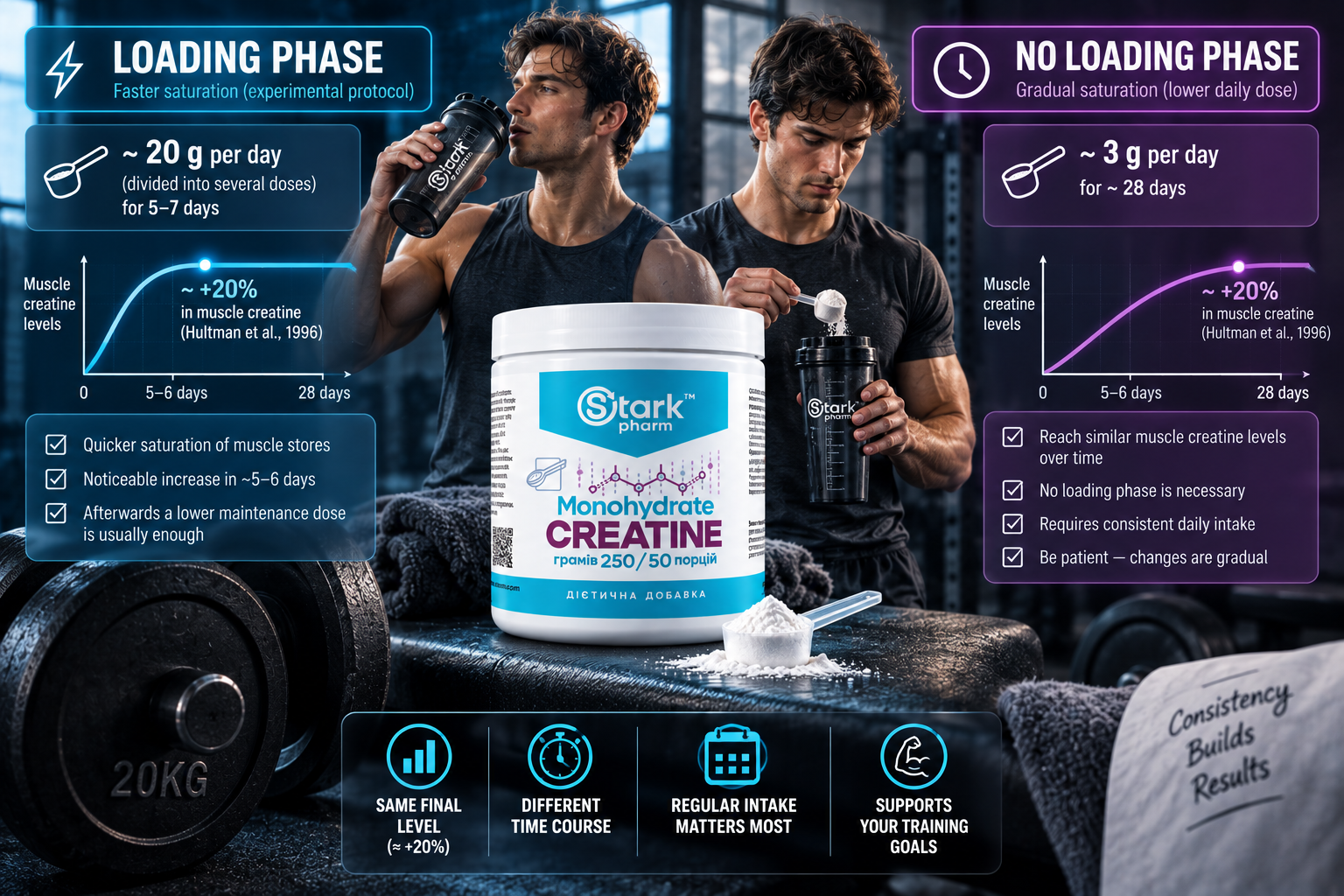
The loading phase is a short period where scientific protocols use a much higher daily amount of creatine monohydrate than the subsequent maintenance dose. In classic studies, this was often around 20g per day, divided into several doses throughout the day, for 5–7 days.
It is important to read these figures as descriptions of experimental protocols, and not as instructions for self-repetition. The goal of such regimens was to rapidly increase total creatine and phosphocreatine concentrations in skeletal muscle and assess biochemical or functional changes within a few days.
The basic mechanism of creatine accumulation in muscles is discussed separately in the material on how creatine monohydrate accumulates and works in muscles. Here, it is more important to compare the saturation rate with different research approaches.
Where did the scheme of approximately 20 g per day come from?
One of the seminal works is the study by Harris et al. (1992). The authors showed that oral creatine does enter skeletal muscle and is able to significantly increase its total creatine pool. The greatest increase was observed in people with lower initial muscle creatine content.
The study also showed that multiple creatine injections throughout the day rapidly increased muscle tissue concentrations. This early work formed the basis for subsequent short loading regimens, which became a standard tool in laboratory research.
But subsequent experiments have shown that fast loading is only one way to achieve increased reserves.
Is it possible to saturate muscles without a loading phase?
The most important answer came from a study by Hultman et al. (1996). In men who received 20 g of creatine per day for six days, total muscle creatine content increased by approximately 20%.
Another regimen in the same study was much slower: 3 grams per day for 28 days. The results for total muscle creatine were similar—about the same 20 percent increase, but achieved more gradually.
This is the main reason why a loading phase is not considered necessary for the very fact of saturation. A high short circuit leads to increased reserves more quickly, while a lower daily level does so more slowly.
Rapid and gradual saturation in classical research
| Study protocol | What happened to muscle creatine? | What does this show? |
|---|---|---|
| 20 g/day for 6 days | Total muscle creatine increased by approximately 20% | Rapid stock saturation |
| 3 g/day for 28 days | Total muscle creatine also increased by approximately 20% | A similar level can be achieved gradually |
| After loading 2 g/day for another 30 days | Elevated muscle creatine levels were maintained | After rapid satiety, the same high amount was not needed in that experiment. |
| Complete shutdown after loading | Stocks gradually decreased and returned to baseline levels in about 30 days. | Saturation does not disappear within one day after discontinuation |
All of these figures come from the specific work of Hultman et al. (1996). They are needed to understand the kinetics of saturation, not to form a universal dosing regimen.
When to realistically expect changes in creatine stores
With classical laboratory loading, a noticeable increase in muscle creatine was recorded after 5–6 days. With a gradual version of 3 g/day, a similar level was reached in approximately 28 days.
This is why people who don't use a loading phase shouldn't expect the same rate of change in the first week. The lack of a quick noticeable effect doesn't mean that creatine isn't accumulating—it's just that saturation occurs more slowly.
The position paper by Kreider et al. (2017) and the review by Antonio et al. (2021) also distinguish between these two approaches: loading is a way to increase muscle stores more quickly, but gradual daily intake of creatine monohydrate also leads to their increase.
When to expect results in training
Casey et al. (1996) gave nine men 20 g of creatine monohydrate daily for five days. Total muscle creatine increased, and total work in two 30-second maximal cycle ergometer tests increased by approximately 4%. The changes in performance correlated with the increase in muscle creatine.
This shows that after rapid satiation, the functional effect for repeated maximal efforts can appear quite early. But this does not mean that in five days a person will build muscle as quickly or significantly increase their one-rep maximum.
The difference between a rapid increase in reserves and long-term adaptation is discussed in more detail in the article about when creatine saturation translates into training results.
Why a faster start doesn't mean better results in a few months
While the two regimens ultimately lead to similar increases in muscle stores, the main advantage of loading is speed. It allows for earlier attainment of high creatine concentrations in the muscles and, consequently, earlier creation of conditions for a possible ergogenic effect.
This does not mean that after a few months someone who started with a loading dose will necessarily have higher creatine levels or perform better than someone who loaded gradually. Hultman et al. have shown that a lower daily dose simply takes longer to lead to similar concentrations.
That is why the phrase “creatine doesn’t work without loading” is not supported by the available data.
Why does the response to creatine differ between people?
Harris et al. (1992) also showed that the magnitude of the increase in muscle creatine is dependent on the initial level. In people with lower starting stores, the potential for increase was greater, while at already high concentrations the response may have been smaller.
In practice, this means that two people on the same research protocol will not necessarily experience the same change in muscle creatine. Diet, starting creatine pool, muscle mass, and individual differences can all influence the magnitude of the response.
Therefore, even the loading phase does not guarantee the same rate of saturation or the same athletic performance for everyone.
What happens after the download is complete?
In a study by Hultman et al., after six days of 20 g/day, elevated muscle creatine concentrations were maintained for another 30 days at 2 g/day. When creatine was completely discontinued after loading, stores did not fall immediately: they gradually returned to baseline levels over about a month.
A longer study by van Loon et al. (2003) also confirmed that after a short loading, muscle creatine remained elevated with subsequent intake, although individual creatine fractions changed over time. This again shows that the creatine pool has inertia and is not dependent on one specific dose on a specific day.
Why you shouldn't copy classic boot protocols
- Doses of 20 g/day in older studies were part of laboratory protocols, not a universal recommendation for everyone.
- Research doses may exceed the amounts permitted for specific dietary supplements and consumer categories.
- A larger single or daily amount does not mean a proportionally better long-term result.
- High short courses are more likely to cause digestive discomfort in sensitive people, especially if large amounts are taken at once.
- For practical use, you should follow the instructions on the packaging of a specific product, rather than reproducing laboratory protocols from publications.
Frequently asked questions
Is a creatine loading phase mandatory?
No. A classic study found that approximately 3g/day for 28 days produced a similar increase in total muscle creatine as 20g/day for six days, but at a slower rate.
Why use the loading phase at all then?
It allowed for rapid muscle satiation and biochemical and functional changes to be studied within a few days. Its main advantage was speed, not necessarily a higher final level.
When does creatine begin to accumulate in muscles?
Changes begin before full saturation is achieved. In classic high-dose protocols, significant increases were measured after 5–6 days, while with lower daily intakes, saturation occurred gradually over several weeks.
When can I expect results from training?
It depends on what outcome is being assessed. After rapid satiation, changes from repeated high-intensity work can appear within a few days, while gains in strength or muscle mass require systematic training and more time.
Does the loading phase give greater results after a few months?
The available data do not show that the loading phase itself creates a unique higher end level that cannot be achieved by gradual saturation. It primarily shortens the time to increased reserves.
What happens to creatine stores after discontinuation?
They decrease gradually, not overnight. In classical work, after complete cessation, elevated muscle creatine returned to baseline levels within approximately 30 days.
Do I need to repeat the loading phase after each break?
Not necessarily. Gradual daily intake also increases muscle stores, so the need for rapid loading only depends on how quickly you need to reach saturation, not on the fact of efficiency itself.
Sources
- Harris RC, Söderlund K., Hultman E. (1992). Elevation of creatine in resting and exercised muscle of normal subjects by creatine supplementation. Clinical Science. PubMed
- Hultman E, Söderlund K, Timmons JA, Cederblad G, Greenhaff PL (1996). Muscle creatine loading in men. Journal of Applied Physiology. PubMed
- Casey A, Constantin-Teodosiu D, Howell S, Hultman E, Greenhaff PL (1996). Creatine ingestion favorably affects performance and muscle metabolism during maximal exercise in humans. American Journal of Physiology. PubMed
- Terjung RL and others. (2000). American College of Sports Medicine roundtable. The physiological and health effects of oral creatine supplementation. Medicine & Science in Sports & Exercise. PubMed
- van Loon LJC and others. (2003). Effects of creatine loading and prolonged creatine supplementation on body composition, fuel selection, sprint and endurance performance in humans. Clinical Science. PubMed
- Kreider RB and others. (2017). International Society of Sports Nutrition position stand: safety and efficacy of creatine supplementation in exercise, sport, and medicine. Journal of the International Society of Sports Nutrition. PubMed
- Antonio J. and others (2021). Common questions and misconceptions about creatine supplementation: what does the scientific evidence really show? Journal of the International Society of Sports Nutrition. PubMed
Dietary supplement. Not a medicine. Consult a doctor before use.
Products related to this post


Related Posts
Comments
Information
Customer Service
Extras
My Account


Sports nutrition manufacturer in Ukraine StarkPharm © 2026