Your shopping cart is empty!

Creatine and Glucose: Does It Affect Insulin Sensitivity?
Published: 13/09/2026
Times Read: 341
Comments : 0
Creatine is most often discussed in the context of strength, power, and recovery between short bursts of intense effort. But skeletal muscle is also one of the main sites of glucose utilization after a meal, so another hypothesis has long been raised: whether changing the energetics of the muscle cell could affect glucose transport, glycogen stores, and insulin sensitivity.
Mechanistically, this idea seems plausible. However, clinical studies paint a more complex picture: some studies have shown changes in GLUT4, glucose tolerance, or HbA1c, while others have shown no improvement in markers of insulin resistance. Therefore, the answer to the question “does creatine increase insulin sensitivity” cannot be reduced to a simple “yes” or “no.”
Why did the creatine and glucose hypothesis arise in the first place?
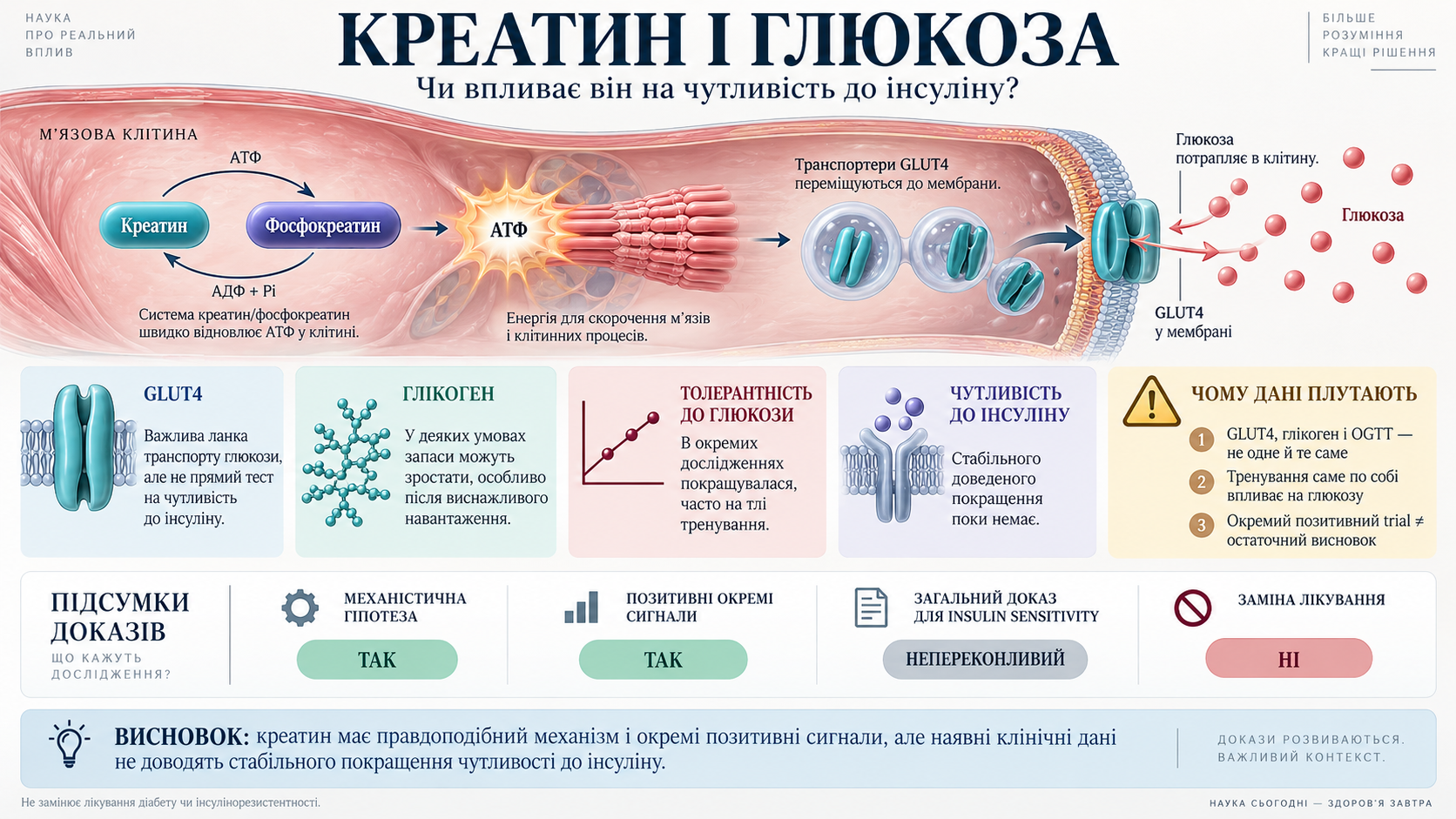
Skeletal muscle requires rapid ATP resynthesis during exercise. The creatine-phosphocreatine system helps support this energy metabolism during times of high demand. We have discussed the basic biochemistry of this system separately in the article on how the creatine-phosphocreatine system works.
Importantly for glucose metabolism, muscle contraction itself stimulates glucose uptake independently of insulin signaling. During and after exercise, the cell changes its energy status, activates glucose transport, and replenishes glycogen stores. It is at this intersection of energetics, muscle contraction, and glucose transport that creatine has become the subject of metabolic research.
GLUT4 is an important link, but not a direct test for insulin sensitivity
GLUT4 is the main insulin-sensitive glucose transporter in skeletal muscle and adipose tissue. When insulin or muscle contraction triggers the appropriate signal, some of GLUT4 moves from intracellular structures to the cell membrane, where the transporters can pass glucose into the cell.
This is where it is easy to get confused between different metrics. A study could be measuring total GLUT4 protein in muscle, its mRNA expression, or actual translocation of the transporter to the membrane. These are different endpoints. More total GLUT4 does not necessarily mean more translocation at a particular point in time, and a change in translocation is not automatic evidence of long-term improvement in systemic insulin sensitivity.
What GLUT4 studies in humans have shown
One of the key early studies was conducted by Op 't Eijnde et al. (2001) in 22 healthy volunteers. Participants had one leg immobilized for two weeks, after which they underwent a 10-week strength rehabilitation program. The creatine group used 20 g/day during immobilization, 15 g/day for the first three weeks of rehabilitation, and 5 g/day for the last seven weeks.
In the placebo group, immobilization reduced muscle GLUT4 by approximately 20%, whereas there was no such reduction in the creatine group. During subsequent training, GLUT4 increased by approximately 40% in the creatine group. This is an important mechanistic signal, but its context is very specific: immobilization, then rehabilitation resistance training and high doses of creatine. This model cannot be directly transferred to healthy individuals without immobilization or to the treatment of insulin resistance.
A different picture was obtained by van Loon et al. (2004). Twenty participants underwent a six-week protocol: first 20 g/day for five days, then 2 g/day for another 37 days. After the loading phase, muscle glycogen increased by approximately 18%, but neither GLUT4 mRNA nor GLUT4 protein content increased. Thus, even if creatine affects glycogen storage, this effect is not necessarily due to an increase in total GLUT4.
Creatine and glycogen: the effect depends on the conditions
Glycogen is a form of glucose storage in the muscles and liver. For an athlete, muscle glycogen is especially important during prolonged or repeated intense exercise, but the mere fact of having a larger glycogen store does not mean improved insulin sensitivity.
Roberts et al. (2016) studied 14 healthy men after a grueling cycling exercise. During recovery, participants were given a high-carbohydrate diet and 20 g of creatine per day or placebo. Creatine enhanced post-exercise muscle glycogen supercompensation within the first 24 hours, and the difference was maintained thereafter.
However, the authors did not see any obvious difference between groups in measures of muscle insulin sensitivity during an oral glucose tolerance test or GLUT4 mRNA, suggesting that glycogen storage, glucose transport, and systemic insulin sensitivity should not be interpreted as interchangeable measures.
Why training changes the picture
Exercise itself affects GLUT4, glucose uptake, glycogen, and insulin sensitivity. This makes it difficult to interpret this study, where creatine is combined with exercise, as a pure test of supplementation. It is possible that an interaction exists: creatine alters the energy conditions in the muscle, and exercise triggers its own strong metabolic signal.
That is why the results of such studies need to be read in conjunction with an understanding of what creatine actually does to training. If both groups train and the difference between them is small, the large independent effect of exercise cannot be ignored.
Gualano et al. (2008) randomized 22 sedentary healthy men to receive creatine or placebo, both groups performing moderate aerobic exercise. The creatine group used approximately 10 g/day for three months.
The area under the glucose curve during the oral glucose tolerance test was reduced compared to placebo. However, fasting insulin and HOMA did not differ between groups. The authors therefore formulated the result quite precisely: creatine together with aerobic training improved glucose tolerance, but showed no effect on insulin sensitivity measured in this study.
This difference is fundamental. A better glucose curve after a glucose load can occur through several mechanisms and does not in itself prove that systemic insulin resistance has become less.
What the study showed in type 2 diabetes
The most frequently cited clinical trial in type 2 diabetes is the study by Gualano et al. (2011). Twenty-five participants completed a 12-week, double-blind, placebo-controlled trial. Both groups completed an exercise program, and the creatine group received 5 g/day.
In the creatine group, HbA1c decreased compared with placebo; lower area under the glucose curve during the meal tolerance test and increased GLUT4 translocation to the sarcolemma were also observed. However, insulin and C-peptide concentrations and surrogate indices of insulin sensitivity did not differ between groups.
This is an interesting clinical observation, but it has limitations. The sample size was small, creatine was administered in conjunction with exercise, and the positive changes did not extend to all markers of carbohydrate metabolism. A single trial does not allow us to conclude that creatine alone treats insulin resistance or type 2 diabetes.
What the systematic review and meta-analysis showed
Delpino and Figueiredo (2022) pooled experimental studies of creatine that assessed glycemic control and insulin resistance parameters. Nine studies were included in the systematic review, and five of them reported a positive effect on at least one measure.
But after pooling the data in a meta-analysis, no statistically significant effect on fasting blood glucose was found. There was also no significant overall effect on insulin resistance. The authors themselves concluded that the available data were insufficient to support a positive effect of creatine on diabetes parameters.
This well explains the gap between individual promising studies and the overall evidence base. A positive result from one small RCT may be real, but whether the effect is replicated in different populations, protocols, and laboratory models is important for clinical conclusions.
Where the data is stronger and where gaps remain
| Question | What the research shows | How confident is the conclusion? |
|---|---|---|
| GLUT4 | Under specific immobilization and training conditions, creatine affected GLUT4 content or translocation, but other work did not show an increase in its overall expression. | There is a mechanistic signal, but it is heterogeneous. |
| Muscle glycogen | After strenuous exercise and on a high-carbohydrate diet, creatine can enhance glycogen supercompensation. | The effect is context-dependent and does not equate to improved insulin sensitivity. |
| Glucose tolerance | In some studies, the glucose response during the OGTT or meal tolerance test improved. | A preliminary positive signal, especially against the background of training. |
| Insulin sensitivity | Individual surrogate measures did not change, and meta-analysis did not show a significant overall effect on insulin resistance. | Stable improvement has not been proven. |
| HbA1c in type 2 diabetes | One small RCT of 5 g/day along with exercise showed a reduction in HbA1c. | Not enough for a therapeutic conclusion. |
Why is this still an evidence gap in 2026?
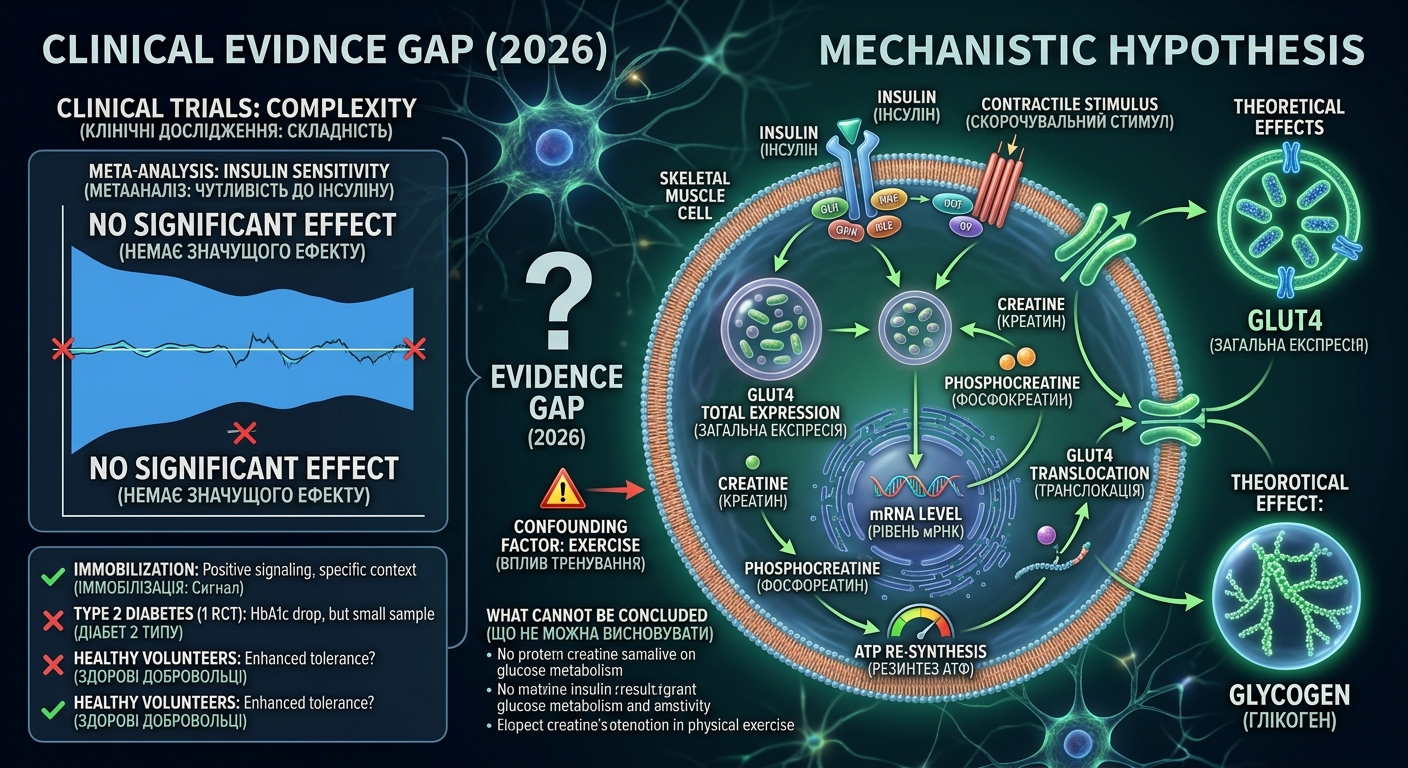
Machado (2026) has highlighted the gap between a strong mechanistic hypothesis and a weaker clinical basis. At the biological level, there are several plausible pathways: muscle energetics, GLUT4, glycogen, and a possible interaction with exercise. However, for people with type 2 diabetes, there are still few large, high-quality clinical trials.
A separate problem is the change in standard diabetes therapy. Some of the older trials were conducted before the widespread use of modern treatment regimens. Therefore, even a positive signal from a small old study needs to be verified in the context of current pharmacotherapy, longer follow-up, and clinically meaningful endpoints, not just laboratory markers.
That is why the mechanism cannot be presented as a ready-made clinical recommendation. The data on GLUT4 or glycogen help to understand why creatine is being studied in this direction at all, but do not prove a therapeutic benefit for a person with insulin resistance or diabetes.
What cannot be concluded from these studies
- Altering GLUT4 in muscle does not automatically cure insulin resistance.
- An improvement in glucose curve in one test is not the same as a proven long-term improvement in insulin sensitivity.
- The effects obtained with physical training cannot be entirely attributed to creatine alone.
- Doses from studies describe protocols for specific studies and are not a recommendation for self-administration.
People with diabetes, impaired glucose tolerance, kidney disease, or ongoing medication should discuss any changes in their dietary supplement use with their doctor. This is especially important if changes are made to their exercise, diet, or blood sugar-lowering medications, as each of these factors can affect glucose levels.
Frequently asked questions
Does creatine lower blood glucose levels?
In some studies, glucose response was improved with exercise, but meta-analysis did not show a significant overall effect on fasting glucose. Therefore, it is not correct to say that creatine consistently “lowers sugar.”
Does creatine increase insulin sensitivity?
A convincing overall effect has not yet been shown. Some studies have shown changes in glucose tolerance or GLUT4, but insulin sensitivity measures have not always improved.
What is GLUT4?
GLUT4 is an insulin-sensitive glucose transporter, particularly important in skeletal muscle and adipose tissue. Its abundance, expression, and translocation to the membrane are different parameters and should not be interpreted as the same thing.
Does creatine affect glycogen stores?
Such changes have been observed in some controlled studies, especially after strenuous exercise with high carbohydrate intake. This does not automatically mean an improvement in systemic insulin sensitivity.
Why is physical activity so important in this topic?
Muscle contraction itself stimulates glucose transport, affects GLUT4, and alters glycogen replenishment. Therefore, in creatine + exercise studies, it is difficult to completely separate the effect of supplementation from the effect of exercise.
Is there research on creatine in type 2 diabetes?
Yes, but they are few. One small 12-week RCT showed positive changes in HbA1c and GLUT4 translocation with an exercise program, but this is not enough to draw a therapeutic conclusion.
Can creatine be used instead of treating insulin resistance or diabetes?
No. The available evidence does not support the use of creatine as a replacement for standard medical treatment, nutritional strategies, or physician-prescribed therapy.
Sources
- Machado M. (2026). Creatine supplementation in type 2 diabetes: A critical appraisal of the evidence gap. Nutrition and Health. PubMed
- Delpino FM, Figueiredo LM (2022). Does creatine supplementation improve glycemic control and insulin resistance in healthy and diabetic patients? A systematic review and meta-analysis. Clinical Nutrition ESPEN. PubMed
- Gualano B. and others. (2011). Creatine in type 2 diabetes: a randomized, double-blind, placebo-controlled trial. Medicine & Science in Sports & Exercise. PubMed
- Gualano B. and others. (2008). Effects of creatine supplementation on glucose tolerance and insulin sensitivity in sedentary healthy males undergoing aerobic training. Amino Acids. PubMed
- Op 't Eijnde B. and others. (2001). Effect of oral creatine supplementation on human muscle GLUT4 protein content after immobilization. Diabetes. PubMed
- van Loon LJC and others. (2004). Creatine supplementation increases glycogen storage but not GLUT-4 expression in human skeletal muscle. Clinical Science. PubMed
- Roberts PA and others. (2016). Creatine ingestion augments dietary carbohydrate mediated muscle glycogen supercompensation during the initial 24 h of recovery following prolonged exhaustive exercise in humans. Amino Acids. PubMed
Dietary supplement. Not a medicine. Consult a doctor before use.
Products related to this post

Related Posts
Comments
Information
Customer Service
Extras
My Account


Sports nutrition manufacturer in Ukraine StarkPharm © 2026