Your shopping cart is empty!

Creatine HCl vs. monohydrate: are there proven benefits of hydrochloride?
Published: 04/10/2026
Times Read: 80
Comments : 0
Creatine hydrochloride, or HCl, is often touted as a more modern form of creatine: it dissolves better in water, is usually sold in smaller servings, and is often touted as having better absorption and tolerability. But some of these claims go far beyond what the research actually shows.
The best-documented difference to date is simple: creatine HCl is indeed much more water-soluble. However, direct human studies have not shown that it produces greater gains in strength, muscle mass, or athletic performance than monohydrate.
What is the difference between HCl and monohydrate?
Both forms are sources of creatine, but have different chemical structures. In monohydrate, the creatine molecule is crystallized together with a water molecule, while in hydrochloride, creatine forms a salt with hydrochloric acid.
This difference changes the physicochemical properties of the powder, including its solubility. But for practical results, it's not just how easily the substance dissolves in a glass that matters, but also how much creatine ultimately reaches the tissues and whether it changes strength or other functional parameters.
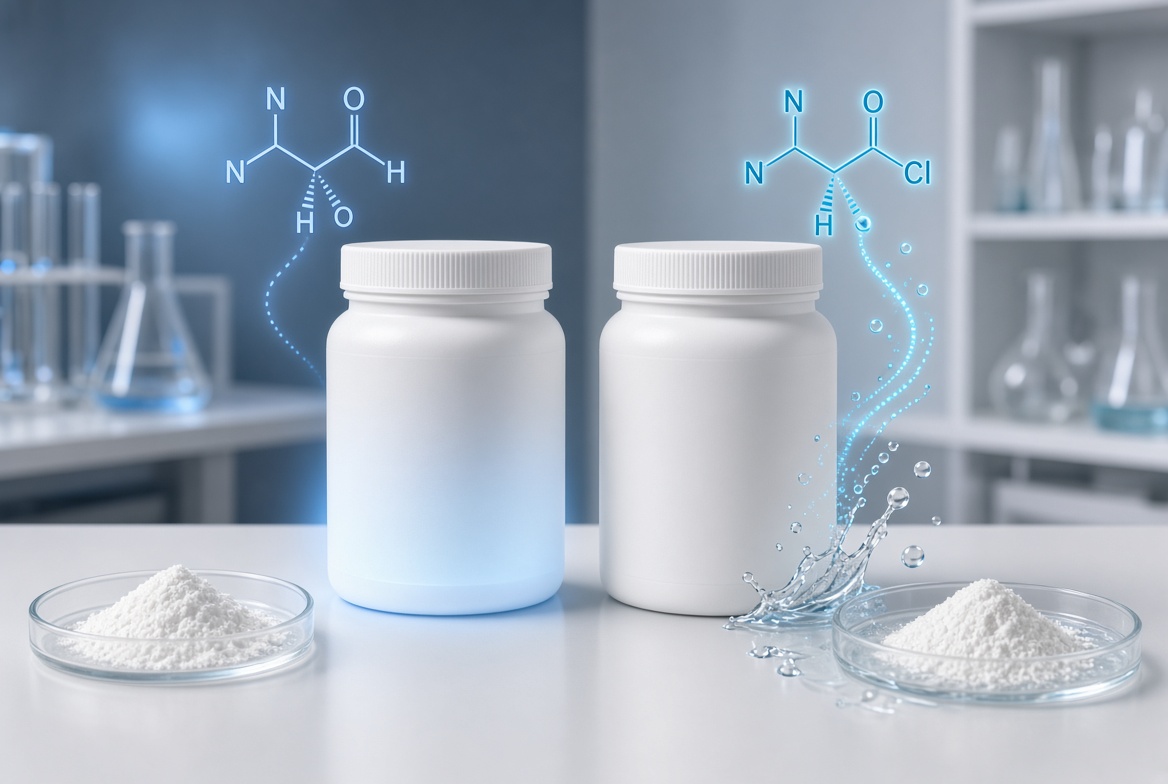
HCl is indeed more soluble in water
Gufford et al. compared several creatine salts with monohydrate. Under laboratory conditions, the hydrochloride was approximately 38 times more soluble in water than creatine monohydrate.
This is a real advantage of HCl as a physicochemical form. The powder can more easily dissolve into solution, potentially affecting the convenience of making a drink.
But this is where one of the most common misconceptions arises: a 38-fold difference in solubility does not mean a 38-fold difference in absorption or effectiveness.
Why better solubility doesn't equal better absorption
In the same study, the authors tested the permeability of several forms of creatine through the Caco-2 intestinal epithelial model. No significant advantage was shown for the hydrochloride over the monohydrate.
This is a laboratory model, not a direct measurement of absorption in humans, so it should not be overstated. But it does illustrate a key principle: better solubility alone does not prove better absorption in the body.
To claim that HCl is better absorbed or requires significantly less for the same effect, direct human studies with appropriate measurements are needed. Such a convincing basis does not yet exist.
Where did the thesis about a much lower dose of HCl come from?
One of the main marketing advantages of HCl is the ability to use less powder. This is often attributed to better solubility and the assumption of better absorption.
But a smaller serving size does not necessarily mean that it provides the same level of muscle creatine saturation. This requires direct comparisons of different doses of both forms in terms of tissue creatine concentration or long-term functional outcomes.
That is why the statement “HCl works at a dose several times lower” does not have the same evidentiary support today as the basic effectiveness of monohydrate.
A brief direct comparison of 2020
Tayebi and Arazi studied 36 trained young men. For seven days, participants received 20 g of monohydrate per day, 3 g of monohydrate, 3 g of HCl, or a placebo.
These quantities are characteristics of the experimental protocol and not a recommendation for self-administration.
There was no significant difference between groups between 3g HCl and 3 or 20g monohydrate in terms of strength, power, and hormonal parameters. Moreover, in the short seven-day protocol, HCl did not demonstrate the obvious functional benefit that would support the claim of its greater efficacy.
The study was short, so it cannot definitively address the question of long-term effectiveness. But as a direct comparison, it did not support the superiority of HCl.
2024 Study: Eight Weeks of Strength Training
Eghbali et al. conducted an eight-week study in 40 people aged 18–25. Participants were divided into four groups: HCl, monohydrate with an initial high-consumption phase, monohydrate without such a phase, and placebo.
Both the HCl and monohydrate groups improved strength, muscle cross-sectional area, and other parameters during the strength program. However, the main result for our comparison was different: HCl showed no advantage over monohydrate.
This is more important than individual within-group changes. If two forms work, but one is not superior to the other in a direct comparison, it cannot be presented as clinically stronger.
What the 2025 direct study added in athletes
Another randomized controlled trial was published in 2025, this time in team sports athletes, comparing monohydrate, HCl, and placebo over eight weeks.
The authors evaluated strength, jumping performance, and body composition. Both forms of creatine were associated with training-related changes, but no significant advantage was found for HCl over monohydrate.
Together with the 2024 study, this already creates a more robust picture: direct human comparisons do not show that better HCl solubility translates into greater athletic performance.
What about strength and muscle mass?
In the available head-to-head comparisons, HCl has not outperformed monohydrate in terms of strength or body composition. This does not mean that HCl “does not work.” The correct conclusion is that there is no evidence that it is more effective.
And this is a fundamental difference. The absence of proven advantage is not the same as proof of the complete ineffectiveness of the form.
Is it proven that HCl is better tolerated by the stomach?
Better solubility could theoretically affect ease of use: fewer undissolved particles in the drink and a smaller powder mass could be more comfortable for some people.
But the claim that HCl consistently causes fewer gastrointestinal symptoms requires direct controlled studies where tolerability is a predetermined endpoint and is assessed equally in both groups.
Such a strong comparative basis is not yet sufficient. Therefore, better solubility can be called a proven property, while better tolerability is only a possible practical difference that does not have the same strength of evidence.
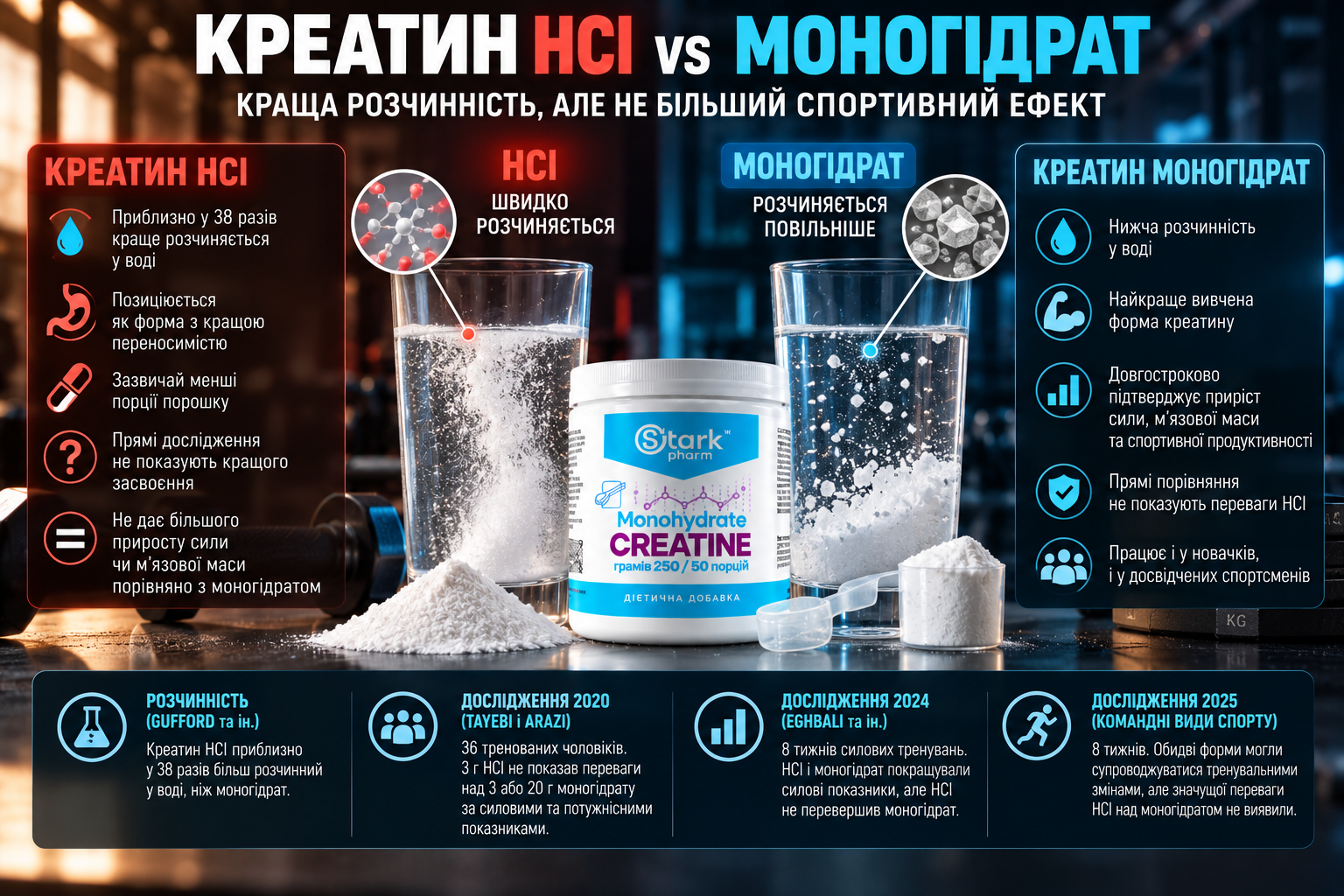
Why monohydrate has a much broader evidence base
Monohydrate has been used as the primary form of creatine in clinical and sports research for decades, and is the basis for most of the data on muscle saturation, strength, repeated high-intensity exercise, body composition, and long-term safety.
More details on why monohydrate remains the primary form of creatine in research are discussed in a separate article.
There is much less evidence for HCl, so even if the two forms produce similar results in small, direct studies, the level of confidence in their evidence base remains different.
HCl vs monohydrate: comparison on equal terms
| Criterion | Creatine monohydrate | Creatine HCl |
|---|---|---|
| Solubility in water | Lower | Significantly higher; approximately 38 times higher in a laboratory study |
| Permeability in the intestinal epithelium model | Baseline comparison | No convincing advantage shown |
| Direct human comparisons | It exists as a reference form | There are, but there are few of them. |
| Strength and athletic performance | Extensive evidence base | Worked in some research, but no advantage over monohydrate has been shown |
| Body composition | A large amount of clinical data | Less data; no proven benefit |
| Effectiveness of a much lower dose | Well-studied standard research protocols | It has not been conclusively proven that significantly smaller amounts produce equivalent effects. |
| Portability | Well studied | Better tolerability is often claimed, but strong direct evidence is lacking |
| Overall breadth of evidence base | Very large | Much smaller |
Is there a scientific winner?
If the question is “which form dissolves better?”, the answer is HCl. If the question is “which form has the most quality clinical data?”, the answer is monohydrate.
But if the question is, “Is HCl proven to improve athletic performance?” the answer is currently no. Head-to-head comparative studies have not shown it to be superior in terms of strength, body composition, or other key performance indicators.
Therefore, there is no reason to create an artificial winner. HCl has a real physicochemical advantage in solubility, and the monohydrate has a much stronger clinical evidence base.
What can be said today?
- HCl dissolves better: this is a confirmed physicochemical difference.
- Better solubility does not prove better absorption: in a laboratory model, the permeability of HCl was not higher than the monohydrate.
- Direct human studies have not shown any benefit of HCl: there is no convincing gain in strength, body composition, and athletic performance.
- A lower effective dose of HCl has not been properly proven: marketing thesis should not be confused with established clinical fact.
- The monohydrate has a much broader evidence base: this does not make HCl ineffective, but it makes the conclusions regarding the monohydrate much more reliable.
Frequently asked questions
Which is better: creatine HCl or monohydrate?
HCl is more soluble in water, but direct clinical studies do not show any advantage over monohydrate in terms of strength, body composition, or athletic performance. Monohydrate has a much broader evidence base.
Is it true that HCl is absorbed 38 times better?
No. About a 38-fold difference was shown for water solubility. It wasn't a 38-fold difference in absorption or athletic performance.
Can I take HCl in much smaller amounts and get the same effect?
There is no convincing clinical basis for such a universal conclusion. A smaller portion of HCl is often used in practice, but the equivalence of a much smaller dose is not as well proven as the efficacy of the monohydrate.
Is HCl better for strength?
Direct studies have not shown that HCl increases strength more than the monohydrate.
Does HCl give more muscle mass?
There is no convincing evidence that HCl is superior to monohydrate in terms of changes in muscle or fat-free mass.
Is HCl less irritating to the stomach?
Theoretically, better solubility and a smaller powder mass may be more convenient for individuals, but strong direct studies demonstrating consistently better gastrointestinal tolerability of HCl are lacking.
Why do most studies use monohydrate?
This form has been used for decades, is well-characterized, and has the most research on efficacy and safety, which is why it remains the primary reference form of creatine.
Sources
- Antonio J. and others (2021). Common questions and misconceptions about creatine supplementation: what does the scientific evidence really show? Journal of the International Society of Sports Nutrition. PubMed
- Gufford BT and others. (2010). Physicochemical characterization of creatine N-methylguanidinium salts. Journal of Dietary Supplements. PubMed
- Tayebi M., Arazi H. (2020). Is creatine hydrochloride better than creatine monohydrate for the improvement of physical performance and hormonal changes in young trained men? Science & Sports. DOI
- Eghbali E., Arazi H., Suzuki K. (2024). Supplementing With Which Form of Creatine (Hydrochloride or Monohydrate) Alongside Resistance Training Can Have More Impacts on Anabolic/Catabolic Hormones, Strength and Body Composition? Physiological Research. PubMed
- Londoño-Velásquez D. and others. (2025). Creatine monohydrate versus creatine hydrochloride on strength and body composition in elite team-sport athletes: A placebo-controlled randomized clinical trial comparing low dosages. Journal of the International Society of Sports Nutrition. PMC
- Kreider RB and others. (2022). Bioavailability, efficacy, safety, and regulatory status of creatine and related compounds: a critical review. PMC
Dietary supplement. Not a medicine. Consult a doctor before use.
Products related to this post


Related Posts
Comments
Information
Customer Service
Extras
My Account


Sports nutrition manufacturer in Ukraine StarkPharm © 2026