Your shopping cart is empty!

Creatine before or after training: does the time of intake matter?
Published: 17/09/2026
Times Read: 312
Comments : 0
The question "creatine before or after training?" is often asked as if it is a supplement with a short, acute effect. But creatine works differently: its main role is associated with a gradual increase in creatine and phosphocreatine stores in the muscles. That is why for long-term results, regularity of intake is usually more important than the exact minute in relation to training.
However, the timing of intake is not completely settled. Small early studies have suggested a benefit of post-workout intake, larger head-to-head comparisons have failed to show a consistent difference between pre- and post-workout intake, and a 2026 pilot study found a possible acute benefit of pre-workout intake. These results relate to different endpoints and are not as contradictory as they may seem.
Why did they even start discussing the reception time?
After resistance training, working muscles experience temporary increases in blood flow, nutrient transport, and sensitivity to insulin signals. This has led to the hypothesis that creatine taken close to exercise may be more efficiently delivered to the muscle than the same amount taken at random times of day.
Reviews by Ribeiro et al. (2021) and Candow et al. (2022) suggest that this hypothesis is physiologically plausible, but there is insufficient direct evidence to suggest a single optimal timing of intake. Training may affect creatine transport, but this does not mean that a small difference in creatine uptake will necessarily translate into greater gains in strength or muscle mass over a few months.
The basic mechanism of action of creatine during repeated intense efforts is separately analyzed in the material on how creatine works during strength training. Another important thing for the question of the time of intake: the accumulation of reserves does not occur only at the time of the workout itself.

The main thing for creatine is to saturate the reserves, not a short stimulus
Creatine does not work in the same way as caffeine, where the concentration of the substance in the blood directly during training is important. Its regular consumption gradually increases the content of creatine and phosphocreatine in skeletal muscles.
As early as the American College of Sports Medicine roundtable, Terjung et al. (2000) noted, a high-dose loading phase is not necessary: approximately 3 g/day can also produce similar increases in muscle phosphocreatine if given enough time. This explains why a regular daily intake is more biologically meaningful than seeking a narrow 30–60 minute “window.”
Where did the idea that it's better after a workout come from?
Antonio and Ciccone (2013) conducted one of the most famous early head-to-head comparisons. Nineteen male bodybuilders took 5 g of creatine either immediately before or immediately after training for four weeks. Both groups trained approximately five times per week.
Standard statistical analysis found no significant interaction between time of administration and changes in lean mass or bench press 1-rep max. The authors additionally used an effect size method that provided a possible signal in favor of post-workout administration. This result has often been the basis for the “post-workout is better” claim, even though the study itself was small and its main traditional analysis did not show a convincing advantage.
Cribb and Hayes (2006) previously reported better adaptations when a combined protein, carbohydrate, and creatine mixture was taken immediately before and after exercise compared to morning and evening. However, this study cannot isolate the effect of the timing of creatine intake specifically, so it only supports the general hypothesis of nutrient intake close to exercise.
Direct before and after comparison in the same person
Forbes et al. (2021) used an unusual design that reduces the influence of individual differences. Ten young adults trained one side of their body on days when creatine was taken immediately before training and the other side on days when creatine was taken immediately after. The dose was 0.1 g per kilogram of body weight, and the program lasted eight weeks.
Muscle thickness and strength increased after the training program, but there was no difference between the pre- and post-treatment intakes. Total training volume was also similar. This is one of the purest direct comparisons because genetics, nutrition, sleep, and other individual factors were essentially the same for both conditions.
What 8 weeks showed in trained athletes
Dinan et al. (2022) randomized 34 trained men and women into three groups: 5 g of creatine within an hour before exercise, 5 g within an hour after exercise, or placebo. All participants completed a resistance training program for eight weeks.
Training performance improved over time, but the researchers found no convincing additional benefit of taking creatine just before or just after training for program adaptations. This study is important because it included trained athletes of both sexes and had a separate placebo group.
What longer studies have shown
In a subsequent 32-week study, Candow et al. (2015) added a placebo. Both pre- and post-workout creatine supplementation resulted in greater strength gains than placebo. The post-workout group showed greater gains in lean mass compared to placebo, but strength changes between the two creatine regimens were very similar.
Together, these works do not support the idea that there is a clear universal “only after” or “only before” rule for long-lasting strength.
What changed in the 2026 pilot study
Ben Maaoui et al. (2026) asked a different question: not about adaptation over 8–32 weeks, but about acute performance after a single dose. Eleven physically active men in a randomized crossover study underwent five conditions: creatine pre-exercise, during exercise, post-exercise, placebo, and a no-supplement control.
The single dose was 0.1 g per kilogram of body weight. During the training, participants performed six sets of bench press and squat with a barbell at 80% of one-rep maximum. The total weight lifted was greater when creatine was taken before training than in the placebo and control conditions.
This is an interesting result, because creatine is not traditionally considered an acute pre-workout supplement. But the study had only 11 participants, did not use a pre-loading phase, and the authors themselves called the findings exploratory. Therefore, one such pilot is not enough to make pre-workout the new standard or to transfer an acute result to months of adaptation.
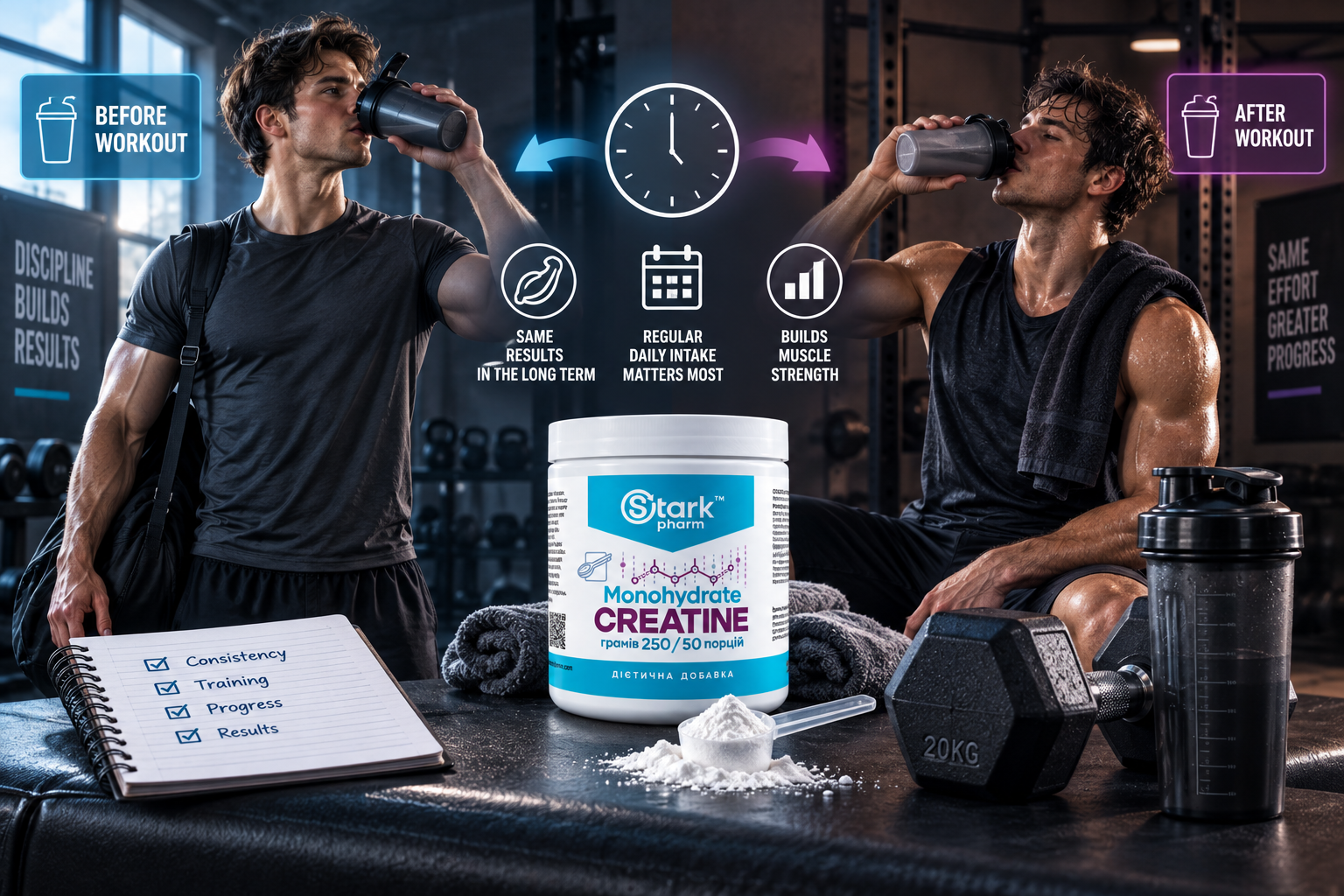
Acute performance and long-term adaptation are different issues
The 2026 pilot evaluated the results of a single workout after a single dose. The Forbes, Dinan, and Candow studies evaluated changes in strength, muscle thickness, or body composition after weeks and months of regular intake and training.
Therefore, an acute pre-workout effect and no long-term difference between pre- and post-workout can coexist. Even if a particular time point of ingestion slightly changes the performance of a particular workout, it may not be enough to produce a measurable difference in strength or hypertrophy after a few months.
Before, after or just regularly
| Version | What the data shows | How to interpret this |
|---|---|---|
| Before training | No long-term stable advantage over post-treatment has been shown; the 2026 pilot gave a positive acute signal | A completely working option, but it has not yet been proven to be the best for long-term adaptations |
| After training | Early small studies suggested a possible advantage, but stronger direct comparisons have not consistently confirmed it. | An equally acceptable option, especially if it is easier to follow |
| At other times of the day | The main effect of creatine is associated with the accumulation of muscle reserves. | For long-term use, regularity is probably more important than the exact minute of intake. |
Should you take creatine with food?
Green et al. (1996) showed that high levels of simple carbohydrates increased creatine retention during a short, high-dose protocol. The study used 5 g of creatine along with 93 g of simple carbohydrates every four hours, for a total of 20 g of creatine per day. Higher insulin levels were associated with better creatine retention.
This confirms that dietary context can influence creatine kinetics. However, it does not follow that for normal daily use, one should deliberately add large amounts of sugar or build a diet around creatine. Reviews of current evidence do not show that such a strategy is necessary for long-term effects.
How to practically choose an appointment time
- Choose the time that is easiest to stick to regularly, not the one that seems "perfect" in minutes.
- Taking it before and after training has direct research, and for long-term adaptations, there is no convincing universal advantage of one regimen.
- On a day without training, binding to a specific time is even less important, since the main goal is to maintain saturated reserves.
- The results of a single-dose pilot study in 2026 should not be extrapolated to all long-term regimens.
- The doses given in individual studies describe experimental protocols and are not a recommendation to repeat them yourself.
Frequently asked questions
Is it better to take creatine before or after a workout?
For long-term adaptations, no single option has been shown to be superior. Direct studies generally find similar changes in strength and muscle performance when taken before and after training.
How many minutes before a workout should you take creatine?
There is no established optimal interval that has been proven to improve long-term performance. A 2026 pilot study showed a strong signal when taken before exercise, but it is not sufficient for a universal recommendation.
Can I take creatine immediately after a workout?
Yes. In studies, taking it immediately or within an hour after exercise has been used without evidence of inferior effectiveness compared to taking it before exercise.
This is not a requirement. A high-carb diet may increase creatine retention, but studies do not show the need to specifically add large amounts of carbohydrates for normal daily use.
Do you need to take creatine on training days?
Regular intake is important for maintaining increased muscle stores. The logic of creatine is not limited to training days.
When to take creatine on a rest day?
There is no proven benefit to choosing a specific time of day without training. It is more practical to choose a stable moment that helps you not to miss a dose.
Does a 2026 study prove that pre-workout creatine is better?
No. It showed an interesting acute effect in only 11 men after a single dose. Confirmation in larger studies with longer follow-up is needed to change long-term recommendations.
Sources
- Ben Maaoui K. and others. (2026). Acute Creatine Ingestion Before Resistance Training Enhances Strength Performance More Than Ingestion During or After Training: A Randomized Crossover Pilot Trial. Nutrients. PubMed
- Dinan NE and others. (2022). Effects of creatine monohydrate timing on resistance training adaptations and body composition after 8 weeks in male and female collegiate athletes. Frontiers in Sports and Active Living. PubMed
- Forbes SC and others. (2021). Timing of creatine supplementation does not influence gains in unilateral muscle hypertrophy or strength from resistance training in young adults: a within-subject design. The Journal of Sports Medicine and Physical Fitness. PubMed
- Ribeiro F. and others. (2021). Timing of Creatine Supplementation around Exercise: A Real Concern? Nutrients. PubMed
- Candow DG and others. (2022). Creatine O'Clock: Does Timing of Ingestion Really Influence Muscle Mass and Performance? Frontiers in Sports and Active Living. PubMed
- Antonio J., Ciccone V. (2013). The effects of pre versus post workout supplementation of creatine monohydrate on body composition and strength. Journal of the International Society of Sports Nutrition. PubMed
- Candow DG and others. (2014). Comparison of creatine supplementation before versus after supervised resistance training in healthy older adults. Research in Sports Medicine. PubMed
- Candow DG and others. (2015). Strategic creatine supplementation and resistance training in healthy older adults. Applied Physiology, Nutrition, and Metabolism. PubMed
- Green AL and others. (1996). Carbohydrate ingestion augments creatine retention during creatine feeding in humans. Acta Physiologica Scandinavica. PubMed
- Cribb PJ, Hayes A. (2006). Effects of supplement timing and resistance exercise on skeletal muscle hypertrophy. Medicine & Science in Sports & Exercise. PubMed
- Terjung RL and others. (2000). American College of Sports Medicine roundtable. The physiological and health effects of oral creatine supplementation. Medicine & Science in Sports & Exercise. PubMed
Dietary supplement. Not a medicine. Consult a doctor before use.
Products related to this post


Related Posts
Comments
Information
Customer Service
Extras
My Account


Sports nutrition manufacturer in Ukraine StarkPharm © 2026