Your shopping cart is empty!

Types of Prebiotics: Inulin, FOS, Pectin and Psyllium — StarkPharm™
Published: 23/06/2026
Times Read: 1812
Comments : 0
Fiber often gets lumped together: "it's a prebiotic, good for your microflora — that's it." In reality, dietary fibers work very differently, and two products from the same "prebiotics" shelf can have almost opposite effects. Stark Pharm's range includes three distinct fiber types — Stark Inulin & FOS, Stark Apple Fiber and Stark Psyllium Husks — and each solves a different task.
Let's look at how fructans (inulin and FOS), pectin (apple fiber) and psyllium differ, what their mechanism is, and how to choose a fiber for a specific goal — rather than by the name on the jar.
The three fiber types at a glance
Briefly, how the three fiber types in the range differ — and below we cover each in more detail.
| Parameter | Inulin + FOS | Apple fiber (pectin) | Psyllium |
|---|---|---|---|
| Type | Fructans | Soluble, viscous | Soluble, gel-forming |
| Fermentability | High (classic prebiotic) | Moderate | Low |
| Viscosity / gel | Almost none | Yes | Pronounced |
| Main focus | Feeding the microflora | Satiety, metabolism (sugar, cholesterol) | Regularity, bulk, satiety |
| Gas at the start | Noticeable (adapts in ~3–4 weeks) | Mild | Minimal |
| Form | Powder | Powder | Powder and capsules |
| Stark product | Inulin & FOS | Apple Fiber | Psyllium Husks |
A prebiotic is not just any fiber
A probiotic is the bacteria themselves. A prebiotic is food for them: a substrate that beneficial gut microorganisms selectively use. The key word is "selectively": not every fiber is a prebiotic, because some fiber simply passes through.
So it's more useful to tell fibers apart not by the marketing shelf, but by two real properties. Fermentability — how actively the bacteria in the large intestine use the fiber (producing short-chain fatty acids): the higher it is, the more pronounced the prebiotic effect. Viscosity — whether the fiber forms a gel in water: a gel slows absorption, provides satiety and affects blood sugar and cholesterol. These two axes are exactly what set inulin, pectin and psyllium apart.
Fructans: inulin and FOS — the classic prebiotic
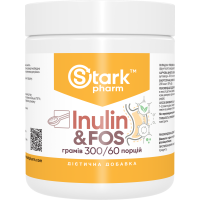
Inulin and fructo-oligosaccharides (FOS, oligofructose) are fructans, among the most studied prebiotics. Inulin is usually extracted from chicory root. They form almost no gel — dissolving clear and tasteless, with FOS even slightly sweet — so their main mechanism is different: active fermentation in the large intestine. This is the most "bacterial" of all fibers: studies link fructans with the growth of bifidobacteria and the production of short-chain fatty acids.
Why the inulin + FOS pairing. They differ in chain length: FOS is short — fermented faster, at the start of the large intestine; inulin is longer — slower and deeper. Together they work along the whole length rather than at a single point, which makes a 50/50 format more logical than "just inulin."
What to expect over time. In the first 1–2 weeks, active fermentation may cause gas and bloating (especially from FOS) — this is a normal reaction. Usually within 3–4 weeks the microflora adapts and the discomfort eases. This is the profile of Stark Inulin & FOS — a powder that dissolves in water or a shake; it's best introduced gradually, starting with a small serving.
Pectin: apple fiber — soluble and viscous
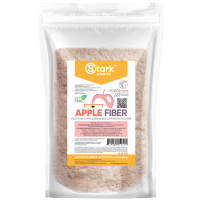
Apple fiber is mostly pectin, a soluble, gel-forming fiber. By mechanism it's closer to "physical" work than to a pure prebiotic. In the stomach and small intestine pectin thickens and forms a gel that slows emptying and absorption — hence a more noticeable feeling of fullness and a smoother rise in blood sugar after meals; pectin may also moderately affect cholesterol. It does ferment too, so it has prebiotic potential, but less selectively than fructans — that's its secondary effect.
That's why Stark Apple Fiber is more often chosen by those who prioritize satiety, diet control and a mild metabolic effect over maximum feeding of bacteria. It works smoothly and gently, without a sharp start.
Psyllium: plantain husk — gel and bulk
Psyllium (the husk of Plantago ovata seeds) is a soluble fiber that forms mucilage and gel but, unlike fructans, ferments only weakly. It absorbs water and turns into a viscous gel — hence its strengths: regularity and gentle bulk (the gel retains water and supports motility) and an effect on blood sugar and cholesterol through slowed absorption. Because bacteria ferment it only to a limited extent, psyllium produces far less gas than inulin or FOS — a real advantage for a sensitive gut.
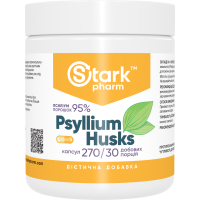
Because of its weak fermentation, psyllium is not a "classic" prebiotic in the same sense as fructans, although it does have some effect on the microflora. Stark Psyllium Husks is available as a powder and in capsules — chosen by format preference.
How to choose and whether to combine
These aren't competitors but different tools. If the main goal is to feed the microflora, lean toward inulin with FOS. If it's satiety and a mild metabolic effect — apple fiber. If it's regularity and comfortable bulk without excess gas — psyllium.
They can be combined, and logically so: for example, inulin with FOS for the microflora plus psyllium for regularity cover two different needs. The general principles of use are the same — introduce gradually, drink enough water (especially with psyllium, which works through a gel) and give the gut 2–4 weeks to adapt. For exact dosing, follow the instructions on the specific product's packaging. Individual response varies and depends on your baseline microflora and diet, so go by how you feel; with chronic conditions, medication, pregnancy or lactation, use should be discussed with a doctor.
Frequently Asked Questions
How is a prebiotic different from a probiotic?
Probiotics are live beneficial bacteria, while prebiotics are dietary fibers that serve as food for them. Prebiotics aren't digested in the upper GI tract and reach the large intestine, where the microflora uses them.
Which fiber is better — inulin, pectin or psyllium?
It depends on the task: inulin and FOS are most focused on feeding the microflora, apple fiber (pectin) provides gel and satiety, and psyllium is primarily about regularity and bulk. They're different tools, not "worse or better."
Why do inulin and FOS cause gas?
Inulin and especially FOS are actively fermented by bacteria, and a by-product of fermentation is gas, so bloating is possible in the first 1–2 weeks. The microflora usually adapts within 3–4 weeks; gradual introduction from a small dose helps, and psyllium produces less gas.
Which fiber is needed after 50?
With age the diet often becomes poorer in fiber, so regularity and feeding the microflora come to the fore. Gentle options are psyllium for regularity and inulin with FOS to support the microflora; with chronic conditions or medication, use should be discussed with a doctor.
Which fiber helps with constipation?
For gentle regularity, psyllium is more often chosen: it forms a gel, retains water and creates comfortable bulk, so it's important to take it with enough water. For prolonged or recurring problems, see a doctor.
Which fiber is needed after a course of antibiotics?
To support the microflora, inulin with FOS is most often chosen, as it serves as food for beneficial bacteria. Introduce it gradually, and ideally discuss use after treatment with a doctor.
Which fiber helps manage cholesterol and blood sugar?
Viscous soluble fibers — psyllium and pectin (apple fiber) — form a gel that slows absorption. This may support a smoother rise in blood sugar after meals and the maintenance of normal cholesterol levels as part of a balanced diet.
Which fiber is better for satiety and diet control?
Usually it's the gel-forming fibers — apple fiber (pectin) and psyllium — because the gel holds the feeling of fullness longer. This works as part of a balanced diet, not instead of one.
Is psyllium a prebiotic?
Psyllium is a soluble, gel-forming fiber that ferments weakly, so in the classic sense it isn't a prebiotic to the same degree as inulin or FOS. Its strengths are bulk, regularity and minimal gas.
Can different types of fiber be combined?
Yes, they work differently, so it makes sense to combine them — for example, inulin with FOS for the microflora and psyllium for regularity. The main thing is to introduce them gradually and drink enough water.
Choose a product
Stark Inulin & FOS — fructans (inulin + FOS 50/50) for those whose goal is feeding the beneficial microflora.
Stark Apple Fiber — apple fiber (pectin) for satiety and a mild metabolic effect.
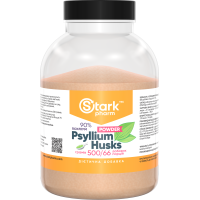
Stark Psyllium Husks Powder — psyllium powder for regularity and comfortable bulk with minimal gas.
Stark Psyllium Husks, 270 capsules — the same psyllium in capsule form, if you prefer it without powder.
Dietary supplement. Not a medicinal product. Consult a healthcare professional before use.
Products related to this post
570.00грн
Add to Cart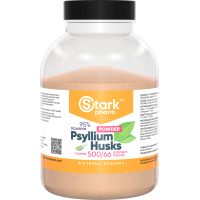
Comments
Information
Customer Service
Extras
My Account


Sports nutrition manufacturer in Ukraine StarkPharm © 2026