Your shopping cart is empty!

Troxerutin for blood vessels: how much does it take to work?
Published: 26/08/2026
Times Read: 289
Comments : 0
Troxerutin belongs to a group of substances that have historically been called “vitamin P” in the vascular literature—flavonoids that can affect capillary permeability and stability. Today, this term is considered obsolete, but the class itself—venoactive flavonoids (venotonics)—remains the subject of active research in chronic venous insufficiency, edema, and capillary fragility.
The most interesting thing about troxerutin is not the fact that it has an effect, but the specific doses at which this effect was recorded. More on this below.
Flavonoids for blood vessels: briefly about the class to which troxerutin belongs
Venoactive flavonoids are a large group of plant-based substances (diosmin, hesperidin, rutin and its derivatives) that are used for symptoms of chronic venous insufficiency: heaviness in the legs, edema, capillary fragility. The mechanisms of action within the class are similar - the effect on vein tone, capillary permeability and inflammatory processes in the vascular wall - but the specific substances differ in structure, absorption and doses at which the effect has been studied.
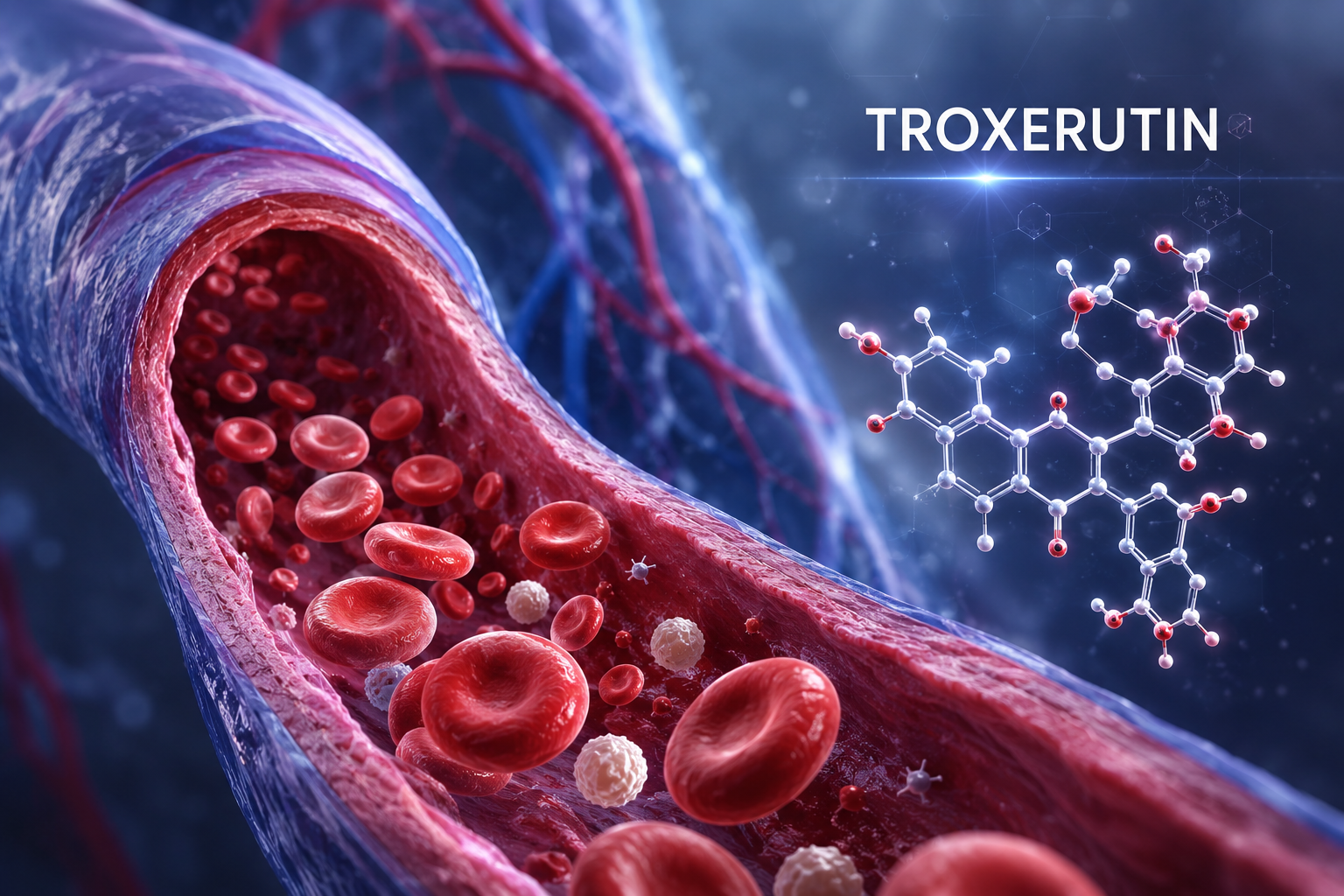
Troxerutin up close: from rutin to a semi-synthetic derivative
Troxerutin is a semisynthetic derivative of rutin (a flavonoid found in buckwheat and citrus fruits) obtained by the addition of hydroxyethyl groups to the rutin molecule. This chemical modification increases its solubility in water compared to the original rutin. Troxerutin is the main component of a mixture also known as oxerutins (hydroxyethylrutosides), and has been used for decades in Europe and Asia as a symptomatic support for venous disorders.
Three mechanisms of action
- Inhibition of hyaluronidase , an enzyme that breaks down hyaluronic acid in the connective tissue of the vascular wall; inhibition of this enzyme stabilizes the structure of the capillary wall.
- Selective accumulation in the endothelium and subendothelial layer of veins - troxerutin penetrates precisely into the vascular tissue, where it can protect cell membranes from oxidative damage.
- Antioxidant protection — neutralization of free radicals, which reduces damage to vascular cells and helps reduce capillary permeability.
A modern mechanistic review (Farzaei et al., 2020) summarizes these and other properties of troxerutin based on preclinical studies — mainly cellular and animal models, therefore, direct transfer of all described mechanisms to clinical effects in humans requires caution.
How much is needed for effect: study dose vs. typical daily serving
| Dose source | Daily dose of troxerutin | Context |
|---|---|---|
| Controlled study (comparison with oxerutins) | 900 mg/day, 12 weeks | Both drugs reduced the volume of the lower leg; oxerutin was significantly more effective than troxerutin (p=0.04) |
| Combined formula SB-LOT (with coumarin) | 540 mg/day | Anti-edema effect in combination with compression hosiery |
| Typical daily serving in dietary supplements | 250–500 mg/day | Available commercially; not tested separately as a single dose in controlled studies |
A controlled trial comparing troxerutin with oxerutins in 12 postmenopausal women with stage II chronic venous insufficiency used a dose of 900 mg/day for 12 weeks for both drugs. It is important to be precise here: both drugs reduced lower leg volume, but **oxerutins were significantly more effective than troxerutin** (volume reduction −261 mL·week vs −73 mL·week, respectively, p=0.04). That is, at this dose and in this direct comparison, troxerutin showed a weaker result than a related mixture of oxerutins, rather than an equivalent effect. There was no placebo group in the study, the sample was small (6 women per group), and the spread of values in the troxerutin group was greater than the mean—this limits confidence in the magnitude of the effect.
The combined formula with coumarin (SB-LOT) used 540 mg of troxerutin per day together with compression hosiery and also showed an anti-edema effect - but here it is impossible to assess the contribution of troxerutin itself separately from coumarin.
Typical daily doses of troxerutin in dietary supplements are usually lower than the dose from a controlled monotherapy study (900 mg) — troxerutin has not been tested separately as a monodrug at such a lower dose in controlled studies, so direct extrapolation of the 900 mg result to lower study doses is not supported.
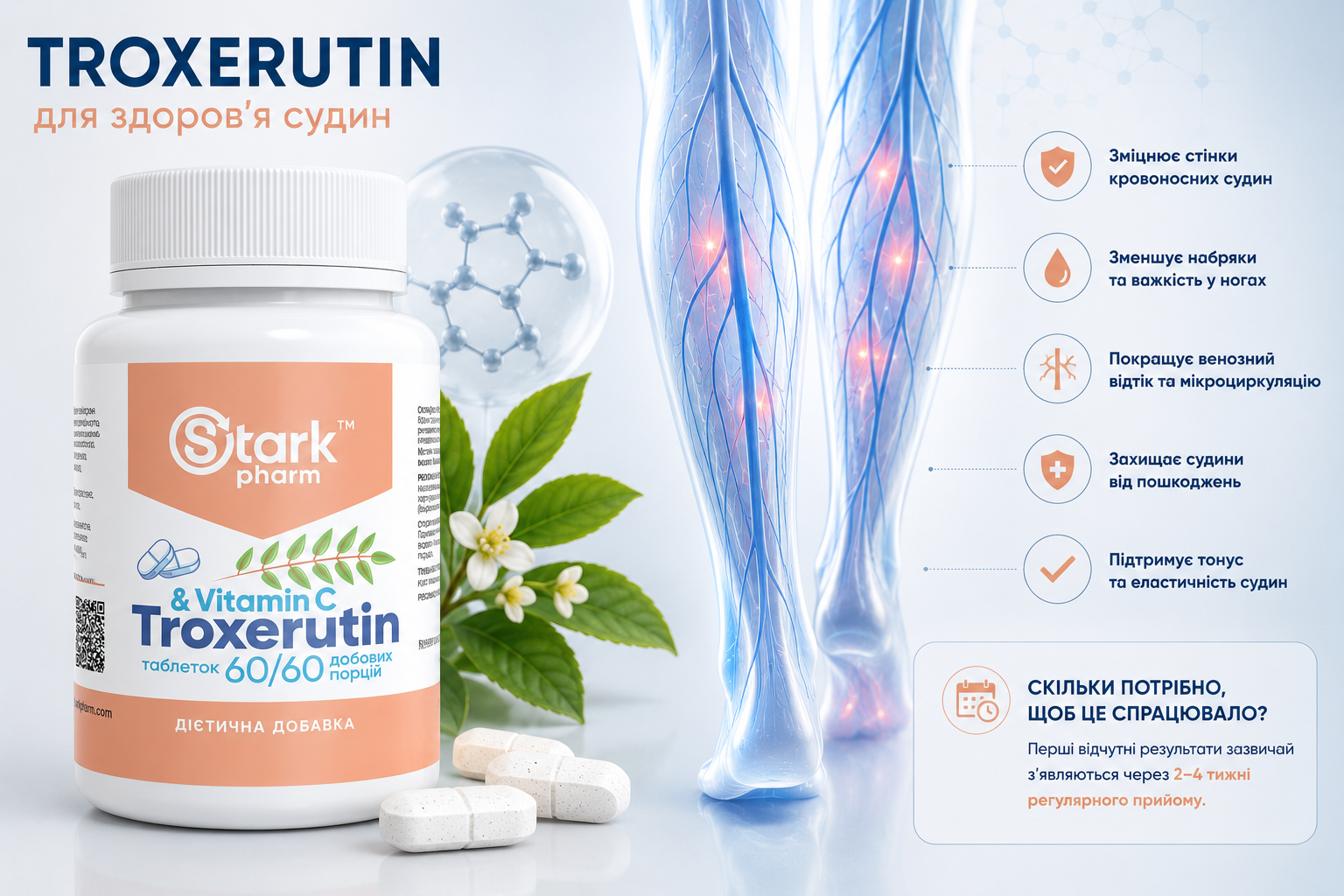
A separate study (Carlsson et al.) examined the distribution of troxerutin directly in vein tissue: patients scheduled for varicose vein surgery (9 people) were given troxerutin 4 days before the procedure — a total of 3500 mg per course or 1000 mg twice a day — and then samples of the removed vein were analyzed by confocal laser microscopy for the substance's own fluorescence. The study confirmed that troxerutin does indeed accumulate directly in the vein wall, and does not remain exclusively in the bloodstream — this confirms the tissue availability of the substance, although the study itself assessed tissue distribution, not clinical symptomatic effect.
What to consider before taking
Troxerutin is of interest mainly to people with symptoms of venous discomfort - heaviness in the legs, a tendency to edema, increased capillary fragility. Before taking it, it is worth consulting a doctor, especially if you have chronic vascular diseases, since taking supplements on your own does not replace the diagnosis and treatment of chronic venous insufficiency by a doctor. Pregnant and lactating women are recommended to consult a doctor in advance.
Frequently asked questions
What is troxerutin?
It is a semi-synthetic derivative of rutin, a flavonoid obtained by adding hydroxyethyl groups to improve water solubility.
What dose of troxerutin was used in the studies?
In a controlled monotherapy study, 900 mg/day for 12 weeks; typical daily servings in supplements are usually lower and have not been tested separately as a single dose.
How does troxerutin differ from oxerutins?
Troxerutin is the main fraction of a mixture of hydroxyethylrutosides known as oxerutins; in a head-to-head comparison study at a dose of 900 mg/day, oxerutins were significantly more effective than troxerutin in reducing lower leg volume.
Is it confirmed that troxerutin accumulates in blood vessels?
Thus, a study of tissue distribution using confocal microscopy confirmed the accumulation of troxerutin directly in the vein wall after several days of administration.
Are there any side effects of troxerutin?
No significant side effects were described in the studies cited, but the data mainly relate to short-term use under supervision; in the presence of chronic diseases, consultation with a doctor is recommended.
Who should consult a doctor before taking it?
For people with chronic vascular diseases, pregnant women, and lactating women, taking the supplement on its own does not replace medical diagnosis of venous disorders.
Sources
- Comparative study of troxerutin and oxerutins in chronic venous insufficiency (1993). Comparison between the efficacy and tolerability of oxerutins and troxerutin in the treatment of patients with chronic venous insufficiency. PubMed
- Carlsson K., Patwardhan A., Poullain JC, Gerentes I. (1996). Transport and localization of troxerutin in the venous wall. Journal des Maladies Vasculaires. PubMed
- Farzaei MH et al. (2020). The Protective Roles and Molecular Mechanisms of Troxerutin (Vitamin P4) for the Treatment of Chronic Diseases: A Mechanistic Review. PubMed
Dietary supplement. Not a medicine. Consult a doctor before use.
Products related to this post
Comments
Information
Customer Service
Extras
My Account


Sports nutrition manufacturer in Ukraine StarkPharm © 2026